

Phase 1: Empathy & Storytelling Hook
안녕하세요! 매일한글 에디터입니다. (Hello! This is your Daily Hangul Editor.)
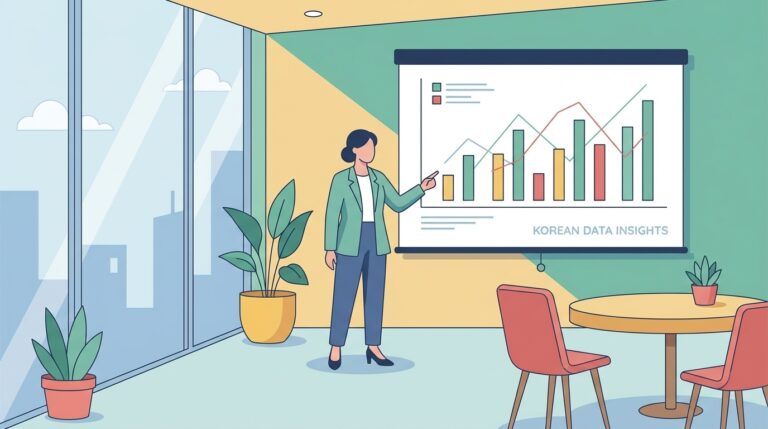
Picture this: You are standing in front of a sleek conference room in Teheran-ro, Gangnam. The projector beam glows against the white screen, illuminating a colorful quarterly growth chart you spent three nights perfecting. Your team lead, the department director, and your colleagues are all looking up at you with expectant eyes. You want to smoothly transition to your main data point, just like Seo Dal-mi pitching her revolutionary startup vision in the K-drama Start-Up.
But as your laser pointer hits the screen, panic strikes. Your mind races through basic Korean, and all that comes out is: “이거 보세요… 이 그림 좋아요…” (Look at this… this picture is good…).
Suddenly, the polished, professional aura evaporates. You feel like a high school student giving an impromptu speech rather than the capable B2-level professional you actually are.
Directing an audience’s attention toward visual aids in Korean requires far more than literal translation. In Korean business culture, how you guide your listeners’ gaze reflects your organizational clarity, your respect for the audience’s time, and your corporate polish. Today, drawing from ten years of coaching international managers, startup founders, and university researchers in Seoul, we are going to break down the exact visual signposting expressions that will instantly make your presentations sound natural, authoritative, and persuasive.
Phase 2: Core Expressions Deep Dive
Here are the three golden phrases you will hear in every boardroom, lecture hall, and tech conference across Korea.
1. 이 화면을 보시면 (I hwamyeon-eul bosimyeon)
- Pronunciation: [I hwamyeon-eul bosimyeon] (Think: “Ee hwa-myeon-eul bo-she-myeon” – soft and rhythmic)
- Meaning: Literal: “If you look at this screen” | Real Nuance: “As you can see on this slide / Directing your attention to the screen”
- K-Culture Moment: The quintessential pitch phrase used by tech founders in K-dramas when unveiling a new app interface or AI prototype.
- Editor’s Insight: Why does Korean use the conditional ending -면 (-myeon, “if”) instead of a direct command like “Look at this screen”? In formal Korean, phrasing instructions as gentle conditional invitations softens the tone while keeping the presentation engaging and polite.
- Situation Spectrum: Casual: 🚫 | Semi-formal: ✅ | Formal: ✅
- 🤔 Think About It: In English, we often say “Take a look at the slide.” How does framing the sentence as an ‘invitation to observe’ change the power dynamic between the speaker and the listeners?
2. 그래프에서 보시는 바와 같이 (Geuraepeueseo bosineun bawa gachi)
- Pronunciation: [Geuraepeueseo bosineun bawa gachi] (Think: “Gray-peu-eh-seo bo-she-neun ba-wa ga-chee”)
- Meaning: Literal: “Like the thing that you see in the graph” | Real Nuance: “As illustrated by the graph / As shown in this chart”
- K-Culture Moment: Heard during tense corporate board meetings in dramas like Misaeng or Agency, where marketing executives prove their point with undeniable sales metrics.
- Editor’s Insight: The grammar pattern
-(으)ㄴ/는 바와 같이is an elite B2/C1 formal connector. It instantly signals that your statement is backed by objective data rather than subjective opinion.- Situation Spectrum: Casual: 🚫 | Semi-formal: ⚠️ | Formal: ✅
- 🤔 Think About It: How does attributing your arguments to visual evidence rather than personal assertions help maintain harmony in a high-context corporate setting?
3. 이 부분에 주목해 주시기 바랍니다 (I bubune jumokhae jusigi baramnida)
- Pronunciation: [I bubun-e jumok-hae jusigi baramnida] (Think: “Ee boo-boon-eh joo-mok-hae joo-she-gee ba-ram-nee-da”)
- Meaning: Literal: “I hope that you pay attention to this part” | Real Nuance: “I would like to highlight this specific area / Please focus on this key point”
- K-Culture Moment: The climactic moment when an analyst points directly to the critical inflection point of a case study.
- Editor’s Insight:
주목하다(jumokhada) means to focus attention or observe closely. Combining it with-기 바랍니다creates a crisp, professional call-to-attention that commands the room without sounding aggressive.- Situation Spectrum: Casual: 🚫 | Semi-formal: ⚠️ | Formal: ✅
- 🤔 Think About It: Why is asking for attention formally considered more respectful than using vocal volume or tapping on the podium?
Phase 3: Textbook Korean vs. Real Korean
Let’s compare robotic textbook phrasing with natural, boardroom-ready Korean.
Situation 1: Directing focus to a statistical table
- 📖 교과서 한국어 (Textbook Korean): 여기에 있는 표를 보세요. (Yeogie inneun pyoreul boseyo. – Look at the table here.)
- 🗣️ 진짜 한국어 (Real Boardroom Korean): 다음 표에서 확인하실 수 있듯이, 매출이 급상승했습니다. (Daeum pyoeseo hwaginhashil su itdeusi, maechuri geupsangseunghaetseumnida. – As you can confirm in the following table, sales have increased sharply.)
- 💡 왜 다를까? (Why the difference?): Using
확인하실 수 있듯이(as you can confirm) empowers the audience by framing the data as something they are actively verifying, rather than being told what to do.
Situation 2: Transitioning to the next chart
- 📖 교과서 한국어 (Textbook Korean): 이제 다른 그림을 보여주겠습니다. (Ije dareun geurimeul boyeojugetseumnida. – Now I will show another picture.)
- 🗣️ 진짜 한국어 (Real Boardroom Korean): 다음 슬라이드의 도표를 함께 살펴보시겠습니다. (Daeum seullaideuui dopyoreul hamkke salpyeobosigetseumnida. – Let us examine the chart on the next slide together.)
- 💡 왜 다를까? (Why the difference?): Real professionals replace generic words like 그림 (picture) with specific terms like 도표 (chart/diagram) or 슬라이드 (slide), using the collaborative phrase
함께 살펴보시겠습니다(let us examine together).
Phase 4: K-Culture Deep Dive & Non-Verbal Manners
4-1. 눈치 (Nunchi), Eye Contact & Laser Pointer Etiquette
- The Open-Palm Gesture: When gesturing toward a screen or projection in Korea, never point with a single index finger—it can appear confrontational or informal. Instead, extend your hand with all four fingers neatly together, palm facing slightly upward.
- The 70/30 Gaze Rule: Keep 70% of your eye contact on the audience and only 30% on the screen. Looking at your own slides for too long gives the impression that you are reading, not presenting.
- The Laser Pointer Hold: Hold the remote pointer with two hands at waist height when you are not actively clicking. When highlighting a metric, circle it once firmly and release. Continuous waving makes Korean listeners dizzy!
4-2. The Aesthetic Standard: ‘깔끔함’ (Kkal-kkeum-ham)
In Korean corporate culture (seen everywhere from tech powerhouses in Pangyo to advertising firms in Gangnam), slides must be 깔끔하다 (neat, clean, structured). Korean business professionals value clear visual hierarchy. When you use precise verbal cues like 좌측 하단 (bottom left) or 우측 상단 (top right), you demonstrate that you respect this meticulous structural harmony.
Phase 5: Real-World Roleplay Scenario
Setting: A modern glass-walled meeting room at a digital marketing agency in Mapo-gu, Seoul. Alex is pitching a new overseas influencer campaign to Team Leader Park Min-jun.
- 박민준 (Park Min-jun): 알렉스 씨, 준비되셨으면 이번 분기 성과 분석부터 발표 시작해 주세요. (Alex-ssi, junbidoesyeosseumyeon ibeon bungi seonggwa bunseokbuteo balpyo sijakhae juseyo. – Alex, if you’re ready, please begin the presentation starting with this quarter’s performance analysis.)
🎭 서류철을 덮고 알렉스를 진지하게 바라보며 (Closing the folder and looking at Alex intently) - 알렉스 (Alex): 네, 팀장님. 바로 시작하겠습니다. 먼저 이 화면을 보시면, 지난달 유입 경로 데이터가 정리되어 있습니다. (Ne, timjangnim. Baro sijakhagetseumnida. Meonjeo i hwamyeon-eul bosimyeon, jinandal yuip gyeongno deiteoga jeongnidoeeo itseumnida. – Yes, Team Leader. I will begin right away. First, if you look at this screen, last month’s traffic acquisition data is organized.)
🎭 레이저 포인터로 슬라이드 상단을 정중하게 가리키며 (Politely gesturing toward the top of the slide with the laser pointer) - 박민준 (Park Min-jun): 음, 소셜 미디어 쪽 유입이 꽤 눈에 띄네요. (Eum, sosyeol midieo jjok yuibi kkwae nune ttwineyo. – Hmm, the traffic from social media is quite noticeable.)
🎭 턱을 괴고 화면을 집중해서 살피며 (Resting his chin on his hand and inspecting the screen closely) - 알렉스 (Alex): 맞습니다. 좌측 그래프에서 보시는 바와 같이, 인스타그램 릴스를 통한 전환율이 전월 대비 40% 증가했습니다. (Matseumnida. Jwacheuk geuraepeueseo bosineun bawa gachi, inseutageuraem rilseureul tonghan jeonhwanyuri jeonwol daebi sasip-peosenteu jeonggahatseumnida. – Exactly. As you can see from the graph on the left, conversion rates through Instagram Reels grew by 40% compared to last month.)
🎭 손바닥을 펴서 그래프 축을 부드럽게 짚으며 (Softly indicating the graph axis with an open palm) - 박민준 (Park Min-jun): 40%나요? 특히 어떤 연령대에서 반응이 좋았습니까? (Sasip-peosenteunayo? Teukhi eotteon yeollyeongdaeeseo baneungi joatseumnikka? – 40%? Which age demographic responded particularly well?)
- 알렉스 (Alex): 특히 우측 상단 도표에 주목해 주시기 바랍니다. 20대 초반 여성 타깃의 구매 전환이 가장 두드러졌습니다. (Teukhi ucheuk sangdan dopyoe jumokhae jusigi baramnida. Ishipdae choban yeoseong tagisui gumae jeonhwani gajang dudeureojyeotseumnida. – Please direct your attention especially to the diagram in the upper right. The purchase conversion among women in their early 20s was most prominent.)
🎭 청중과 아이컨택을 맞추며 자신감 넘치는 미소로 (Making eye contact with the audience with a confident smile) - 박민준 (Park Min-jun): 데이터 정리가 아주 명확하군요. 다음 전략 슬라이드로 넘어가 보죠. (Deiteo jeongniga aju myeonghwakhagunyo. Daeum jeollyak seullaideuro neomeoga bojyo. – The data layout is very clear. Let’s move on to the next strategy slide.)
🎭 만족스러운 표정으로 고개를 끄덕이며 (Nodding with a satisfied expression) - 알렉스 (Alex): 감사합니다. 다음 슬라이드에서 향후 예산 배분 계획을 말씀드리겠습니다. (Gamsahamnida. Daeum seullaideueseo hyanghu yesan baebun gyehoegeul malsseumdeurigetseumnida. – Thank you. On the next slide, I will explain our future budget allocation plan.)
🎭 리모컨 버튼을 눌러 부드럽게 화면을 전환하며 (Pressing the remote button to smoothly transition the slide)
🔀 Interactive Decision Point
During the Q&A, a stakeholder asks: “Where did you source these regional demographic numbers?” How will you direct them back to your reference chart on Slide 4?
- Choice A: “4번 슬라이드 보세요. 거기 출처 있어요.” (Look at Slide 4. The source is there.)
- Choice B: “4번 슬라이드 하단에 제시된 출처를 참고해 주시면 감사하겠습니다.” (I would appreciate it if you could refer to the source presented at the bottom of Slide 4.)
- Choice C: “제가 실수를 한 것 같은데, 4번 슬라이드 다시 보여드릴까요?” (I think I made a mistake, shall I show Slide 4 again?)
👉 Click to see the Feedback & Result!
- Choice A (Bad): Too direct and informal. Using the plain imperative 보세요 to a senior colleague or client sounds curt and dismissive.
- Choice B (Best! ⭐): Exemplary B2/C1 business Korean! Combining 제시된 출처 (presented source) with -해 주시면 감사하겠습니다 (I would appreciate it if you…) radiates professionalism and respect.
- Choice C (Risk): Avoid unnecessary self-blame (제가 실수한 것 같은데). Admitting faults you didn’t commit weakens your professional authority.
Phase 6: 10-Second Emotion Shadowing Drill
Practice reading these lines aloud with the specified emotion. The slashes (/) indicate natural breath pauses.
[💼 당당하고 프로페셔널하게 - Confident and professional]- 이 화면을 보시면 / 저희 팀의 이번 분기 핵심 성과가 / 요약되어 있습니다.
- (I hwamyeon-eul bosimyeon / jeohui timui ibeon bungi haeksim seonggwaga / yoyakdoeeo itseumnida.)
- “If you look at this screen / our team’s core achievements for this quarter / are summarized.”
[📊 데이터 신뢰감을 주며 - Authoritative and data-driven]- 그래프에서 보시는 바와 같이 / 사용자 만족도가 / 전년대비 25% 상승했습니다.
- (Geuraepeueseo bosineun bawa gachi / sayongja manjogdoga / jeonnyeondaebi ishibo-peosenteu sangseunghaetseumnida.)
- “As you can see from the graph / user satisfaction / has increased by 25% year-over-year.”
[🎯 핵심을 짚어주며 집중시키는 톤 - Focused call-to-action]- 이 부분의 붉은색 수치에 / 각별히 주목해 주시기 바랍니다.
- (I bubun-ui bulgeunsaek suchie / gakbyeolhi jumokhae jusigi baramnida.)
- “To the red figures in this section / I kindly request your special attention.”
Phase 7: K-Culture Mini Dictionary
- 시각 자료 (Sigak Jaryo) | Visual Aids
- Used universally in business and academia to refer to slides, charts, infographics, and handouts.
- 슬라이드를 넘기다 (Seullaideureul Neomgida) | To advance / flip slides
- Literal meaning is “to turn a page.” In presentation contexts, it means moving to the next slide.
- 핵심 포인트 (Haeksim Pointeu) | Key Takeaway / Core Point
- A Sino-Korean and English loanword blend commonly used when summarizing the primary conclusion of a slide.
- 점유율 (Jeomyuyul) | Market Share / Percentage Share
- An indispensable B2-level business metric word when presenting pie charts and competitive analysis.
Phase 8: Survival Kit for Business Presenters
Top 3 On-the-Spot Survival Phrases
- 1. 다음 슬라이드로 넘어가겠습니다. (Daeum seullaideuro neomeogagetseumnida.)
- Pro Tip: Use this standard transition line when you want to keep the presentation moving smoothly.
- 2. 화면이 잘 보이십니까? (Hwamyeoni jal boisimnikka?)
- Pro Tip: Ask this right after opening your presentation or sharing your screen on Zoom/Teams to check visibility politely.
- 3. 질문은 발표가 끝난 후 일괄적으로 받겠습니다. (Jilmuneun balpyoga kkeutnan hu ilgwaljeogeuro batgetseumnida.)
- Pro Tip: A polite way to say: “I will take all questions together at the end of the presentation.”
Editor’s Travel & Tech Note
If you are traveling to Seoul for an expo at COEX or presenting at a co-working hub like FastFive in Pangyo, remember that most meeting rooms utilize HDMI or wireless screen-mirroring (Smart View/AirPlay). When moving between convention halls and transit hubs, use the 네이버 지도 앱 다운로드 to find tech stores for display adapters, or reserve high-speed transit tickets via the 코레일톡 앱 다운로드 if presenting in Busan or Daejeon.
Phase 9: Think Deeper (Cultural Perspective)
In Western presentation styles, speakers often command the room with bold, assertive directives: “Look at this number!” or “I want you to see this trend.” In contrast, high-level Korean rhetoric values 청중 중심 화법 (audience-centric discourse).
Notice how business Korean frequently embeds honorific suffixes (-시-), collaborative modals (-함께 보시겠습니다), and humble deferrals. Rather than claiming sole ownership of the insight, the presenter acts as an enlightened guide inviting the audience to observe the facts together. Mastering these phrases isn’t just about vocabulary—it is about embracing a cultural philosophy where mutual respect and modesty reinforce true authority.
💬 Your Turn: Have you ever noticed how presentation styles differ between your home country and Korea? Share your thoughts in the comments below!
Phase 10: FAQ & Common Mistakes
Q: Can I say “이 슬라이드 봐주세요” in a formal presentation?
A: It is understood, but it sounds a bit too casual and conversational for a business or academic setting. Instead, elevate your sentence to “이 슬라이드를 참고해 주시기 바랍니다” (Please refer to this slide) or “이 슬라이드를 함께 보시겠습니다” (Let us look at this slide together).
Q: What is the difference between ‘도표’ (Dopyo) and ‘그래프’ (Geuraepeu)?
A: ‘그래프’ refers specifically to statistical line, bar, or pie graphs. ‘도표’ is a broader category that includes diagrams, flowcharts, tables, and structured visual representations.
Q: How do I politely tell someone their screen share isn’t visible on a video call?
A: Say: “화면 공유가 아직 보이지 않는데, 다시 한번 확인해 주시겠습니까?” (The screen share is not visible yet, could you please check it once more?).
🚨 Common Mistakes Warning Board
- ❌ Mistake 1: Saying “이 사진 보세요” (Look at this photo) for financial charts.
- 👉 Correct Action: Use professional vocabulary: “이 도표/그래프를 보시면” (If you look at this chart/graph).
- ❌ Mistake 2: Using plain imperative “-아/어라” or blunt “-세요” during investor presentations.
- 👉 Correct Action: Use high-formality deferential endings: “-(으)시기 바랍니다” or “-해 주시면 감사하겠습니다”.
- ❌ Mistake 3: Saying “제가 맞다는 것을 보여주는 그래프입니다” (This graph shows I am right).
- 👉 Correct Action: Maintain objective framing: “그래프에서 확인하실 수 있듯이…” (As can be confirmed from the graph…).
Phase 11: Action Missions
- 🥉 Bronze Mission: Stand in front of your mirror or screen, point with an open palm, and recite “이 화면을 보시면…” 5 times with smooth intonation.
- 🥈 Silver Mission: Write a 2-sentence presentation transition in the comments below introducing your favorite K-pop chart or drama rating using
보시는 바와 같이. - 🥇 Gold Mission: In your next Korean study session or work presentation, deliver a 1-minute slide overview without using the word 이거 (this thing) once!
- 🎮 K-Culture Mission: Watch an episode of Start-Up (스타트업) or Misaeng (미생). Pause when a character presents a slide and spot which visual cue they use!
Phase 12: Interactive Quiz Challenge
Test your presentation mastery! Click each question to reveal the answers.
1. Situational Judgment
You are presenting to executives and want to guide their attention to the upward trendline in the top-right corner. Which sentence is the most natural and polite?
* (A) 저기 오른쪽 위를 보세요.
* (B) 우측 상단 그래프에서 보시는 바와 같이, 상승세를 확인하실 수 있습니다.
* (C) 이 그림을 제가 설명해 줄게요.
🔍 Check Answer & Explanation
Correct Answer: (B)
Explanation: (B) combines precise directional vocabulary (우측 상단), professional visual referencing (보시는 바와 같이), and respectful confirmation phrasing (확인하실 수 있습니다). (A) is too blunt, and (C) uses informal speech unsuitable for executives.
2. Fill-in-the-Blank
Complete the formal presentation transition:
“다음 표에서 _________ 바와 같이, 올해 예산이 확정되었습니다.” (As seen in the following table, this year’s budget has been finalized.)
* (A) 보는
* (B) 보시는
* (C) 봤던
🔍 Check Answer & Explanation
Correct Answer: (B) 보시는
Explanation: In formal presentations, applying the subject honorific suffix -시- to the audience’s action of viewing (보시다 -> 보시는 바와 같이) is the standard gold etiquette.
3. True or False Cultural Quiz
True or False: When pointing at a presentation slide in Korea, pointing firmly with your index finger is considered a sign of leadership and confidence.
🔍 Check Answer & Explanation
Correct Answer: False (F)
Explanation: Pointing with an index finger can look aggressive or informal. Native professionals use an open palm with fingers gently aligned to gesture toward screens and visual aids.







