

The Warmth in a Tupperware: Navigating Korean Banchan Sharing & Jeong (정) Culture
Phase 1: Empathy (Real-Life K-Culture Story)
안녕하세요! 매일한글 에디터입니다.
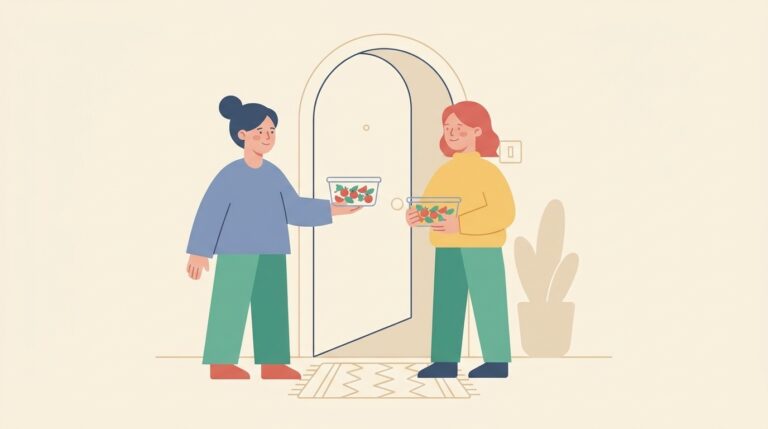
Picture this: You are relaxing in your cozy one-room studio apartment in Seoul after a long week of Korean classes. Suddenly, your doorbell rings. You open the door to find your warm-hearted landlord lady, Sun-hee Imo (이모, “Auntie”), holding a stack of glass containers filled with glistening kimchi, seasoned spinach (sigeumchi-namul), and braised beef (jangjorim). With a bright smile, she pushes them into your hands, saying: “혼자 사니까 밥 잘 못 챙겨 먹지? 반찬 좀 나눠 먹으려고 가져왔어!”
Your mind instantly freezes in panic. Is this a gift? Do I need to pay her? Should I invite her in right now? What do I say in Korean so I don’t sound cold or awkward? And what on earth do I do with these empty Tupperware containers later?
If you have ever felt confused by the sheer volume of unsolicited food gifts in Korea, you are not alone! Over 80% of our beginner A2 learners report feeling both touched and terrified by spontaneous neighbor interactions. In this guide, backed by real cultural consulting insights, you will master the unspoken etiquette and essential A2 phrases of Korean 반찬 나눠주기 (Banchan Sharing) and the legendary concept of 정 (Jeong). By the end of this post, you’ll welcome food gifts with total confidence and zero social anxiety!
Phase 2: Core Expressions Deep Dive (핵심 표현 3선)
1. 반찬 좀 나눠 드리려고요. (Banchan jom nanwo deuriryeogoyo.)
- Pronunciation: [Ban-chan jom nan-wo deu-ri-ryeo-go-yo] (Sounds like: Bahn-chahn johm nahn-woh deh-ree-ryuh-goh-yoh)
- Meaning:
- Literal: “I am intending to share some side dishes with you.”
- Nuance: “I made some extra food and immediately thought of you! Please enjoy it without feeling pressured.”
- K-Culture Moment: You will hear this exact phrase whenever friendly neighbors in dramas like Reply 1988 (응답하라 1988) or Hometown Cha-Cha-Cha (갯마을 차차차) arrive at someone’s front door with freshly cooked food.
- Editor’s Insight: The tiny word 좀 (jom) literally means “a little,” but Koreans use it as a social cushion. It softens the statement so you don’t sound like you’re showing off your cooking skills or making the other person feel indebted.
- Situation Spectrum:
- Casual (Close Friends): ⚠️ (Use 반찬 좀 나눠 먹자!)
- Semi-formal (Neighbors, Acquaintances, Landlords): ✅ (Best fit!)
- Strict Formal (Corporate Boardroom): 🚫
- 🤔 Think About It: In many Western cultures, giving homemade food unexpectedly might feel like an intrusion of privacy. In Korea, why is feeding a neighbor considered the highest form of showing care?
2. 맛있게 드세요! (Mas-itge deuseyo!)
- Pronunciation: [Ma-sit-ge deu-se-yo] (Sounds like: Mah-sheet-geh deh-seh-yoh)
- Meaning:
- Literal: “Please eat deliciously!”
- Nuance: “Bon appétit! I really hope you enjoy the meal!”
- K-Culture Moment: Handing over a lunchbox on a variety show like Three Meals a Day (삼시세끼) or handing a neighbor a plate of warm Korean pancakes (jeon) on a rainy afternoon.
- Editor’s Insight: When someone gives you food and says this, they are seeking an emotional connection. The perfect immediate response is a cheerful: “잘 먹겠습니다! (Jal meokgetseumnida! – I will eat well!)”.
- Situation Spectrum:
- Casual: ⚠️ (Use 맛있게 먹어!)
- Semi-formal: ✅ (Polite honorifics standard)
- Formal: ✅ (Always respectful)
- 🤔 Think About It: Notice that Koreans wish you deliciousness rather than just a “good appetite.” How does this highlight the sensory and emotional importance of taste in Korean dining?
3. 통은 안 돌려주셔도 돼요. (Tong-eun an dollyeojusyeodo dwaeyo.)
- Pronunciation: [Tong-eun an dol-lyeo-ju-syeo-do dwae-yo] (Sounds like: Tohng-eun ahn dohl-lyuh-joo-shyuh-doh dway-yoh)
- Meaning:
- Literal: “You do not have to return the container.”
- Nuance: “Please don’t stress about washing and giving this container back. Keep it or toss it!”
- K-Culture Moment: The moment an older Korean lady gives you a plastic container and insists you don’t need to return it—even though Korean cultural etiquette secretly suggests otherwise!
- Editor’s Insight: Even when a Korean giver says this to be polite and reduce your burden, returning the container completely empty is culturally awkward. (We’ll reveal the golden secret in Phase 4!)
- Situation Spectrum:
- Casual: ⚠️ (Use 통 안 돌려줘도 돼!)
- Semi-formal: ✅ (Very thoughtful and polite)
- Formal: ✅
- 🤔 Think About It: Why do Koreans offer a polite “out” to relieve social burden, even when traditions exist?
Phase 3: Textbook Korean vs. Real Korean (교과서 vs. 진짜 한국어)
Situation 1: Expressing gratitude when receiving side dishes
- 📖 교과서 한국어 (Textbook): “이 반찬을 주셔서 정말 대단히 감사합니다.” (I am truly exceedingly grateful to you for giving these side dishes.)
- 🗣️ 진짜 한국어 (Real-Life Natural): “우와, 진짜 맛있겠어요! 감사히 잘 먹겠습니다!” (Wow, this looks so delicious! I’ll eat it with deep gratitude!)
- 💡 왜 다를까? (Why the difference?): Textbook Korean is often overly rigid and sounds like a diplomatic speech. Real Koreans use vivid emotional reactions like 우와 (Uwa – Wow) and focus on how delicious the food looks to make the giver feel proud.
Situation 2: Reacting to a surprisingly large portion of food
- 📖 교과서 한국어 (Textbook): “이 음식의 양은 저에게 너무 많습니다.” (The quantity of this food is excessively large for me.)
- 🗣️ 진짜 한국어 (Real-Life Natural): “어머, 이렇게 많이 주셔도 돼요?” (Oh my goodness, are you sure you can give me this much?)
- 💡 왜 다를까? (Why the difference?): Directly saying something is “too much” can sound ungrateful. Asking “이렇게 많이 주셔도 돼요?” acts as a warm compliment on their overwhelming generosity while expressing polite modesty.
Phase 4: K-Culture Deep Dive & Non-Verbal Manners
4-1. 눈치 (Nunchi) & Body Language: The “Never-Empty Container” Rule
When sharing or receiving banchan, your non-verbal cues speak louder than your words:
1. Two-Hand Rule (두 손 사용): When receiving food containers from an elder or neighbor, always hold the container with both hands, bowing your head slightly (around 15 to 30 degrees).
2. The Golden Container Rule (통 매너): If someone gives you banchan in a reusable glass or plastic container (like Lock&Lock), NEVER return it completely empty! In Korea, returning an empty container symbolizes cutting off the connection.
* Pro-Tip: You don’t need to cook a gourmet meal. Simply wash the container cleanly and fill it with a few fresh fruits (tangerines, apples), a pack of Korean juice, or snacks from a bakery before returning it!
4-2. Culture Code: The Power of 정 (Jeong) in Daily Life
In K-dramas like Reply 1988, the opening scene shows children running back and forth between neighboring houses before dinner, carrying plates of food in exchange for soup, kimchi, and meat until every family has a full feast. This collective bond is called 정 (Jeong)—an unconditional, sticky feeling of emotional affection, community warmth, and empathy. Sharing banchan is the primary currency through which Jeong is exchanged in Korean society.
Phase 5: Real-Life Role-Play Scenario (실전 롤플레이)
Setting: Outside your apartment front door in Mapo-gu, Seoul.
Characters: You & Sun-hee Imo (이모), the friendly 58-year-old neighbor holding a warm container of homemade Tteok-galbi (grilled short rib patties) and Jangjorim.
- Turn 1 (Imo): 띵동~ 학생, 집에 있어? 반찬 좀 나눠 주려고 잠깐 들렀어! (Ding-dong~ Student, are you home? I stopped by to share some side dishes!)
- 🎭 행동 지문: Holding two clean glass containers with a warm smile.
- Turn 2 (You): 어머, 이모님! 안녕하세요! (Oh my, Imo! Hello!)
- 🎭 행동 지문: Opening the door quickly and bowing politely.
- Turn 3 (Imo): 오늘 장조림이랑 떡갈비 많이 만들었거든. 혼자 밥 챙겨 먹기 힘들지? (I made a lot of jangjorim and tteok-galbi today. It’s tough cooking for yourself, right?)
- 🎭 행동 지문: Extending the containers forward with both hands.
- Turn 4 (You): 우와, 냄새 진짜 좋아요! 이렇게 많이 주셔도 돼요? (Wow, it smells so good! Are you sure you can give me this much?)
- 🎭 행동 지문: Receiving the containers with both hands and showing genuine excitement.
- Turn 5 (Imo): 당연하지! 입맛에 맞을지 모르겠네. 따뜻할 때 맛있게 먹어! (Of course! I don’t know if it fits your taste. Eat it while it’s warm!)
- 🎭 행동 지문: Patting your arm affectionately.
- Turn 6 (You): 정말 감사히 잘 먹겠습니다! 이모님 최고예요! (Thank you so much, I will eat it gratefully! You are the best, Imo!)
- 🎭 행동 지문: Smiling brightly and nodding.
- Turn 7 (Imo): 그래그래, 통은 안 돌려줘도 되니까 천천히 먹어~ (Alright, alright, you don’t have to return the container, so eat slowly~)
- 🎭 행동 지문: Waving her hand dismissively before turning toward the elevator.
- Turn 8 (You): 네! 조심히 들어가세요, 이모님! (Yes! Have a safe walk back home, Imo!)
- 🎭 행동 지문: Bowing respectfully until the elevator doors close.
🔀 Interactive Choice Point: Returning the Container
A few days later, you finished all the delicious food. What is your next move?
- Choice A: Wash the glass container until sparkling clean, put two sweet apples inside, and knock on Imo’s door with a smile.
- 👉 Feedback [BEST]: ⭐⭐⭐⭐⭐ Perfect score! You have completely mastered Korean Jeong! Imo will be thrilled and will likely brag about you to the whole apartment building.
- Choice B: Wash the container and hand it back empty with a polite “감사합니다.”
- 👉 Feedback [RISK]: ⚠️ While not a crime, it feels a bit cold. Imo might say nothing, but an empty container misses a golden opportunity to deepen the friendship.
- Choice C: Throw the container away because she said “통은 안 돌려주셔도 돼요” (You don’t have to return the container).
- 👉 Feedback [BAD]: ❌ Cultural trap! When glass containers (밀폐용기) are involved, that phrase is just a polite formality. Tossing good glassware breaks neighborly etiquette!
Phase 6: 10-Second Emotion Shadowing Drill (감정 섀도잉 드릴)
Practice these lines out loud! Focus on the pauses (/) and embody the emotion tags.
[😊 기쁘고 신나게 / Bright & Excited]- “우와! / 진짜 맛있겠어요! / 잘 먹겠습니다!”
- (Uwa! / Jinjja mas-itgesseoyo! / Jal meokgetseumnida!)
- “Wow! / It really looks delicious! / I will eat well!”
[🥺 감동받고 겸손하게 / Touched & Modest]- “어머, / 이렇게 많이 주셔도 돼요? / 정말 감사해요!”
- (Eomeo, / ireoke mani jusyeodo dwaeyo? / Jeongmal gamsahaeyo!)
- “Oh my, / are you sure you can give me this much? / Thank you so much!”
[🥰 다정하고 따뜻하게 / Warm & Affectionate]- “이모님, / 반찬 맛있게 드세요! / 조금 가져왔어요.”
- (Imo-nim, / banchan mas-itge deuseyo! / Jogeum gajyeowasseoyo.)
- “Auntie, / please enjoy these side dishes! / I brought a little bit for you.”
Phase 7: K-Culture Mini Dictionary (핵심 키워드 4선)
| No | Keyword (한글 + Rom) | Meaning | Cultural Context & Usage |
|---|---|---|---|
| 1 | 반찬 (Banchan) | Side dishes | Small savory dishes served alongside rice in Korean cuisine. Sharing them is an act of daily friendship. |
| 2 | 정 (Jeong) | Deep affection / communal bond | A unique Korean emotional concept representing warmth, connection, and empathy built through repeated sharing. |
| 3 | 덤 (Deom) | Extra freebie / bonus | An extra scoop of food or free item given generously by market vendors or restaurant owners out of Jeong. |
| 4 | 밀폐용기 / 통 (Tong) | Airtight storage container | Typically Lock&Lock or glass Tupperware used to store banchan. Returning it with fruit or treats is top etiquette! |
Phase 8: Traveler’s Survival Kit (여행자 생존 키트)
Top 3 Survival Expressions for Food Sharing & Markets
- “조금만 맛봐도 돼요?” (Jogeum-man matbwado dwaeyo?)
- Meaning: “Can I try a little sample?”
- Pro Tip: Use this at traditional markets (like Gwangjang Market or Mangwon Market) when looking at freshly made banchan.
- “이거 직접 만드신 거예요?” (Igeoh jikjeop mandeusin geoyeyo?)
- Meaning: “Did you make this by hand yourself?”
- Pro Tip: Market aunties love this compliment! It shows high interest in their culinary craft.
- “덤도 주셔서 감사해요!” (Deom-do jusyeoseo gamsahaeyo!)
- Meaning: “Thank you for the extra bonus!”
- Pro Tip: Say this with a warm bow when an owner slides an extra dumpling or side dish into your bag.
🗺️ Editor’s Local Travel Note
When exploring Seoul’s traditional side dish alleys, navigation is everything. Make sure you have the 다운로드 가능한 네이버 지도 앱 installed on your phone, as foreign map apps often lack updated lane-by-lane details of local residential markets. Don’t forget that many neighborhood banchan shops accept the T-Money transit card or simple mobile payment alongside cash!
Phase 9: “One Step Deeper” (한 발 더 깊이)
In modern Korean apartment living where heavy digital door locks dominate, the act of passing a warm Tupperware container over a threshold is a powerful rebellion against urban isolation. Jeong reminds us that food in Korea is never just biological fuel—it is an emotional bridge. When someone shares their banchan with you, they are essentially saying: “You are not a stranger; you are part of my community.”
💬 Your Turn: Have you ever received a surprising food gift from a neighbor or friend in Korea or your home country? How did you respond? Share your story in the comments below!
Phase 10: FAQ & Common Mistakes
Q: Do I need to give cash or an expensive gift when a neighbor gives me homemade banchan?
A: Absolutely not! Offering cash can actually offend the giver because banchan is an expression of pure Jeong, not a financial transaction. A small return gesture like seasonal fruit, bakery treats, or a sincere thank-you message is the most culturally appropriate response.
Q: What should I say if a neighbor gives me banchan containing ingredients I cannot eat (e.g., seafood allergy or dietary restrictions)?
A: Never reject it on the spot! Accept it politely with both hands saying, “우와, 정말 감사합니다!” Later, if asked how it tasted, you can gently explain your allergy or share it with a roommate or friend. Rejecting food at the front door hurts the giver’s Jeong.
Q: How long should I wait before returning the empty container?
A: Within 3 to 7 days is ideal. You do not need to rush back within an hour, but holding onto someone’s glass container for months can leave them wondering what happened to their favorite Tupperware.
🚨 흔한 실수 (Common Mistakes) 경고판
- ❌ Mistake 1: Returning the container completely unwashed.
- 👉 Correct Action: Wash the container thoroughly with dish soap and let it dry completely before giving it back.
- ❌ Mistake 2: Refusing the food because you feel burdened.
- 👉 Correct Action: Say “이렇게 챙겨주셔서 정말 감사해요!” (Thank you so much for taking care of me!) and accept it warmly.
- ❌ Mistake 3: Taking the food with one hand while looking at your smartphone.
- 👉 Correct Action: Put your phone away, use two hands, and make warm eye contact with a gentle bow.
Phase 11: Action Mission & Community Challenge
- 🥉 Bronze Mission: Stand in front of your mirror and practice the phrase: “감사히 잘 먹겠습니다! (I will eat with gratitude!)” 5 times using both hands.
- 🥈 Silver Mission: Post a picture of your favorite Korean side dish on Instagram or Threads and caption it using the Korean hashtag #반찬나눔 and #정문화.
- 🥇 Gold Mission: Visit a local Korean supermarket or market stall this week, order one side dish, and say: “감사합니다, 맛있게 먹을게요!”
- 🎮 K-Culture Mission: Watch Episode 1 of Reply 1988 and spot the iconic dinner plate relay scene between the neighbors!
Phase 12: Interactive Quiz Challenge (인터랙티브 퀴즈)
Q1. Situation Judgment
Your Korean neighbor knocks and hands you a tub of freshly made Kimchi. What is the most natural, polite response at the A2 level?
* A) 이것은 필요 없습니다. (I do not need this.)
* B) 우와, 진짜 맛있겠어요! 감사히 잘 먹겠습니다! (Wow, it looks so delicious! I’ll eat it with gratitude!)
* C) 돈 얼마 드리면 돼요? (How much money should I give you?)
Q2. Fill-in-the-Blank
Fill in the missing word used to soften a request or gift:
* “반찬 [ ] 나눠 드리려고요.”
Q3. True or False Culture Check
- Statement: When someone gives you food in a reusable glass container and says “통은 안 돌려주셔도 돼요”, you should throw the container in the trash.
- (True / False)
👉 Click here to reveal the Quiz Answers & Explanations!
- Q1 Answer: B (우와, 진짜 맛있겠어요! 감사히 잘 먹겠습니다!)
- Explanation: Option B shows enthusiasm, praises the food, and expresses warm gratitude. Option A is rude, and Option C turns a warm cultural gift into a transaction.
- Q2 Answer: 좀 (Jom)
- Explanation: “좀” literally means “a little,” but here it softens the statement and prevents the speaker from sounding boastful.
- Q3 Answer: False
- Explanation: The phrase is a polite social cushion. You should wash the reusable container, put a small snack or fruit inside, and return it with gratitude!







