

Master Korean Housework: How to Offer to Do Dishes Like a Local
Phase 1: 공감 (Story-Driven Opening)
안녕하세요! 매일한글 에디터입니다. Picture this classic K-Drama scene: You just finished a delicious, piping-hot pot of homemade Kimchi Jjigae with your Korean friends or host family. Everyone is full, satisfied, and leaning back with happy smiles. But then, an awkward silence creeps in as eyes slowly drift toward the kitchen sink. A mountain of red-stained bowls and oily spoons is waiting. In Korea, this exact second is where true friendships and stellar impressions are forged! Should you sit back, or should you jump up and offer to wash? Many Korean language learners freeze up because they know the textbook word seolgeoji, but panic about how to offer politely without sounding stiff like a robot. Don’t worry! Today, we will turn dish duty into your ultimate charm offensive with authentic, easy A1 phrases that will make your Korean friends adore you.
Phase 2: 핵심 표현 3선 심층 분석 (3 Core Expressions Deep Dive)
1. 제가 설거지할게요. (Jega seolgeoji-halgeyo.)
- Pronunciation: [Je-ga seol-geo-ji-hal-ge-yo] (Sounds like “Jay-gah sull-guh-jee hal-gay-yo”)
- Meaning: Literal: “I will do dishwashing.” / Natural: “I will do the dishes!”
- K-Culture Moment: In Korean reality shows like Jinny’s Kitchen or Three Meals a Day, whenever the youngest cast member jumps up right after eating, this is the exact line they shout with a cheerful bow.
- Editor’s Insight: The ending
-(으)ㄹ게요(-eulgeyo) expresses your personal promise and proactive willingness to do something for others. It sounds warm, respectful, and eager to help!- Situation Spectrum: Casual ⚠️ | Semi-formal (Polite) ✅ | Formal ✅
- 🤔 Think About It: In English, we often ask “Can I help with the dishes?” In Korean, stating your helpful intention directly with
할게요(halgeyo) feels much more proactive and thoughtful than asking for permission.
2. 고무장갑 있어요? (Gomu-janggap isseoyo?)
- Pronunciation: [Go-mu-jang-gap is-seo-yo] (Sounds like “Go-moo jahng-gahp ee-ssuh-yo”)
- Meaning: Literal: “Rubber gloves exist?” / Natural: “Do you have rubber gloves?”
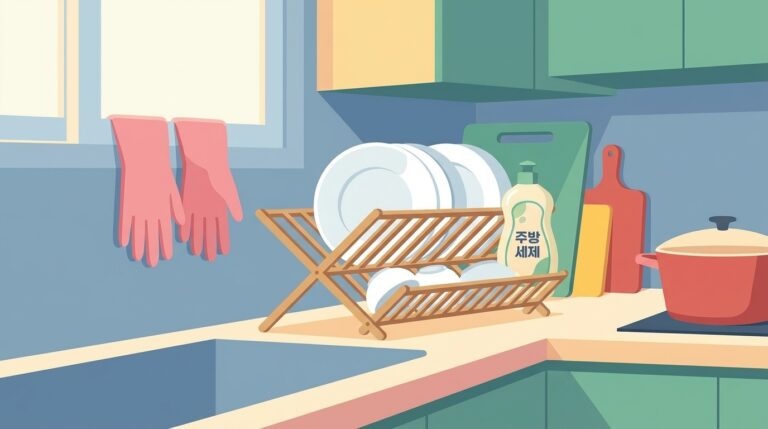
- K-Culture Moment: Look in almost any Korean kitchen cabinet, and you will spot iconic, long pink rubber gloves! Korean moms and roommates consider them essential gear to protect hands from strong dish soap and hot water.
- Editor’s Insight:
있어요?(Isseoyo?) is the ultimate A1 magic key. Just attach it after any noun when asking if an item is available in a home, store, or restaurant.- Situation Spectrum: Casual ⚠️ | Semi-formal (Polite) ✅ | Formal ⚠️
- 🤔 Think About It: Why are dishwashing gloves practically a national symbol in Korean kitchens? It reflects a domestic culture that takes skincare and efficient cleaning very seriously!
3. 설거지 다 했어요! (Seolgeoji da haesseoyo!)
- Pronunciation: [Seol-geo-ji da haet-seo-yo] (Sounds like “Sull-guh-jee dah heat-ssuh-yo”)
- Meaning: Literal: “Dishes all did!” / Natural: “I finished all the dishes!”
- K-Culture Moment: In K-Dramas, whenever a son-in-law or helpful guest finishes cleaning up, they dry their hands on an apron and announce this proudly with a bright smile.
- Editor’s Insight: The short syllable
다(da) means “all” or “completely”. Adding다before a past-tense verb highlights that not a single dirty spoon was left behind!- Situation Spectrum: Casual ⚠️ | Semi-formal (Polite) ✅ | Formal ✅
- 🤔 Think About It: Notice how Korean easily drops the subject “I” when the context is obvious. Keeping sentences concise makes you sound far more natural.
Phase 3: 교과서 한국어 vs 진짜 한국어 (Textbook vs. Real-Life Korean)
Situation 1: Offering to clean up after dinner
- 📖 교과서 한국어 (Textbook Korean): 설거지를 제가 수행하겠습니다. (Seolgeojireul jega suhaenghagetseumnida. – “I shall perform the dishwashing.”)
- 🗣️ 진짜 한국어 (Real-Life Korean): 제가 할게요! 편하게 계세요. (Jega halgeyo! Pyeonhage gyeseyo. – “I’ll do it! Just relax.”)
- 💡 왜 다를까? (Why is it different?): Textbook sentences often rely on overly formal, stiff verbs. Real-life Koreans drop object markers (
를) in casual settings and add warm reassurances like 편하게 계세요 (Please rest comfortably).
Situation 2: Asking for dishwashing liquid
- 📖 교과서 한국어 (Textbook Korean): 주방 세제가 어디에 위치합니까? (Jubang sejejega eodie wichi-hamnikka? – “Where is the dish detergent located?”)
- 🗣️ 진짜 한국어 (Real-Life Korean): 세제 어디 있어요? (Seje eodi isseoyo? – “Where’s the soap/detergent?”)
- 💡 왜 다를까? (Why is it different?): Everyday Korean values brief, spoken clarity. Simply combining the noun with
어디 있어요?(Where is it?) is polite, natural, and instantly understood.
Phase 4: K-Culture 딥다이브 & 비언어적 매너 (K-Culture Deep Dive & Manners)
4-1. 눈치 (Nunchi) & The Dishwashing Battle
In Korean culture, the guest offering to do the dishes is a quintessential test of 눈치 (Nunchi – situational tact). When someone cooks for you, sitting still while they clean feels impolite.
* The Friendly Refusal Game: When you say 제가 설거지할게요 (Jega seolgeoji-halgeyo), your host will almost certainly wave their hands and say, “아니에요, 괜찮아요!” (No, it’s okay!).
* The Golden Rule: Don’t sit down immediately after the first refusal! Offer at least twice with a warm smile, roll up your sleeves, and take the dishes to the sink. Even if they insist on washing, you can offer to dry or wipe the dining table (식탁 닦을게요 – Siktak dakkeulgeyo).
4-2. The Pink Rubber Glove & Food Waste Protocol
Korean kitchens have a unique workflow. Before you start the soap and sponge (수세미 – Susemi), make sure to scrape food scraps into the designated food waste bin (음식물 쓰레기통 – Eumsikmul sseuregitong). Mixing food waste with regular trash is a major house rule violation in Korea!
Phase 5: 실전 롤플레이 시나리오 (Real-Life Roleplay Scenario)
Setting: Minji’s cozy apartment in Hongdae. You two have just enjoyed homemade Tteokbokki together.
- 민지 (Minji): 와, 배부르다! 맛있게 먹었어?
(Wa, baebureuda! Mas-itge meogeosseo?)
“Wow, I’m so full! Did you enjoy the food?”
🎭 (Minji leans back and pats her stomach happily) -
당신 (You): 네, 정말 맛있었어요! 잘 먹었습니다.
(Ne, jeongmal mas-isseosseoyo! Jal meogeotseumnida.)
“Yes, it was truly delicious! Thank you for the meal.”
🎭 (You neatly stack your chopsticks onto your plate) -
민지 (Minji): 다행이다. 그릇은 그냥 싱크대에 둘게.
(Dahaeng-ida. Geureos-eun geunyang singkeudae-e dulge.)
“I’m glad! I’ll just leave the bowls in the sink for now.”
🎭 (Minji begins picking up the pots) -
당신 (You): 아니에요! 제가 설거지할게요.
(Anieyo! Jega seolgeoji-halgeyo.)
“No way! I will do the dishes.”
🎭 (You stand up immediately and take the bowls from her hands) -
민지 (Minji): 에이, 손님인데 괜찮아. 내가 할게!
(Ei, sonnim-inde gwaenchana. Naega halge!)
“Hey, you’re my guest, it’s totally fine. I’ll do it!”
🎭 (Minji gently tries to block the sink with a friendly laugh) -
당신 (You): 맛있게 먹었으니까 제가 할게요. 고무장갑 있어요?
(Mas-itge meogeosseunikka jega halgeyo. Gomu-janggap isseoyo?)
“Since you made great food, let me do it. Do you have rubber gloves?”
🎭 (You roll up both sleeves with determination) -
민지 (Minji): 고마워! 분홍색 고무장갑 싱크대 밑에 있어.
(Gomawo! Bunhongsaek gomu-janggap singkeudae mite isseo.)
“Thank you! The pink rubber gloves are under the sink.”
🎭 (Minji smiles gratefully and opens the cabinet for you) -
당신 (You): 네! 설거지 다 하고 말씀드릴게요.
(Ne! Seolgeoji da hago malsseumdeurilgeyo.)
“Got it! I will let you know once I finish everything.”
🎭 (You put on the gloves and turn on the water tap)
🔀 인터랙티브 분기점 (Interactive Choice)
Minji says she will do the dishes herself. What do you do?
* Choice A: Sit down right away on the sofa and play with your phone.
Feedback (Bad): ❌ Oh no! While she said it’s okay, immediately checking your phone without insisting at least once feels distant.
* Choice B: Grab the sponge and say: “제가 할게요! 쉬고 계세요.” (I’ll do it! Please take a rest.)
Feedback (Best): 🌟 Perfect 100 points! Showing proactive consideration makes you the best guest ever.
* Choice C: Stand next to the sink and watch her silently without saying anything.
Feedback (Risk): ⚠️ Awkward silence alert! If she really won’t let you wash, offer to wipe the table (식탁 닦을게요) instead!
Phase 6: 10초 감정 섀도잉 드릴 (10-Second Emotional Shadowing Drill)
Practice reading these out loud with authentic intonation marks (/) and emotional cues!
- [😊 Bright & Enthusiastic]
맛있게 먹었으니까 / 제가 설거지할게요!
(Mas-itge meogeosseunikka / jega seolgeoji-halgeyo!) -
[🧐 Curious & Friendly]
싱크대에 / 고무장갑 / 있어요?
(Singkeudae-e / gomu-janggap / isseoyo?) -
[✨ Proud & Satisfied]
깨끗하게 / 설거지 다 했어요!
(Kkaekkeuthage / seolgeoji da haesseoyo!)
Phase 7: K-Culture 미니 사전 (Essential Kitchen Mini-Dictionary)
- 설거지 (Seolgeoji) | Dishwashing | The general act of washing pots, pans, bowls, and utensils after a meal.
- 고무장갑 (Gomu-janggap) | Rubber Gloves | Essential thick rubber gloves (often vibrant pink) found in every Korean household.
- 주방세제 / 퐁퐁 (Jubang-seje / Pongpong) | Dish Soap | The formal word is 주방세제, but Koreans affectionately call dish detergent 퐁퐁 (Pongpong) after a famous vintage brand name.
- 수세미 (Susemi) | Dish Scrubber / Sponge | Cleaning sponges used for scrubbing greasy pots and dinnerware.
Phase 8: 여행자를 위한 생존 키트 (Traveler’s Survival Kit)
Top 3 Survival Expressions
- 세제 어디 있어요? (Seje eodi isseoyo?) – Where is the dish soap?
Pro Tip: Use this at your Airbnb or guesthouse shared kitchen. - 수세미 새 거 있어요? (Susemi sae geo isseoyo?) – Is there a new dish sponge?
Pro Tip: Handy when staying at long-term residences or guest houses. - 음식물 쓰레기는 어디에 버려요? (Eumsikmul sseuregineun eodie beoryeoyo?) – Where do I throw away food waste?
Pro Tip: Crucial for preventing recycling fines in Korean rentals!
Editor’s Travel Note
When booking accommodation in Korea, Airbnb hosts expect guests to wash all dishes and clear food waste before checkout. Download the official 네이버 지도 앱 다운로드 to easily locate nearby convenience stores or Daiso branches when you need to buy extra sponges or trash bags.
Phase 9: “한 발 더 깊이” (Cultural Essay: The Dish Tug-of-War)
In Korean culture, sharing food is an intimate act of care (정 – Jeong). When someone feeds you, they are giving you their time, energy, and love. Therefore, offering to wash dishes isn’t just about kitchen hygiene; it is a reciprocal emotional exchange that says, “I value the care you just gave me.” This is why Koreans often playfully fight over who gets to stand at the sink! Next time you are invited to a Korean home, join this gentle tug-of-war—it proves you understand the heart of Korean hospitality.
💬 Your Turn: In your home country, what is the polite rule after dinner? Do guests wash dishes, or is it strictly forbidden? Tell us in the comments below!
Phase 10: FAQ & 흔한 실수 (FAQ & Common Mistakes)
Q: Can I use 제가 설거지할게요 with my professor or boss?
A: Yes! 제가 설거지할게요 (Jega seolgeoji-halgeyo) is in the polite honorific form (해요체), making it respectful enough for teachers, in-laws, and colleagues.
Q: Why do Koreans call dish soap “Pong-pong”?
A: Pong-pong (퐁퐁) was the first iconic dishwashing detergent brand released in Korea in the 1960s. Much like “Kleenex” for facial tissue, Koreans casually call any dish soap 퐁퐁.
Q: What should I say if they strictly forbid me from washing dishes?
A: Simply smile and say: “그럼 식탁이라도 닦을게요!” (Geureom siktagirado dakkeulgeyo! – “Then let me at least wipe the table!”).
🚨 흔한 실수 (Common Mistakes)
- Mistake: Saying “내가 설거지할게요” to older people or hosts.
Correct Action: Always use 제가 (jega – humble “I”), not 내가 (naega – casual “I”). - Mistake: Leaving food chunks in the sink drain without emptying the strainer basket.
Correct Action: Empty the sink strainer (싱크대 거름망) into the food trash bin after finishing. - Mistake: Asking “설거지하고 싶어요?” (Do you want to do dishes?).
Correct Action: State your own offer: “제가 설거지할게요!”
Phase 11: 액션 미션 & 참여 유도 (Action Missions)
- 🥉 Bronze Mission: Stand in front of your kitchen sink and practice saying 제가 설거지할게요! 5 times aloud.
- 🥈 Silver Mission: Leave a comment below using the word 고무장갑 in a full sentence.
- 🥇 Gold Mission: Next time you eat with Korean friends or stay at a Korean guesthouse, say 제가 설거지할게요 before anyone else stands up!
- 🎮 K-Culture Mission: Watch an episode of a Korean variety show (like Three Meals a Day) and spot the moment they put on pink rubber gloves.
Phase 12: 인터랙티브 퀴즈 챌린지 (Interactive Quiz Challenge)
1. Situation Decision: Your Korean friend made delicious Ramen for you at their house. What is the most natural and polite phrase to say right after eating?
* (A) 설거지 네가 해. (Seolgeoji nega hae.)
* (B) 제가 설거지할게요! (Jega seolgeoji-halgeyo!)
* (C) 퐁퐁 없어요. (Pongpong eopseoyo.)
👉 Click to reveal Answer & Explanation
Correct Answer: (B)
Explanation: (B) is the polite and friendly way to offer help. (A) is rude command speech (“You do dishes”), and (C) means “There is no dish soap.”
2. Fill in the Blank: Complete the sentence to ask for rubber gloves:
* “싱크대에 _________ 있어요?”
👉 Click to reveal Answer & Explanation
Correct Answer: 고무장갑 (Gomu-janggap)
Full sentence: 싱크대에 고무장갑 있어요? (Is there rubber gloves in the sink?)
3. True or False: In Korea, throwing leftover food waste into the regular plastic garbage bag is completely acceptable.
👉 Click to reveal Answer & Explanation
Correct Answer: False
Explanation: Korea has strict waste sorting laws. Food waste must be separated into designated food waste bins or special bags!







