

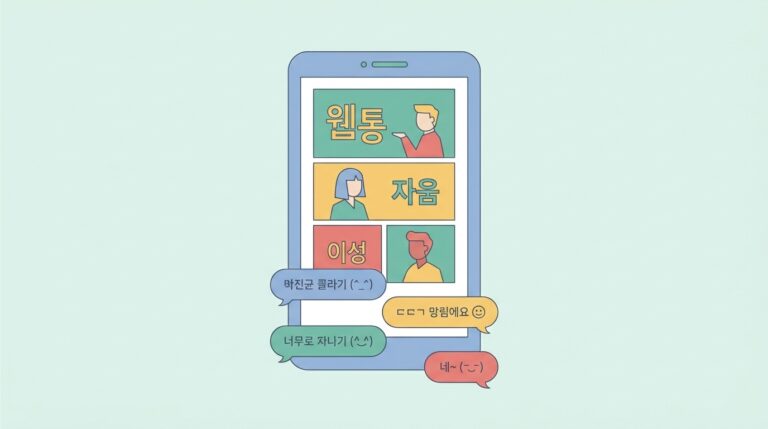
Decoding K-Webtoon Comments: From ‘Goguma’ to ‘Cider’ Like a Native Reader
Phase 1: Empathy & Storytelling Opening
안녕하세요! 매일한글 에디터입니다. (Hello! This is your Daily Hangul editor.)
Picture this: It is 11:03 PM on a Sunday night in Seoul. You just spent your precious digital “cookies” to unlock the latest cliffhanger chapter of your favorite Naver Webtoon. The male lead just misunderstood the female protagonist for the fifth time in a row, the villain smirked, and the episode abruptly cut to black. Your heart is pounding, your fingers immediately swipe down to open the comment section (댓글창), eager to share your raw shock with thousands of fellow readers.
But as you gaze at the top “Best Comments” (베스트 댓글 or 베댓), your screen is filled with cryptic remarks:
* “아 진짜 작가님 고구마 100개 먹은 것 같아요…”
* “다음 화에 사이다 없으면 하차합니다.”
* “와 오늘 연출 폼 미쳤다 ㄷㄷ”
You pause. Sweet potatoes? Cider soda? Form? Getting off a vehicle? What do snacks and athletic fitness have to do with this romance-thriller webtoon?
If you have ever felt left out of the funniest, sharpest, and most emotional discussions in Korean fandom culture because of internet slang, you are certainly not alone. Webtoon and web novel comment sections in Korea are not just passive feedback boxes—they are a dynamic, collective comedy club, debate forum, and emotional support group all rolled into one. Drawing from over 10 years of navigating digital K-Culture and mentoring intermediate Korean learners, this guide will unlock the exact linguistic keys you need to decode, enjoy, and actively participate in Korean episode discussions.
Phase 2: Top 3 Core Expressions In-Depth
📌 Quick Insight:
Korean webtoon slang often uses physical sensations (food textures, carbonation, physical athletic prowess) to describe storytelling pacing and quality.
1. 고구마 먹은 것 같다 (Goguma meogeun geot gatda)
- Pronunciation: [Go-gu-ma meo-geun geot gat-da] (Think of go-goo-mah + mug-eun)
- Meaning:
- Literal: It feels like I ate a dry sweet potato.
- Nuance: A situation, character decision, or plot development is agonizingly suffocating, frustrating, or painfully slow.
- K-Culture Moment: Used whenever the protagonist gets unfairly framed, fails to speak up for themselves, or lets the villain walk all over them without fighting back.
- Editor’s Insight: Have you ever eaten a dense, roasted Korean sweet potato (밤고구마) without a single sip of water or kimchi? Your throat feels blocked and chest tight. That exact physical choking sensation is what Koreans feel when a story stalls!
- Situation Spectrum: Casual ✅ | Semi-formal ⚠️ | Formal 🚫
- 🤔 Think About It: In English, we say “This is so frustrating” or “It makes my blood boil.” Why do you think Korean culture expresses emotional frustration through digestive and throat sensations (답답함)?
2. 완전 사이다 / 사이다 전개 (Wanjeon Saida / Saida Jeongae)
- Pronunciation: [Wan-jeon sa-i-da / Sa-i-da jeon-gae] (Wan-jun + sigh-dah)
- Meaning:
- Literal: Total lemon-lime cider / Cider-like plot progression.
- Nuance: An exhilaratingly refreshing resolution where justice is served, revenge is exacted, or misunderstandings are instantly cleared up.
- K-Culture Moment: The moment the undercover CEO protagonist finally reveals their true identity and fires the arrogant manager who was bullying the intern.
- Editor’s Insight: In Korea, Chilsung Cider (a clear lemon-lime carbonated soda) is the ultimate palate cleanser. The fizzy, popping bubbles represent the instant relief that washes over you after enduring a long “goguma” period.
- Situation Spectrum: Casual ✅ | Semi-formal ⚠️ | Formal 🚫
- 🤔 Think About It: In your native culture, what food or drink represents supreme relief or satisfaction?
3. 이번 화 폼 미쳤다 (Ibeon hwa pom michyeotda)
- Pronunciation: [Ee-beon hwa pom mee-chyeot-da] (Pom rhymes with British “form”)
- Meaning:
- Literal: This episode’s form is crazy/insane.
- Nuance: The creator’s artistic skills, writing, pacing, or dramatic direction have reached an astronomical peak.
- K-Culture Moment: Left in the top comment when the illustrator draws a mind-blowing full-page action spread or delivers an unforgettable emotional monologue.
- Editor’s Insight: Borrowed from sports terminology (“being in top form”), Koreans use 폼 미쳤다 for artists, chefs, actors, and webtoon creators who are delivering legendary work consistently.
- Situation Spectrum: Casual ✅ | Semi-formal ⚠️ | Formal 🚫
- 🤔 Think About It: Notice how Korean internet praise leans into hyperbole (using words like 미쳤다 – crazy). How does online praise in your language compare?
Phase 3: Textbook Korean vs. Real Native Korean
Let’s compare how traditional textbooks describe webtoon reactions versus how real Koreans type in the comments.
Situation 1: Describing a frustrating plot delay
- 📖 교과서 한국어 (Textbook):
- 이야기가 너무 답답하고 진행이 느립니다. (Iyagiga neomu dapdaphago jinhaengi neurimnida.)
- “The story is very stifling and the progression is slow.”
- 🗣️ 진짜 한국어 (Real Webtoon Comment):
- 고구마 100개 먹고 물 한 모금도 못 마신 기분이에요. (Goguma baekgae meokgo mul han mogeumdo mot masin gibunieyo.)
- “Feels like I ate 100 sweet potatoes and couldn’t even drink a single sip of water.”
- 💡 Why the difference? Webtoon commenters compete for the top upvotes (베댓), so they employ creative, sensory hyperboles that make readers laugh while strongly agreeing.
Situation 2: Praising an incredible cliffhanger or art
- 📖 교과서 한국어 (Textbook):
- 이번 회차의 그림과 연출이 대단히 훌륭합니다. (Ibeon hoechaui geurimgwa yeonchuri daedanhi hullyunghamnida.)
- “The illustration and direction of this episode are extremely magnificent.”
- 🗣️ 진짜 한국어 (Real Webtoon Comment):
- 와, 오늘 작화랑 연출 폼 진짜 레전드네요. (Wa, oneul jakhwarang yeonchul pom jinjja rejeondeuneyo.)
- “Whoa, today’s art style and dramatic direction form are absolute legend.”
- 💡 Why the difference? Modern Korean internet culture blends English loanwords (Form, Legend) with energetic particles to create punchy, high-impact compliments.
Phase 4: K-Culture Deep Dive & Non-Verbal Manners
💡 Cultural Key: The Sacred Unwritten Laws of the Korean Comment Section
4-1. 눈치 (Nunchi) & Comment Etiquette
- The “Spoiler Wall” (
스포 방지 엔터): If you are discussing the original web novel (원작 소설) plot ahead of the webtoon adaptation, it is considered extremely rude to blurt out spoilers without warning. Polite readers type:[원작 스포 주의](Original work spoiler alert)- Followed by pressing
Enter15–20 times to push the spoiler below the preview fold!
- Top Comment Courtesy (
베댓 매너): If your comment accidentally becomes a “Best Comment” (베댓), modifying your comment to advertise your personal SNS or unrelated opinions is considered bad taste and will earn you immediate downvotes (비추천 / 비추).
4-2. Cultural Code: The Weekly Catharsis & “Cookie Baking”
In Korea, webtoons are not simply read in isolation; they are scheduled weekly events. At 11:00 PM when new chapters drop, readers engage in 쿠키 굽기 (Kuki gupgi – “Baking cookies”), referring to buying Naver’s paid currency (“Cookies”) to read preview chapters ahead. The comment section acts as a live community room where thousands of people simultaneously react, theorize (떡밥 분석), and bond over shared fandom emotions.
Phase 5: Real-World Roleplay Scenario
Setting: You are on a Friday night Discord call with Minji, your Korean webtoon-enthusiast friend, discussing the latest episode of a popular mystery-thriller webtoon.
Characters:
• 민지 (Minji): Dedicated webtoon reader who bakes 20 cookies a week.
• You (학습자): An intermediate Korean learner eager to join the theory debate.
- Turn 1: 민지
- 한글: 너 방금 올라온 목요웹툰 45화 봤어? 완전 대박이지 않아?
- Romanization: Neo banggeum ollao-on mogyowebtun sasibo-hwa bwasseo? Wanjeon daebag-iji ana?
- English: Did you see episode 45 of the Thursday webtoon that just dropped? Isn’t it totally insane?
- 🎭 Action: Leaning into her camera with eyes wide in excitement.
- Turn 2: You
- 한글: 방금 다 봤어! 드디어 주인공이 비밀을 알게 됐네.
- Romanization: Banggeum da bwasseo! Deudieo juingong-i bimireul alge dwaenne.
- English: I just finished it! Finally, the main character found out the secret.
- 🎭 Action: Nodding eagerly while holding your phone.
- Turn 3: 민지
- 한글: 맞아! 지난 5화 동안 범인 때문에 너무 고구마였잖아. 속 터지는 줄 알았어.
- Romanization: Maja! Jinan o-hwa dongan beomin ttaemune neomu gogumayeotjana. Sok teojineun jul arasseo.
- English: Right! The villain made the last 5 episodes such a sweet potato. I thought my chest would burst.
- 🎭 Action: Dramatically clutching her chest.
- Turn 4: You
- 한글: 인정! 주인공이 경찰 앞에서 증거 딱 보여줄 때 완전 사이다였어.
- Romanization: Injeong! Juingong-i gyeongchal ap-eseo jeunggeo ttak boyeojul ttae wanjeon saidayeosseo.
- English: Agreed! When the main lead slammed the evidence right in front of the police, it was pure cider.
- 🎭 Action: Snapping fingers with a satisfied grin.
- Turn 5: 민지
- 한글: 그러니까! 댓글창 봤어? 베댓 1위가 ‘작가님 폼 미쳤다’더라고.
- Romanization: Geureonikka! Daetgeulchang bwasseo? Bedaet il-wiga ‘jakganim pom michyeotda’deorago.
- English: Exactly! Did you check the comment section? The #1 Best Comment is ‘Writer’s form is insane.’
- 🎭 Action: Scrolling through Naver comments and laughing.
- Turn 6: You
- 한글: 나도 그 댓글에 ‘좋아요’ 눌렀어. 마지막 반전 연출이 진짜 레전드였거든.
- Romanization: Nado geu daetgeure ‘joayo’ nulleosseo. Majimak banjeon yeonchuri jinjja rejeondeuyeotgeodeun.
- English: I hit ‘Like’ on that comment too. The final plot twist direction was truly legendary.
- 🎭 Action: Showing your upvoted screen to the webcam.
- Turn 7: 민지
- 한글: 이제 남은 떡밥만 회수하면 완벽할 텐데… 다음 주까지 어떻게 기다리지?
- Romanization: Ije nameun tteokbapman hoesuhamyeon wanbyeokhal tende… Daeum jukkaji eotteoke gidariji?
- English: Now if they just resolve the remaining foreshadowing clues, it’ll be perfect… How do we wait until next week?
- 🎭 Action: Sighing with dramatic anticipation.
- Turn 8: You
- 한글: 우리 다음 화 쿠키 구워서 미리 볼까?
- Romanization: Uri daeum hwa kuki guwoseo miri bolkka?
- English: Should we bake cookies and watch the preview chapter right now?
- 🎭 Action: Winking playfully.
🔀 Interactive Choice Point
How would you reply to Minji when she asks if you want to know what happens in the original novel?
- Option A: “스포일러 하지 마세요. 기분이 나쁩니다.” (Formal & overly aggressive)
- Option B: “안 돼, 스포 절대 금지! 사이다는 웹툰으로 직접 맛볼 거야!” (Natural, playful B2 native style)
- Option C: “고구마 주세요, 맛있어요.” (Nonsensical literal translation)
Analysis:
✅ Option B is the BEST choice! It uses natural conversational tone, playful refusal, and cleverly applies the '사이다' metaphor.
⚠️ Option A is too rigid and accusatory for a friendly conversation with a peer.
🚫 Option C misunderstands the metaphor completely—eating actual sweet potatoes doesn't make sense here!
Phase 6: 10-Second Emotion Shadowing Drill
Read these out loud! Focus on the rhythm slashes (/) and embody the bracketed emotion.
- [🔥 Frustrated & Suffocated / 고구마 한탄]
- 아 진짜 / 주인공 답답해서 / 고구마 100개 먹은 줄 알았잖아! / 하차할 뻔했네.
- [A jinjja / juingong dapdap-haeseo / goguma baekgae meogeun jul aratjana! / hachahal ppeonhaenne.]
- “Seriously / the main lead was so frustrating / I felt like I ate 100 sweet potatoes! / I almost dropped the series.”
- [⚡ Thrilled & Refreshingly Satisfied / 사이다 감탄]
- 와! / 악역 참교육하는 장면 / 완전 뼈 때리는 사이다 전개다! / 속이 다 시원하네.
- [Wa! / agyeok chamgyoyuk-haneun jangmyeon / wanjeon ppyeo ttae-rineun saida jeongaeda! / sogi da siwonhane.]
- “Wow! / That scene putting the villain in their place / is totally refreshing cider plot! / My chest feels so cleared up.”
- [🤩 Hyped & Mind-blown / 작화 찬양]
- 이번 화 엔딩 컷 / 작화 폼 미쳤다! / 무조건 결제각이야.
- [Ibeon hwa ending keot / jakhwa pom michyeotda! / mujogeon gyeoljegagiya.]
- “This episode’s ending cut / the art form is completely insane! / This definitely calls for paid unlock.”
Phase 7: K-Culture Mini Dictionary
📖 Essential Terms for Webtoon & Web Novel Fans
- 베댓 (Bedaet – Best Comment):
- Abbreviation of
베스트 댓글. The comments with the highest net upvotes displayed right at the top of the episode. - Usage: “내 댓글 베댓 올라갔어!” (My comment made it to the Best Comments!)
- Abbreviation of
- 쿠키 굽다 (Kuki gupda – Baking Cookies):
- Refers to purchasing tokens (Naver Webtoon uses “Cookies”) to read fast-pass preview episodes.
- Usage: “결국 참지 못하고 쿠키를 구워버렸다…” (In the end, I couldn’t resist and baked cookies…)
- 떡밥 회수 (Tteokbap hoesu – Retrieving Bait / Resolving Plot Clues):
- 떡밥 (bait) refers to foreshadowing or hidden clues. 떡밥 회수 means the author is finally tying up narrative loose ends.
- Usage: “초반 떡밥 회수하는 속도가 미쳤네요.” (The speed at which they are resolving early plot clues is insane.)
- 하차하다 (Hachahada – To Get Off / Drop a Series):
- Literally “to step off a bus/train.” In internet slang, it means to stop reading a webtoon because the plot became too frustrating.
- Usage: “전개 너무 느려서 이번 화에서 하차합니다.” (The pacing is too slow, so I’m dropping the series at this chapter.)
Phase 8: Traveler’s & Fandom Survival Kit
If you visit Seoul, webtoon pop-up stores and themed cafes (like those in Hongdae or The Hyundai Seoul) are everywhere!
Survival Expressions TOP 3
- 혹시 이 웹툰 단행본이나 굿즈 재고 남아있나요?
- [Hoksi i webtun danhaengbon-ina gutjeu jaego nam-aitnayo?]
- Pro Tip: “Are there physical book volumes or official merchandise in stock for this webtoon?”
- 여기 포토존에서 사진 한 장만 찍어주실 수 있나요?
- [Yeogi photojon-eseo sajin han jangman jjigeojusil su itnayo?]
- Pro Tip: “Could you take a photo of me at this photo zone?”
- 네이버페이로 결제할게요.
- [Naibeope-iro gyeoljehalgeyo.]
- Pro Tip: “I will pay with Naver Pay.” (Standard payment at pop-ups).
🗺️ Editor's Fandom Travel Note:
To reserve tickets for limited-run Korean pop-up stores, search for the official 네이버 지도 앱 다운로드 (Naver Map app download) and link your booking through Naver Reservations. Most popular webtoon pop-ups require advance reservations via KakaoTalk or Naver!
Phase 9: “One Step Deeper” (Fandom Sociology)
In many Western comic platforms, reading is a solitary experience. However, the Korean webtoon ecosystem is inherently communal. Korean society values shared emotional consensus—whether that is collective mourning over an unfair plot (공감) or collective thrill over righteous vengeance (사이다). When Koreans read webtoon comments, they are checking the “emotional temperature” of the room. A witty top comment can become more famous than the chapter itself, creating a shared subculture where creators and readers build a running dialogue week after week.
💬 Your Turn: What is the most “Goguma (답답한)” plot twist you have ever experienced in a drama or comic? Drop a comment below using the word 사이다 or 고구마!
Phase 10: FAQ & Common Mistakes
Q: Can I use ‘사이다’ or ‘고구마’ in a formal business meeting?
A: No! While understood by everyone, both terms are strictly informal slang. In a corporate meeting or formal email, replace 고구마 with 답답한 상황 (frustrating situation) or 진행 난항 (difficult progress), and replace 사이다 with 통쾌한 해결책 (satisfying/refreshing solution).
Q: What is the difference between ‘베댓’ and ‘댓망진창’?
A: 베댓 (Best Comment) refers to the most upvoted positive or funny comments. 댓망진창 is a pun combining 댓글 (comment) and 엉망진창 (a total mess), describing a comment section ruined by severe fan arguments or shipping wars.
Q: Why do Korean commenters type ‘ㄷㄷ’ or ‘ㄹㅇ’?
A: These are Korean consonant initialisms (초성). ㄷㄷ represents trembling in shock or awe (덜덜), while ㄹㅇ stands for 리얼 (Real / For real).
🚨 Common Mistakes Warning Board
- ❌ Mistake: Translating 고구마 literally and saying “이 영화는 맛있는 고구마예요.” when you mean the movie was frustrating.
- 👉 Correct Action: Say “이 영화 전개가 너무 고구마예요.” (The plot progression of this movie is suffocatingly slow).
- ❌ Mistake: Using 하차하다 to tell a friend you are leaving a physical cafe.
- 👉 Correct Action: 하차하다 for leaving places only applies to vehicles (buses/subways). For leaving a social gathering, use 먼저 갈게 or 일어날게.
- ❌ Mistake: Typing spoilers in the first 2 lines of your public comment.
- 👉 Correct Action: Type
[스포 주의]and insert line breaks to be considerate of other readers’ experience.
- 👉 Correct Action: Type
Phase 11: Action Missions
- 🥉 Bronze Mission (Self-Practice): Open your favorite Korean webtoon app (Naver Webtoon, KakaoPage) and find 1 comment containing 사이다 and 1 comment containing 폼 미쳤다. Read them aloud with emotion.
- 🥈 Silver Mission (Social Sharing): Screenshot a funny webtoon panel and write a one-sentence Korean reaction on your study Instagram or X: “오늘자 작화 폼 미쳤다!”
- 🥇 Gold Mission (Real Interaction): Post your very first polite Korean comment on an ongoing webtoon episode: “오늘 연출 대박! 다음 화 사이다 전개 기대합니다 작가님 파이팅!”
🎮 K-Culture Bonus Mission: In K-Dramas like Business Proposal or Marry My Husband (which are based on webtoons), listen closely to see if the characters describe satisfying revenge moments as 사이다!
Phase 12: Interactive Quiz Challenge
Test your knowledge before you jump into the comment section!
- Situation Judgment: The male lead just discovered the evil stepmother’s schemes and had her arrested on the spot in episode 50. How should you comment?
- A) 완전 고구마 전개네요. 하차합니다.
- B) 10년 묵은 체증이 내려가는 역대급 사이다!
- C) 작가님 폼이 너무 떨어졌어요.
- Fill-in-the-Blank:
- “작가가 초반에 깔아둔 비밀 복선을 드디어 회수할 때, 우리는 ‘____ 회수’라고 부른다.”
- (Hint: Bait)
- True / False:
- It is polite etiquette to write novel spoilers directly in the preview text of a webtoon comment without line breaks. (T/F)
👉 Click here to reveal Answers & Explanations!
- Answer: B
- Explanation: Instant revenge and justice is the textbook definition of a 사이다 (Cider) moment! A and C are negative criticisms.
- Answer: 떡밥 (Tteokbap)
- Explanation: 떡밥 회수 means retrieving foreshadowing clues and tying up plot points.
- Answer: False
- Explanation: You should always write
[스포 주의]and add space so readers aren’t spoiled accidentally!
- Explanation: You should always write







