

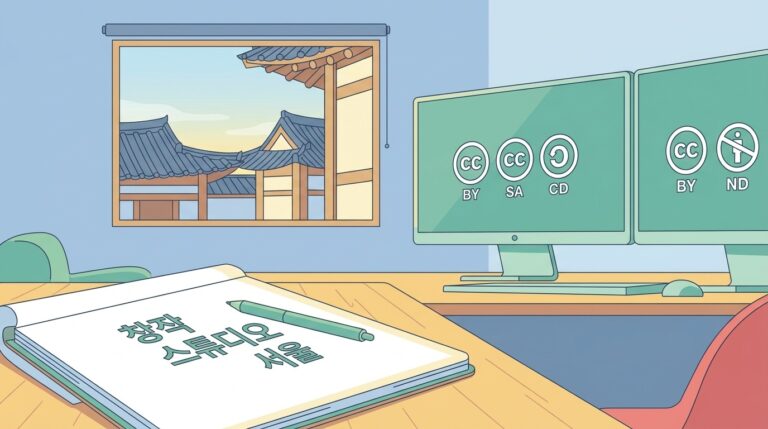
Master Korean Copyright & Creative Commons: The Ultimate C1 Guide for Creators
Phase 1: Empathy (Story-Driven Opening)
안녕하세요! 매일한글 에디터입니다. (Hello! I’m your Daily Hangul editor.)
Picture this: You’ve just spent three days producing a stunning video essay on Seoul’s indie coffee culture or designing a gorgeous webtoon fan art poster to share on Korean creator platforms like Naver Blog, Brunch, or YouTube. You want to use a catchy traditional fusion BGM and some public cultural assets, but when you check the description box, you’re hit with cryptic terms: 상업적 이용 불가 (Commercial use prohibited), 저작자표시 필수 (Attribution required), and 2차적 저작물 작성 금지 (No derivative works).
Suddenly, self-doubt creeps in. If you monetize your video, is that a copyright violation? If you translate a Korean article and credit the author, are you safe or committing an accidental infringement (불펌, unauthorized reposting)? At the C1 level, mastering Korean isn’t just about ordering food or passing a grammar exam; it’s about navigating complex legal, social, and creative nuances with precision and confidence.
This guide draws directly on real feedback from international content creators, translators, and designers working in Seoul’s fast-paced creative industry. By the end of this masterclass, you will speak and negotiate copyright terms with professional flair, ensuring your creative work remains both legally sound and culturally respectful in South Korea.
Phase 2: Top 3 Core Expressions Deep Dive
1. 출처를 명확히 밝혀주세요 (Chulcheoreul myeonghwakhi balkhyeojuseyo)
- Pronunciation: [Chool-chuh-reul myeong-hwak-hee bal-kyuh-joo-seh-yo] (Think of ‘Chul’ sounding like ‘chilly’ without the ‘y’, followed by ‘cheo’ as in ‘chore’ said fast)
- Meaning: Literal: “Please clearly reveal the origin.” / Actual Nuance: “Please provide precise and unambiguous source attribution (Creative Commons Attribution: BY).”
- K-Culture Moment: Commonly seen in the description headers of major Korean YouTube channels, webtoon creator notices on Postype, or collegiate research collaborations.
- Editor’s Insight: The verb 밝히다 (to illuminate / reveal) carries a much stronger, more active responsibility than simply 적다 (to write down). It commands the user to trace the original root clearly, including the creator’s handle and link.
- Situation Spectrum:
- Casual (to close creator friends): ⚠️ 출처 꼭 남겨줘! (Chulcheo kkok namgyeojwo!)
- Semi-formal (creator forums/DMs): ✅ 출처를 명확히 남겨주세요.
- Formal (official copyright/business notices): ✅ 출처를 명확히 밝혀주시기 바랍니다.
- 🤔 Think About It: In English, we often say “Credit to the artist,” which feels casual. Why does Korean emphasize the “source/origin” (출처) so formally even in casual digital spaces?
2. 2차적 저작물 작성이 가능한가요? (I-chajeok jeojakmul jakseongi ganeunghangayo?)
- Pronunciation: [Ee-cha-jeok juh-jak-mool jak-seong-ee gah-neung-hahn-gah-yo?]
- Meaning: Literal: “Is the creation of secondary work possible?” / Actual Nuance: “Is it permissible to create derivative works or remixes from this original content (CC ND vs. CC Derivative permissive)?”
- K-Culture Moment: Essential when an overseas K-Pop cover artist or video editor contacts an indie Korean label asking permission to remix a song or sample an animation clip.
- Editor’s Insight: 2차적 저작물 (derivative work) is the exact legal phrasing used in the Korean Copyright Act (저작권법). Using this precise term elevates your Korean from an amateur content scraper to a legally savvy creative professional.
- Situation Spectrum:
- Casual: 🚫 이거 고쳐서 다시 올려도 돼? (Too blunt and informal for IP inquiries)
- Semi-formal: ⚠️ 이거 수정해서 써도 될까요?
- Formal (business negotiations & IP licensing): ✅ 2차적 저작물 작성 및 배포가 가능한지 여쭙고 싶습니다.
- 🤔 Think About It: How does asking for “derivative rights” reflect the high level of respect for original ownership in South Korea’s bustling digital IP economy?
3. 상업적 이용 및 변경을 금지합니다 (Sang-eopjeok iyong mit byeongyeong-eul geumjihamnida)
- Pronunciation: [Sahng-uhp-juhk ee-yong meet byuhn-gyuhng-eul geum-jee-hahm-nee-dah]
- Meaning: Literal: “Commercial usage along with alterations are prohibited.” / Actual Nuance: “This work is protected under CC BY-NC-ND (Attribution-NonCommercial-NoDerivatives).”
- K-Culture Moment: Standard disclaimer displayed at the end of K-Drama behind-the-scenes cuts, fan-site photo galleries, and indie game asset distribution pages.
- Editor’s Insight: The conjunction 및 (and/as well as) creates a concise, binding legal tone. Notice the use of 금지합니다 (strictly forbidden) rather than 안 됩니다 (cannot be done), establishing firm legal boundaries.
- Situation Spectrum:
- Casual: 🚫 돈 벌려고 쓰거나 바꾸지 마세요 (Sounds immature in a portfolio)
- Semi-formal: ⚠️ 상업적으로 쓰거나 고치시면 안 돼요.
- Formal / Public Portfolio: ✅ 무단 전재, 상업적 이용 및 2차 가공을 엄격히 금지합니다.
- 🤔 Think About It: Why does Korean digital copyright emphasize both commercial gain (상업적) and modifications (변경/가공) separately?
Phase 3: Textbook Korean vs. Real Korean
Situation 1: Warning people against reposting your content without credit
- 📖 Textbook Korean: 저작권법을 준수하여 주십시오. (Jeojakkwonbeobeul junsuhayeo jusipsio. – “Please comply with copyright laws.”)
- 🗣️ Real Korean (C1 Natural): 무단 전재 및 재배포, 불펌은 절대 삼가시기 바랍니다. (Mudan jeonjae mit jaebaepo, bulpeomeun jeoldae samgasigi baramnida. – “Unauthorized reproduction, redistribution, and content scraping are strictly prohibited.”)
- 💡 Why is it different?: Textbook phrases sound like generic municipal posters. Real creators in Korea combine formal legal phrasing (무단 전재 및 재배포) with the universally recognized cultural buzzword 불펌 (illegal scraping/reposting) to make the boundaries crystal clear.
Situation 2: Asking a fellow creator how they want to be credited
- 📖 Textbook Korean: 당신의 이름을 어떻게 적을까요? (Dangsinui ireumeul eotteoke jeogeulkkayo? – “How shall I write your name?”)
- 🗣️ Real Korean (C1 Natural): 크레딧에 닉네임이나 채널 링크를 어떻게 표기해 드릴까요? (Keuredise ningneim-ina chaeneol ringkeureul eotteoke pyogihye deurilkkayo? – “How would you prefer your nickname or channel link to be displayed in the credits?”)
- 💡 Why is it different?: Using the pronoun 당신 can sound awkward or confrontational. Real creators use the loanword 크레딧 (credits) and the humble polite form 표기해 드릴까요 to demonstrate respect for digital identity.
Phase 4: K-Culture Deep Dive & Non-Verbal Manners
4-1. 눈치 (Nunchi) & Digital Etiquette in Korea’s Creator Sphere
In the West, citing a source under “Fair Use” is often seen as standard practice without contacting the creator first. In Korea, however, 선연락 후사용 (contacting first, using after) is deeply tied to digital Nunchi.
* The Direct Message (DM) Etiquette: When sliding into a Korean creator’s Instagram or X (Twitter) DM to ask for CCL asset permissions, never send just “Can I use this?” Start with warm praise for their work (항상 멋진 작품 잘 보고 있습니다), introduce your project’s scope, and clearly state whether monetization is involved.
* The Golden Courtesy Rule (펌 매너): If you re-share a Korean blogger’s recipe, travel map, or graphic with permission, the attribution link must be placed at the top or prominent middle section of your post, not hidden in micro-font at the bottom.
4-2. The Culture Code: K-Pop Fan Creations vs. Official IP
Korea possesses one of the world’s most vibrant fan-art and 2차 창작 (secondary creation) cultures, yet agencies (like HYBE, SM, JYP) have razor-sharp legal boundaries regarding merchandise sales. While non-commercial fan fiction or fan art shared on social media is celebrated as fandom engagement, creating derivative physical merchandise (굿즈) for profit without an official CCL license will instantly trigger a cease-and-desist. Navigating this fine line requires clear understanding of 비영리 목적 (non-profit purpose).
Phase 5: Real-Life Roleplay Scenario
Setting: A trendy creator studio in Seongsu-dong, Seoul.
Characters:
* Liam (리암): An international visual designer launching a YouTube documentary about Korean architecture.
* Min-ji (민지): A Korean indie photographer and asset creator whose Seoul cityscapes Liam wants to license under CCL.
민지: 안녕하세요, 리암 님! 보내주신 포트폴리오와 기획안 인상 깊게 잘 읽었습니다.
(Annyeohaseyo, Liam nim! Bonaejusin poteupolriowa gihoegang insang gipge jal ilgeotseumnida.)
🎭 [Sitting across the wooden studio table, handing over a warm cup of barley tea with a bright smile]
“Hello, Liam! I was very impressed reading the portfolio and project proposal you sent over.”
리암: 좋게 봐주셔서 감사합니다, 민지 님. 이번 다큐멘터리 도입부에 민지 님이 촬영하신 야경 사진들을 활용하고 싶어서요.
(Joke bwajusyeoseo gamsahamnida, Minji nim. Ibeon dakyumenteori doipbue Minji nimi chwaryeonghasin yagyeong sajindeureul hwalyonghago sipeoseoyo.)
🎭 [Leaning forward attentively, nodding with genuine gratitude]
“Thank you for looking at it favorably, Minji. I would love to use the night cityscape photos you took for the intro section of this documentary.”
민지: 네, 제 사진들은 기본적으로 CCL(저작자표시-비영리) 조건으로 배포하고 있는데요. 이번 영상에 수익 창출 계획이 있으신가요?
(Ne, je sajindeureun gibonjeogeuro CCL(jeojakjapyo-si – bi-yeongni) jogeoneuro baepohago inneundeyo. Ibeon yeongsange suik changchul gyehoeghi itsisin-gayo?)
🎭 [Resting her hands together, asking with a calm yet professional curiosity]
“Yes, my photos are fundamentally distributed under CC BY-NC (Attribution-NonCommercial) terms. Do you have plans for monetization with this video?”
리암: 우선 비영리 공개가 원칙이지만, 향후 독립영화제 출품이나 채널 수익 창출 가능성도 열려 있습니다. 그래서 라이선스 조건을 명확히 조율하고 싶습니다.
(Useon bi-yeongni gong-gaega wonchik-ijiman, hyanghu dongnip-yeonghwaje chulpumina chaeneol suik changchul ganeungseongdo yeollyeo itseumnida. Geuraeseo raiseonseu jogeoneul myeonghwakhi joyulhago sipeoseumnida.)
🎭 [Speaking clearly and transparently, showing full respect for her creative ownership]
“First, non-commercial release is the baseline rule, but entries into indie film festivals and channel monetization in the future remain possible. That’s why I’d like to clearly calibrate the license terms.”
민지: 솔직하게 말씀해 주셔서 감사해요. 그럼 영상 하단과 엔딩 크레딧에 출처와 원본 링크를 명확히 표기해 주시는 조건으로 상업적 이용을 허가해 드릴게요.
(Soljikhage malsseumhae jusyeoseo gamsahaeyo. Geureom yeongsang hadangwa ending keuredise chulcheowa wonbon ringkeureul myeonghwakhi pyogihye jusineun jogeoneuro sang-eopjeok iyong-eul heogahae deurilgeyo.)
🎭 [Nodding with deep appreciation for his honesty, tapping on her tablet to pull up the agreement]
“Thank you for being upfront. In that case, on the condition that you clearly display the attribution and original link in the video description and ending credits, I will grant permission for commercial usage.”
리암: 배려해 주셔서 정말 감사합니다! 2차 가공(색감 보정 및 줌 효과)도 허용 범위에 포함될까요?
(Baeryeohae jusyeoseo jeongmal gamsahamnida! I-cha gagong(saekgam bojeong mit jum hyogwa)do heoyong beomwie pohamdoelkkayo?)
🎭 [Asking with a cautious tilt of the head to ensure no creative boundaries are crossed]
“Thank you so much for your generosity! Would minor secondary processing (color grading and zoom effects) also be included in the permitted scope?”
민지: 사진의 원형을 해치지 않는 선에서의 단순 편집이라면 얼마든지 가능합니다. 계약서 조항에 반영해 둘게요.
(Sajinui wonhyeongeul haechiji anneun seoneseoui dansun pyeonjibiramyeon eolmadeunji ganeunghamnida. Gyeyakseo johange banyeonghae dulgeyo.)
🎭 [Smiles with satisfaction, making notes on the draft]
“As long as it’s simple editing that doesn’t distort the integrity of the original photos, that is totally fine. I will reflect this in the agreement clauses.”
리암: 완벽합니다. 크레딧 양식과 계약안 확정되는 대로 서명해서 바로 회신드리겠습니다!
(Wanbyeokhamnida. Keuredit yangsikgwa gyeyak-an hwakjeongdoeneun daero seomyeonghaeseo baro hoesindeurigesseumnida!)
🎭 [Bowing slightly with both hands on the table in professional closing etiquette]
“Perfect. As soon as the credit format and agreement draft are finalized, I will sign and get back to you immediately!”
🔀 Interactive Decision Point
Imagine Min-ji asked: “혹시 사진을 썸네일(대표 이미지)로 사용하실 때 글자를 크게 덮어씌우실 예정인가요? (Do you plan to overlay large text directly over the photo when using it as a thumbnail?)”
How should you reply in natural C1 Korean?
- Choice A: “제 마음대로 편집할 권리가 있는 것 아닌가요?”
- 🚫 Critique (Risk/Bad): Highly defensive and rude. It ignores the creator’s moral rights (저작인격권) and will immediately destroy the collaboration.
- Choice B: “네, 썸네일이니까 당연히 글자를 넣어야죠.”
- ⚠️ Critique (Suboptimal): Too blunt. It lacks respect for the visual integrity of the artist’s photography.
- Choice C: “원작자님의 사진 구도를 최대한 살리는 선에서 최소한의 텍스트만 배치할 계획입니다. 시안이 나오면 먼저 컨펌을 요청드려도 될까요?”
- ✅ Critique (Best / Pro Level): Exceptional C1 Korean! You demonstrate artistic consideration (구도를 최대한 살리는 선에서) and offer a proactive review loop (컨펌 요청), which guarantees deep trust.
Phase 6: 10-Second Emotion Shadowing Drill
Practice these high-impact C1 creator sentences aloud. Pay special attention to the natural pause markers (/) and dynamic emotional delivery:
[🧐 정중하고 명확한 비즈니스 톤 - Polite & Crisp Negotiation]
본 저작물은 / 비영리 목적으로만 사용 가능하며, / 2차 가공 시에는 / 원작자의 사전 동의가 필요합니다.
(Bon jeojakmureun / bi-yeongni mokjeog-euroman sayong ganeunghamyeo, / i-cha gagong sieneun / wonjakjaui sajeon dong-uiga piryohamnida.)
“This work is available exclusively for non-profit purposes, and prior consent from the original author is required for any secondary modifications.”-
[😊 신뢰를 주는 안심 톤 - Reassuring & Professional]
출처 표기 가이드라인을 / 철저히 준수하여 / 원작자님의 권리를 / 확실히 보장해 드리겠습니다.
(Chulcheo pyogi gaideuraineul / cheoljeohi junsuhayeo / wonjakjanimui gwonrireul / hwaksilhi bojanghae deurigesseumnida.)
“I will strictly abide by the attribution guidelines to firmly safeguard the original creator’s rights.” -
[🚨 단호하고 명확한 경고 톤 - Firm & Assertive Protection]
어떠한 경우에도 / 무단 캡처 및 도용은 / 법적 조치의 대상이 될 수 있음을 / 알려드립니다.
(Eotteohan gyeong-uedo / mudan kaepcheo mit doyong-eun / beopjeok jochiui daesangi doel su isseumeul / allyeodeurimnida.)
“Please be advised that unauthorized screen capture and plagiarism may be subject to legal action under any circumstances.”
Phase 7: K-Culture Mini Dictionary (Core 4 Keywords)
| Term (한글 + Rom.) | Meaning | Context & Practical Usage |
|---|---|---|
| 1. 불펌 (Bul-peom) | Unauthorized Content Scraping / Illegal Reposting | A portmanteau of 불법 (illegal) + 퍼가기 (scraping). Widely used in online forums and creator communities to warn scrapers against copying blog posts, art, or captions without explicit permission. |
| 2. 공공누리 (Gong-gong-nu-ri) | Korea Open Government License (KOGL) | South Korea’s national public domain/CCL framework for government, municipal, and public cultural assets. Divided into Types 1 through 4 (제1유형 ~ 제4유형), determining commercial use and adaptation rights. |
| 3. 2차 창작 (I-cha chang-jak) | Secondary / Derivative Creative Work | Refers to fan arts, parodies, translations, and remixes based on existing intellectual property. Extremely prevalent in K-Pop fandoms, Webtoon adaptations, and independent game mods. |
| 4. 원작자 표기 (Won-jak-ja pyo-gi) | Original Creator Attribution | The formal administrative requirement to state the creator’s legal name, handle, and publication source when utilizing Creative Commons materials in Korea. |
Phase 8: Creator & Traveler Survival Kit
Top 3 Survival Expressions for Freelancers & Creators in Korea
- “상업적 무료 폰트인가요?” (Sang-eopjeok muryo ponteu-in-gayo?)
Meaning: “Is this font free for commercial use?”
Pro Tip: Font copyright litigation is notoriously strict in South Korea. Always verify if a font allows 임베딩 (embedding) or 인쇄/영상 상업 이용 (print/video commercial use). - “무료 배포 라이선스 범위를 확인할 수 있을까요?” (Muryo baepo raiseonseu beomwireul hwag-inhal su isseulkkayo?)
Meaning: “Could I check the scope of the free distribution license?” - “저작권 등록이 완료된 저작물입니다.” (Jeojakkwon deungnoki wanryodoen jeojakmul-imnida.)
Meaning: “This work is officially registered with the Korea Copyright Commission.”
Editor’s Travel & Workflow Note
If you are producing content while traveling or staying as a digital nomad in Seoul:
* When seeking free, verified high-resolution cultural assets, visit the official Gonggong Nuri Public Domain Portal operated by the Ministry of Culture, Sports and Tourism.
* Need help resolving an intellectual property dispute or registering your creative portfolio in Korea? Consult the English consultation desk at the Korea Copyright Commission.
* For seamless workspace navigation around creative hubs like Hongdae, Seongsu, and Pangyo Techno Valley, bookmark your commute via the Naver Map Application.
Phase 9: “한 발 더 깊이” (One Step Deeper: Thought Reflection)
In Western intellectual property frameworks, copyright discussions often revolve around individual property rights and economic exclusivity. In South Korea, while economic rights (저작재산권) are strictly enforced, there is an equally strong societal emphasis on 저작인격권 (Moral Rights of the Author)—specifically the right of integrity (동일성유지권) and the right of paternity (성명표시권). Korean digital culture views modifying an artist’s creation without humble consultation not merely as a contract violation, but as a breach of mutual interpersonal respect (예의).
💬 Your Turn: How does the digital copyright culture in your home country balance the freedom to remix content with honoring original creators? Have you ever had your work shared without credit? Let’s discuss in the comments below!
Phase 10: FAQ & Common Mistakes
Q: What is the difference between CCL (크리에이티브 커먼즈) and Gonggong Nuri (공공누리) in Korea?
A: CCL is the international Creative Commons system used globally by independent creators and platforms. 공공누리 (KOGL) is the official South Korean government standard applied to national cultural heritage, government data, public photos, and museum archives. While both use similar icons for attribution and non-commercial restrictions, KOGL specifically applies to public works (공공저작물).
Q: If I translate a Korean web novel or news article into English on my personal blog, does that count as fair use?
A: Under Korean copyright law, unauthorized translation constitutes the creation of a derivative work (2차적 저작물 작성권 침해). Even if it is for non-profit study purposes, publicly hosting full translated chapters without the author’s or publisher’s explicit consent is legally considered copyright infringement. You must obtain prior written permission or translate only short excerpts for critique and review with clear attribution.
Q: Can I use K-pop songs as background music on my monetized YouTube vlog if I state “No copyright infringement intended” in the description?
A: No. The phrase “No copyright infringement intended” (저작권 침해 의도가 없습니다) holds zero legal validity in South Korea. Korean music copyright associations (KOMCA) and platform algorithms will either claim the ad revenue or block the video entirely. You should use royalty-free music or tracks released under explicit commercial CCL licenses.
🚨 Common Mistakes Warning Board
- ❌ Mistake 1: Reposting an image and writing simply “출처: 구글 / 핀터레스트” (Source: Google / Pinterest).
- 👉 Correct Action: Search engines and curation platforms are not originators. Always identify the actual creator’s name/handle and direct portfolio URL (e.g., 출처: 네이버 블로그 [창작자명]).
- ❌ Mistake 2: Assuming “Non-Commercial” (비영리) allows use on a monetized YouTube channel or personal portfolio displaying freelance services.
- 👉 Correct Action: If your platform generates AdSense revenue or markets your commercial services, it is deemed commercial. Request commercial licensing (상업적 이용 라이선스) from the owner.
- ❌ Mistake 3: Removing watermarks (워터마크) or cropping creator signatures during video editing.
- 👉 Correct Action: Intentionally erasing or cropping out a signature or watermark violates 성명표시권 (Right of Paternity) and 동일성유지권 (Right of Integrity), leading to serious legal penalties.
Phase 11: Action Mission & Community Challenge
- 🥉 Bronze Mission (Solo Practice): Check the description of 3 Korean YouTube videos or Webtoon author notices today. Identify and write down whether they use 저작자표시, 상업적 이용 금지, or 2차 변경 금지.
- 🥈 Silver Mission (Social Connection): Write an attribution disclaimer in proper C1 Korean for your Instagram or blog footer protecting your own creative work (예: 본 게시물의 무단 전재 및 2차 가공을 금지합니다).
- 🥇 Gold Mission (Real-life Execution): Find an indie Korean creator on Postype, Brunch, or X (Twitter). Leave a polite, professional Korean comment praising their work and asking an informed question about their creative process using our C1 phrases!
🎮 K-Culture Mission: Watch the ending credits of your favorite K-Drama or indie film. Spot the official copyright disclaimer screen at the very end and verify how many terms from Phase 2 and 7 you can spot in real-time!
Phase 12: Interactive Quiz Challenge
Test your mastery of Korean copyright nuances with these three C1 challenge questions:
Q1. Situational Judgment
You want to use an indie illustrator’s Seoul cityscape drawing as the cover of your self-published e-book, which you will sell for $3.99 on Amazon. The image is tagged: CCL: 저작자표시-비영리-변경금지 (CC BY-NC-ND). Can you legally use this image without contacting the artist?
A) Yes, as long as you put the artist’s name on the front cover.
B) No, because self-publishing for a price violates the “비영리 (Non-Commercial)” condition.
C) Yes, because Amazon handles overseas copyright differently.
🔍 Click to Reveal Answer & Detailed Explanation
Correct Answer: B
Explanation: The tag includes 비영리 (NC – NonCommercial), which strictly forbids selling any product that features the work. Furthermore, formatting it as a book cover may constitute a modification (변경). You must contact the illustrator and negotiate commercial licensing terms.
Q2. Fill-in-the-Blank (C1 Professional Vocabulary)
Complete the official copyright notice below using the appropriate Korean terms:
“본 웹툰의 모든 저작권은 작가에게 있으며, 사전 협의 없는 ( ________ ) 및 ( ________ )을 엄격히 금지합니다.”
A) 무료 나눔 / 친구 공유
B) 무단 전재 / 2차 가공
C) 단순 열람 / 댓글 작성
🔍 Click to Reveal Answer & Detailed Explanation
Correct Answer: B
Explanation: 무단 전재 (Unauthorized reproduction/reprinting) and 2차 가공 (Secondary modification/processing) are the standard formal legal terms used in professional Korean creator notices.
Q3. True / False Cultural IP Quiz
Statement: In South Korea, public cultural assets produced by the national government and marked as 공공누리 제1유형 (KOGL Type 1) can be used for commercial projects without paying royalty fees, provided the source is clearly cited.
- [ ] True
- [ ] False
🔍 Click to Reveal Answer & Detailed Explanation
Correct Answer: True
Explanation: 공공누리 제1유형 (KOGL Type 1) allows both commercial utilization and adaptation/modification completely free of charge, as long as the source (출처) is explicitly cited according to standard guidelines.







