

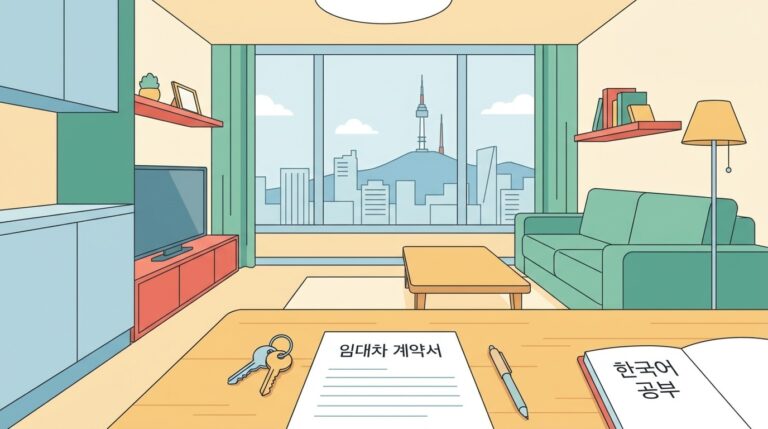
Phase 1: 공감 (Relatable Story Opening)
안녕하세요! (Annyeonghaseyo!) I’m your Daily Hangul editor and cultural navigator. If you have ever watched the K-Drama Because This Is My First Life (이번 생은 처음이라) or watched your favorite K-Pop idol go apartment hunting on I Live Alone (나 혼자 산다), you have probably stumbled across a total financial puzzle: Why on earth does someone hand over hundreds of thousands of dollars as a “deposit” and pay zero monthly rent? Or why does a tiny studio apartment demand a $10,000 upfront cash deposit just for ordinary monthly rent?
Welcome to the dizzying world of Korean housing. When international residents and study-abroad students first land in Seoul, housing is easily the number one source of culture shock and anxiety. You walk past street-level real estate offices (부동산, budongsan) plastered with mysterious stickers reading “500/45” or “전세 2억”, feeling like you need an economics degree just to sign a studio lease.
Don’t worry! This comprehensive guide is built directly on hundreds of real coaching sessions with expats who went from completely overwhelmed to confidently signing their dream studio (원룸, wonrum) leases in Mapo and Gangnam. By the end of this guide, you will master the essential vocabulary, understand the cultural nunchi of house hunting, and navigate negotiations like a seasoned local.
Phase 2: 핵심 표현 3선 심층 분석 (Top 3 Key Expressions)
1. 보증금 얼마예요? (Bojeunggeum eolmayeyo?)
- Pronunciation: [Bo-jeung-geum eol-ma-ye-yo?] (Think: ‘Boh-jung-geum’ like ‘judge’ with an ‘um’ sound, followed by ‘all-ma-ye-yo’)
- Meaning: Literal: “How much is the guarantee money?” | Real Nuance: “What is the upfront security deposit for this place?”
- K-Culture Moment: In dramas when young characters search for a rooftop room (옥탑방), they nervously ask the landlord this phrase while praying it fits their tight savings.
- Editor’s Insight: In Korea, the 보증금 (deposit) dictates everything. A higher deposit usually means lower monthly rent. When you see “1000/60”, the first number (1,000만 원 = ~10,000 USD) is the 보증금.
- Situation Spectrum: Casual: ⚠️ (Use 보증금 얼마야?) | Semi-formal: ✅ | Formal: ✅ (보증금이 얼마입니까?)
- 🤔 Think About It: In Western rentals, deposits are typically 1–2 months of rent. Why do you think Korean society developed a system where deposits represent a massive portion of the property’s asset value?
2. 전세로 알아보고 있어요. (Jeonsero arabogo isseoyo.)
- Pronunciation: [Jeon-se-ro a-ra-bo-go i-sseo-yo.] (Sounds like: ‘Jun-seh-ro ah-rah-boh-goh ee-ssuh-yoh’)
- Meaning: Literal: “I am looking around via Jeonse.” | Real Nuance: “I’m looking for a lump-sum deposit lease (no monthly rent).”
- K-Culture Moment: When newlywed couples in K-dramas visit a bank or realtor, declaring this sentence signifies they are ready to invest their joint life savings into their first major home together.
- Editor’s Insight: 전세 (Jeonse) is Korea’s unique system where you deposit 50%–80% of the home’s market value with the landlord, live there rent-free for 2 years, and get 100% of that money back when you move out.
- Situation Spectrum: Casual: ⚠️ (전세로 알아보고 있어) | Semi-formal: ✅ | Formal: ✅ (전세 매물을 찾고 있습니다)
- 🤔 Think About It: How does the trust required to hand over a life-savings deposit reflect historical community banking (계, gye) and rapid economic growth in Korea?
3. 관리비는 포함되어 있나요? (Gwanribineun pohamdoeeo innayo?)
- Pronunciation: [Gwal-li-bi-neun po-ham-doe-eo in-na-yo?] (Flow: ‘Gwal-lee-bee-neun poh-hahm-dweh-uh een-nah-yoh’)
- Meaning: Literal: “Is the maintenance fee included?” | Real Nuance: “Does the rent cover building maintenance and utilities, or is that extra?”
- K-Culture Moment: Frugal characters in webtoons and sitcoms scrutinizing utility bills to avoid the dreaded “hidden monthly costs” trap.
- Editor’s Insight: A room might advertise a cheap monthly rent of 400,000 KRW, but if the 관리비 (maintenance fee) is 150,000 KRW without internet or water, it’s not actually a bargain! Always verify what is included (인터넷, 수도, 전기).
- Situation Spectrum: Casual: ⚠️ (관리비 포함이야?) | Semi-formal: ✅ | Formal: ✅ (관리비가 포함되어 있습니까?)
- 🤔 Think About It: Why is it common in dense city apartments (아파트/오피스텔) to separate building management fees from individual unit rents?
Phase 3: 교과서 한국어 vs 진짜 한국어 (Textbook vs. Real-Life Korean)
Situation 1: Inquiring about Rent Prices
- 📖 교과서 한국어 (Textbook): “이 방의 월세와 보증금은 얼마입니까?” (I bang-ui wolse-wa bojeunggeum-eun eolma-imnikka? – How much is the monthly rent and deposit for this room?)
- 🗣️ 진짜 한국어 (Real-Life Native): “여기 보증금 천에 월세 오십 맞나요?” (Yeogi bojeunggeum cheon-e wolse osip mannayo? – Is this one 10 million deposit and 500k rent?)
- 💡 왜 다를까? (Why is it different?): Native Koreans condense monetary units. Instead of saying 천만 원 (10,000,000 KRW) and 오십만 원 (500,000 KRW), they casually drop the “만 원” and say “보증금 천에 오십” (1,000 deposit / 50 rent).
Situation 2: Asking to Adjust the Deposit/Rent Ratio
- 📖 교과서 한국어 (Textbook): “가격을 깎아주실 수 있습니까?” (Gagyeok-eul kkakka-jusil su itsseumnikka? – Can you give me a discount?)
- 🗣️ 진짜 한국어 (Real-Life Native): “혹시 보증금 올리고 월세 좀 낮출 수 있을까요?” (Hoksi bojeunggeum olligo wolse jom natchul su isseulkkayo? – Could I raise the deposit a bit to lower the monthly rent?)
- 💡 왜 다를까? (Why is it different?): In Korean real estate, straightforwardly demanding a discount sounds rude. Instead, tenants negotiate the 전월세 전환율 (conversion ratio) by offering more upfront deposit cash in exchange for lower monthly payments.
Phase 4: K-Culture 딥다이브 & 비언어적 매너 (Deep Dive & Non-Verbal Etiquette)
4-1. 눈치(Nunchi) & Body Language at the Real Estate Office (부동산)
- Shoe Etiquette During House Tours: When entering an occupied apartment or a newly cleaned studio, never step onto the main floorboards (장판) with shoes on. Step out of your shoes onto the entryway tile (현관), and step directly up. If the agent offers guest slippers, accept them with both hands.
- Subtle Quality Checking (티 안 나게 확인하기): Turn on the bathroom sink and flush the toilet simultaneously to check water pressure (수압). Tap the window frames to check for winter draft insulation (외풍). Do this quietly with polite nods rather than loudly pointing out flaws in front of the current tenant.
4-2. Cultural Code: The Evolution of Korean Rentals in K-Drama
In older K-Dramas like Rooftop Prince or slice-of-life series, characters often live in 옥탑방 (rooftop rooms) or 반지하 (semi-basement rooms, made world-famous by the film Parasite). These were traditionally cheap 월세 (monthly rent) options for students arriving from rural provinces.
Today, young urban Koreans strive for 오피스텔 (officetels: multi-purpose studio buildings) or modern 청년안심주택 (government youth housing). Understanding Jeonse vs. Wolse unlocks the deep social storylines in modern K-Dramas where saving money for housing deposits represents adult independence and romantic readiness.
Phase 5: 실전 롤플레이 시나리오 (Real-World Roleplay Scenario)
Setting: A bustling real estate office near Hongdae. Agent Kim (공인중개사 김 소장님) is reviewing property listings with Sarah (사라), an international student looking for a studio.
- Sarah: 안녕하세요! 역 근처 원룸 월세 매물 좀 보러 왔어요.
(Annyeonghaseyo! Yeok geuncheo wonrum wolse maemul jom boreo wasseoyo.)
“Hello! I came to see some monthly rental studio listings near the station.”
🎭 (Politely bowing at a 15-degree angle while taking a seat) -
Agent Kim: 어서 오세요! 생각해 두신 보증금이랑 월세 예산이 어떻게 되세요?
(Eoseo oseyo! Saenggakhae dusin bojeunggeum-irang wolse yesan-i eotteoke doeseyo?)
“Welcome! What budget do you have in mind for deposit and monthly rent?”
🎭 (Offering a warm cup of green tea with two hands) -
Sarah: 보증금은 천만 원까지 가능하고, 월세는 관리비 포함해서 65만 원 생각하고 있어요.
(Bojeunggeum-eun cheonman won-kkaji ganeunghago, wolse-neun gwanlibi pohamhaeseo yuksip-o-man won saenggakhago isseoyo.)
“My deposit max is 10 million KRW, and for rent, I’m thinking around 650,000 KRW including maintenance.”
🎭 (Checking notes on her smartphone) -
Agent Kim: 마침 역 도보 5분 거리에 보증금 천에 월세 육십짜리 좋은 방이 하나 있어요.
(Machim yeok dobo obun geori-e bojeunggeum cheon-e wolse yuksip-jjari joeun bang-i hana isseoyo.)
“It just so happens there is a great room 5 minutes from the station: 10 million deposit and 600,000 rent.”
🎭 (Pointing at a floor plan on the tablet) -
Sarah: 오, 좋아요! 혹시 그 집 관리비는 따로 얼마인가요?
(Oh, joayo! Hoksi geu jip gwanlibi-neun ttaro eolma-ingayo?)
“Oh, nice! By the way, how much is the maintenance fee separately for that unit?”
🎭 (Leaning forward with attentive eye contact) -
Agent Kim: 관리비는 7만 원인데 인터넷이랑 수도세가 포함되어 있어요.
(Gwanlibi-neun chilman won-inde inteonet-irang sudose-ga pohamdoeeo isseoyo.)
“Maintenance is 70,000 KRW, which includes high-speed internet and water.”
🎭 (Flipping to the detailed utility ledger) -
Sarah: 채광도 괜찮나요? 지금 바로 방 보러 갈 수 있을까요?
(Chaegwang-do gwaenchanhnayo? Jigeum baro bang boreo gal su isseulkkayo?)
“Is the natural sunlight good too? Could we go see the room right now?”
🎭 (Putting on coat and getting ready) -
Agent Kim: 네! 남향이라 해가 아주 잘 듭니다. 바로 가시죠!
(Ne! Namhyang-ira hae-ga aju jal deumnida. Baro gasijyo!)
“Yes! It faces south so it gets plenty of sun. Let’s head over right away!”
🎭 (Grabbing the master keys with an encouraging smile)
🔀 Interactive Decision Point
After inspecting the room, Sarah discovers the maintenance fee is slightly over budget. What should Sarah say?
- Option A: “너무 비싸요. 깎아주지 않으면 계약 안 해요!” (Too expensive. If you don’t discount it, I won’t sign!)
- Option B: “혹시 보증금을 2천으로 올리면 월세를 5만 원 정도 낮출 수 있을까요?” (If I raise the deposit to 20 million, could the landlord lower monthly rent by 50k?)
- Option C: “그냥 관리비 안 내고 살면 안 될까요?” (Can I just live here without paying any maintenance fee?)
Feedback:
* Option A (Bad): Aggressive negotiation breaks rapport with Korean landlords and realtors.
* Option B (Best ✅): This is the standard, polite, and effective way to negotiate rent using Korea’s 전월세 전환 concept.
* Option C (Risk 🚫): Maintenance fees cover essential building cleaning, elevators, and shared lights; asking to skip them shows a lack of civic etiquette.
Phase 6: 10초 감정 섀도잉 드릴 (10-Second Shadowing Drill)
Practice reading these lines aloud with natural pauses (/) and dynamic emotional delivery!
[😊 희망차고 정중하게 - Hopeful & Polite]
“저기요, / 역 근처에 / 보증금 천에 오십짜리 / 원룸 있을까요?”
(Jeogiyo, / yeok geuncheo-e / bojeunggeum cheon-e osip-jjari / wonrum isseulkkayo?)
“Excuse me, / near the station / deposit 10 million and 500k rent / do you have any studios?”-
[🤔 꼼꼼하고 신중하게 - Detail-oriented & Inquiring]
“관리비에 / 인터넷이랑 수도 요금이 / 다 포함되어 있는 건가요?”
(Gwanlibi-e / inteonet-irang sudo yogeum-i / da pohamdoeeo inneun geongayo?)
“In the maintenance fee / are internet and water bills / all included?” -
[✨ 확신에 차고 결단력 있게 - Confident & Decisive]
“채광도 좋고 수압도 세네요. / 이 방으로 계약 진행해 주세요!”
(Chaegwang-do joko suap-do seneyo. / I bang-euro gyeyak jinhaenghae juseyo!)
“The sunlight is great and the water pressure is strong. / Please proceed with the contract for this room!”
Phase 7: K-Culture 미니 사전 (Mini Glossary)
- 보증금 (Bojeunggeum) | Security Deposit (Key Money)
- Upfront collateral held by the landlord throughout the lease duration to secure against unpaid rent or damages, returned at move-out.
- 전세 (Jeonse) | Lump-Sum Lease System
- Unique Korean housing contract where a massive deposit (no monthly rent) is paid for 2 years and fully refunded upon lease termination.
- 확정일자 (Hwakjeong-ilja) | Fixed Date Stamp
- An official legal timestamp received at the local Community Service Center (주민센터) that grants your deposit top priority protection under Korean tenancy law.
- 복비 / 중개수수료 (Bokbi / Junggae-susuryo) | Real Estate Commission
- The legally regulated broker fee paid to the realtor upon signing a housing contract.
Phase 8: 여행자를 위한 생존 키트 (Housing Survival Kit)
Top 3 Survival Phrases
- “등기부등본 보여주세요.” (Deunggibudeungbon boyeojuseyo.)
- Meaning: “Please show me the Certified Real Estate Register.”
- Pro Tip: Never sign or pay money until the agent shows you this document to prove the landlord doesn’t have dangerous outstanding debts.
- “수압 확인해 봐도 될까요?” (Suap hwaginhae bwado doelkkayo?)
- Meaning: “May I check the water pressure?”
- Pro Tip: Essential phrase during room tours; tests shower and sink strength.
- “계약 기간은 1년으로 가능한가요?” (Gyeyak giganeun ilnyeon-euro ganeunghangayo?)
- Meaning: “Is a 1-year contract possible?”
- Pro Tip: Standard Korean leases are 2 years, but students can often request 1 year for studios.
Editor’s Real Estate Action Guide
- Explore Listings on Apps: Before stepping into a neighborhood, check real market prices by doing a 네이버 부동산 앱 다운로드 or browsing studio listings through a 직방 앱 다운로드 search.
- Banking Prep: Ensure your Korean bank account has a high enough daily online transfer limit (이체한도) before the contract signing day, as deposits are paid via immediate bank transfer.
Phase 9: “한 발 더 깊이” (Cultural Essay & Reflection)
Why did the Jeonse system develop in Korea? During Korea’s rapid industrialization in the 1970s and 80s, private home construction boomed, but commercial banks rarely offered affordable mortgage loans to everyday citizens. Private citizens stepped in to act as each other’s banks: landlords received huge sums of zero-interest capital to buy property or invest in high-interest bank accounts, while renters lived rent-free and accumulated savings.
Today, as global interest rates fluctuate, the market is gradually shifting towards 반전세 (hybrid rent with medium deposits) and traditional 월세. Housing in Korea isn’t just about shelter; it is deeply tied to social milestones, financial discipline, and mutual economic history.
💬 Your Turn: Does your home country have anything comparable to key-money deposits, or is rent strictly paid monthly? Share your thoughts and questions in the comments below!
Phase 10: FAQ & 오해 방지 (FAQ Schema)
Q: What is the safest way to protect my deposit from landlord bankruptcy?
A: On the day you move in (잔금일), immediately complete your Resident Registration (전입신고, Jeonip-singo) and obtain a Fixed Date stamp (확정일자, Hwakjeong-ilja) at your neighborhood Community Service Center (주민센터). This establishes your “Opposable Power” (대항력) and legal priority repayment rights over other creditors.
Q: Can foreign passport holders sign a Jeonse or Wolse contract in Korea?
A: Yes! Foreigners registered with an Alien Registration Card (ARC / 외국인등록증) have equal legal rights to rent homes, receive deposit protection under the Housing Lease Protection Act, and register their addresses.
Q: What is “반전세” (Ban-jeonse)?
A: Ban-jeonse (half-jeonse) is a hybrid rental model where the tenant pays a substantial deposit (e.g., 50,000,000 KRW to 100,000,000 KRW) alongside a modest monthly rent (e.g., 200,000 to 400,000 KRW), balancing cash liquidity with reduced monthly living costs.
🚨 Common Mistakes Checklist (흔한 실수 TOP 3)
- Paying a deposit before checking debt (근저당): Always verify that the building owner’s mortgage debt plus total tenant deposits doesn’t exceed 60-70% of the building value.
- Assuming utilities are free in 월세: Water, gas, electricity, and building cleaning are often billed separately. Clarify every item in the contract.
- Skipping move-in photos: Take timestamped photos and videos of any wallpaper scuffs, floor scratches, or broken appliances on day one to avoid unfair deposit deductions at move-out.
Phase 11: 액션 미션 & 참여 유도 (Action Missions)
- 🥉 Bronze Mission (Solo Practice):
Practice saying the sentence “보증금 천에 월세 오십 매물 있나요?” smoothly 5 times in under 10 seconds. - 🥈 Silver Mission (Social Sharing):
Look up a Korean studio on a real estate platform and post in our community describing its specs in Korean (예: “이 원룸은 보증금 500에 월세 45예요!”). - 🥇 Gold Mission (Real-Life Mastery):
Visit a local 부동산 or roleplay with your Korean language exchange partner to inquire about listings with specific sunlight (채광) and floor level (층수) preferences. - 🎮 K-Culture Mission:
Watch an episode of I Live Alone (나 혼자 산다) and spot at least 2 housing terms (전세, 보증금, 관리비, 원룸) used by the cast!
Phase 12: 인터랙티브 퀴즈 챌린지 (Interactive Quiz)
1. Situational Judgment Quiz
You visit an officetel listed as “2000 / 50 / 8”. What does this pricing structure mean?
* (A) 2 million deposit, 500k rent, 80k maintenance
* (B) 20 million deposit, 500k rent, 80k maintenance
* (C) 200 million Jeonse, 50k rent, 8k maintenance
👉 Click to see the answer and explanation!
Correct Answer: (B)
Explanation: In Korean rental listings, numbers represent units of 10,000 KRW (만 원). Therefore, “2000” = 20,000,000 KRW (보증금), “50” = 500,000 KRW (월세), and “8” = 80,000 KRW (관리비).
2. Fill-in-the-Blank Quiz
이사한 첫날에 주민센터에 가서 보증금을 보호하기 위해 ________를 받아야 합니다.
(On moving day, you must visit the community center to get a ________ to protect your deposit.)
👉 Click to see the answer and explanation!
Correct Answer: 확정일자 (Hwakjeong-ilja / Fixed Date Stamp)
Explanation: Obtaining 확정일자 along with 전입신고 gives you legal priority repayment rights over the property if complications arise.
3. True or False Cultural Quiz
True or False: Under the traditional Jeonse system, the tenant pays a small monthly maintenance fee, but 100% of the primary deposit is returned at the end of the contract term.
👉 Click to see the answer and explanation!
Correct Answer: TRUE
Explanation: Jeonse requires no monthly rent (though separate building maintenance fees may apply). The full principal deposit amount is legally returned to the tenant when moving out.







