

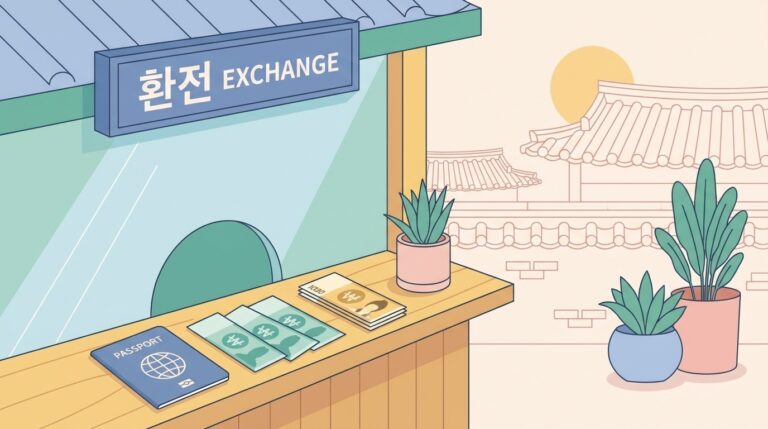
Master Currency Exchange in Korea: Essential Phrases and Cultural Tips for Travelers
Phase 1: 공감 (Story-Immersive Opening)
안녕하세요! 매일한글 에디터입니다. (Hello! This is your Daily Hangul editor.)
Picture this: You have just landed at Incheon International Airport after a long flight. You can already smell the savory street food calling your name from the nearest subway station, but you open your wallet and realize you only have foreign banknotes. You spot an exchange counter near the exit, your heart begins to race, and your mind goes blank. Should you just slide your passport across the counter in silence? What if they hand you only 50,000 KRW bills and you cannot pay for a 1,500 KRW single subway ride?
Exchanging money is often the very first real-world hurdle every traveler faces in South Korea. Many beginner learners tell us, “I memorized vocabulary, but when I stood in front of the cashier, I panicked!” You do not need to memorize a whole financial dictionary. With just three practical A2-level sentences and an understanding of local exchange customs, you can stride up to any booth in Myeongdong or Incheon Airport with total poise. Let us turn this stressful arrival moment into your first confident Korean conversation!
Phase 2: 핵심 표현 3선 심층 분석 (Top 3 Core Expressions)
1. 환전해 주세요 (Hwanjeonhae juseyo)
- Pronunciation: [Hwan-jeon-hae ju-se-yo] (Sounds like “Hwan-john-heh joo-say-yo” — imagine saying “swan” with an ‘H’, then “John”)
- Meaning: Literal: “Please do money exchange” | Actual Nuance: “I would like to exchange this money, please.”
- K-Culture Moment: You will hear this in almost every K-drama travel episode when a character lands in Seoul and dashes to the airport bank counter to buy food.
- Editor’s Insight: The word
환전(hwanjeon) combines exchange (환) and money (전). Adding~해 주세요creates an instant, polite, and foolproof request.- Situation Spectrum: Casual 🚫 | Semi-formal ✅ | Formal ✅
- 🤔 Think About It: In English, we often ask “Can I exchange money?” as a question. In Korean service encounters, polite command statements ending in
~해 주세요are standard and respectful. Why do you think Korean service interactions prefer clear polite requests over indirect questions?2. 환율이 어떻게 돼요? (Hwanyuri eotteoke dwaeyo?)
- Pronunciation: [Hwan-yu-ri eo-tteo-ke dwae-yo] (Think of “Hwan-yoo-ree uh-ttoh-keh dway-yo”)
- Meaning: Literal: “How does the exchange rate become?” | Actual Nuance: “What is the current exchange rate?”
- K-Culture Moment: Travelers walking through the famous currency exchange alleys of Myeongdong asking street window clerks for the day’s best rate.
- Editor’s Insight:
어떻게 돼요?is the Swiss Army knife of A2 Korean. Instead of asking for numbers mechanically, asking “how does it become?” sounds natural and polite.- Situation Spectrum: Casual ⚠️ | Semi-formal ✅ | Formal ✅
- 🤔 Think About It: Notice how Korean uses “how” (
어떻게) rather than “what” (무엇) when asking for prices, rates, and ages. How does this reflect a mindset focused on the flow of circumstance rather than static facts?3. 작은 돈도 섞어 주세요 (Jageun dondo seokkeo juseyo)
- Pronunciation: [Ja-geun don-do seok-keo ju-se-yo] (Sounds like “Jah-geun doan-doh suck-kuh joo-say-yo”)
- Meaning: Literal: “Please mix in small money too” | Actual Nuance: “Could you please include some smaller bills (like 1,000 and 5,000 KRW)?”
- K-Culture Moment: When shopping at traditional markets like Gwangjang Market where food stall owners prefer 1,000 or 5,000 won notes over 50,000 won notes.
- Editor’s Insight: If you do not say this, counters will naturally give you thick 50,000 won notes (
오만 원권). Using작은 돈(small money) or소액권(so-aek-gwon) saves you from breaking large bills at small street carts.- Situation Spectrum: Casual ⚠️ | Semi-formal ✅ | Formal ✅
- 🤔 Think About It: In many Western markets, exact change is demanded, but in Korea, asking for mixed denominations politely is welcomed. How does this smooth out everyday market transactions?
Phase 3: 교과서 한국어 vs 진짜 한국어 (Textbook vs. Real Korean)
Situation 1: Asking to exchange US dollars to Korean Won
- 📖 교과서 한국어 (Textbook): 미국 달러를 대한민국 원화로 환전하고 싶습니다. (Miguk dalleoreul daehanminguk wonhwaro hwanjeonhago sipsumnida. / “I desire to exchange United States Dollars into Republic of Korea Won.”)
- 🗣️ 진짜 한국어 (Real Korean): 달러를 원화로 바꿔 주세요. (Dalloreul wonhwaro bakkwo juseyo. / “Please change these dollars into won.”)
- 💡 왜 다를까? (Why the difference?): Real Koreans frequently use the native verb
바꾸다(bakkuda – to change) instead of the Sino-Korean term환전하다when the context is already crystal clear at an exchange desk.
Situation 2: Asking about exchange fees/commissions
- 📖 교과서 한국어 (Textbook): 환전 수수료가 얼마로 책정되어 있습니까? (Hwanjeon susuryoga eolmaro chaekjeongdoe-eo itsseumnikka? / “At what amount is the exchange commission established?”)
- 🗣️ 진짜 한국어 (Real Korean): 수수료 있어요? (Susuryo isseoyo? / “Is there a fee?”)
- 💡 왜 다를까? (Why the difference?): Short, direct questions using
있어요?(Is there…?) are completely polite and far more common in fast-paced city booths.
Phase 4: K-Culture 딥다이브 & 비언어적 매너 (Culture Deep Dive & Etiquette)
4-1. 눈치 (Nunchi) & Two-Hand Etiquette
When exchanging money or handing over your passport, never toss or push them across the counter with one hand. In Korean culture, handing cash or sensitive cards is an expression of respect. Always hold your cash or passport with both hands (or support your right forearm lightly with your left hand). Maintain soft eye contact, give a slight nod, and receive your Korean Won with both hands as well.
4-2. Cultural Code: Cash vs. Cashless Seoul
South Korea is one of the most cashless societies on earth. You can buy a pack of gum with an international credit card or mobile pay in 95% of retail stores. However, you will still need cash for two vital things: reloading your physical public transit card (T-Money) and buying snacks at traditional street markets. Pro-tip: Do not exchange all your traveling funds at airport bank counters where rates are lower. Exchange just 30,000 to 50,000 KRW at the airport for immediate subway transport, and convert the rest in Myeongdong or via automated WOWPASS kiosks!
Phase 5: 실전 롤플레이 시나리오 (Real-World Roleplay Scenario)
Setting: A vibrant, neon-lit money exchange booth in Myeongdong, Seoul.
Characters: Alex (A traveler visiting Korea for the first time) & Minji (A friendly, sharp money exchange teller).
- Turn 1 (Alex): 안녕하세요! 환율이 어떻게 돼요?
(Annyeonghaseyo! Hwanyuri eotteoke dwaeyo?)
“Hello! What is the exchange rate today?”
🎭 Hands over USD 100 note with both hands while smiling. -
Turn 2 (Minji): 오늘 100달러에 135,000원이에요.
(Oneul baek-dallae-e sip-sam-man o-cheon-won-i-e-yo.)
“Today it is 135,000 KRW for 100 USD.”
🎭 Points politely to the digital exchange rate screen. -
Turn 3 (Alex): 네, 100달러 환전해 주세요.
(Ne, baek-dalla hwanjeonhae juseyo.)
“Okay, please exchange 100 dollars for me.” -
Turn 4 (Minji): 여권 보여주시겠어요?
(Yeogwon boyeojusigesseoyo?)
“Could you please show me your passport?”
🎭 Extends hand toward the counter tray. -
Turn 5 (Alex): 여기 있습니다. 작은 돈도 섞어 주세요.
(Yeogi itsseumnida. Jageun dondo seokkeo juseyo.)
“Here it is. Please mix in some smaller bills too.”
🎭 Hands passport with both hands. -
Turn 6 (Minji): 네, 만 원짜리 다섯 장이랑 천 원짜리 다섯 장 섞어 드릴게요.
(Ne, man-won-jjari daseot jang-irang cheon-won-jjari daseot jang seokkeo deurilgeyo.)
“Sure, I will mix five 10,000-won bills and five 1,000-won bills for you.”
🎭 Counts the bills carefully in front of the window. -
Turn 7 (Minji): 여기 135,000원하고 영수증입니다. 확인해 보세요.
(Yeogi sip-sam-man o-cheon-won-hago yeongsujeung-imnida. Hwaginhae boseyo.)
“Here is 135,000 Won and your receipt. Please check it.” -
Turn 8 (Alex): 감사합니다! 좋은 하루 보내세요!
(Gamsahamnida! Joeun haru bonaeseyo!)
“Thank you! Have a great day!”
🎭 Receives cash with both hands and bows slightly.
🔀 Interactive Decision Point
When Minji asks for your passport in Turn 4, what is the best response?
* Choice A: “여권 없어요. 그냥 해줘요.” (No passport. Just do it anyway.)
❌ Bad: Currency exchange legally requires passport identification in Korea. Unregistered transactions are prohibited.
* Choice B: “여기 있어요! 작은 돈도 같이 주세요.” (Here it is! Please give smaller bills together.)
✅ Best: Polite, complies with legal requirements, and ensures you get usable street-food cash right away.
* Choice C: (Throwing passport onto the counter silently with one hand)
⚠️ Risk: While the clerk will process it, one-handed tossing comes across as dismissive and rude.
Phase 6: 10초 감정 섀도잉 드릴 (10-Second Emotion Shadowing Drill)
Practice these lines out loud with the emotional cues and rhythm pauses (/):
[😊 Polite & Inquiring]
안녕하세요! / 오늘 환율이 / 어떻게 돼요?
(Annyeonghaseyo! / Oneul hwanyuri / eotteoke dwaeyo?)-
[🤝 Clear & Respectful]
달러를 / 원화로 / 바꿔 주세요.
(Dalloreul / wonhwaro / bakkwo juseyo.) -
[💡 Friendly & Practical]
만 원짜리도 / 몇 장 / 섞어 주세요!
(Man-won-jjarido / myeot jang / seokkeo juseyo!)
Phase 7: K-Culture 미니 사전 (Mini Dictionary)
- 환율 (Hwanyol) | Exchange Rate | Checked daily by tourists and locals alike. Look for boards showing
매매기준율(Standard Base Rate) or현찰 살 때(When Buying Cash). - 현금 (Hyeongeum) | Cash | While cards rule Korea, signs stating “현금 결제 시 할인” (Discount for cash payment) still pop up in flea markets and underground shopping arcades.
- 잔돈 (Jandon) | Small Change / Coins | When paying street food vendors, having
잔돈makes you an instant favorite customer. - 영수증 (Yeongsujeung) | Receipt | After exchanging money or shopping, the clerk will ask: “영수증 드릴까요?” (Shall I give you the receipt?). You can reply: “네, 주세요” (Yes, please) or “괜찮아요” (No thank you).
Phase 8: 여행자를 위한 생존 키트 (Traveler’s Survival Kit)
Top 3 Survival Phrases
- 카드 돼요? (Kadeu dwaeyo?) — “Do you take credit cards?”
Pro Tip: Use this at small food stalls or independent fashion boutiques. - 영수증 버려 주세요 (Yeongsujeung beoryeo juseyo) — “Please throw away the receipt for me.”
Pro Tip: Perfect when you don’t want your pockets cluttered with paper slips. - ATM 어디에 있어요? (ATM eodie isseoyo?) — “Where is the ATM?”
Pro Tip: Look for ATMs with the “Global ATM” logo to use foreign Visa/Mastercard cards.
Editor’s Travel Note
- Check the official currency exchange rate via the Naver Search Portal before heading to exchange booths so you know the baseline.
- To find the nearest highly-rated money changers in Myeongdong or Hongdae, use the Naver Map app for foreign travelers instead of Google Maps, which lacks accurate transit walking data in Korea.
Phase 9: “한 발 더 깊이” (Cultural Reflection)
In Korea, monetary transactions reflect a deep undercurrent of mutual courtesy and social trust (신뢰). Handing money with two hands is not just an old-fashioned gesture; it acknowledges the human being serving you across the counter. While modern Korea is blazing fast and ultra-digital, these brief interpersonal rituals keep everyday interactions warm and grounded.
💬 Your Turn: What is the money exchange culture like in your home country? Do people pay mostly in cash, or is it 100% digital? Share your stories in the comments below!
Phase 10: FAQ & 오해 방지 (FAQ Schema)
Q: Do I always need my physical passport to exchange money in Korea?
A: Yes. Korean financial regulations strictly require foreign visitors to present their original physical passport for identification during currency exchange at official booths and banks.
Q: Where can I get the best currency exchange rates in Seoul?
A: Private licensed exchange booths located around Myeongdong (specifically near the Chinese Embassy area) generally offer significantly better rates than airport bank desks or hotel lobbies.
Q: Can I use foreign credit cards to withdraw Korean Won at convenience store ATMs?
A: Yes, but only at machines marked with a “Global ATM” sign. Standard local Korean ATMs often reject foreign-issued debit and credit cards.
🚨 흔한 실수 (Common Mistakes) Warning Board
- Mistake: Handing over a passport and cash with one hand while looking at your smartphone.
Correct Action: Step forward, pause your phone screen, and hand over your documents using both hands with a light nod. - Mistake: Exchanging entire trip budgets at the airport terminal upon landing.
Correct Action: Exchange only around $30-$50 at the airport for transit, then exchange the rest in central Seoul for much higher rates. - Mistake: Forgetting to request smaller bills and ending up with only 50,000 KRW notes for subway reload machines.
Correct Action: Always remember the golden phrase:작은 돈도 섞어 주세요(Please mix in smaller bills).
Phase 11: 액션 미션 & 참여 유도 (Action Missions)
- 🥉 Bronze Mission (Solo Practice): Stand in front of your mirror with a mock passport and practice saying
달러를 원화로 바꿔 주세요with two-handed manners 3 times. - 🥈 Silver Mission (Social Share): Leave a comment below translating your own local currency into Korean (e.g., “미국 달러” or “유로”)!
- 🥇 Gold Mission (Real Action): On your upcoming trip to Korea, visit an exchange booth in Seoul and complete the entire transaction in Korean from “안녕하세요” to “감사합니다” without speaking English!
- 🎮 K-Culture Mission: Watch a Korea travel vlog on YouTube and spot how many times the creator receives cash or cards with both hands.
Phase 12: 인터랙티브 퀴즈 챌린지 (Interactive Quiz)
1. Situation Judgment: You are at an exchange booth in Myeongdong and want to ask what today’s rate is. Which sentence is most natural?
* (A) 오늘 환전 얼마예요?
* (B) 환율이 어떻게 돼요?
* (C) 돈을 주세요.
2. Fill-in-the-Blank: Fill in the missing word: “작은 돈도 ______ 주세요.” (Please mix in smaller bills.)
* (A) 섞어 (seokkeo)
* (B) 먹어 (meogeo)
* (C) 닫아 (dada)
3. True or False: In Korea, you can hand your passport and cash with one hand without being perceived as impolite.
* (True / False)
👉 Click here to reveal answers & explanations!
- Answer: (B) 환율이 어떻게 돼요? — This is the most natural and polite way to inquire about the current exchange rate.
- Answer: (A) 섞어 (seokkeo) —
섞다means ‘to mix’.섞어 주세요means ‘please mix/blend for me’. - Answer: False — In Korean etiquette, using two hands when offering money, cards, or identification is the golden standard of respect.







