

How to Find the Best Reading Spot in Korean Bookstores Without Feeling Awkward
Phase 1: Empathy (Story Opening)
안녕하세요! 매일한글 에디터입니다. (Hello! I am your Daily Hangul editor.)
Have you ever walked into a massive Korean bookstore like Kyobo Book Centre in Gwanghwamun or the breathtaking Starfield Library in COEX? You hold a gorgeous new book, look around, and suddenly freeze. You see a cozy wooden table, some lounge benches, and an in-store café, but a wave of hesitation washes over you: “Wait… am I allowed to sit here and read this before buying it? What if a clerk taps my shoulder? Where exactly is the reading zone?”
If you have ever awkwardly hovered near a bookshelf shifting your weight from one foot to another, you are definitely not alone! In K-Dramas like Romance is a Bonus Book, characters effortlessly glide between towering wooden bookshelves and find romantic, sunlit reading nooks. In real life, however, asking where to sit can feel intimidating if you don’t know the local etiquette. This guide is built directly from real student feedback and a decade of navigating Korean cultural spaces. By the end of this lesson, you will possess the exact A2-level phrases and cultural nunchi needed to find a cozy reading corner, ask staff with polite confidence, and enjoy your book like a true Seoulite.
Phase 2: Core 3 Expressions In-Depth Analysis
1. 여기서 읽어도 돼요? (Yeogiseo ilgeodo dwaeyo?)
- Pronunciation: [Yeo-gi-seo il-geo-do dwae-yo?] (Sound analogy: “Yeo-gi” sounds like “yogi”, “dwae-yo” rhymes with “way-yo” with a gentle rising intonation at the end).
- Meaning: Literal: “Is it okay even if I read here?” / Actual Nuance: “May I read here?” or “Is reading allowed in this spot?”
- K-Culture Moment: In calm slice-of-life K-dramas, this is the polite go-to phrase when a character wants to make sure they aren’t occupying a reserved or staff-only display bench.
- Editor’s Insight: The grammatical pattern -아/어도 돼요? (-a/eodo dwaeyo?) is the universal Korean key for asking permission. It sounds humble, considerate, and shows instant respect for the store’s rules.
- Situation Spectrum: Casual: ⚠️ (Use 여기서 읽어도 돼? with close friends) | Semi-formal / Polite: ✅ (Perfect for clerks and strangers) | Formal: ✅ (여기서 읽어도 됩니까?)
- 🤔 Think About It: In English, we often ask “Can I sit here?” focusing on our action. Korean asks “Is it okay?” focusing on whether the surrounding harmony is preserved. Notice how Korean grammar naturally centers on collective comfort!
2. 앉아서 볼 수 있는 곳이 어디예요? (Anjaseo bol su inneun gosi eodieyo?)
- Pronunciation: [An-ja-seo bol su in-neun go-si eo-di-ye-yo?] (Sound analogy: “An-ja” sounds like “Ahn-jah”, “eo-di-ye-yo” rhymes with “audio-yo”).
- Meaning: Literal: “Where is the place where I can sit and look/read?” / Actual Nuance: “Where are the reading seats located?”
- K-Culture Moment: Used when navigating multi-floor mega bookstores in Seoul where reading tables (yeol-lam-dae) are tucked away in designated quiet zones.
- Editor’s Insight: In Korean, people often use the verb 보다 (boda – to see/look) interchangeably with 읽다 (ikda – to read) when casually browsing books or magazines.
- Situation Spectrum: Casual: ⚠️ | Semi-formal / Polite: ✅ | Formal: ✅
- 🤔 Think About It: Why does Korean combine “sitting” (앉아서) and “reading/viewing” (볼 수 있는)? Korean sentence structures love connecting sequential actions together to create vivid, exact requests.
3. 카페 테이블 이용해도 되나요? (Kape teibeul yiyonghaedo doenayo?)
- Pronunciation: [Ka-pe te-i-beul i-yong-hae-do doe-na-yo?] (Sound analogy: “Te-i-beul” is the Korean loanword for “table”, “doe-na-yo” ends softly like “doe-nah-yo”).
- Meaning: Literal: “May I utilize the cafe table?” / Actual Nuance: “Can I sit at the bookstore cafe tables with an unpurchased book?”
- K-Culture Moment: Seen frequently in trendy lifestyle complex bookstores (like Kyobo with inside coffee shops), where some tables require a drink purchase while others are open to all.
- Editor’s Insight: Ending your question with ~되나요? (~doenayo?) sounds slightly softer and more inquisitive than ~돼요? (~dwaeyo?), making it ideal when asking service staff delicate questions.
- Situation Spectrum: Casual: 🚫 | Semi-formal / Polite: ✅ | Formal: ✅
- 🤔 Think About It: Korean stores frequently combine commercial retail with relaxation spaces. Asking clear questions keeps you from experiencing awkward café misunderstandings!
Phase 3: Textbook Korean vs. Real Korean
Situation 1: Asking where the reading area is
- 📖 Textbook Korean: 독서 공간이 어디에 위치해 있습니까? (Dokseo gonggani eodie wichihae isseumnikka? – Where is the reading area situated?)
- 🗣️ Real Korean: 앉아서 읽는 곳 어디예요? (Anjaseo ilnneun got eodieyo? – Where is the place to sit and read?)
- 💡 Why is it different?: Textbook Korean relies on Sino-Korean formal nouns like 독서 (reading) and 위치하다 (to be located). Real Koreans use everyday descriptive verbs (앉아서 읽다) in standard polite -요 (-yo) endings for a warm, natural conversation.
Situation 2: Asking if you can flip through a sample book
- 📖 Textbook Korean: 이 책을 열람해도 됩니까? (I chaegeul yeollamhaedo doepnikka? – May I inspect this book?)
- 🗣️ Real Korean: 이거 잠깐 봐도 돼요? (Igeo jamkkan bwado dwaeyo? – Can I take a quick look at this?)
- 💡 Why is it different?: Words like 열람 (reading/viewing) sound like legal or library archive terms. Native speakers simply say 잠깐 봐도 돼요? (Can I look for a moment?).
Phase 4: K-Culture Deep Dive & Non-Verbal Manners
4-1. 눈치 (Nunchi) & Polite Bookstore Manners
- The Two-Handed Hold: When taking an unpurchased book to a reading table, hold it gently with both hands at chest level. This non-verbally signals to staff: “I respect this book and won’t damage its spine.”
- The Plastic Wrap Rule (비닐 포장): If a book or comic is wrapped in plastic seal (binil), it is strictly meant for purchase only. Never rip open the plastic! Look for an open copy marked 견본 (Gyeon-bon – Sample Copy) nearby.
- Eye Contact & Slight Bow: When approaching a bookstore staff member, make soft eye contact and give a slight 15-degree head nod before asking your question.
4-2. Culture Code: The “100-Person Reading Table” Revolution
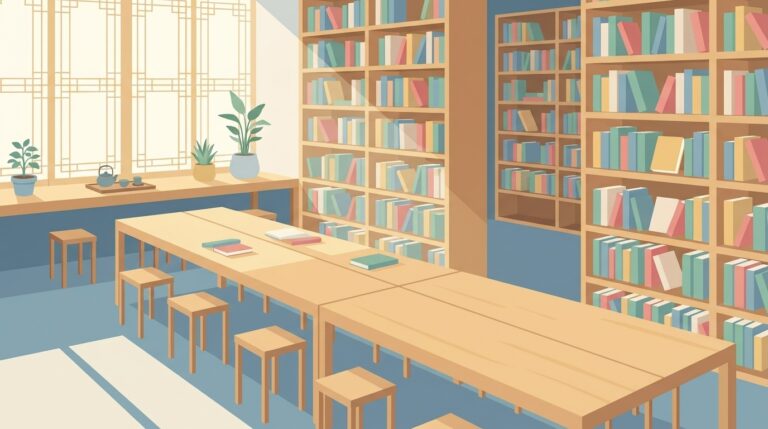
In the past, bookstores frowned upon customers reading without buying. However, modern Korean mega-bookstores (pioneered by Kyobo’s founder Shin Yong-ho) established a philosophy: “Never treat someone reading a book poorly, even if they don’t buy it.” Today, massive communal reading tables called 독서 테이블 or 열람대 are centerpieces of Korean bookstores. Knowing how to ask for these spots allows you to fully enjoy this uniquely generous Korean reading culture.
Phase 5: Real-World Roleplay Scenario
Setting: The sunny interior of a bustling Seoul bookstore.
NPC: 민준 (Minjun), a friendly bookstore staff member wearing a beige linen apron.
- Turn 1 (Learner): 저기요, 실례합니다. (Jeogiyo, sillyehamnida.)
(🎭 Approach politely with hands folded in front).
“Excuse me, pardon me.” - Turn 2 (Minjun): 네, 고객님! 무엇을 도와드릴까요? (Ne, gogaengnim! Mueoseul dowadeurilkkayo?)
(🎭 Smiles warmly and turns toward you).
“Yes, valued customer! How can I help you?” - Turn 3 (Learner): 이 책 / 앉아서 읽고 싶은데요. (I chaek / anjaseo ikgo sipeundeyo.)
(🎭 Holds up the Korean essay book gently).
“I would like to sit down and read this book.” - Turn 4 (Minjun): 아, 편하게 읽으실 수 있는 자리가 안쪽에 준비되어 있어요. (A, pyeonhage ilgeusil su inneun jariga anjjoge junbidoeeo isseoyo.)
(🎭 Gestures with an open palm toward the back window).
“Ah, there are comfortable seats prepared for reading inside.” - Turn 5 (Learner): 혹시 / 결제하기 전에 읽어도 돼요? (Hoksi / gyeoljehagi jeone ilgeodo dwaeyo?)
(🎭 Asks cautiously with a curious expression).
“By any chance, may I read it before paying?” - Turn 6 (Minjun): 네! 비닐 포장된 책만 아니면 / 자유롭게 보셔도 됩니다. (Ne! Binil pojangdoen chaengman animyeon / jayuropge bosyeodo doemnida.)
(🎭 Nodding reassuringly).
“Yes! As long as it’s not sealed in plastic, you are free to browse.” - Turn 7 (Learner): 와, 다행이네요! 감사합니다. (Wa, dahaeng-ineyo! Gamsahamnida.)
(🎭 Bows head lightly with a smile).
“Wow, what a relief! Thank you so much.” - Turn 8 (Minjun): 좋은 시간 보내세요! (Joeun sigan bonaeseyo!)
(🎭 Gives a polite bow).
“Have a wonderful time!”
🔀 Interactive Choice Point
You found a seat inside the bookstore café, but you haven’t ordered a drink yet. What do you say to the barista?
- Option A: “여기서 그냥 책 볼래요.” (Yeogiseo geunyang chaek bollaeyo. – I’ll just read books here.)
- 🚫 Feedback (Bad): Sounds blunt and slightly impolite. Café spaces usually require at least one beverage order.
- Option B: “책 보려면 음료 주문해야 하나요?” (Chaek boryeomyeon eumnyo jumunhaeya hanayo? – Do I need to order a drink to read here?)
- ✨ Feedback (Best): Exceptionally polite, clear, and considerate of the café’s business rules!
- Option C: “나 여기서 책 읽을게요!” (Na yeogiseo chaek ilgeulgeyo! – I’m gonna read here!)
- ⚠️ Feedback (Risk): Uses casual 반말 (banmal). The barista will likely be startled by the lack of honorifics.
Phase 6: 10-Second Emotion Shadowing Drill
Practice reading these out loud at normal conversational speed! Pay attention to the pauses marked by /.
[😊 Politeness & Curiosity]
저기요, / 앉아서 볼 수 있는 곳이 / 어디예요?
(Jeogiyo, / anjaseo bol su inneun gosi / eodieyo?)
“Excuse me, / where is the place / I can sit and read?”-
[🤔 Hesitant & Respectful]
이 책 / 계산 전에 / 읽어봐도 되나요?
(I chaek / gyesan jeone / ilgeobwado doenayo?)
“Can I try reading / this book / before paying?” -
[✨ Relieved & Cheerful]
안쪽에 자리가 있네요! / 감사합니다.
(Anjjoge jariga inneyo! / Gamsahamnida.)
“There are seats inside! / Thank you.”
Phase 7: K-Culture Mini Dictionary
- 열람대 (Yeol-lam-dae)
Translation: Reading Desk / Table.
Usage: The large communal desk in big Korean bookstores where anyone can sit and read freely. - 견본 (Gyeon-bon)
Translation: Sample copy / Display copy.
Usage: A sticker placed on unwrapped books indicating you can flip through and preview before purchasing. - 북카페 (Buk-ka-pe)
Translation: Book Café.
Usage: A hybrid venue where you can sip specialty coffee while browsing hundreds of curated titles. - 완독 (Wan-dok)
Translation: Reading a book completely from start to finish.
Usage: Koreans often say, “오늘 이 책 완독했어요!” (I finished reading this entire book today!
Phase 8: Traveler’s Survival Kit
Top 3 Survival Phrases
- 자리 있어요? (Jari isseoyo?)
Romanization: Ja-ri is-seo-yo?
Pro Tip: Ask someone sitting at a large table if the chair next to them is empty. - 여기 앉아도 돼요? (Yeogi anjado dwaeyo?)
Romanization: Yeo-gi an-ja-do dwae-yo?
Pro Tip: The cleanest, foolproof way to claim a seat without awkward misunderstandings. - 와이파이 비밀번호가 뭐예요? (Wa-i-pa-i bimilbeonhoga mwo-ye-yo?)
Romanization: Wa-i-pa-i bi-mil-beon-ho-ga mwo-ye-yo?
Pro Tip: Essential for checking translations while reading at a bookstore lounge.
Editor’s Travel Note
- Finding Spots on Maps: Open your map and search for “대형서점” (Mega bookstore) or “북카페” (Book cafe). Be sure to complete your Naver Map App Download before traveling, as it provides accurate seat and café layout details in English.
- Best Time to Visit: Visit on weekday mornings (around 10:30 AM – 12:00 PM). The reading tables are peaceful, sunlit, and you won’t have to compete for a seat!
Phase 9: A Step Deeper (Cultural Reflection)
In many global cities, bookstores are purely commercial retail spaces where lingering without buying is discouraged. In Korea, however, bookstores are viewed as communal cultural sanctuaries. When you visit a Korean bookstore, you will see people of all ages—students, office workers, and grandparents—peacefully sharing one massive wooden table in mutual silence. This reflects Korea’s value of collective cultural enrichment (함께 누리는 문화). When you ask politely for a place to read, you aren’t being an inconvenience; you are actively taking part in a cherished local tradition.
💬 Your Turn: What does bookstore culture look like in your home country? Would you feel comfortable reading an entire chapter before buying? Share your thoughts in the comments below!
Phase 10: FAQ & Misunderstanding Prevention
Q: Can I really read books in Korean bookstores without buying them first?
A: Yes! In major bookstores like Kyobo or Bandi & Luni’s, you are completely free to read unwrapped books at designated reading tables. Just make sure not to fold pages, write notes, or consume food while reading.
Q: What if a book is wrapped in plastic film?
A: If a book has a plastic seal, it cannot be opened. If you really want to preview it, look for a copy with a 견본 (Sample) sticker or politely ask a staff member.
Q: Can I bring coffee into the bookstore reading tables?
A: Drinks with secure lids are generally allowed at reading desks, but open cups without lids or greasy snacks are strictly forbidden to protect the books.
🚨 Common Mistakes TOP 3
- Mistake: Ripping open plastic wrap to look inside.
Correct Action: Look for an open sample copy (견본) on the shelf instead. - Mistake: Using informal language (반말) like “여기 앉아?” to strangers.
Correct Action: Always use the polite form: “여기 앉아도 돼요?” - Mistake: Leaving a stack of 10 unpurchased books on the reading table when leaving.
Correct Action: Return the books to the return cart marked 도서 반납대 (Book Return Cart).
Phase 11: Action Missions & Community Engagement
- 🥉 Bronze Mission (Solo Drill): Practice saying “앉아서 읽을 수 있는 곳 어디예요?” 5 times in front of your mirror with a warm, polite smile.
- 🥈 Silver Mission (Social Share): Take a photo of your current favorite Korean book or study guide and post it on social media with the caption: “여기서 읽어도 돼요? 📖 #DailyHangul”.
- 🥇 Gold Mission (Real-World Action): On your next trip to Korea (or at a local Korean bookstore), ask the clerk for reading seats using your new Korean phrase!
🎮 K-Culture Mission: Watch an episode of a bookstore-themed K-Drama (like Romance is a Bonus Book or When the Weather is Fine) and spot the characters using the reading desks (열람대)!
Phase 12: Interactive Quiz Challenge
Test your knowledge before you head out on your bookstore adventure!
1. Situational Judgment: You want to ask the bookstore clerk if you can sit down and read a novel. Which sentence is the most natural and polite?
* A) 여기서 절대 읽지 마세요.
* B) 여기서 읽어도 돼요?
* C) 책 빨리 내놓으세요.
2. Fill-in-the-Blank: Complete the phrase asking for reading seats:
* 앉아서 ______ 수 있는 곳이 어디예요? (bol / jam)
3. True or False: You can rip open a plastic-sealed book if there are no sample copies available.
* (True / False)
👉 Click here to check answers and explanations!
- Answer: B) 여기서 읽어도 돼요?
Explanation: Option A means “Never read here,” and Option C means “Hand over the book quickly.” B is the perfect polite permission request. - Answer: 볼 (bol)
Explanation: 앉아서 볼 수 있는 곳 (A place where I can sit and look/read). - Answer: False
Explanation: Sealed books must remain intact for buyers. Always ask staff if a sample copy is available!






