

Don’t Get Trapped on the Mountain: Essential Korean Phrases for National Park Trail Curfews
Phase 1: Empathy & Story Immersion
안녕하세요! This is your Daily Hangul editor and your personal Korean cultural navigator.
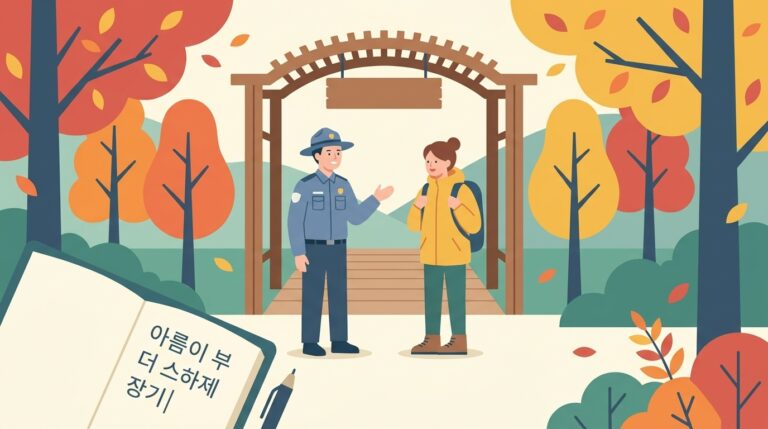
Picture this: You have just geared up in your sleek windbreaker, laced up your hiking boots, and arrived at the majestic entrance of Bukhansan National Park (북한산 국립공원) around 3:45 PM on a crisp autumn Saturday. You are excited to conquer Baegundae Peak, catch the golden sunset, and treat yourself to crispy seafood pancake (해물파전) and Makgeolli at the mountain base. But right as you approach the trailhead wooden gate, an official in a green ranger uniform steps out, gently waving their arms in an ‘X’ gesture while pointing firmly at a digital signboard that reads 입산 통제 (Ipsan Tongje).
The ranger speaks quickly in Korean: “지금은 정상 방향 통제 시간이라 진입이 어렵습니다.” Your heart sinks. You understand basic Korean, but trail-specific administrative jargon caught you completely off guard. Are you locked out completely? Can you take a shorter loop? When will they fine people?
Navigating Korea’s famous hiking culture (등산 문화) requires more than just physical endurance—it demands an understanding of Korea’s strict 입산 통제 시간 (National Park Trail Curfew / Access Control Times). Designed to protect hikers from rapid mountain temperature drops and prevent wildfires, these curfews are strictly enforced. By mastering the natural, B2-intermediate conversational strategies in this guide, you will avoid awkward trail rejections, communicate courteously with rangers, and hike through Korea’s peaks safely and confidently.
Phase 2: Deep Dive into 3 Core Expressions
1. 지금 올라가면 통제 시간에 걸릴까요?
- Pronunciation: Jigeum ol-la-ga-myeon tong-je si-gan-e geol-lil-kka-yo? (Think of tong-je like “tone-jeh” and geol-lil like rolling a light “L” against the roof of your mouth: gull-leel).
- Meaning:
- Literal: “If I go up now, will I get caught in the control time?”
- Actual Nuance: “If I start hiking right now, will I miss the trail curfew / get turned back?”
- K-Culture Moment: You will hear this frequently in outdoor reality shows like 2 Days & 1 Night or hiking vlogs when cast members race against daylight at Jirisan.
- Editor’s Insight: The verb 걸리다 (geollida) is extremely versatile in Korean. While it literally means “to be caught” or “to take time,” here it functions as “to run into a regulatory violation or deadline.” Using it shows intermediate natural fluency.
- Situation Spectrum:
- Casual (to hiking buddies): 지금 가면 통제 시간에 걸릴까? (⚠️ Casual only)
- Semi-formal (to rangers/hikers): 지금 올라가면 통제 시간에 걸릴까요? (✅ Best choice)
- Formal (announcement style): 통제 시간에 저촉될 수 있습니다. (🚫 Too rigid for daily speech)
- 🤔 Think About It: In English, we ask “Is the trail closed?” but Korean conceptualizes it dynamically: “Will my movement collide with the regulation time?”
2. 하산 완료해야 하는 시간이 언제예요?
- Pronunciation: Ha-san wan-ryo-hae-ya ha-neun si-gan-i eon-je-ye-yo? (Pronounce Hasan sharply like “Hah-sahn”, and wan-ryo sounds naturally like wal-lyo due to liquid consonant assimilation).
- Meaning:
- Literal: “When is the time by which descending the mountain must be completed?”
- Actual Nuance: “What is the mandatory cutoff time to finish descending the trail?”
- K-Culture Moment: Seen in disaster and rescue K-Dramas like Jirisan (지리산), where rangers emphasize designated descent deadlines before darkness falls.
- Editor’s Insight: Korean distinguishes ascending (등산 / 입산) from descending (하산 – Hasan). In Korea’s national park safety system, rangers do not just monitor when you go up; they mandate when you must exit the mountain gates completely.
- Situation Spectrum:
- Casual: 언제까지 하산해야 돼? (⚠️ Close friends only)
- Semi-formal: 하산 완료해야 하는 시간이 언제예요? (✅ Highly recommended)
- Formal: 최종 하산 시각을 확인해 주시겠습니까? (✅ Formal & polite)
- 🤔 Think About It: Why does Korean have dedicated Sino-Korean verbs for ascending (Ipsan/Deungsan) and descending (Hasan) instead of simply saying “going up” and “coming down”? It highlights mountain terrain as a distinct, revered physical realm.
3. 일몰 전까지 안전하게 내려올 수 있는 코스가 있나요?
- Pronunciation: Il-mol jeon-kka-ji an-jeon-ha-ge nae-ryeo-ol su in-neun ko-seu-ga in-na-yo? (Rhyme Il-mol with “eel-mole”, emphasizing the double-k sound kka-ji).
- Meaning:
- Literal: “Is there a course that I can descend safely before sunset?”
- Actual Nuance: “Could you recommend an alternative route that gets me down safely before sunset?”
- K-Culture Moment: The classic line a sensible solo traveler asks the national park visitor center manager before rerouting their itinerary.
- Editor’s Insight: Instead of arguing with a park ranger when a major summit trail is restricted, asking for a safe alternative with 일몰 전까지 (before sunset) demonstrates humility, safety consciousness, and high social competence (Nunchi).
- Situation Spectrum:
- Casual: 해 지기 전에 내려올 만한 데 있어? (⚠️ Friends only)
- Semi-formal: 일몰 전까지 안전하게 내려올 수 있는 코스가 있나요? (✅ Perfect balance)
- Formal: 일몰 전 하산 가능한 우회 탐방로를 안내해 주시겠습니까? (⚠️ Overly bureaucratic)
- 🤔 Think About It: Safety inquiries in Korean often frame the hiker’s responsibility (anjeonhage naeryeool su inneun) rather than asking “What is open?”
Phase 3: Textbook Korean vs Real Korean
Scenario 1: Asking about trail gate closure
- 📖 교과서 한국어 (Textbook): 몇 시에 산에 들어가지 못합니까? (Myeot si-e san-e deul-eo-ga-ji mot-ham-ni-kka? – “At what time cannot one enter the mountain?”)
- 🗣️ 진짜 한국어 (Real Korean): 몇 시부터 입산 통제예요? (Myeot si-bu-teo ip-san tong-je-ye-yo? – “From what time is trail entry restricted?”)
- 💡 Why the difference? Native speakers rarely use clunky negative grammar structures (-ji mothada) when inquiring about official rules. They use nominalized terms like 입산 통제 (Ipsan tongje) paired with the basic particle ~부터 (from).
Scenario 2: Rushing your companion down before dark
- 📖 교과서 한국어 (Textbook): 어두워지기 전에 빨리 내려가십시오. (Eo-du-wo-ji-gi jeon-e ppal-li nae-ryeo-ga-sip-si-o. – “Please descend quickly before it gets dark.”)
- 🗣️ 진짜 한국어 (Real Korean): 해 지기 전에 얼른 하산해요. 칼하산 해야겠어요! (Hae ji-gi jeon-e eol-leun ha-san-hae-yo. Kal-ha-san hae-ya-gess-eo-yo! – “Let’s head down quickly before sundown. We need to do a sharp, on-time descent!”)
- 💡 Why the difference? The prefix 칼 (Kal- / knife) is modern colloquial Korean for doing something strictly on schedule or sharply (e.g., Kal-toe-geun = leaving work on the dot; Kal-ha-san = descending strictly on schedule).
Phase 4: K-Culture Deep Dive & Non-Verbal Manners
4-1. Nunchi & Ranger Etiquette at the Trailhead
When approaching a Korean National Park information booth (탐방지원센터), body language carries immense weight. National Park Service Rangers (국립공원공단 직원) are authorized safety officers who take trail curfews seriously.
* Posture: Remove your hiking sunglasses when speaking to the staff. A slight 15-degree bow while saying “수고 많으십니다” (Thank you for your hard work) immediately softens the conversation.
* Smartphone Readiness: Do not just point at the mountain. Open your map app (such as Naver Map or KakaoMap) and show your intended route on the screen. It signals that you are an organized, respectful hiker.
4-2. The “Sunset Peak & Post-Hike Feast” Culture
In Korea, hiking is a complete lifestyle ecosystem often called 오등완 (O-deung-wan – Hiking Workout Complete). But there is a golden rule: mountains in Korea get pitch-black almost instantly once the sun dips below mountain ridgelines because of dense tree canopies.
To prevent costly helicopter rescues and forest fires, the Korean government implements the 입산시간지정제 (Designated Trail Entry Time System) across all 22 National Parks. Summer entry usually closes between 15:00 and 16:00, while winter cutoffs can be as early as 13:00 to 14:00. Seasoned Korean hikers plan their schedule around descending well before curfew so they can enjoy the ultimate hiking reward: gathering at traditional restaurants at the mountain foot for sizzling jeon (전) and iced acorn jelly salad (도토리묵).
Phase 5: Real-Life Roleplay Scenario
Setting: Bukhansan Bukhansanseong Information Center. It is 3:50 PM in late October. Ranger Park Min-ho is guarding the main ridge entrance.
- Ranger Min-ho: 🎭 Holding a handheld transceiver, raising a hand courteously
안녕하세요, 탐방객님. 어디까지 가실 예정이신가요?
(An-nyeong-ha-se-yo, tam-bang-gaek-nim. Eo-di-kka-ji ga-sil ye-jeong-i-sin-ga-yo?)
“Hello, hiker. How far are you planning to go?” - You: 🎭 Taking off sunglasses, showing phone map
백운대 정상 찍고 내려오려고 하는데요, 지금 올라가면 통제 시간에 걸릴까요?
(Baeg-un-dae jeong-sang jjik-go nae-ryeo-o-ryeo-go ha-neun-de-yo, ji-geum ol-la-ga-myeon tong-je si-gan-e geol-lil-kka-yo?)
“I was planning to hit Baegundae Peak and come down. If I go up now, will I hit the curfew?” - Ranger Min-ho: 🎭 Checking wristwatch and shaking head with concern
네, 백운대 방면은 오후 4시부터 입산 통제라 지금은 진입이 불가능합니다.
(Ne, Baeg-un-dae bang-myeon-eun o-hu ne-si-bu-teo ip-san tong-je-ra ji-geum-eun jin-ib-i bul-ga-neung-ham-ni-da.)
“Yes, the Baegundae route is restricted from 4:00 PM, so entry is not possible right now.” - You: 🎭 Nodding understandingly
아, 그렇군요! 그럼 혹시 하산 완료해야 하는 최종 시간이 언제예요?
(A, geu-reoh-gun-yo! Geu-reom hok-si ha-san wan-ryo-hae-ya ha-neun choe-jong si-gan-i eon-je-ye-yo?)
“Ah, I see! Then what is the final time by which everyone must be completely off the mountain?” - Ranger Min-ho: 🎭 Pointing at the trail map board
일몰 시간 감안해서 5시 반까지는 완전히 하산하셔야 안전합니다.
(Il-mol si-gan gam-an-hae-seo da-seot-si ban-kka-ji-neun wan-jeon-hi ha-san-ha-syeo-ya an-jeon-ham-ni-da.)
“Considering sunset time, you must be fully descended by 5:30 PM for safety.” - You: 🎭 Looking at the alternative trail paths
일몰 전까지 안전하게 내려올 수 있는 가벼운 둘레길 코스가 있나요?
(Il-mol jeon-kka-ji an-jeon-ha-ge nae-ryeo-ol su in-neun ga-byeo-un dul-le-gil ko-seu-ga in-na-yo?)
“Is there a lighter Dullegil trail route where I can descend safely before sunset?” - Ranger Min-ho: 🎭 Smiling warmly and handing over a trail pamphlet
이쪽 둘레길 계곡 코스로 가시면 1시간 안쪽으로 편안하게 다녀오실 수 있어요.
(I-jjok dul-le-gil gye-gok ko-seu-ro ga-si-myeon han-si-gan an-jjok-eu-ro pyeon-an-ha-ge da-nyeo-o-sil su iss-eo-yo.)
“If you take this Valley Dullegil trail, you can finish a comfortable round trip within an hour.” - You: 🎭 Bowing politely with two hands clasped in front
친절하게 알려주셔서 감사합니다! 안전하게 다녀올게요.
(Chin-jeol-ha-ge al-ryeo-ju-syeo-seo gam-sa-ham-ni-da! An-jeon-ha-ge da-nyeo-ol-ge-yo.)
“Thank you for kindly explaining! I will hike safely.”
🔀 Interactive Choice Point
What would you do if you realized you only had 30 minutes left before a cutoff checkpoint further up the ridge?
* Choice A: Ignore the ranger and sprint up the rocky path while listening to music.
* Feedback: 🛑 Bad & Dangerous. Violating national park entry restrictions in Korea can result in fines up to 500,000 KRW under the Natural Parks Act, and you risk getting stranded in total darkness.
* Choice B: Ask the ranger: “여기서 일몰 전에 돌아올 수 있는 가장 짧은 코스가 어디예요?”
* Feedback: 🌟 Best Action. Respectful, safety-conscious, and receives immediate personalized route advice from the local authority.
* Choice C: Try bargaining by saying “저 발 엄청 빨라요! 30분이면 정상 찍어요.”
* Feedback: ⚠️ Risk. Park rangers prioritize safety regulations over individual athletic claims. It wastes time and creates an uncomfortable friction.
Phase 6: 10-Second Emotion Shadowing Drill
Practice these lines with rhythm, pausing at / and channeling the emotional tone indicator.
[😟 Worried and polite inquiry]
지금 올라가면 / 통제 시간에 / 걸릴까요?
Ji-geum ol-la-ga-myeon / tong-je si-gan-e / geol-lil-kka-yo?-
[💡 Cooperative and flexible]
일몰 전까지 / 안전하게 내려올 수 있는 / 코스가 있나요?
Il-mol jeon-kka-ji / an-jeon-ha-ge nae-ryeo-ol su in-neun / ko-seu-ga in-na-yo? -
[🏃 Decisive and energetic]
날이 금방 어두워지니까 / 얼른 칼하산 합시다!
Nal-i geum-bang eo-du-wo-ji-ni-kka / eol-leun kal-ha-san hap-si-da!
Phase 7: K-Culture Mini Dictionary
- 입산통제 (Ipsan Tongje) | Trail Access Restriction / Entry Control
- Essential administrative term posted on electronic billboards and park gates indicating that trail entry is legally closed due to time limits, seasonal wildfire protection, or weather alerts.
- 하산 (Hasan) | Descending the Mountain
- While Deungsan (등산) is climbing up, Hasan is the critical downward journey. In Korean mountaineering philosophy, Hasan is considered the most crucial half of hiking where most safety attention is required.
- 일몰 (Ilmol) | Sunset
- Distinct from the conversational word 해 질 녘 (dusk), Ilmol is the formal term used in weather forecasts and park safety signboards to specify exact sundown minutes.
- 안전산행 (Anjeon Sanhaeng) | Safe Mountain Hiking
- A very common four-character compound slogan you will see on banners throughout all Korean national parks promoting gear readiness, sober hiking, and curfew adherence.
Phase 8: Survival Kit for Travelers
Top 3 Survival Phrases
- 등산로 입구가 어디예요? (Deung-san-ro ip-gu-ga eo-di-ye-yo?)
- Pro Tip: Use this when exiting subway stations near mountains (like Dobongsan Stn or Gwanaksan Stn) crowded with hiking gear shops.
- 정상까지 얼마나 걸려요? (Jeong-sang-kka-ji eol-ma-na geol-lyeo-yo?)
- Pro Tip: Ask passing hikers descending the trail. Friendly Korean elders (Deungsan-manias) will happily analyze your pace!
- 랜턴(손전등) 없으면 위험해요? (Raen-teon eop-seu-myeon wi-heom-hae-yo?)
- Pro Tip: Mountain trails lose light 40 minutes faster than city centers. Rangers will strongly restrict entry if you lack a headlamp past 4 PM.
Editor’s Travel Note
- Live Official Trail Status: Before departing your hotel, check trail openings on the Korea National Park Service website to verify whether specific ridges are closed due to seasonal dry-season wildfire controls (산불방지 입산통제 기간 usually February–May and November–December).
- Navigation Essential: Download the route beforehand on the Naver Map app download because GPS pinpointing is exceptionally detailed on Korean rocky terrain.
Phase 9: Think Deeper
In many Western outdoor cultures, wilderness navigation is framed as an individual adventure with personal responsibility. You sign a backcountry log, and the rest is between you and the elements. However, in Korea, mountains are viewed through a deeply communal lens. National parks are intimately connected to surrounding metropolitan areas, and community safety is treated as a shared civic contract.
When a Korean park ranger firmly halts your ascent at 3:59 PM, they are not simply enforcing a bureaucratic statute; they are exercising a collective duty of care (돌봄) to guarantee that rescue workers and hikers alike return home safely to their families for dinner. Viewing trail curfews through this cultural lens transforms frustration into mutual respect.
💬 Your Turn: Have you ever experienced strict curfew rules while hiking in your home country or Korea? How do you feel about government-mandated trail closure times? Share your thoughts in the comments below!
Phase 10: FAQ & Misconceptions
Q: Can I continue hiking past the trail curfew if I have my own high-end headlamp and winter gear?
A: No. The 입산시간지정제 (Designated Trail Entry Time System) applies universally regardless of individual equipment. Rangers are legally obligated to deny passage at checkpoint gates once the posted curfew passes.
Q: What is the difference between 둘레길 (Dullegil) and 등산로 (Deungsanro)?
A: Deungsanro refers to trails that climb upward toward mountain summits, which are subject to early curfews. Dullegil refers to gentle, circumferential perimeter trails circling the base of the mountain, which often have longer accessible hours and easier walking conditions.
Q: Are all trails closed during the wildfire prevention season (산불조심기간)?
A: Not all, but major backcountry ridgelines close. Main public tourist paths to prominent peaks usually remain open, but you must check the park’s official bulletin for specific open/closed trail tables (개방/통제 탐방로).
🚨 Common Mistakes (흔한 실수 TOP 3)
| Mistake | Why It Happens | Correct Action |
|---|---|---|
| Starting Bukhansan climb after 3:30 PM in Autumn | Underestimating how quickly mountain valleys go dark. | Plan start times before 11:00 AM; always check season-specific gate cutoffs. |
| Arguing with rangers about fitness level | Assuming curfews are suggestions rather than legal regulations. | Respectfully ask for open perimeter routes (둘레길). |
| Ignoring seasonal Wildfire Restriction notices | Searching generic blogs rather than the real-time National Park portal. | Check the live trail status list on the National Park website before transit. |
Phase 11: Action Missions
- 🥉 Bronze Mission (Solo Practice): Practice the shadowing drill phrase “지금 올라가면 통제 시간에 걸릴까요?” aloud 5 times until the transition between tongje and sigane flows without stuttering.
- 🥈 Silver Mission (Community / Social): Next time you share your hiking photo on Instagram, caption it using the real colloquial hashtag #안전산행 and #칼하산!
- 🥇 Gold Mission (Real-life Execution): At your next visit to Bukhansan, Inwangsan, or Seoraksan, walk up to the information booth and ask the ranger: “오늘 최종 하산 완료 시간이 몇 시예요?”
- 🎮 K-Culture Mission: Watch an episode of the drama Jirisan (지리산) or a Korean hiking variety show episode and spot how rangers communicate trail check-in times on their walkie-talkies.
Phase 12: Interactive Quiz Challenge
Test your mountain knowledge and language intuition!
1. Situational Judgment:
You arrive at the trailhead at 4:10 PM. The sign says “하절기 입산통제 16:00” (Summer entry control 16:00). What is the most polite and natural way to ask the ranger for a safe alternative?
* A) 비켜주세요, 저 빨리 갔다 올게요. (Bikyeo-juse-yo, jeo ppal-li gat-da ol-ge-yo.)
* B) 일몰 전까지 안전하게 다녀올 수 있는 다른 코스가 있을까요? (Il-mol jeon-kka-ji an-jeon-ha-ge da-nyeo-ol su in-neun da-reun ko-seu-ga iss-eul-kka-yo?)
* C) 왜 4시에 닫아요? 법적으로 따져봅시다. (Wae ne-si-e dad-a-yo? Beop-jeok-eu-ro tta-jyeo-bop-si-da.)
2. Fill-in-the-Blank:
해 지기 전에 시간 맞춰서 딱 내려가는 것을 속어로 ‘___하산’이라고 부릅니다. (Hint: The word for knife)
3. True or False:
In Korea, you can camp overnight anywhere along national park trails as long as you descend before sunrise the next day. (O / X)
👉 Click here to reveal the answers and explanations!
- Answer: B
- Explanation: Option B is courteous, safety-minded, and asks for alternative advice without creating friction. Option A is dangerous and rude; Option C is unnecessarily confrontational.
- Answer: 칼 (Kal)
- Explanation: Combined with Hasan, 칼하산 (Kal-ha-san) means descending strictly on schedule before dusk or curfew.
- Answer: X (False)
- Explanation: Backcountry wild camping / bivouacking is strictly prohibited in Korean National Parks outside of officially designated, pre-reserved park shelter campgrounds (대피소 야영장). Violations carry steep legal fines!
- Explanation: Backcountry wild camping / bivouacking is strictly prohibited in Korean National Parks outside of officially designated, pre-reserved park shelter campgrounds (대피소 야영장). Violations carry steep legal fines!







