

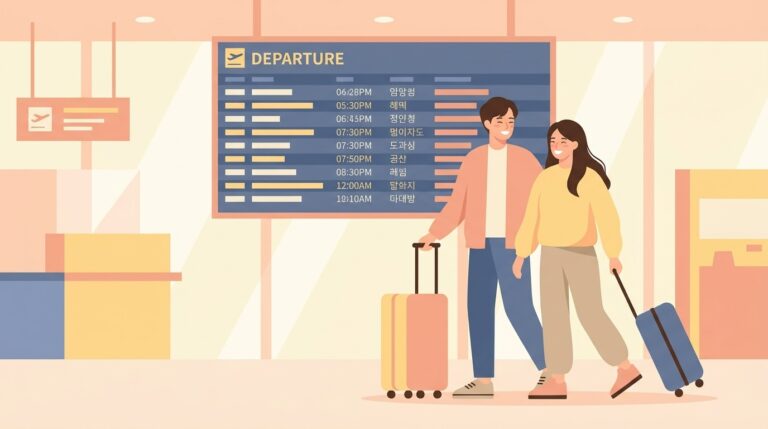
Phase 1: Empathy (Story-Immersive Opening)
안녕하세요! 매일한글 에디터입니다. (Hello! It’s your Daily Hangul editor here!)
Picture this classic K-drama scene: the wedding march has barely finished, confetti is still floating down the aisle of a sleek Gangnam wedding hall, and the bride is hurriedly taking down her intricate updo in the dressing room while the groom shoves a tuxedo into a garment bag. Within forty-five minutes of saying their vows, they are in the back of a black taxi speeding down the Olympic Highway toward Incheon International Airport, still wearing half of their stage makeup!
If you have ever attended a wedding in Korea or watched modern couples on YouTube and variety shows, you know that Korean weddings move at lightning speed (ppalli-ppalli). The entire ceremony often wraps up in under two hours, and couples frequently dash straight from the reception to their flight for Hawaii, Bali, or Paris.
For intermediate (B1) Korean learners, being part of this whirlwind moment—whether you are congratulating a close Korean friend sprinting to their terminal or talking about your own post-wedding travel plans—can feel overwhelming. You want to sound supportive, express heartfelt gratitude, and handle the rush smoothly without sounding like a robotic textbook. Drawing from over a decade of guiding expats and K-culture enthusiasts through real-life cultural nuances, this guide will give you the exact conversational tools, cultural cues, and quick-witted phrases you need to navigate the high-energy bridge between the wedding altar and the departure gate.
Phase 2: Core Expressions Breakdown
Here are the three must-know expressions used when wrapping up a wedding and heading straight to the honeymoon:
1. 저희 이제 바로 공항 가요! (Jeohi ije baro gonghang gayo!)
- Pronunciation: [Jeo-hee ee-jeh bah-ro gong-hahng gah-yo!] (Sounds like: “Juh-hee” + “ee-jeh” + “bah-ro” as in ‘barometer’ + “gong-hahng gah-yo”)
- Meaning: Literal: “We now straight airport go!” | Nuance: “We’re heading straight to the airport right now!”
- K-Culture Moment: Seen in vlog-style wedding videos where newlyweds wave to friends in the parking garage while loading their oversized luggage into a van.
- Editor’s Insight: Notice the use of 저희 (jeohi) instead of 우리 (uri). In polite Korean society, using jeohi humbly lowers your own couple/family unit when speaking to guests or respected elders, striking the perfect balance of warmth and courtesy.
- Situation Spectrum: Casual: ✅ (to friends with 반말: 우리 이제 바로 공항 가!) | Semi-formal: ✅ (저희 이제 바로 공항 가요!) | Formal: ✅ (저희는 이제 곧바로 공항으로 이동합니다)
- 🤔 Think About It: Why does Korean differentiate between inclusive “we” (uri) and humble “we” (jeohi)? How does lowering yourself show respect to your wedding guests?
2. 신혼여행 잘 다녀오겠습니다! (Sinhon-yeohaeng jal danyeo-ogetseumnida!)
- Pronunciation: [Shin-hon-yeo-haeng jal dah-nyeo-oh-get-seum-nee-dah!]
- Meaning: Literal: “We will go to and come back well from our honeymoon!” | Nuance: “We’ll have a safe and wonderful honeymoon and see you when we return!”
- K-Culture Moment: The ceremonial farewell shout given to parents, in-laws, and guests right before stepping into the bridal car.
- Editor’s Insight: The verb 다녀오다 (danyeo-oda) combines going and returning. In Korean culture, departing on a long journey always emphasizes the promise of a safe return to the community.
- Situation Spectrum: Casual: ✅ (잘 다녀올게!) | Semi-formal: ✅ (잘 다녀올게요!) | Formal: ✅ (잘 다녀오겠습니다!)
- 🤔 Think About It: In English, we often just say “Have a great trip!” Why do Koreans emphasize the act of returning safely (다녀오다) in customary departures?
3. 와주셔서 정말 감사해요 (Wajusyeoseo jeongmal gamsahaeyo)
- Pronunciation: [Wah-joo-syeo-seo jeong-mahl gahm-sah-hae-yo]
- Meaning: Literal: “Because you came, I am truly grateful.” | Nuance: “Thank you so much for taking the time to come today.”
- K-Culture Moment: Exchanged during the brief 15-minute table greetings (피로연 인사) at the buffet hall just before the couple changes into comfortable travel clothes.
- Editor’s Insight: The honorific infix -시- (-si-) in 와주셔서 honors the guest’s physical effort of attending. It conveys deep emotional sincerity even when spoken in a rush.
- Situation Spectrum: Casual: ⚠️ (Use 와줘서 고마워 for same-age friends) | Semi-formal: ✅ (와주셔서 정말 감사해요) | Formal: ✅ (참석해 주셔서 진심으로 감사드립니다)
- 🤔 Think About It: Korean guests often travel across the country and give monetary gifts (축의금). How does this phrase acknowledge their active contribution to the celebration?
Phase 3: Textbook Korean vs. Real-Life Korean
Let’s compare stiff classroom textbook phrasing with the dynamic, natural Korean spoken on the wedding floor.
Situation 1: Excusing yourself from guests because your flight time is tight
- 📖 Textbook Korean: 안녕히 계십시오, 우리는 지금 신혼여행을 떠납니다. (Annyeonghi gyesipsio, urineun jigeum sinhon-yeohaeng-eul tteonamnida. / “Goodbye, we are now departing for our honeymoon.”)
- 🗣️ Real Korean: 저희 비행기 시간 때문에 먼저 일어나 볼게요! 조심히 들어가세요! (Jeohi bihaenggi sigan ttaemune meonjeo ireona bolgeyo! Josimhi deureogaseyo! / “We need to get going because of our flight time! Please get home safely!”)
- 💡 Why the difference? Textbook phrasing sounds like a scripted public announcement. Real Koreans use softenings like 먼저 일어나 볼게요 (“I’ll get up first”) to politely excuse their sudden exit while wishing safety to their guests (조심히 들어가세요).
Situation 2: Expressing gratitude to a close friend while hurrying out
- 📖 Textbook Korean: 방문해 주셔서 진심으로 감사드립니다. (Bangmunhae jusyeoseo jinsimeuro gamsadeurimnida. / “I express my sincere thanks for your visit.”)
- 🗣️ Real Korean: 오늘 와줘서 진짜 든든했어! 갔다 와서 맛있는 거 먹자! (Oneul wajwoeseo jinjja deundeunhaesseo! Gatda waseo masinneun geo meokja! / “Having you here today meant the world to me! Let’s grab delicious food when I get back!”)
- 💡 Why the difference? With friends, Koreans prize emotional solidarity (든든하다 – feeling reassured/supported) and look forward to treating the friend to a meal after the trip (밥 한 턱 내다).
Phase 4: K-Culture Deep Dive & Non-Verbal Manners
4-1. 눈치 (Nunchi) & Essential Gestures
- The Double-Hand Clasp Farewell: When thanking elder relatives in a hurry, clasp both hands over theirs with a slight 30-degree bow. It signals, “I would love to chat longer, but duty calls us to the airport!”
- The Smooth Hand-Off of Luggage: Wedding planners or the groom’s best man (신랑 친구) usually load the suitcases into the trunk beforehand. Acknowledge this with a nod and a polite “진짜 고마워, 형/누나!” rather than halting the departure flow.
- Transitioning into ‘Airport Fashion’ (공항 패션): It is completely normal for brides to wash off their heavy foundation at the Incheon Airport lounge and change out of high heels into comfortable oversized sweats or designer matching sets.
4-2. Culture Code Analysis: The ‘Speedy Wedding to Exotic Getaway’ Phenomenon
In Korea, wedding halls run on strict 60-to-90-minute booking intervals. Because wedding preparations are mentally and physically draining, the honeymoon (신혼여행) is viewed not just as a holiday, but as a well-deserved sanctuary. Heading directly to the airport maximizes limited annual leave (연차) and marks an instant, exhilarating psychological shift from formal filial responsibility to romantic freedom.
Phase 5: Real-World Roleplay Scenario
Setting: Outside the Gangnam Wedding Hall elevator. Min-woo (the groom, holding a coat and passport wallet) and Chloe (an old college friend who attended the ceremony) meet right before Min-woo heads to the airport limousine.
- Turn 1 (Chloe): 민우야! 결혼식 진짜 멋졌어! 축하해! (Min-u-ya! Gyeolhonsik jinjja meotjyeosseo! Chukahae!)
🎭 Smiling brightly and offering two thumbs up - Turn 2 (Min-woo): 클로이야, 오늘 바쁜데 와줘서 진짜 고마워! (Chloe-ya, oneul bappeunde wajwoeseo jinjja gomawo!)
🎭 Placing a hand over his chest gratefully - Turn 3 (Chloe): 정신없지? 이제 밥 먹으러 가? (Jeongsin-eopji? Ije bap meogeureo ga?)
🎭 Looking around the bustling lobby - Turn 4 (Min-woo): 아니, 저희 이제 바로 공항 가야 해! 비행기가 저녁 7시거든. (Ani, jeohi ije baro gonghang gaya hae! Bihaenggiga jeonyeok ilgopsi-geodeun.)
🎭 Glancing at his watch with an excited smile - Turn 5 (Chloe): 와, 대박! 어디로 간다고 했지? (Wa, daebak! Eodiro gandago haetji?)
🎭 Eyes widening in surprise - Turn 6 (Min-woo): 하와이로 가! 신혼여행 잘 다녀올게! (Hawai-ro ga! Sinhon-yeohaeng jal danyeo-olge!)
🎭 Rolling his carry-on suitcase forward - Turn 7 (Chloe): 짐 조심하고, 사진 많이 찍어와! 잘 다녀와! (Jim josimhago, sajin mani jjigeo-wa! Jal danyeo-wa!)
🎭 Waving enthusiastically - Turn 8 (Min-woo): 응! 갔다 와서 다 같이 보자. 조심히 들어가! (Eung! Gatda waseo da gachi boja. Josimhi deureoga!)
🎭 Giving a warm farewell wave as the elevator door opens
🔀 Interactive Branching Point
If you were Chloe in Turn 7, how would you respond?
* Choice A: “늦으면 안 되니까 빨리 가 봐! 다녀와서 연락해!” (Neujeumyeon an doenikka ppalli ga bwa! Danyeowaseo yeollakhae!)
* Choice B: “왜 그렇게 급하게 가? 커피 한잔하고 가지.” (Wae geureoke geup-hage ga? Keopi hanjanhago gaji.)
* Choice C: “안녕히 가십시오. 결혼을 축하드립니다.” (Annyeonghi gasipsio. Gyeolhoneul chukadeurimnida.)
Feedback:
* Choice A [BEST]: Perfect balance of empathy, consideration of their tight flight schedule, and warm friendship.
* Choice B [BAD]: Lacks nunchi. Suggesting coffee when they have an international flight creates awkward social pressure.
* Choice C [RISK]: Far too formal for a college peer; it sounds distant and stiff like a business transaction.
Phase 6: 10-Second Emotion Shadowing Drill
Practice these lines with rhythm, proper pauses (/), and natural emotion!
[😅 바쁘지만 행복하게 / Rushed yet delighted]
“저희 / 비행기 시간 때문에 / 먼저 가볼게요!”
(Jeohi / bihaenggi sigan ttaemune / meonjeo gabolgeyo!)-
[✈️ 설레는 마음으로 / With traveling excitement]
“신혼여행 / 예쁘게 잘 다녀오겠습니다!”
(Sinhon-yeohaeng / yeoppeuge jal danyeo-ogetseumnida!) -
[🥰 진심 어린 감사 / Heartfelt appreciation]
“오늘 와주셔서 / 정말 큰 힘이 됐어요!”
(Oneul wajusyeoseo / jeongmal keun himi dwaesseoyo!)
Phase 7: K-Culture Mini Dictionary
| Korean Word | Romanization | Cultural Context & Usage |
|---|---|---|
| 1. 신혼여행 | Sinhon-yeohaeng | Honeymoon. Composed of 신혼 (newlywed) + 여행 (travel). The most anticipated vacation for working Korean adults. |
| 2. 피로연 | Piroyeon | The post-ceremony banquet/reception. Literal meaning: “banquet to dispel fatigue.” Guests eat while couples do quick rounds. |
| 3. 공항 패션 | Gonghang paesyeon | Airport fashion. The stylish yet comfortable outfits chosen specifically for the departure terminal photo-ops. |
| 4. 축의금 | Chug-uigeum | Congratulatory cash gift handed over in clean white envelopes at the reception desk before entering the hall. |
Phase 8: Traveler’s Survival Kit
Top 3 On-the-Go Phrases
- “인천공항 제1/제2터미널로 가주세요.” (Incheon-gonghang je-il / je-i teomineol-ro gajuseyo.)
- Meaning: “Please take us to Incheon Airport Terminal 1 / Terminal 2.”
- Pro Tip: Double check your airline terminal in advance so the taxi driver takes the correct highway ramp.
- “면세품 인도장이 어디에 있어요?” (Myeonse-pum indojang-i eodie isseoyo?)
- Meaning: “Where is the duty-free pickup counter?”
- Pro Tip: Couples often order wedding gifts online beforehand and pick them up airside at Incheon Airport.
- “저희 신혼여행 가는데 자리 붙여주실 수 있나요?” (Jeohi sinhon-yeohaeng ganeunde jari buchyeojusil su innayo?)
- Meaning: “We’re on our honeymoon, could you assign our seats together if possible?”
- Pro Tip: Airport counter staff will gladly accommodate newlyweds with side-by-side seating if available.
Editor’s Travel Note
- Smart Transportation: For stress-free transit from wedding halls directly to Incheon Airport, use the Kakao T taxi booking app to pre-book a Kakao Black or Venti van for all your wedding luggage.
- Airport Express (AREX): If departing from central Seoul (Seoul Station), the non-stop AREX train reaches Terminal 1 in 43 minutes.
Phase 9: “One Step Deeper” (Cultural Reflection)
Korean weddings are unique in their communal efficiency: the ritual serves family honor and community connection, while the honeymoon immediately restores personal autonomy and romance. This instant transition from public obligation to private celebration reflects the rapid dualities of contemporary Korean life. Within two hours, a couple shifts from formal traditional bows (폐백 or reception greetings) to packing sunblock for the tropics.
💬 Your Turn: In your home country, do newlyweds leave for their honeymoon right after the reception, or do they wait a few days to rest? Share your thoughts and experiences in the comments below!
Phase 10: FAQ & Common Pitfalls
Q: Can I use ‘우리’ instead of ‘저희’ when talking to my older relatives at the wedding?
A: It is much better to use 저희 (jeohi). When addressing older relatives, in-laws, or formal guests, 저희 shows humility and polite manners on behalf of the newlywed couple.
Q: What is the most natural thing to say to a Korean friend leaving for their honeymoon right now?
A: Simply say: “조심히 잘 다녀와! 사진 많이 보내줘!” (Josimhi jal danyeo-wa! Sajin mani bonaejwo! / “Have a safe trip and send lots of pictures!”).
Q: Do couples still wear traditional Hanbok to the airport?
A: No, that custom faded in the late 1990s! Today, couples change into comfortable casual streetwear or matching sporty outfits (시밀러 룩 / similar look) before heading to the airport.
🚨 Common Mistakes Alert!
- ❌ Mistake 1: Saying “안녕히 가세요” to guests while you are the one running off to the airport.
- 👉 Correct Action: If guests are staying behind at the buffet, say “맛있게 드시고 조심히 들어가세요!” (Enjoy the meal and get home safely!).
- ❌ Mistake 2: Forgetting the particle ~로/으로 when stating travel destinations.
- 👉 Correct Action: Say “발리로 가요” (Heading to Bali) instead of just “발리 가요” in semi-formal speech.
- ❌ Mistake 3: Using extreme formal grammar (~옵소서) with peers.
- 👉 Correct Action: Keep it lively and natural with -겠어요 or -을게요.
Phase 11: Action Missions
- 🥉 Bronze Level: Record yourself saying “저희 이제 바로 공항 가요!” with clear intonation in under 5 seconds.
- 🥈 Silver Level: Leave a comment below using the pattern “Destination로 신혼여행 잘 다녀오겠습니다!”.
- 🥇 Gold Level: Next time you watch a K-drama wedding scene, spot whether the couple leaves directly for their trip and transcribe the exact farewell phrase they use!
- 🎮 K-Culture Mission: Search the hashtag
#신혼여행출발(Departing for honeymoon) on Instagram to see real Korean couples’ airport fashion and departure captions!
Phase 12: Interactive Quiz Challenge
1. Situational Judgment:
Your Korean co-worker just finished their wedding reception and is rolling a suitcase to the taxi. What should you say?
* (A) 내일 회사에서 만나요.
* (B) 신혼여행 조심히 잘 다녀오세요!
* (C) 왜 벌써 가세요?
🔍 Click to reveal Answer & Explanation
Correct Answer: (B)
Explanation: (B) “신혼여행 조심히 잘 다녀오세요!” is the most polite and natural blessing for a departing newlywed colleague. (A) makes no sense because they will be on leave, and (C) lacks social etiquette (nunchi).
2. Fill-in-the-Blank:
“오늘 결혼식에 와주셔서 정말 큰 ______ 됐어요!” (Having you at the wedding today gave me great strength/support!)
* (A) 밥
* (B) 짐
* (C) 힘
🔍 Click to reveal Answer & Explanation
Correct Answer: (C) 힘 (Him)
Explanation: The idiom 큰 힘이 되다 means “to be a great source of strength/support.”
3. True or False Cultural Quiz:
Modern Korean couples typically wear their wedding tuxedo and dress on the airplane to receive honeymoon upgrades. (True / False)
🔍 Click to reveal Answer & Explanation
Correct Answer: False
Explanation: Couples swiftly change into comfy loungewear or trendy casual travel clothes at the wedding hall dressing room or Incheon Airport before boarding.







