

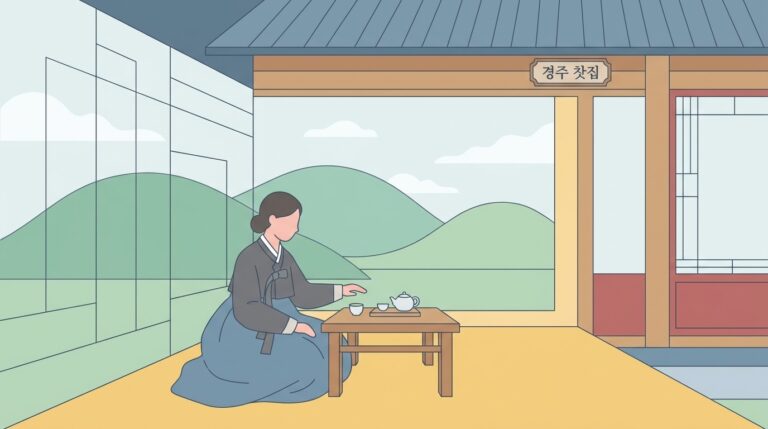
안녕하세요! 매일한글 에디터입니다.
Have you ever stood in the heart of Gyeongju’s Hwangridan-gil (황리단길), surrounded by centuries-old Silla dynastic tombs on one side and bustling, hyper-modernized Hanok cafes on the other, only to realize your standard Korean textbook phrases feel surprisingly flat? You might know how to say “이거 얼마예요?” (How much is this?) or “아메리카노 한 잔 주세요” (One Americano, please), but true cultural immersion at a C2 mastery level demands an appreciation of nuanced aesthetic vocabulary, unspoken spatial etiquette, and the refined vernacular used by local curators and trendsetters.
Whether you are selecting a bespoke, muted-tone traditional Hanbok rather than a mass-produced neon costume, or discussing the architectural rhythm (서까래 and 차경) of a heritage cafe over a sesame latte, mastering these high-register yet natural expressions bridges the gap between being a passive tourist and a culturally fluent connoisseur. Based on years of feedback from advanced learners exploring Korea’s cultural heartlands, this guide will elevate your linguistic repertoire to match the timeless elegance of Gyeongju.
Phase 2: Core Expressions Deep Dive
1. 고즈넉한 정취를 만끽하다 (Gojeuneokhan jeongchwireul mankkwikhada)
- Pronunciation: [Go-jeu-neok-han jeong-chwi-reul man-kkwik-ha-da] (Think: “Go-jeu-knock-hahn jung-chwee-reul mahn-kweek-hah-dah”)
- Meaning: Literal: To fully enjoy the quiet, tranquil atmosphere. / Nuanced: To deeply savor the serene, contemplative, and historic ambiance unique to traditional Korean architectural and natural landscapes.
- K-Culture Moment: Frequently uttered in reflective travel documentaries like Korean Architecture Odyssey or tranquil healing variety shows like Three Meals a Day when protagonists sit on a wooden veranda enjoying the afternoon breeze.
- Editor’s Insight: At the C2 level, replace generic adjectives like 조용하다 (quiet) or 분위기가 좋다 (nice atmosphere) with 고즈넉하다. It carries a classical weight that instantly reveals your profound appreciation of spatial stillness and heritage.
- Situation Spectrum: Casual ⚠️ | Semi-formal ✅ | Formal ✅
- 🤔 Think About It: In English, “peace and quiet” often describes the absence of noise. How does the Korean concept of 정취 (jeongchwi)—which blends emotional mood, natural surroundings, and historical resonance—differ from merely being in a silent room?
2. 배색이 참 단아하고 곱네요 (Baesaegi cham dan-ahago gomneyo)
- Pronunciation: [Bae-sae-gi cham dan-ah-ha-go gom-ne-yo] (Think: “Bae-seh-ghee chahm dahn-ah-hah-goh gohm-neh-yoh”)
- Meaning: Literal: The color combination is very graceful and pretty. / Nuanced: Expressing sophisticated praise for the understated harmony, elegance, and traditional color balance of a Hanbok ensemble.
- K-Culture Moment: A signature line in historical dramas (Sageuk) when a high-ranking court noble or artisan acknowledges the superior textile taste and poise of the protagonist.
- Editor’s Insight: Hanbok aesthetics rely on 배색 (color matching). Modern fusion Hanboks often use loud, glossy pastels, whereas traditional heritage lovers favor 단아함 (graceful serenity) and natural dyes (천연 염색). Using 단아하다 instead of 예쁘다 elevates your aesthetic commentary immediately.
- Situation Spectrum: Casual ⚠️ | Semi-formal ✅ | Formal ✅
- 🤔 Think About It: Why does Korean culture place such immense praise on 단아함 (subdued, quiet elegance) over flamboyant grandeur in traditional dress?
3. 웨이팅을 감수할 만한 가치가 있네요 (Weiting-eul gamsuhal manhan gachiga inne-yo)
- Pronunciation: [We-i-ting-eul gam-su-hal man-han ga-chi-ga ing-ne-yo] (Think: “Way-ee-ting-eul gahm-soo-hahl mahn-hahn gah-chee-gah eeng-neh-yoh”)
- Meaning: Literal: It has the worth to endure the waiting. / Nuanced: This trendy spot fully justifies the long line and hype due to its exceptional quality and vibe.
- K-Culture Moment: Commonly used in gourmet travel programs when tasting an artisanal dessert in popular heritage alleys like Hwangridan-gil or Bukchon.
- Editor’s Insight: 감수하다 (to bear/endure with patience) combined with modern lifestyle loanwords like 웨이팅 (queueing) reflects the sophisticated urbanite who acknowledges the hustle of 핫플 (hot places) without losing composure.
- Situation Spectrum: Casual ✅ | Semi-formal ✅ | Formal ⚠️
- 🤔 Think About It: How does the social tolerance for waiting hours at trendy spots (웨이팅 문화) reflect South Korea’s fast-paced trend-cycles and collective validation of cultural spaces?
Phase 3: Textbook Korean vs. Real-World C2 Korean
Scenario 1: Describing a Hanok Cafe Ambiance
- 📖 교과서 한국어: 이 카페는 전통 한옥 스타일이라서 분위기가 참 좋고 아름답습니다. (I kape-neun jeontong han-ok seutail-iraseo bunwigiga cham jotgo areumdapseumnida.)
- 🗣️ 진짜 한국어: 서까래를 그대로 살린 인테리어에 통창 너머로 능 뷰가 펼쳐져서, 고즈넉하면서도 감각적이네요. (Seokkaraereul geudaero sallin interi-eoe tongchang neomeoro neung byuga pyeolchyeojyeoseo, gojeuneokhamyeonseodo gamgakjeogine-yo.)
- 💡 왜 다를까?: Native Korean speakers and design enthusiasts articulate specific architectural elements—like 서까래 (exposed wooden rafters) and 능 뷰 (view of the ancient royal burial mounds)—rather than using broad adjectives like 좋다 or 아름답다.
Scenario 2: Renting a Refined Hanbok
- 📖 교과서 한국어: 화려한 한복을 빌리고 싶어요. 사진이 잘 나오는 것으로 추천해 주세요. (Hwaryeohan hanbogeul billigo sipeoyo. Sajini jal naoneun geoseuro chucheonhae juseyo.)
- 🗣️ 진짜 한국어: 너무 화려한 금박 퓨전보다는, 톤다운된 전통 배색으로 단아하게 맞추고 싶은데 추천해 주실 수 있나요? (Neomu hwaryeohan geumbak pyujeon-bodaneun, tondaundoen jeontong baasaegeuro dan-ahage matchugo sipeunde chucheonhae jusil su innayo.)
- 💡 왜 다를까?: Discriminating travelers know how to contrast 금박 퓨전 (gold-foiled fusion hanbok) with 톤다운된 전통 배색 (tone-downed traditional color palette) to communicate clear stylistic intent to rental curators.
Phase 4: K-Culture Deep Dive & Non-Verbal Manners
4-1. 눈치 (Nunchi) & Spatial Etiquette in Hanok Cafes & Hanbok Walkways
- The Hem Lift (치맛자락 쥐기): When walking in a Hanbok across historic stone paths or wooden 툇마루 (veranda floors), never let the skirt drag. Gently gather the top left layer of the skirt (치맛자락) with one hand at hip height. This shows grace and prevents fabric damage.
- Threshold Mindfulness (문턱 밟지 않기): In traditional Hanok structures, stepping directly onto the wooden door sill (문턱) is historically considered disrespectful and structurally damaging. Always step gracefully over it.
- Seating Etiquette on 좌식 (Floor Seating) Areas: Many aesthetic Gyeongju cafes feature floor seating. Discreetly check if shoes must be removed. Align your shoes facing outward toward the walkway before stepping onto the raised platform.
4-2. The “Newtro” (뉴트로) Renaissance in Gyeongju
Hwangridan-gil represents the pinnacle of Korea’s Newtro (New + Retro) movement. Gyeongju was once viewed predominantly as a compulsory middle-school field trip destination (수학여행지). Today, young artisans, baristas, and fashion designers have revitalized 1960s-70s residential Hanoks into modern sanctuaries blending minimalist espresso bars with thousand-year-old Silla vistas. Navigating this space requires acknowledging both the sacred historical weight of the ancient capital and the playful, Instagrammable trendiness of modern Korean youth culture.
Phase 5: Real-World Roleplay Scenario
Setting: Yeonwoo Hanbok & Tearoom (연우 한복당), a boutique Hanbok atelier and quiet tea lounge situated on the edge of Hwangridan-gil overlooking the Daereungwon burial mounds.
Characters:
* You (지민 / Jimin): An experienced traveler seeking an authentic, elegant cultural experience.
* Sora (소라): The head curator and traditional stylist at the atelier.
- 소라 (Sora): 어서 오세요! 오늘 날씨가 참 맑아서 경주 산책하시기 딱 좋은 날이네요. 어떤 스타일의 한복을 염두에 두고 오셨나요? (Eoseo oseyo! Oneul nalssiga cham malgaseo Gyeongju sanchaekhasigi ttak joeun narineyo. Eotteon seutairui hanbogeul yeomdue dugo osyeonnayo?)
🎭 [따뜻한 미소로 옷걸이에 걸린 한복들을 부드럽게 가리키며] - You (지민): 안녕하세요! SNS에서 화려한 퓨전 한복을 많이 봤는데, 저는 오히려 고즈넉한 대릉원 분위기에 어울리는 단아한 전통 한복을 입어보고 싶어요. (Annyeonghaseyo! SNS-eseo hwaryeohan pyujeon hanbogeul mani bwanneunde, jeoneun ohiryeo gojeuneokhan Daereungwon bunwigie eoullineun dan-ahan jeontong hanbogeul ibeobogo sipeoyo.)
🎭 [정중하게 눈을 맞추며 부드러운 어조로] - 소라 (Sora): 탁월한 안목이시네요! 요즘은 인위적인 광택보다는 옥색이나 연회색처럼 차분한 천연 염색 톤이 사진에도 훨씬 기품 있게 나오거든요. (Takwolhan anmogisineyo! Yojeumeun inwijeogin gwangtaekbodaneun oksaegina yeonhoesaekcheoreom chabunhan cheon-yeon yeomsaek toni sajinedo hwolssin gipum itge naogodeunyo.)
🎭 [고급스러운 비단 치마와 저고리를 매만지며] - You (지민): 저고리 깃이랑 고름 배색도 은은해서 참 곱네요. 소품은 어떤 걸 매치하면 좋을까요? (Jeogori gisit-rang goreum baesaekdo euneunhaeseo cham gomneyo. Sopumeun eotteon geol maechihamyeon joeulkkayo?)
🎭 [옷감의 결을 조심스럽게 살피며] - 소라 (Sora): 너무 과한 장신구보다는 옥노리개 하나에 배씨댕기로 포인트를 주면 단아한 매력이 한층 살아납니다. 머리도 땋아서 정갈하게 정리해 드릴게요. (Neomu gwahan jangsingubodaneun oknorigae hana-e baessidaenggiro pointeureul jumyeon dan-ahan maeryeogi hancheung saranamnida. Meorido ttahaseo jeonggalhage jeongnihae deurilgeyo.)
🎭 [노리개를 치마허리에 살짝 대어 보이며] - You (지민): 완벽하네요! 환복 후에 황리단길 한옥 카페도 들를 생각인데, 서까래가 멋진 곳으로 추천해 주실 만한 데가 있을까요? (Wanbyeokhaneyo! Hwanbok hue Hwangridan-gil han-ok kapedo deulleul saenggaginde, seokkaraega meotjin goseuro chucheonhae jusil manhan dega isseulkkayo?)
🎭 [기대감 어린 미소를 지으며] - 소라 (Sora): 골목 안쪽에 툇마루와 중정이 있는 숨은 핫플이 있어요. 웨이팅이 좀 있지만 정취를 느끼기엔 제격입니다. 지도로 찍어 드릴게요! (Golmok anjjoge toetmaruwa jungjeongi inneun sumeun hatpeuri isseoyo. Weiting-i jom itjiman jeongchwireul neukkigien jegyeogimnida. Jidoro jjigeo deurilgeyo!)
🎭 [스마트폰 지도 앱을 열어 장소를 공유해주며] - You (지민): 세심하게 챙겨주셔서 감사합니다. 덕분에 경주에서의 하루가 특별해질 것 같아요. (Sesimhage chaenggyeojusyeoseo gamsahamnida. Deokbune Gyeongjueseoui haruga teukbyeolhaejil geot gatayo.)
🎭 [두 손을 모아 가볍게 목례하며]
🔀 Interactive Branching Moment
After exploring Daereungwon, you arrive at the popular Hanok cafe suggested by Sora, but find a massive 45-minute digital queue (테이블링 원격 줄서기). How do you address the host at the entrance counter?
- Choice A: “웨이팅이 좀 길긴 하지만, 중정 뷰가 워낙 고즈넉해서 기다릴 만한 가치가 충분하네요. 등록해 주시겠어요?” (Waiting is a bit long, but the courtyard view is so serene that it’s well worth the wait. Could you register us?)
- Choice B: “왜 이렇게 오래 걸려요? 한복 입어서 더운데 빨리 들어갈 수 있는 자리 없나요?” (Why does it take so long? I’m wearing a Hanbok and feeling hot, is there no seat to enter quickly?)
- Choice C: “그냥 테이크아웃해서 툇마루에 앉아 사진만 몇 장 찍고 갈게요.” (I’ll just take out and sit on the veranda to snap a few photos and leave.)
Feedback on Your Selection:
- Choice A (Best – Master Level 🌟): Demonstrates immaculate cultural poise (여유와 배려), acknowledges the venue’s aesthetic value, and navigates standard Korean queueing systems fluently.
- Choice B (Bad – Linguistic & Cultural Misstep ❌): Violates Korean public etiquette (눈치 없음), creates unnecessary confrontation, and disregards fairness in public queueing systems.
- Choice C (Risk – Etiquette Infraction ⚠️): Many heritage Hanok cafes strictly enforce separate rules for takeout vs. dine-in seating to prevent crowding and property misuse. Assuming you can occupy picturesque seating with takeout without ordering dine-in disrupts cafe rules.
Phase 6: 10-Second Emotional Shadowing Drill
Practice these high-level sentences by mimicking the pause markers (/) and dynamic tonal intonations.
- [😊 여유롭고 우아하게 / Relaxed & Elegant]
“한옥 특유의 서까래와 / 통창 너머로 펼쳐진 능 뷰가 / 참 고즈넉하네요.”
(Han-ok teukyui seokkaraewa / tongchang neomeoro pyeolchyeojin neung byuga / cham gojeuneokhaneyo.) -
[✨ 진심 어린 감탄을 담아 / Sincere Aesthetic Admiration]
“화려한 장식보다 / 차분한 배색과 노리개 포인트가 / 훨씬 단아해 보여요.”
(Hwaryeohan jangsingboda / chabunhan baesaekgwa norigae pointeuga / hwolssin dan-ahae boyeoyo.) -
[🤝 세련되고 정중하게 / Sophisticated & Polite Acceptance]
“웨이팅을 감수하더라도 / 이 집 시그니처 흑임자 라테는 / 꼭 맛보고 가야겠어요.”
(Weiting-eul gamsuhadeorado / i jip sigeunicheo heugimja rateneun / kkok matbogo gayagesseoyo.)
Phase 7: K-Culture Mini Dictionary
- 풍류 (Pungryu) | Literary: Savoring arts, nature, and leisurely taste.
- Usage: Refers to the traditional Korean mindset of leisurely appreciating natural beauty, tea, poetry, and refined ambiance without rushing.
- 뉴트로 (Newtro) | Modern Culture: Modern + Retro synthesis.
- Usage: Describes the lifestyle trend in Gyeongju where traditional architectural heritage meets contemporary millennial and Gen-Z aesthetics.
- 배색 (Baesaek) | Fashion/Art: Color arrangement and harmony.
- Usage: Essential terminology when discussing the sophisticated balance between Hanbok 저고리 (jacket), 치마 (skirt), and 고름 (ribbon tie).
- 툇마루 (Toetmaru) | Architecture: Narrow wooden veranda.
- Usage: The open-air wooden floor connecting rooms along the exterior of a Hanok, popular for cafe seating and reflective contemplation.
Phase 8: Traveler’s Survival Kit
Top 3 Survival Expressions for Hwangridan-gil
- “창가 쪽 좌석 나면 자리 이동 가능할까요?” (Chang-ga jjok jwaseok namyeon jari idong ganeunghalkkayo?)
- Pro Tip: Hanok cafes in Gyeongju have prime window seats overlooking royal tombs. Asking politely about seat changes beforehand prevents confusion.
- “대여 시간 연장하려면 추가 요금이 어떻게 되나요?” (Daeyeo sigan yeonjangharyeomyeon chuga yogeumi eotteoke doenayo?)
- Pro Tip: Hwangridan-gil photo walks often take longer than expected due to beautiful back alleys. Confirm extension rates prior to departure.
- “한복 입고 들어가도 괜찮은 좌식 테이블인가요?” (Hanbok ipgo deureogado gwaenchaneun jwasik teibeurin-gayo?)
- Pro Tip: Wire skirts (속치마) can make sitting cross-legged on floor cushions awkward. Asking staff ensures they guide you to appropriate wide seating.
Editor’s Travel Note: Logistics & Digital Preparedness
- Navigation: Google Maps has limited walking navigation accuracy in dense Korean heritage alleys. Install and use 네이버 지도 앱 다운로드 to locate hidden Hanok cafes and verify real-time operational hours.
- Transit: Take the KTX to Singyeongju Station (신경주역), then hop on bus routes 50, 51, or 700 directly to the Hwangridan-gil entrance.
- Smart Waiting Apps: Top cafes utilize digital queue tablets at entrances. Having a local Korean phone number or roaming data ready for CatchTable or Tabling SMS updates is essential for smooth entry.
Phase 9: “한 발 더 깊이” (A Step Deeper)
In traditional Korean aesthetics, there is a profound philosophical concept known as 여백의 미 (Yeobaeg-ui Mi)—the beauty of empty space. Unlike Western architectural traditions that often seek to fill every corner with intricate ornamentation, a traditional Hanok uses empty courtyards (중정) and paper-framed sliding windows (창호문) to invite the exterior landscape inside, a concept called 차경 (Borrowing Landscape). When you walk through Hwangridan-gil wearing a harmoniously balanced Hanbok, you are not merely dressing up for a photo; you are participating in a living aesthetic philosophy where human presence, architecture, and nature breathe together in balanced harmony.
💬 Your Turn: What traditional aesthetic concept in your own culture mirrors the serene minimalism of Korea’s 여백의 미? Share your perspective in the comments below!
Phase 10: FAQ & Common Mistakes
Q: Are modern fusion Hanboks considered disrespectful by locals in Gyeongju?
A: Not at all! Fusion Hanboks with glitter and hoop skirts are seen as fun and celebratory for younger tourists. However, opting for a traditional, naturally-dyed Hanbok (전통 한복) earns deep appreciation from local elders, artisans, and photographers for honoring classical aesthetic sensibilities.
Q: How do digital queueing systems (웨이팅 시스템) work in Hwangridan-gil cafes?
A: Most popular Hanok cafes place a digital tablet near the entrance. You enter your party size and mobile number. You will receive an instant notification when your turn approaches. Always stay within a 5-minute walking radius once you are within the top 3 on the list.
Q: Can I wear Hanbok inside royal tomb complexes like Daereungwon (대릉원)?
A: Yes! Hanbok wearers are warmly welcomed, and historical sites often offer free or discounted admission to visitors wearing traditional Korean attire.
🚨 Common Mistakes TOP 3
- Dragging the Skirt Hem: Letting your Hanbok hem sweep the ground ruins delicate silk and fabric. Action: Gently hold the skirt fold at hip level while walking.
- Stepping on Hanok Thresholds (문턱): Stepping onto raised wooden doorframes is a cultural faux pas. Action: Consciously step over the threshold.
- Demanding Immediate Seating Over Waiting Lists: Trying to bypass digital queues because you are wearing Hanbok. Action: Register digitally and enjoy taking photos in the alley while waiting.
Phase 11: Action Mission & Engagement
- 🥉 Bronze Mission (Solo Practice): Record yourself reading the 3 Shadowing Drill sentences, focusing on the rhythmic pause markers (
/) and refined tone. - 🥈 Silver Mission (Social Share): Find a photo of a Korean Hanok or Hanbok on social media, and write a one-sentence comment in Korean using either 고즈넉하다 or 단아하다.
- 🥇 Gold Mission (Real-World Application): On your next trip to Gyeongju or Bukchon, converse with a Hanbok stylist using the expression: “톤다운된 전통 배색으로 단아하게 추천해 주세요.”
🎮 K-Culture Mission: Watch an episode of a modern-meets-traditional K-Drama (such as Mr. Queen or The King’s Affection) and spot how character descriptions shift when discussing royal court attire (단아함) versus commoner clothing!
Phase 12: Interactive Quiz Challenge
Test your mastery of Gyeongju travel expressions and cultural etiquette!
1. Situational Judgment Quiz
You enter an aesthetically restored Hanok cafe in Hwangridan-gil with historic wooden beams and open glass windows. Which sentence best demonstrates C2-level cultural mastery?
* A) “여기 진짜 예뻐요. 사진 찍기 좋네요.”
* B) “서까래를 살린 인테리어와 능 뷰가 어우러져서 정취가 참 고즈넉하네요.”
* C) “전통적인 집이라서 옛날 느낌이 많이 납니다.”
2. Fill-in-the-Blank Quiz
“너무 화려한 원색보다는 차분한 파스텔 톤의 [ ]이/가 저고리와 치마에 참 잘 어울려요.”
(Hint: The Korean word for refined color arrangement and harmony)
3. True / False Cultural Etiquette Quiz
- (T/F) In traditional Hanok cafe architecture, it is considered polite and natural to step directly with your full weight on the wooden door threshold (문턱) when entering rooms.
🔍 Click here to reveal the Quiz Answers & Explanations!
- Answer: B
- Explanation: Option B integrates precise architectural terminology (서까래), spatial views (능 뷰), and the sophisticated aesthetic descriptor (고즈넉하다).
- Answer: 배색 (Baesaek – Color matching/harmony)
- Explanation: 배색 specifically refers to the artistic harmony and balance created by combining colors in textiles and design.
- Answer: False (F)
- Explanation: Stepping on the door threshold (문턱) is traditionally believed to bring misfortune and causes structural wear to heritage woodwork. Always step over it!
- Explanation: Stepping on the door threshold (문턱) is traditionally believed to bring misfortune and causes structural wear to heritage woodwork. Always step over it!







