

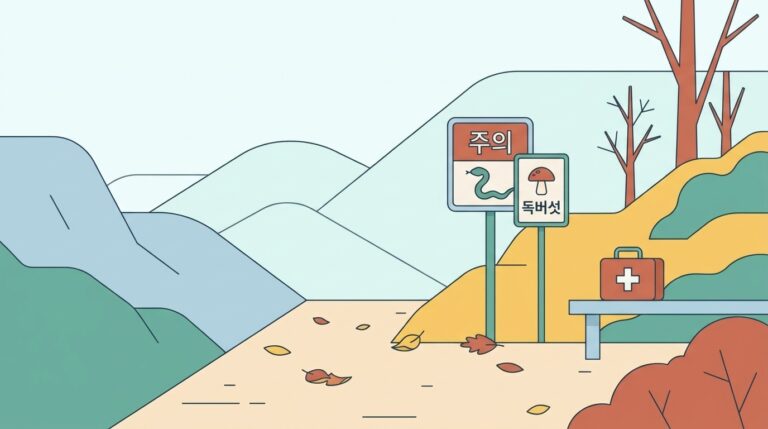
Surviving the Korean Wild: How to Spot Toxic Mushrooms and Venomous Snakes Like a Local
Phase 1: Empathy (Immersive Storytelling Opening)
안녕하세요! 매일한글 에디터입니다.
Picture this: You are trekking through the breathtaking, crimson-draped ridges of Seoraksan in autumn. Inspired by wholesome episodes of Three Meals a Day (삼시세끼), you spot a cluster of plump, pristine white mushrooms nestled under an ancient pine tree. Nearby, amidst the rustling oak leaves, a patterned snake slithers quietly across the rocky trail. For an instant, your inner survivalist ponders: Is that mushroom a prized wild delicacy, or the deadly Destroying Angel? Is that snake a harmless garter snake or a lethal Korean pit viper (살무사)?
Every year, even seasoned Korean hikers fall victim to wild mushroom toxicity and venomous snake bites because traditional folk myths—like “colorful mushrooms are poisonous, plain ones are edible”—are dangerously false. When an outdoor emergency strikes in the backcountry of Jirisan or Bukhansan, basic textbook phrases like “도와주세요 (Help me)” won’t suffice. At an advanced C1 level, you need the nuanced, precise vocabulary required to report symptoms, describe ecological features, and coordinate with mountain rescue teams (119 산악구조대).
This guide combines verified clinical first-aid insights with natural, advanced Korean expressions so that you can navigate Korea’s wilderness with confidence, authority, and safety.
Phase 2: Core 3 Expressions In-Depth Analysis
1. 야생 버섯은 겉모습만으로 식독(食毒)을 구별하기 어려우니 절대 채취하지 마세요.
- Pronunciation: Yasaeng beoseoseun geommoseummaneuro sikdokeul gubyeolhagi eoryeouni jeoldae chaechwihaji maseyo. (Sound analogy: “Yah-saeng buh-sut-eun gum-mo-seum-man-eu-ro…” – rhythmically smooth with a firm, cautionary cadence).
- Meaning: Literal: As for wild mushrooms, distinguishing edible from poisonous by appearance alone is difficult, so never harvest them. | Nuance: An authoritative safety warning emphasizing that visual identification of wild fungi is deceptive and inherently hazardous.
- K-Culture Moment: Heard frequently on public safety announcements by Korea National Park Service rangers during autumn hiking season, or cautionary segments on KBS Live Info Show (생생정보통).
- Editor’s Insight: Notice the Sino-Korean compound 식독(食毒), blending 식용(edible) and 독성(toxic). Using “식독 구별 (differentiating edible from poisonous)” elevates your language to a sophisticated C1 regulatory and scientific register.
- Situation Spectrum: Casual ⚠️ | Semi-formal ✅ | Formal ✅
- 🤔 Think About It: In many Western foraging traditions, spore printing and field guides are celebrated hobbies. Why does modern Korean culture treat wild foraging with such stringent institutional warnings?
2. 뱀에 물렸을 때는 환부를 심장보다 낮게 두고 상처를 째거나 독을 빨아내면 안 됩니다.
- Pronunciation: Baeme mullyeosseul ttaeneun hwanbureul simjangboda natge dudo sangcheoreul jjaegeona dokeul pparanaemyeon an doemnida. (Sound analogy: “Baem-eh mool-lyuh-sseul ttae-neun hwan-boo-reul…”).
- Meaning: Literal: When bitten by a snake, place the affected area lower than your heart and do not cut the wound or suck out the venom. | Nuance: A critical medical guideline dispelling outdated cinematic survival tropes.
- K-Culture Moment: Essential medical advice delivered by doctors on medical dramas like Hospital Playlist (슬기로운 의사생활) or outdoor reality programs where cast members hike deep wilderness routes.
- Editor’s Insight: The word 환부 (患部, hwanbu) denotes the “affected/injured area.” Using this medical term over the colloquial “다친 곳 (hurt place)” is crucial when communicating with emergency dispatchers (119) or triage nurses.
- Situation Spectrum: Casual ⚠️ | Semi-formal ✅ | Formal ✅
- 🤔 Think About It: Old action movies often depict heroes cutting open a snakebite and sucking venom out. How do medical advancements change emergency vernacular across cultures?
3. 저기 삼각형 머리에 줄무늬가 있는 독사가 또아리를 틀고 있으니 자극하지 말고 우회합시다.
- Pronunciation: Jeogi samgak-hyeong meorie julmunuiga inneun doksaga ttoarireul teulgo isseuni jageukhaji malgo uuhoehapsida. (Sound analogy: “Juh-gi sam-gak-hyung muh-ri-eh jool-moo-nui-ga…”).
- Meaning: Literal: Over there, a venomous snake with a triangular head and crossbands is coiled up, so let’s not agitate it and take a detour instead. | Nuance: A tactical, calm observation among experienced mountaineers describing a Korean pit viper (Salmusa) to prevent sudden panicked movements.
- K-Culture Moment: Mountain guides in adventure programs or wilderness survival shows whispering to team members when spotting a Kkachi-salmusa (Gloydius saxatilis) basking on sunlit rocks.
- Editor’s Insight: 또아리를 틀다 (ttoarireul teulda) is an idiomatic phrase meaning “to coil up” (as a snake does). In figurative Korean, it also describes a bad thought or habit lingering deeply in someone’s mind.
- Situation Spectrum: Casual ✅ | Semi-formal ✅ | Formal ✅
- 🤔 Think About It: How does descriptive precision (e.g., noting the triangular head shape and coiling behavior) help de-escalate collective panic in high-stress outdoor situations?
Phase 3: Textbook Korean vs. Real-Life Korean
Situation 1: Warning a fellow hiker against touching an unidentified mushroom
- 📖 교과서 한국어 (Textbook):
이 버섯은 독이 있을 수 있으니 만지지 마십시오. (I beoseoseun dokei isseul su isseuni manjiji masipsio.)
Translation: This mushroom may have poison, so do not touch it. - 🗣️ 진짜 한국어 (Real-Life):
그거 야생 독버섯일 확률이 높으니까 아예 손도 대지 마세요. 큰일 나요. (Geugeo yasaeng dokbeoseosil hwangnyuri nopeunikka aye sondo daeji maseyo. Keunil nayo.)
Translation: There is a really high chance that’s a toxic wild mushroom, so don’t even touch it. You’ll be in serious trouble. - 💡 왜 다를까? (Why the difference?):
Native speakers use emphatic idioms like 손도 대지 마다 (not even lay a hand on) and the cautionary phrase 큰일 나다 (to be in big trouble) to convey urgent protective concern rather than cold textbook grammar.
Situation 2: Spotting a venomous snake on the hiking path
- 📖 교과서 한국어 (Textbook):
길에 뱀이 있으니 조심해서 걸어가세요. (Gire baemi isseuni josimhaeseo georeogaseyo.)
Translation: There is a snake on the road, so walk carefully. - 🗣️ 진짜 한국어 (Real-Life):
발밑 조심해요! 살무사 지나가니까 멈춰 서서 지나갈 때까지 기다려요. (Balmit josimhaeyo! Salmusa jinaganikka meomchwo seoseo jinagal ttaekkaji gidaryeoyo.)
Translation: Watch your step! A pit viper is passing by, so freeze and wait until it moves along. - 💡 왜 다를까? (Why the difference?):
In immediate trail hazards, native hikers shout localized warnings like 발밑 조심 (watch your feet) and identify the specific predator genus (살무사 rather than generic 뱀) to trigger the correct freeze-response.
Phase 4: K-Culture Deep Dive & Non-Verbal Manners
4-1. 눈치 (Nunchi) & Non-Verbal Wilderness Etiquette
- Trail Awareness & Trekking Poles: When encountering suspected venomous wildlife in Korea, never swing your hiking poles (등산 스틱) aggressively. Instead, gently tap the ground several meters away; Korean pit vipers sense vibrational frequencies and will generally retreat.
- Vocal Warning Decorum: If you spot a hazardous mushroom cluster or a viper on a shared public trail, it is considered basic hiking nunchi (social consideration) to alert incoming hikers behind you by saying softly yet firmly: “앞쪽에 살무사/독버섯 주의하세요 (Caution: Pit viper/toxic mushroom ahead).”
4-2. Cultural Code: The Dual Nature of Korean “Deungsan” Culture
Korea’s hiking culture (등산 문화) is legendary—colorful high-tech gear, summit selfies, and post-hike makgeolli. However, middle-aged hikers (등산 동호회) often possess a deep-rooted foraging instinct passed down from agricultural traditions (산나물 채취). This creates a seasonal conflict: while elders search for wild ginseng (심마니 문화) or seasonal delicacies, modern forestry and medical authorities strictly forbid unauthorized foraging due to toxic look-alikes like the Amanita verna (독우산광대버섯), nicknamed the “Death Angel” in Korean forests. Understanding this tension helps you appreciate why conservation rangers enforce rules with utmost seriousness.
Phase 5: Real-Life Roleplay Scenario
Setting: A rocky trail section at Jirisan National Park.
Characters:
* Alex (알렉스): Advanced foreign hiker hiking the Baekdudaegan trail.
* Ranger Park (박 레인저): A 50-something veteran National Park Ranger.
— Dialogue —
- Alex: 레인저님, 방금 저 바위 틈에서 붉은 반점이 있는 갈색 뱀을 봤는데 살무사 맞나요?
(Reinjeonim, banggeum jeo bawi teumeseo bulgeun banjeomi inneun gal-saek baemeul bwanneunde salmusa mannayo?)
🎭 Pointing calmly toward the rocks without stepping closer.
“Ranger Park, I just spotted a brown snake with reddish markings in that rock crevice. Is that a pit viper?” -
Ranger Park: 네, 맞습니다. 쇠살무사네요. 출혈독과 신경독을 모두 지닌 맹독사니까 절대 접근하지 마세요.
(Ne, matseumnida. Soesalmusaneyo. Chulhyeoldokgwa singyeongdokeul modu jinin maengdoksanikka jeoldae jeopgeonhaji maseyo.)
🎭 Nodding approvingly at Alex’s distance.
“Yes, that’s correct. It’s an Asian pit viper (Soesalmusa). It possesses both hemotoxins and neurotoxins, making it highly venomous. Do not approach it under any circumstances.” -
Alex: 만약 산행 중에 뱀에 물리면 현장에서 가장 먼저 취해야 할 응급 조치는 무엇인가요?
(Manyak sanhaeng junge baeme mullimyeon hyeonjangeseo gajang meonjeo chwihaeya hal eunggeup jochineun mueosingayo?)
🎭 Taking notes mental checklist.
“If someone gets bitten by a snake during a hike, what is the very first emergency measure to take on site?” -
Ranger Park: 당황해서 뛰면 독이 빨리 퍼집니다. 환자를 안정시키고, 물린 부위를 심장보다 낮게 고정해야 해요.
(Danghwanghaeseo ttwimyeon dokei ppalli peojimnida. Hwanjareul anjeongsikigo, mullin buwireul simjangboda natge gojeonghaeya haeyo.)
🎭 Demonstrating by supporting his forearm lower than chest level.
“Panicking and running accelerates venom spread. Calm the patient and immobilize the bitten limb below heart level.” -
Alex: 그리고 119에 신고할 때 뱀의 생김새나 사진을 확보하는 게 혈청 투여에 도움이 되죠?
(Geurigo 119-e singohal ttae baemui saenggimsaena sajineul hwakbohanean ge hyeolcheong tuyeoe doumi doejo?)
🎭 Holding up a smartphone at a safe distance.
“And when reporting to 119, capturing the snake’s appearance or a photo helps with antivenom administration, right?” -
Ranger Park: 정확합니다! 마찬가지로 야생 버섯 중독 사고 때도 섭취한 버섯 실물을 챙겨 병원에 가야 합니다.
(Jeonghwakhamnida! Machangajiro yasaeng beoseot jungdok sago ttaedo seopchwihan beoseot silmureul chaenggyeo byeong-wone gaya hamnida.)
🎭 Emphasizing with a serious hand gesture.
“Spot on! Likewise, in mushroom poisoning incidents, one must bring actual samples of the ingested mushroom to the hospital.” -
Alex: 화려하지 않고 수수한 색깔의 버섯도 치명적인 독버섯일 수 있다는 점을 항상 명심해야겠네요.
(Hwaryeohaji anko susuhan saekkarui beoseotdo chimyeongjeogin dokbeoseosil su itdaneun jeomeul hangsang myeongsimhaeyagetneyo.)
🎭 Looking at the damp underbrush with renewed vigilance.
“I should always keep in mind that even plain, unostentatious mushrooms can be fatal toxic varieties.” -
Ranger Park: 훌륭한 안전 의식입니다. 국립공원 안전 지침을 숙지하고 안산(안전 산행)하시길 바랍니다!
(Hullyunghan anjeon uisik-imnida. Gungnipgongwon anjeon jichimeul sukjihago ansanhasigil baramnida!)
🎭 Smiling warmly and tapping his rescue radio.
“Excellent safety awareness. Keep national park guidelines in mind and enjoy a safe hike!”
🔀 Interactive Choice Point
A hiking companion mistakenly touches a white wild mushroom and wonders whether to taste-test it to check if it’s edible pine mushroom (송이버섯). What do you say?
- Option A: “야생 버섯은 미량이라도 맹독성 성분이 있으면 간부전을 일으킬 수 있으니 당장 버리고 손 씻으세요!”
(Wild mushrooms can cause liver failure even in trace amounts if toxic, so throw it away immediately and wash your hands!) - Option B: “색깔이 하얗고 예쁘니까 조금만 씹어보고 쓴맛이 나면 뱉으세요.”
(Since it’s white and pretty, chew just a tiny bit and spit it out if it tastes bitter.) - Option C: “버섯 전문가한테 사진 찍어 보낼 때까지 주머니에 넣어둡시다.”
(Let’s keep it in your pocket until we take a photo and send it to a mushroom expert.)
Feedback:
* Option A (Best Choice): 🌟 Flawless C1 Response! You demonstrated critical emergency knowledge—many lethal Korean fungi like Amanita virosa contain amatoxins that induce fatal hepatic failure without early taste warnings.
* Option B (Bad Choice): ❌ Extremely Dangerous! Folk wisdom claiming bitterness indicates toxicity is false; lethal amatoxins can taste mild and pleasant.
* Option C (Risk Choice): ⚠️ Risky. Storing unidentified toxic fungi with personal items can lead to cross-contamination or accidental ingestion.
Phase 6: 10-Second Emotional Shadowing Drill
Practice these high-stakes sentences with emotional inflection and natural pausing (/ indicates rhythmic pauses):
[🚨 긴박하고 단호하게 - Urgent & Resolute]
독사에 물렸을 땐 / 상처 부위를 묶지 말고 / 즉시 119 구조대에 / 정확한 위치 좌표를 알려야 합니다.
(Doksa-e mullyeosseul ttaen / sangcheo buwireul mukji malgo / jeuksi 119 gujodae-e / jeonghwakhan wichi jwapyoreul allyeoya hamnida.)
When bitten by a venomous snake, do not tie off the wound tightly; report your exact location coordinates to 119 rescue immediately.-
[🛑 단호하고 경고하듯이 - Firm & Cautionary]
식용 버섯인 싸리버섯과 / 독버섯인 노랑싸리버섯은 / 전문가조차 육안으로 / 식별하기 어렵습니다.
(Sikyong beoseosin ssaribeoseotgwa / dokbeoseosin norangssaribeoseoteun / jeonmun-gajocha yugan-euro / sikbyeolhagi eoryeopseumnida.)
Even specialists find it difficult to visually distinguish edible coral mushrooms from toxic yellow coral mushrooms with the naked eye. -
[📞 차분하고 신속하게 - Calm & Informative during Dispatch]
국립공원 표지판 번호를 확인했으니 / 환자를 그늘로 옮겨 안정을 취하게 한 뒤 / 구조를 기다리겠습니다.
(Gungnipgongwon pyojipan beonhoreul hwaginhaesseuni / hwanjareul geuneullo olmgyeo anjeongeul chwihage han dwi / gujoreul gidarigetseumnida.)
Since I verified the National Park trail marker number, I will move the patient to the shade to rest and await rescue.
Phase 7: K-Culture Mini Dictionary
| # | Word (Hangul + Romanization) | English Translation | Real-Life & Ecological Application |
|---|---|---|---|
| 1 | 맹독성 (Maengdokseong) | Lethal / Acute Toxicity | Refers to substances or organisms capable of causing severe systemic failure or death with minimal exposure (e.g., 맹독성 독버섯, 맹독사). |
| 2 | 살무사 (Salmusa) | Korean Pit Viper (Gloydius) | Korea’s premier native venomous snake family, recognized by triangular heads and heat-sensing pits. Etymology humorously reflects lethal folklore (“a snake so toxic its parent dies”). |
| 3 | 식독 구별 (Sikdok gubyeol) | Differentiating Edible vs. Poisonous | The technical and regulatory terminology used by forestry officials and toxicologists regarding botanical/fungal taxonomy. |
| 4 | 국립공원 구조대 (Gungnipgongwon Gujodae) | National Park Mountain Rescue Team | Specialized elite ranger units trained in helicopter extraction, antivenom transport, and wilderness trauma management across Korean national parks. |
Phase 8: Survival Kit for Travelers
Top 3 Survival Expressions
- “여기 뱀에 물린 응급 환자가 발생했습니다. 119 구조대 급파 부탁드립니다.”
(Yeogi baeme mullin eunggeup hwanjaga balsaenghaesseumnida. 119 gujodae geuppa butakdeurimnida.)
Pro Tip: Use the formal term 급파 (geuppa – urgent dispatch) when calling emergency services for swift mobilization. - “환자가 어지럼증과 호흡 곤란을 호소하고 있습니다.”
(Hwanjaga eojireomjeunggwa hoheup gollaneul hosohago isseumnida.)
Pro Tip: 호소하다 (hosohada – to complain of symptoms) is the standard medical phrasing used by triage teams. - “주변 국립공원 다목적 위치표지판 국가지점번호를 불러드릴게요.”
(Jubyeon gungnipgongwon damokjeok wichipyojipan gukgajijeombeonhoreul bulleodeurilgeyo.)
Pro Tip: Korea’s trail systems feature yellow “National Point Numbers” (국가지점번호) on metal posts every 500m. Reading this code gives 119 your exact GPS grid.
Editor’s Travel Note
- Essential App Setup: Before trekking, install the 국립공원 산행정보 앱 다운로드 (Korea National Park Smart Trail App) to access real-time distress beacons, and keep the 119 신고 앱 다운로드 ready for instant cell-tower coordinate transmissions during emergencies.
- Emergency Hotlines: Dial 119 (Fire & Rescue / Medical) or 112 (Police). English interpretation is automatically routed upon request.
Phase 9: “One Step Deeper” (Reflective Cultural Essay)
In South Korea, mountain safety is rarely treated as a solitary sport or an individualist conquest. When hiking along ridgelines, you will frequently witness strangers sharing water, calling out warnings about loose rocks, and checking on weary travelers. This stems from a deep-rooted ethos of 공동체적 안전의식 (communal safety consciousness). In Korean outdoor culture, preserving life against natural hazards like venomous vipers and toxic fungi is considered a collective social duty. Respecting these wilderness safety codes is not just about personal survival—it is an act of shared harmony with fellow mountaineers and nature itself.
💬 Your Turn: Have you ever encountered a wild snake or mushroom on a hike in your home country? How does the outdoor safety culture and emergency protocol where you live compare to Korea’s system? Share your stories in the comments below!
Phase 10: FAQ & Mistake Prevention
Q: Can you tell if a mushroom in Korea is poisonous if it doesn’t change color when boiled with silver spoons?
A: No. The silver spoon myth (은수저 테스트) is completely unscientific. Silver only tarnishes in the presence of certain sulfur compounds, whereas deadly mushroom toxins like amatoxins, muscarine, and gyromitrin do not react with silver at all. Never consume wild mushrooms based on home chemistry tests.
Q: Should I apply a tourniquet tightly around my limb if bitten by a Korean pit viper (살무사)?
A: Absolutely not. Medical guidelines from the Korean Society of Emergency Medicine explicitly warn that tightly tying off a limb with a tourniquet concentrates cytotoxic venoms in a localized area, dramatically increasing the risk of tissue necrosis (조직 괴사) and eventual amputation. Keep the limb immobilized and positioned below the heart without cutting off arterial circulation.
Q: What should I do if I accidentally swallowed a wild mushroom and start feeling nausea hours later?
A: Immediately seek emergency medical attention at a university hospital emergency room (대학병원 응급실). Amatoxin poisoning typically features a deceptive asymptomatic “honeymoon phase” before triggering fulminant hepatic failure. If possible, bring the remaining raw mushroom specimens or take clear photographs of where it was picked to assist clinical toxicologists.
🚨 Common Mistakes Warning Board
| Foreign Hiker Mistake | Why It’s Risky | Correct Action (올바른 대처법) |
|---|---|---|
| 1. Sucking venom out with the mouth | Bacteria from oral saliva infects the open wound, and oral micro-abrasions allow toxins to enter the rescuer’s bloodstream. | Wash the wound gently with clean water or saline, immobilize the limb, and wait for 119 antivenom transport. |
| 2. Trusting insect nibbles as proof of edible mushrooms | Insects, gastropods (snails), and rodents have completely different metabolic resistance to toxins that are fatal to humans. | Assume all wild mushrooms are non-edible unless purchased from certified markets. |
| 3. Trying to kill or capture the snake to show the doctor | High risk of receiving a secondary, often more severe bite while handling an agitated snake. | Step back safely and snap a photo with your phone’s zoom lens from at least 2 meters away. |
Phase 11: Action Missions & Engagement
- 🥉 Bronze Mission (Solo Shadowing): Practice saying the phrase “살무사에 물렸을 땐 상처를 심장보다 낮게 유지하세요” out loud 5 times using Phase 6’s emotional inflection.
- 🥈 Silver Mission (Safety Check): Download the 국립공원 산행정보 앱 다운로드 and locate the nearest National Park marker on your map.
- 🥇 Gold Mission (Real-life Practice): Next time you watch an outdoor K-drama or hiking vlog on YouTube, identify whether the characters follow proper wilderness etiquette and post your Korean analysis in the comments!
- 🎮 K-Culture Mission: Watch an episode of tvN’s Three Meals a Day (Mountain Village Edition) or I Live Alone (나 혼자 산다) hiking episodes, and note how cast members react to wild plants and insects!
Phase 12: Interactive Quiz Challenge
1. Situational Judgment Quiz
You are trekking Mount Bukhansan with a friend. Your friend suddenly feels a sharp pinch on the ankle in tall grass and sees two puncture fang marks bleeding slightly. What is the most appropriate first-aid response in Korean?
* A) “독을 빨리 입으로 빨아내고 산 아래로 전속력으로 뛰어내려가자!”
* B) “환부를 심장보다 낮게 두고 편히 앉아 119에 현재 위치 표지판 번호를 신고하자.”
* C) “상처를 칼로 살짝 째서 피를 뺀 다음 압박붕대로 꽉 조여 매자.”
2. Fill-in-the-Blank Quiz
야생 버섯은 외형만으로 (_________) 구별이 불가능하므로, 임의로 채취하거나 섭취해서는 안 된다.
(Wild mushrooms cannot be differentiated into edible and toxic by appearance alone, so they must never be harvested or consumed arbitrarily.)
* Word Bank: [ 식독 / 혈청 / 환부 / 괴사 ]
3. True / False Cultural & Safety Quiz
- Q: “한국의 살무사는 독성이 약해서 물려도 병원에 갈 필요 없이 소독약만 바르면 된다.” (True / False)
👉 Click here to reveal the Answer Key & Explanations!
- Situational Judgment Answer: B
Explanation: Running accelerates circulation of hemotoxins/neurotoxins, and cutting or sucking the wound causes severe secondary infection and tissue damage. Resting and reporting the National Park marker number to 119 is the gold standard. -
Fill-in-the-Blank Answer: 식독 (Sik-dok)
Explanation: 식독 구별 is the proper compound term for distinguishing edible (식용) vs. poisonous (독성) fungi. -
True / False Answer: FALSE
Explanation: Korean pit vipers (Salmusa, Kkachi-salmusa, Soesalmusa) carry potent hemotoxins and neurotoxins that can cause severe coagulation defects, tissue necrosis, and acute renal damage. Immediate antivenom therapy (항독소 혈청) at an emergency center is mandatory!







