

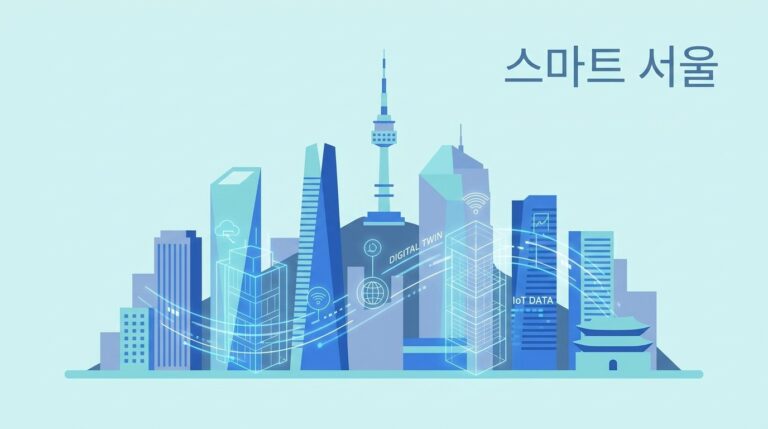
Mastering Smart City Data Infrastructure in Korean: The C2 Architect’s Guide
Phase 1: Empathy & Immersion Opening
안녕하세요! 매일한글 에디터입니다. (Hello! This is your Daily Hangul editor.)
Imagine walking into a high-stakes government strategy session in Sejong City or a smart-hub boardroom in Songdo. The screens display real-time IoT sensory streams, autonomous transit heatmaps, and digital twin simulations of residential districts. As a senior urban planner or tech strategist, everyone turns to you to discuss the city’s foundational architecture. You know your data pipelines and API protocols inside out in English, but the moment you try to propose solving institutional data silos or establishing cross-agency data interoperability in Korean, you hit a linguistic wall. Standard textbook Korean only taught you how to ask for subway directions or describe a high-rise apartment, leaving you without the executive-level Korean vocabulary needed to articulate sophisticated urban informatics.
Mastering C2-level discourse in smart city urban planning isn’t just about sounding smart—it earns you instant credibility with Korean public officials, engineering consortiums, and civic architects. This masterclass is distilled from real-world consultations with international urban planners working alongside Korean municipal authorities. Let’s elevate your Korean from fluent to authoritative.
Phase 2: Core C2 Expressions Deep-Dive
1. 데이터 상호운용성을 확보하다 (Daeta sangho-unyongseong-eul hwakbohyeoda)
- Pronunciation: [Dae-tah sang-ho-oon-yong-seong-eul hwak-po-ha-da] (Sounds like ‘sang-ho’ as in two partners shaking hands, followed by ‘un-yong’ like operating a machine)
- Meaning: Literally: “To secure data interoperability.” Real Nuance: Ensuring heterogeneous civic systems, IoT sensors, and public databases seamlessly exchange and process information without protocol friction.
- K-Culture Moment: Seen in administrative tech-thrillers like Designated Survivor: 60 Days or corporate strategy scenes in Start-Up when tech architects pitch civic-scale infrastructure to government committees.
- Editor’s Insight: ‘확보하다’ (to secure/guarantee) is the gold-standard executive verb in Korean public policy. Pairing it with ‘상호운용성’ (interoperability) instantly signals that you view urban infrastructure as a cohesive, unified ecosystem rather than fragmented tech silos.
- Situation Spectrum: Casual: 🚫 | Semi-formal: ⚠️ | Formal: ✅
- 🤔 Think About It: Why does Korean administrative discourse favor nominal compounds like ‘상호운용성’ over active descriptive verbs? How does this reflect the institutional emphasis on structural standardization?
2. 실시간 관제 시스템을 고도화하다 (Silsigan gwanje siseutem-eul godohwahada)
- Pronunciation: [Sil-si-gan gwan-je see-seu-tem-eul go-do-hwa-ha-da] (Pronounce ‘gwanje’ with a crisp, watchful ‘gwan’, and ‘godohwa’ with an uplifting rise on ‘go-do’)
- Meaning: Literally: “To advance/upgrade the real-time monitoring and control system.” Real Nuance: Transitioning from reactive municipal monitoring to proactive, AI-driven predictive control over urban grids.
- K-Culture Moment: Typical of municipal command center briefings in dramas like Voice or civic disaster response narratives where mayors inspect the city’s integrated control center (통합관제센터).
- Editor’s Insight: While beginners say ‘시스템을 업그레이드하다’ (upgrade the system), C2 professionals use ‘고도화하다’ (to enhance/advance to a high level). It conveys architectural sophistication, optimization, and institutional maturity.
- Situation Spectrum: Casual: 🚫 | Semi-formal: ⚠️ | Formal: ✅
- 🤔 Think About It: In many Western contexts, ‘monitoring’ can imply surveillance. How does the Korean civic concept of ‘관제’ (control & management) balance public safety, operational efficiency, and civic welfare?
3. 부서 간 데이터 사일로를 타파하다 (Buseo gan daeta saillo-reul tapahada)
- Pronunciation: [Bu-seo gan dae-tah sa-il-lo-reul ta-pa-ha-da] (Crisp ‘ta-pa’ sounds like breaking through an obstacle with a single decisive stroke)
- Meaning: Literally: “To break down data silos between departments.” Real Nuance: Eliminating administrative territorialism and fragmented databases to build a single source of truth for urban governance.
- K-Culture Moment: Frequently heard during high-level bureaucratic reform debates in Korean news roundtables and smart governance documentaries.
- Editor’s Insight: ‘타파하다’ (to break down/overthrow an outdated practice) carries strong executive resolve. Using this verb highlights your leadership and structural vision in overcoming bureaucratic resistance.
- Situation Spectrum: Casual: ⚠️ | Semi-formal: ✅ | Formal: ✅
- 🤔 Think About It: How does the challenge of institutional silos in Korea’s hierarchical departmental structure shape the language used by digital transformation leaders?
Phase 3: Textbook Korean vs Real Executive Korean
Situation 1: Proposing API Standardization Across City Agencies
- 📖 교과서 한국어 (Textbook): 각 부서의 데이터를 하나로 연결해야 스마트 시티를 만들 수 있습니다. (Gak buseo-ui daeta-reul hana-ro yeongyeolhaeya seumateu siti-reul mandeul su itseumnida. – “We must connect the data of each department into one to make a smart city.”)
- 🗣️ 진짜 한국어 (Real Executive C2): 도시 통합 플랫폼의 실효성을 높이려면, 표준 API 기반의 데이터 파이프라인 연계가 선행되어야 합니다. (Dosi tonghap peullaetpom-ui silhyoseong-eul nop-iryeomyeon, pyojun API giban-ui daeta paipeurain yeongyega seonhaengdoe-eoya hamnida. – “To maximize the efficacy of the integrated city platform, interconnecting data pipelines based on standardized APIs must precede all else.”)
- 💡 왜 다를까? (Why the difference?): C2 Korean utilizes conditional policy structures (
~의 실효성을 높이려면) and explicit prioritization vocabulary (~가 선행되어야 합니다) rather than basic modal verbs (~해야 합니다).
Situation 2: Addressing Data Privacy & Regulatory Compliance
- 📖 교과서 한국어 (Textbook): 개인정보 유출 문제를 조심해서 개발해야 합니다. (Gaeinjeongbo yuchul munje-reul josimhaeseo gaebalhaeya hamnida. – “We must develop carefully regarding personal data leak problems.”)
- 🗣️ 진짜 한국어 (Real Executive C2): 가명정보 결합 및 개인정보 비식별화 조치가 제도적으로 뒷받침되지 않고서는 인프라 확장에 구조적 한계가 따릅니다. (Gamyeongjeongbo gyeolhap mit gaeinjeongbo bisikbyeolhwa jochiga jedojeog-euro dwitbatchimdoeji ankgoseoneun inpeura hwakjang-e gujojeok hangyega ttareumnida. – “Unless institutional measures for pseudonymous data combination and de-identification are secured, structural constraints on infrastructure scaling are inevitable.”)
- 💡 왜 다를까? (Why the difference?): Advanced administrative debate uses double-negative conditional frameworks (
~되지 않고서는 ~한계가 따릅니다) to highlight systemic prerequisites.
Phase 4: K-Culture Deep Dive & Non-Verbal Manners
4-1. Nunchi & Executive Meeting Etiquette in Korea’s Tech Sector
When presenting smart city data infrastructure to Korean municipal committees or executive boards:
* The Two-Handed Device Gesture: When handing over an iPad displaying a digital twin dashboard or pointing to an architectural schematic, support your right forearm lightly with your left hand. It conveys technical authority tempered by deep organizational respect.
* Strategic Deference Before Innovation: Open your recommendations by acknowledging previous municipal infrastructure milestones: “기존에 구축된 훌륭한 인프라를 기반으로…” (“Building upon the exemplary infrastructure already established…”). Direct confrontation is considered unrefined; framing your proposal as an “evolutionary leap” (도약) ensures stakeholder buy-in.
4-2. Cultural Code: The ‘Ppalli-Ppalli’ Dynamic in Digital Twin Implementation
Korea’s smart cities (such as Songdo, Sejong 5-1 Living Lab, and Busan Eco Delta Smart City) operate on ultra-rapid iteration. In Korean civic planning, data infrastructure is not viewed as a passive archive, but as an active, living nervous system (도시의 신경망). Consequently, vocabulary surrounding speed, real-time analytics, and immediate civic feedback loops (선제적 대응, 초연결성, 체감형 서비스) dominates boardroom discussions.
Phase 5: Real-World Roleplay Scenario
Setting: Municipal Smart City Strategy Conference Room at Sejong City Hall.
Characters:
* Alex (알렉스): Global Smart Infrastructure Chief Architect.
* Director Kang (강 국장): Director General of Smart Urban Planning Bureau.
Turn 1
* 강 국장: 알렉스 수석님, 세종 스마트시티의 실시간 교통 관제와 에너지망 연동 사업의 핵심 과제는 무엇이라고 보십니까?
(Alex suseok-nim, Sejong seumateusiti-ui silsigan gyotong gwanjewa eneojimang yeondong sa-eop-ui haeksim gwajeneun mueos-irago bosimnikka?)
🎭 Leaning forward, hands clasped over the project brief with an analytical expression.
“Chief Architect Alex, what do you identify as the critical challenge in integrating real-time traffic control and the smart energy grid for Sejong Smart City?”
Turn 2
* 알렉스: 무엇보다 공공과 민간 영역의 데이터 상호운용성을 확보하는 것이 최우선 과제입니다.
(Mueosboda gong-gong-gwa min-gan yeong-yeok-ui daeta sangho-unyongseong-eul hwakbohwanun geot-i choe-useon gwaje-imnida.)
🎭 Gesturing smoothly toward the central architectural blueprint on screen.
“Above all, securing data interoperability between the public and private sectors is the paramount priority.”
Turn 3
* 강 국장: 현재 각 기관별로 프로토콜과 데이터 포맷이 상이해서 병목 현상이 심각한 상황입니다.
(Hyeonjae gak giganbyeollo peurotokolgwa daeta pomoesi sang-ihaeseo byeongmok hyeonsang-i simgakhan sanghwang-imnida.)
🎭 Nodding slowly, sighing with realistic concern over bureaucratic friction.
“Currently, disparate protocols and data formats across agencies are causing severe operational bottlenecks.”
Turn 4
* 알렉스: 맞습니다. 따라서 부서 간 데이터 사일로를 과감히 타파하고, 오픈 데이터 허브 체계로 전환해야 합니다.
(Matseumnida. Ttaraseo buseo gan daeta saillo-reul gwagamhi tapahago, opeun daeta heobu chegyero jeonhwanhaeya hamnida.)
🎭 Making a decisive downward leveling gesture with an open palm.
“Precisely. Therefore, we must decisively break down inter-departmental data silos and transition to an open data hub architecture.”
Turn 5
* 강 국장: 그렇다면 시민들의 민감한 개인정보 보호 문제와 데이터 개방 사이의 균형은 어떻게 잡아야 할까요?
(Geureotdamyeon simindeul-ui min-gamhan gaeinjeongbo boho munjewa daeta gaebang sai-ui gyunhyeong-eun eotteoke jab-aya halkkayo?)
🎭 Adjusting his glasses, probing for institutional feasibility.
“In that case, how should we strike a balance between safeguarding sensitive citizen privacy and promoting open data access?”
Turn 6
* 알렉스: 데이터 안심구역과 인공지능 기반의 동적 비식별화 기술을 선제적으로 도입할 필요가 있습니다.
(Daeta ansim-guyeok-gwa ingongji-neung giban-ui dongjeok bisikbyeolhwa gisul-eul seonjejeog-euro do-ip-hal piryoga itseumnida.)
🎭 Presenting a structured multi-tier security diagram on his tablet.
“We need to preemptively implement secure data zones and AI-driven dynamic de-identification technologies.”
Turn 7
* 강 국장: 일리가 있군요. 이를 통해 통합 플랫폼의 실시간 관제 시스템을 고도화할 수 있겠습니까?
(Illiga itgunyo. Ireul tonghae tonghap peullaetpom-ui silsigan gwanje siseutem-eul godohwahal su itgetseumnikka?)
🎭 Jotting down notes enthusiastically while maintaining direct eye contact.
“That is sound reasoning. Do you believe this will enable us to elevate our integrated platform’s real-time control system?”
Turn 8
* 알렉스: 네, 도시 전역의 엣지 컴퓨팅 노드와 연계한다면 진정한 지능형 도시 운영이 가능해집니다.
(Ne, dosi jeon-yeok-ui etji keompyuting nodeuwa yeon-gyehandamyeon jinjeonghan jineunghyeong dosi un-yeong-i ganeunghaejimnida.)
🎭 Concluding with a confident, respectful nod.
“Yes, if coupled with city-wide edge computing nodes, truly intelligent urban operations will be fully realized.”
🔀 Interactive Decision Point
How would you conclude your presentation to Director Kang to lock in executive approval?
- Option A (Best Choice): “실증 사업 단계부터 단계별 KPI를 설정하여, 거버넌스와 인프라 구축을 동시에 견인하겠습니다.” (Setting phased KPIs starting from the pilot stage, we will drive both governance and infrastructure simultaneously.)
👉 Feedback: Flawless C2 executive articulation! Balances technical delivery with strategic governance. - Option B (Risky Choice): “기존 시스템을 다 버리고 클라우드로 전부 바꾸면 문제없습니다.” (If we discard all legacy systems and switch everything to the cloud, there will be no issues.)
👉 Feedback: Overly aggressive and dismissive of legacy public investments; lacks institutional nuance. - Option C (Sub-optimal Choice): “제가 기술적인 부분은 알아서 다 처리해 드릴 테니 믿어주세요.” (I will take care of all technical parts myself, so please just trust me.)
👉 Feedback: Lacks administrative credibility and ignores the necessity of multi-stakeholder collaboration.
Phase 6: 10-Second Executive Shadowing Drill
Practice these rhythmic pauses (/) and dynamic emotional registers to sound like an authoritative keynote speaker:
[💼 결단력 있고 단호하게 - Resolute & Decisive]
도시 인프라의 디지털 전환은 / 데이터 상호운용성 확보에서부터 / 시작됩니다.
(Dosi inpeura-ui dijiteol jeonhwan-eun / daeta sangho-unyongseong hwakbo-eseobuteo / sijakdoemnida.)
“The digital transformation of urban infrastructure begins with securing data interoperability.”-
[🧐 분석적이고 신중하게 - Analytical & Prudent]
개별 부서의 단편적 접근으로는 / 데이터 사일로 현상을 / 근본적으로 해결할 수 없습니다.
(Gaebyeol buseo-ui danpyeonjeok jeopgeun-eoroneun / daeta saillo hyeonsang-eul / geunbonjeog-euro haegyeolhal su eopseumnida.)
“A fragmented approach by individual departments cannot fundamentally resolve data silos.” -
[🚀 비전 제시형 - Visionary & Confident]
인공지능 기반 분석을 통해 / 실시간 통합 관제 시스템을 고도화하여 / 도시 회복탄력성을 극대화하겠습니다.
(Ingongjineung giban bunseog-eul tonghae / silsigan tonghap gwanje siseutem-eul godohwahayeo / dosi hoeboktallyeokseong-eul geukdaehwahagetseumnida.)
“Through AI-driven analytics, we will advance real-time integrated monitoring systems to maximize urban resilience.”
Phase 7: K-Culture Mini Dictionary
-
디지털 트윈 (Dijiteol Teuwin) | Digital Twin
- Usage: A high-fidelity virtual replica of a physical city used to simulate urban policies, traffic changes, and disaster impacts before physical deployment.
- Example: 서울시는 침수 피해 예측을 위해 디지털 트윈 플랫폼을 가동하고 있습니다. (Seoul City is operating a digital twin platform to predict flood inundation.)
- 공공데이터 개방 (Gonggongdaeta Gaebang) | Public Data Open Initiative
- Usage: Government-mandated release of civic datasets (transportation, energy, zoning) to encourage civic innovation and startup ecosystems.
- Example: 공공데이터 개방 확대를 통해 민관 협력 모델을 창출해야 합니다. (We must foster public-private partnership models by expanding open public data.)
- 스마트폴 (Seumateupol) | Smart Pole
- Usage: Streetlight infrastructure integrated with CCTV, Wi-Fi, EV charging, and environmental IoT sensors across Korean metro stations and pedestrian walkways.
- Example: 스마트폴은 도심 내 핵심 데이터 수집 거점 역할을 수행합니다. (Smart poles serve as critical data collection hubs within downtown areas.)
- 초연결 데이터 허브 (Choyeongyeol Daeta Heobu) | Hyper-Connected Data Hub
- Usage: A unified urban data exchange architecture connecting smart grids, healthcare, transit, and public safety data streams in real time.
- Example: 분산된 센서 데이터를 초연결 데이터 허브로 통합 집계합니다. (We aggregate decentralized sensor data into a hyper-connected data hub.)
Phase 8: Survival Kit for Urban Tech Professionals
Top 3 Field Phrases
- 데이터 파이프라인 연계 방안을 검토해 주십시오.
(Daeta paipeurain yeon-gye bang-an-eul geomtohae jusipsio.)
Meaning: “Please review the data pipeline interconnection plan.”
Pro Tip: Use during technical sync meetings when requesting integration architecture reviews from municipal leads. -
개인정보 비식별 조치 가이드라인을 준수해야 합니다.
(Gaeinjeongbo bisikbyeol jochi gaideurain-eul junsuhaeya hamnida.)
Meaning: “We must strictly adhere to the personal data de-identification guidelines.”
Pro Tip: Essential when dealing with citizen telemetry, mobile floating population data, and smart meter records. -
레거시 시스템과의 호환성 테스트가 필수적입니다.
(Reogeosi siseutem-gwaui hohwanseong teseuteuga pilsujeog-imnida.)
Meaning: “Compatibility testing with legacy systems is mandatory.”
Pro Tip: Drops directly into technical risk assessment presentations.
Editor’s Professional Note
- Check the 국토교통부 스마트시티 종합포털 공식 사이트 방문하기 to examine Korea’s standardized National Smart City Architecture blueprints.
- For on-the-ground spatial transit analysis, utilize 카카오맵 실시간 대중교통 데이터 확인 to observe how Korea standardizes real-time public transit API streams.
Phase 9: One Step Deeper (Reflection Essay)
South Korea’s smart city evolution offers a unique lens into modern civic governance. In many Western frameworks, urban digitization navigates a fragmented landscape of local municipality autonomy and rigid private-sector proprietary barriers. In contrast, Korea leverages a unified, state-guided data orchestration framework—exemplified by standardized national smart city data hubs and swift public-private consensus building. This cultural foundation prioritizes rapid collective utility and high-density civic welfare, yet it demands rigorous intellectual debate on privacy thresholds and algorithmic transparency. True executive mastery requires navigating this delicate balance between centralized execution speed (추진력) and democratic civic governance (시민 참여형 거버넌스).
💬 Your Turn: In your home country, what is the biggest hurdle to smart city data integration: legacy government silos, privacy regulations, or funding models? Share your perspective in the comments below in Korean or English!
Phase 10: FAQ & Avoiding Misunderstandings
Q: Can I simply use ‘데이터를 모으다’ (gather data) instead of ‘데이터를 연계·통합하다’ in a formal meeting?
A: In casual conversation, ‘모으다’ is fine. However, in formal urban planning contexts, ‘모으다’ sounds like passive data hoarding. Executive Korean prefers ‘연계하다’ (interconnect), ‘통합하다’ (integrate), or ‘수집·정제하다’ (collect and sanitize), which reflects deliberate architectural process.
Q: What is the exact distinction between ‘관제’ (Gwanje) and ‘모니터링’ (Monitoring)?
A: While ‘모니터링’ simply refers to observation, ‘관제’ (管制) implies active command, dynamic regulation, and real-time operational response (e.g., dispatching emergency services or rerouting autonomous buses based on sensory input).
Q: How do public officials in Korea refer to data compliance issues?
A: Rather than saying ‘법적인 문제’ (legal problem), seasoned planners refer to ‘규제 샌드박스 적용 여부’ (applicability of regulatory sandboxes) or ‘개인정보보호법상 저촉 요인’ (infringement factors under the Personal Information Protection Act).
🚨 Common Mistakes Warning Board
- ❌ Mistake 1: Translating “upgrade the system” literally as 시스템을 업그레이드하다 in ministerial reports.
✔️ Correction: Use 시스템을 고도화하다 or 인프라를 확충하다. - ❌ Mistake 2: Saying 데이터가 따로따로 놀고 있습니다 to describe data silos in boardrooms.
✔️ Correction: Use 부서 간 데이터 사일로가 심화되어 있습니다 or 데이터 파편화가 발생하고 있습니다. - ❌ Mistake 3: Saying 컴퓨터로 도시를 복사하다 when explaining digital twins.
✔️ Correction: Use 가상 공간에 현실 도시를 동기화하는 디지털 트윈을 구축하다.
Phase 11: Action Missions
- 🥉 Bronze Mission (Solo Practice): Read the 3 Phase 6 Shadowing Drills aloud 5 times each, focusing on executive pauses (
/) and confident pronunciation. - 🥈 Silver Mission (Social Share): Write a 2-sentence comment on LinkedIn or in the comment section below proposing a smart city data improvement for your city using the expression “데이터 상호운용성을 확보해야…”
- 🥇 Gold Mission (Real-world Execution): In your next international or bilingual project meeting, introduce the term ‘데이터 사일로 타파’ or ‘관제 고도화’ when discussing cross-functional data integration.
- 🎮 K-Culture Mission: Watch an episode of a modern Korean administrative drama or tech documentary and spot at least two instances of terms containing ‘~화하다’ (e.g., 고도화, 표준화, 일원화).
Phase 12: Interactive Quiz Challenge
1. Situation Judgment Quiz:
You are drafting an official project proposal for a smart city command center. Which sentence represents the highest level of professional Korean?
* A) 도시 데이터를 열심히 모아서 좋은 도시를 만들겠습니다.
* B) 이기종 센서 데이터의 상호운용성을 확보하여 실시간 통합 관제를 고도화하겠습니다.
* C) 부서마다 데이터가 다르니까 한곳에 합쳐서 보도록 하겠습니다.
2. Fill-in-the-Blank:
“각 기관의 데이터가 공유되지 않는 문제를 해결하기 위해, 부서 간 데이터 _________를 타파해야 합니다.”
* Hint: Think of the industrial cylindrical storage term used metaphorically for isolated departments.
3. True or False:
In Korean urban planning, ‘관제 시스템’ refers strictly to passive video surveillance without any control capabilities. (T / F)
👉 정답 및 해설 확인하기 (Click to view answers & explanations)
- Answer: B
Explanation: Option B incorporates precise C2 technical vocabulary (‘이기종 센서 데이터’, ‘상호운용성 확보’, ‘통합 관제 고도화’) suitable for government whitepapers. - Answer: 사일로 (Silo)
Explanation: The complete phrase is ‘데이터 사일로를 타파하다’ (to break down data silos). - Answer: False (F)
Explanation: ‘관제’ (管制) inherently denotes real-time control, active intervention, and operational governance, not just passive observation.







