

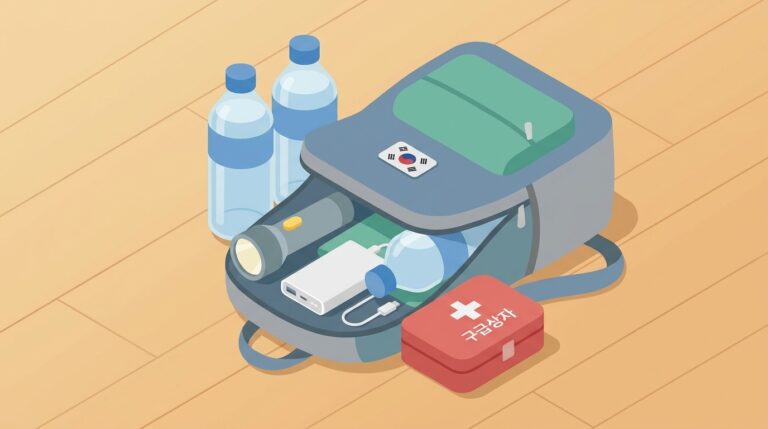
Phase 1: Empathy (Story-Immersive Opening)
안녕하세요! 매일한글 에디터입니다.
Imagine this: It is 2:00 AM in your Seoul officetel. Suddenly, every smartphone in the building erupts with that unmistakable, bone-chilling screech—an 안전안내문자 (Emergency Disaster Text). Your heart jumps into your throat. You glance at your phone screen: a flash flood warning or an earthquake advisory. You look around your living room. What do you grab? A passport? A bottle of water? Do you even know where the nearest underground bunker is located?
If you’ve watched hit Korean disaster thrillers like Exit (엑시트) or Concrete Utopia (콘크리트 유토피아), you know that in South Korea, preparedness isn’t just paranoia—it’s an art form. Living in high-density urban landscapes means emergency survival requires rapid communication, acute spatial awareness, and community cohesion.
Many advanced Korean learners can debate philosophical concepts or analyze K-drama plots with ease, yet freeze completely when asked to coordinate disaster logistics or itemize emergency gear in natural, native-level Korean. Today, drawing from actual civil defense protocols and feedback from foreign residents who lived through the torrential monsoon seasons in Gangnam, we are breaking down how to pack a 생존 배낭 (survival go-bag) and talk about emergency readiness with unflinching C1 confidence.
Phase 2: Core Expressions Deep Dive (C1 Level)
1. 만약의 사태에 대비해서 생존 배낭을 꾸려 둬야 해. (Man-yag-ui sa-tae-e dae-bi-hae-seo saeng-jon bae-nang-eul kku-ryeo dwo-ya hae.)
- Pronunciation: Man-yag-ui sa-tae-e dae-bi-hae-seo saeng-jon bae-nang-eul kku-ryeo dwo-ya hae (Sounds like: Mahn-yahg-wee sah-teh-eh deh-bee-heh-saw seng-john beh-nahng-eul kkoo-ryaw dwo-yah heh)
- Meaning: “We must assemble a disaster survival go-bag just in case of an emergency.”
- K-Culture Moment: In survival thrillers like Sweet Home or All of Us Are Dead, characters meticulously bundle essential gear before an evacuation. The verb 꾸리다 (to bundle/pack purposefully) is used instead of the generic 싸다 (to pack) when referring to a comprehensive, intentional kit.
- Editor’s Insight: The phrase 만약의 사태 (a hypothetical catastrophic contingency) elevates your register from basic conversation to an articulate, proactive adult assessing real-world risk. Adding ~어/아 두다 emphasizes future preparedness.
- Situation Spectrum: Casual (✅ with close peers) | Semi-formal (✅) | Formal (⚠️ use 꾸려 두어야 합니다)
- 🤔 Think About It: How does your native language distinguish casual packing for a weekend trip from packing an emergency tactical bug-out bag? Notice how Korean differentiates 짐을 싸다 from 생존 배낭을 꾸리다.
2. 비상식량이랑 건전지는 넉넉하게 쟁여 둬. (Bi-sang-sing-nyang-i-rang geon-jeon-ji-neun neong-neog-ha-ge jaeng-yeo dwo.)
- Pronunciation: Bi-sang-sing-nyang-i-rang geon-jeon-ji-neun neong-neog-ha-ge jaeng-yeo dwo (Sounds like: Bee-sahng-sing-nyahng-ee-rahng gun-john-jee-neun nung-nug-hah-geh jeng-yaw dwo)
- Meaning: “Stockpile plenty of non-perishable emergency rations and batteries in advance.”
- K-Culture Moment: During supply runs in K-dramas, you’ll hear practical characters tell their families to gather resources 넉넉하게 (with generous surplus).
- Editor’s Insight: 쟁여 두다 is an indispensable native idiom meaning to stockpile or stash items methodically so you won’t run out. Pairing it with 넉넉하게 (generously/with buffer) signals sophisticated command of Korean colloquial pragmatics.
- Situation Spectrum: Casual (✅) | Semi-formal (✅) | Formal (🚫 use 비축해 두십시오 in official broadcasts)
- 🤔 Think About It: What does the preference for 쟁여 두다 reveal about Korean consumer culture and modern preparedness habits?
3. 유사시에 대비해서 인근 대피소 위치부터 파악해 둬야 해. (Yu-sa-si-e dae-bi-hae-seo in-geun dae-pi-so wi-chi-bu-teo pa-ak-hae dwo-ya hae.)
- Pronunciation: Yu-sa-si-e dae-bi-hae-seo in-geun dae-pi-so wi-chi-bu-teo pa-ak-hae dwo-ya hae (Sounds like: Yoo-sah-she-eh deh-bee-heh-saw in-geun deh-pee-soh wee-chee-boo-tuh pah-ahk-heh dwo-yah heh)
- Meaning: “We need to locate and familiarize ourselves with the nearest evacuation shelter in case of an emergency.”
- K-Culture Moment: Seen on municipal safety posters across Seoul subway stations and apartment elevators marked with the yellow-and-blue 민방위 대피소 (Civil Defense Shelter) shield.
- Editor’s Insight: 유사시 (類似時) is an advanced Sino-Korean term referring specifically to a critical state of emergency or crisis. 파악하다 means to clearly identify, map out, and comprehend logistics.
- Situation Spectrum: Casual (✅) | Semi-formal (✅) | Formal (✅)
- 🤔 Think About It: In many Western countries, shelters are standalone civic buildings; in South Korea, nearly all large subway stations and underground apartment parking structures are designated shelters. How does vocabulary reflect this urban topography?
Phase 3: Textbook Korean vs. Real Native Korean
Situation A: Telling someone to stockpile canned foods and water
- 📖 Textbook Korean: 비상시를 위해 물과 통조림을 많이 사 두십시오. (Bi-sang-si-reul wi-hae mul-gwa tong-jo-rim-eul man-i sa du-sip-si-o. / “Please buy plenty of water and canned food for emergencies.”)
- 🗣️ Real Native Korean: 만약을 대비해서 생수랑 캔 음식 좀 넉넉히 쟁여 놔야겠어. (Man-yag-eul dae-bi-hae-seo saeng-su-rang kaen eum-sik jom neong-neok-hi jaeng-yeo nwa-ya-get-seo. / “I should definitely hoard some bottled water and canned goods just in case.”)
- 💡 Why the difference? Textbook phrasing sounds like an automated municipal public service announcement. Native speakers use colloquial compounds like 생수 (instead of just 물), 캔 음식, and the lively idiom 쟁여 놓다.
Situation B: Reacting to an emergency evacuation alert
- 📖 Textbook Korean: 사이렌이 울리면 신속히 안전한 장소로 이동하세요. (Sa-i-ren-i ul-ri-myeon sin-sok-hi an-jeon-han jang-so-ro i-dong-ha-se-yo. / “When the siren sounds, move promptly to a safe location.”)
- 🗣️ Real Native Korean: 삐 소리 울리자마자 바로 지하 대피소로 튀어야 돼! (Ppi so-ri ul-ri-ja-ma-ja ba-ro ji-ha dae-pi-so-ro twi-eo-ya dwae! / “The second that alarm blares, we have to haul ourselves down to the underground shelter!”)
- 💡 Why the difference? In high-stress scenarios, Koreans replace formal verbs like 이동하다 (to relocate) with dynamic, instinctive action verbs like 튀다 (slang for bolt/sprint) while referencing the distinct 삐 소리 of national cell broadcast alarms.
Phase 4: K-Culture Deep Dive & Non-Verbal Manners
4-1. 눈치 (Nunchi) & Emergency Demeanor
In Korean apartment complexes and crowded public areas during an emergency alert, public behavior is dictated by collective calm and swift compliance. Screaming, dramatic panic, or blocking shared building corridors with oversized luggage violates community etiquette.
- Spatial Consideration: Survival bags should be compact and strapped to the front or kept tight to the body when descending emergency stairwells (비상계단).
- Subtle Non-Verbal Checks: Koreans will immediately make eye contact with neighbors or building security (경비실) to verify whether an alert is a drill (훈련) or real (실제상황). Keep your ears open for the intercom broadcast (구내방송).
4-2. Cultural Code: The Apartment Survival Architecture
Over 60% of South Koreans live in high-rise apartment complexes (아파트 단지). Because of this, Korean disaster preparedness focuses heavily on multi-unit survival dynamics: knowing how to shut off the main gas valve (가스 밸브 차단), identifying the breakable partition wall on balconies (경량칸막이) to escape to next door, and locating your building’s civil defense bunker (민방위 대피소).
Phase 5: Interactive Real-Life Roleplay Scenario
Setting: Mapo-gu, Seoul. A sudden torrential downpour triggers an extreme weather alert (호우경보). Min-jun, your Korean neighbor and seasoned outdoor survivalist, knocks on your door with a checklist in hand.
- Turn 1 (Min-jun):
🎭 Serious, peering at your entryway이모지 없이 진지하게 묻는 건데, 혹시 생존 배낭 꾸려 둔 거 있어? (I-mo-ji eop-si jin-ji-ha-ge mut-neun geon-de, hok-si saeng-jon bae-nang kku-ryeo dun geo it-seo? / “I’m asking seriously: do you have a survival go-bag packed by any chance?”) - Turn 2 (You):
🎭 Gesturing toward an empty backpack아직 다는 못 쌌어. 지금 당장 뭘 제일 먼저 챙겨야 돼? (A-jik da-neun mot ssat-seo. Ji-geum dang-jang mwol je-il meon-jeo chaeng-gyeo-ya dwae? / “Not fully. What should I pack first right now?”) - Turn 3 (Min-jun):
🎭 Pointing firmly toward the kitchen일단 3일 치 생수랑 보조배터리, 그리고 비상약부터 때려 넣어. (Il-dan sam-il chi saeng-su-rang bo-jo-bae-teo-ri, geu-ri-go bi-sang-yak-bu-teo ttae-ryeo neo-eo. / “First, throw in a 3-day supply of bottled water, power banks, and first-aid meds.”) - Turn 4 (You):
🎭 Checking your cabinets통조림이랑 건전지도 넉넉하게 쟁여 뒀는데 이것도 넣을까? (Tong-jo-rim-i-rang geon-jeon-ji-do neong-neog-ha-ge jaeng-yeo dwot-neun-de i-geot-do neo-eul-kka? / “I stocked plenty of canned foods and batteries too; should I toss those in?”) - Turn 5 (Min-jun):
🎭 Nodding approvingly완벽해. 그리고 라이터랑 다용도 칼도 방수 팩에 넣어서 챙겨. (Wan-byeok-hae. Geu-ri-go ra-i-teo-rang da-yong-do kal-do bang-su paek-e neo-eo-seo chaeng-gyeo. / “Perfect. Also, put a lighter and a multi-tool inside a waterproof pouch.”) - Turn 6 (You):
🎭 Looking down at your phone notification만약에 정전되거나 대피 명령 떨어지면 어디로 가야 해? (Man-yag-e jeong-jeon-doe-geo-na dae-pi myeong-ryeong tteol-eo-ji-myeon eo-di-ro ga-ya hae? / “If the power goes out or an evacuation order drops, where do we go?”) - Turn 7 (Min-jun):
🎭 Tapping an app on his phone screen우리 건물 지하철 연결 통로가 1차 대피소야. 위치 파악해 뒀으니까 신호 오면 바로 튀자. (U-ri geon-mul ji-ha-cheol yeon-gyeol tong-ro-ga il-cha dae-pi-so-ya. Wi-chi pa-ak-hae dwot-eu-ni-kka sin-ho o-myeon ba-ro twi-ja. / “Our building’s subway connection tunnel is the primary shelter. I mapped it out, so when the signal sounds, let’s move immediately.”) - Turn 8 (You):
🎭 Zipping up your bag decisively알겠어. 배낭 문 앞 손잡이에 걸어 두고 대기할게. (Al-get-seo. Bae-nang mun ap son-jab-i-e geol-eo du-go dae-gi-hal-ge. / “Understood. I’ll hang the backpack by the front door handle on standby.”)
🔀 Interactive Choice Point
Min-jun receives another loud alert on his phone indicating rising river levels nearby. How do you respond?
- Choice A: “여권이랑 현금도 방수 지퍼백에 챙겼어. 이제 바로 나갈 수 있어.” (Yeo-gwon-i-rang hyeon-geum-do bang-su ji-peo-baek-e chaeng-gyeot-seo. I-je ba-ro na-gal su it-seo.)
- Choice B: “라면 끓여 먹으면서 인터넷으로 뉴스나 더 찾아보자.” (Ra-myeon kkeul-yeo meog-eu-myeon-seo in-teo-net-eu-ro nyu-seu-na deo cha-ja-bo-ja.)
- Choice C: “짐이 너무 무거우니까 여행용 캐리어에 다 옮겨 담을게.” (Jim-i neo-mu mu-geou-ni-kka yeo-haeng-yong kae-ri-eo-e da olm-gyeo dam-eul-ge.)
Outcome Feedback:
* Choice A (Best): Flawless response! Protecting identity documents and physical cash in waterproof pouches while confirming readiness shows peak survival fluency.
* Choice B (Bad): Procrastinating during a critical evacuation advisory can leave you trapped without power or escape routes.
* Choice C (Risk): High risk! Rolling wheeled suitcases through floodwaters, debris, or crowded stairwells drastically impedes mobility; always stick to a two-strap backpack.
Phase 6: 10-Second Emotional Shadowing Drill
Repeat these rhythmic sentences aloud, paying close attention to pause markers (/) and emotional inflection:
[🚨 다급하고 단호하게 | Urgent & Decisive]
“만약의 사태를 대비해서 / 생수랑 비상약부터 / 가방에 때려 넣어!”
(Man-yag-ui sa-tae-reul dae-bi-hae-seo / saeng-su-rang bi-sang-yak-bu-teo / ga-bang-e ttae-ryeo neo-eo!)-
[😟 걱정스럽지만 침착하게 | Concerned yet Composed]
“정전될 수도 있으니까 / 건전지랑 보조배터리 / 넉넉하게 챙겨 둬.”
(Jeong-jeon-doel su-do it-seu-ni-kka / geon-jeon-ji-rang bo-jo-bae-teo-ri / neong-neog-ha-ge chaeng-gyeo dwo.) -
[🧠 카리스마 있게 주도하며 | Confident & Authoritative]
“사이렌 울리면 지체 없이 / 인근 지하철역 대피소로 / 바로 튀어야 돼.”
(Sa-i-ren ul-ri-myeon ji-che eop-si / in-geun ji-ha-cheol-yeok dae-pi-so-ro / ba-ro twi-eo-ya dwae.)
Phase 7: K-Culture Mini Dictionary
- 생존 배낭 (Saeng-jon Bae-nang) | Emergency Bug-Out Bag / Go-Bag
- Usage: A curated backpack containing 72 hours of survival essentials (water, rations, first-aid, radio, thermal blanket) kept near your front door.
- 안전안내문자 (An-jeon An-nae Mun-ja) | Emergency Disaster Alert Broadcast
- Usage: Geo-targeted national text alerts sent to mobile devices regarding severe weather, missing persons, or civic defense alerts.
- 민방위 대피소 (Min-bang-wi Dae-pi-so) | Civil Defense Evacuation Shelter
- Usage: Officially designated underground safe zones marked by yellow shields found across subway stations and commercial basement floors.
- 비축하다 / 쟁여두다 (Bi-chuk-ha-da / Jaeng-yeo-du-da) | To Stockpile / Hoard Strategically
- Usage: The formal and colloquial verbs, respectively, used to describe setting aside non-perishable goods and emergency supplies.
Phase 8: Emergency Survival Kit for Foreign Residents
Survival Expressions TOP 3
- 가장 가까운 대피소가 어디예요? (Ga-jang ga-kka-un dae-pi-so-ga eo-di-ye-yo? / “Where is the closest evacuation shelter?”)
- Pro Tip: Use this with building security or emergency personnel when cellular data fails.
- 건물 가스 밸브랑 두꺼비집부터 내리세요! (Geon-mul ga-seu bael-beu-rang du-kkeo-bi-jip-bu-teo nae-ri-se-yo! / “Shut off the building gas valve and circuit breaker first!”)
- Pro Tip: Crucial phrase for earthquake and flood situations to prevent secondary fires.
- 119에 외국어 통역 서비스 연결해 주세요. (Il-il-gu-e oe-guk-eo tong-yeok seo-bi-seu yeon-gyeol-hae ju-se-yo. / “Please connect me to the foreign language interpretation service on 119.”)
- Pro Tip: Korea’s 119 dispatch offers 24/7 real-time 3-way translation support.
Editor’s Travel & Living Note
Make sure to install the official government multilingual disaster app via the National Disaster & Safety Portal Emergency Ready App Guide. Furthermore, open your preferred Korean map application and search 대피소 to cache offline routes to your local civil defense shelter before mobile service disruption occurs.
Phase 9: “One Step Deeper” (Sociolinguistic Insight)
In South Korea, survival is deeply rooted in the philosophy of community resilience (공동체 의식). In high-density apartments, an individual’s emergency preparedness directly impacts the safety of dozens of surrounding families. Knowing how to articulate disaster terms not only keeps you secure, but also allows you to assist vulnerable neighbors during unforeseen crises.
💬 Your Turn: Have you packed a survival go-bag in your apartment or home? What is the one item you consider indispensable? Share your thoughts below in Korean using the expression “만약의 사태를 대비해서…”!
Phase 10: FAQ & Common Pitfalls
Q: What is the difference between an earthquake shelter and a flood shelter in Korea?
A: Earthquake outdoor evacuation areas (지진옥외대피장소) are wide open spaces like school playgrounds and parks away from falling glass. In contrast, civil defense shelters (민방위 대피소) for airstrikes or severe artillery threats are located underground (such as subway stations).
Q: Does the Korean Emergency Disaster Alert (안전안내문자) charge mobile data?
A: No, it is broadcast via Cell Broadcast Service (CBS) radio frequencies directly through telecommunication towers and functions even if you have no data balance.
Q: Can I use tap water as emergency survival water in Korea?
A: While Korean tap water (아리수 in Seoul) is potable during normal times, municipal pipes may become contaminated during floods or seismic events; always prioritize sealed commercial bottled water (생수).
🚨 Common Mistakes Alert
- Mistaking 소화제 for 소화기: 소화기 (Fire Extinguisher) vs. 소화제 (Digestive Medicine). Saying you need a 소화제 during a fire drill will confuse everyone!
- Confusing 짐을 싸다 with 짐을 챙기다/꾸리다: 짐을 싸다 is generic packing for travel; when talking about critical emergency readiness, use 비상용품을 챙기다 or 생존 배낭을 꾸리다.
- Relying Solely on Mobile Payments: During blackouts or network collapse, KakaoPay and Samsung Pay will not work. Always stash physical 10,000 KRW and 1,000 KRW banknotes in your go-bag.
Phase 11: Action Missions
- 🥉 Bronze Level: Open your notes app and list 5 survival items in Korean (e.g., 생수, 보조배터리, 구급함, 손전등, 비상식량).
- 🥈 Silver Level: Open your Korean map app, search 대피소, and take a screenshot of your building’s closest underground shelter.
- 🥇 Gold Level: Assemble a real go-bag by your door and post a short video or text in Korean tagging
@DailyHangulusing the sentence: 만약의 사태에 대비해서 생존 배낭을 꾸렸어요! -
🎮 K-Culture Mission: Watch the first 20 minutes of the movie Exit (엑시트) or Concrete Utopia and identify how characters manage emergency signaling tools and food distribution.
Phase 12: Interactive Quiz Challenge
1. [Contextual Judgment] You are in a Seoul apartment and an official earthquake advisory occurs. Which action and statement is correct?
* (A) “엘리베이터 타고 빨리 내려가자!”
* (B) “가스 밸브 잠그고 문 열어서 탈출구부터 확보해!”
* (C) “짐이 많으니까 여행용 트렁크 3개에 나눠 담자.”
2. [Fill in the Blank] Fill in the appropriate Sino-Korean term for a high-level emergency state:
“__________에 대비해서 비상식량과 식수를 넉넉히 비축해야 합니다.”
* (A) 식사시 (Sik-sa-si)
* (B) 유사시 (Yu-sa-si)
* (C) 평상시 (Pyeong-sang-si)
3. [True / False Cultural Check] In South Korea, public subway stations frequently double as certified civil defense shelters (민방위 대피소). (True / False)
👉 Click here to reveal the answers and detailed explanations!
- Answer: (B)
Explanation: During an earthquake, you must turn off the gas valve to prevent gas explosions and open the door immediately because building frames can warp, trapping you inside. Never use elevators during seismic events! - Answer: (B) 유사시 (Yu-sa-si)
Explanation: 유사시 refers to a contingency or time of emergency. (식사시 = during mealtime, 평상시 = ordinary/normal times). - Answer: True
Explanation: Most major subway platforms and underground pathways in Korean cities are designated civil defense shelters equipped with emergency water fountains, air filters, and gas masks.







