

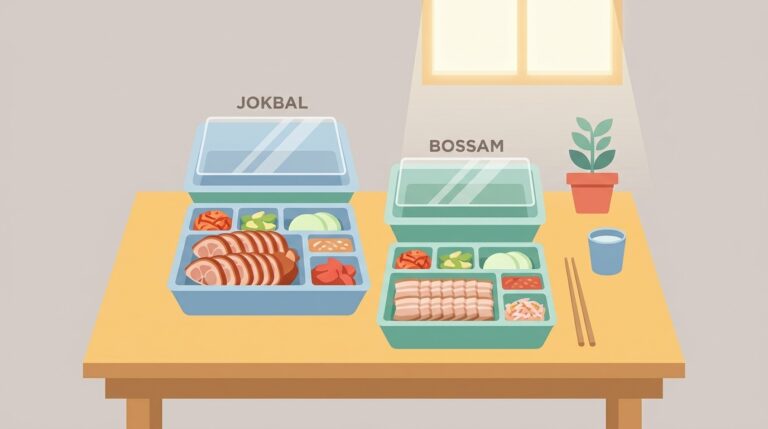
The Ultimate Late-Night Dilemma: Jokbal vs. Bossam (족발과 보쌈의 야식 대결)
Phase 1: Empathy (스토리 몰입형 오프닝)
안녕하세요! 매일한글 에디터입니다. (Hello! I’m your Daily Hangul editor.)
Picture this: It’s 11:30 PM on a brisk Friday night in Seoul. You’ve just finished a marathon session of your favorite K-Drama, and your stomach lets out an undeniable rumble. You open a Korean delivery app, and immediately you are confronted with the holy grail of Korean late-night snack (야식, yasik) debates: Jokbal (족발 – Braised Pig’s Trotters) or Bossam (보쌈 – Boiled Pork Wraps)?
Your Korean friends are passionately divided in the group chat. One is screaming about the collagen-rich, chewy skin of Jokbal, while another insists that nothing beats steaming, tender slices of Bossam wrapped in crunchy, freshly made radish kimchi (무말랭이). You want to jump into the conversation, customize your combo order, ask for extra side noodles (막국수), and negotiate the order like a true Seoulite—but textbook Korean only taught you how to say “Please give me pork.”
Don’t worry! Drawing from hundreds of real intermediate learners’ real-life feedback and midnight delivery mishaps, this guide will elevate your Korean to a natural, expressive B2 level. By the end of this post, you will comfortably navigate delivery menus, debate food textures with native flair, and order the legendary “Jokbo Set” (족보세트) without breaking a sweat.
Phase 2: 핵심 표현 3선 심층 분석 (Top 3 Core Expressions)
1. 반반으로 시킬까요? (한글)
- Pronunciation: Ban-ban-eu-ro si-kil-kka-yo? (Sound analogy: Think of “bahn-bahn” like a train rolling on tracks, followed by “she-kill-kkah-yo”).
- Meaning: Literal: “Shall we order half-and-half?” | Actual Nuance: “Why fight when we can have both? Let’s compromise on a combo set!”
- K-Culture Moment: Seen in countless web dramas and variety shows like I Live Alone whenever roommates cannot reach a food consensus.
- Editor’s Insight: The word 반 (ban) means “half.” Doubling it into 반반 creates the ultimate Korean problem-solving word for fried chicken flavors, Chinese dishes (Jjamppong + Jajangmyeon = Jjambbong), and of course, Jokbal vs. Bossam.
- Situation Spectrum:
- Casual (Friends/Peers): ✅
반반으로 시키자!(Banbaneuro sikija!) - Semi-formal (Coworkers/Acquaintances): ✅
반반으로 시킬까요?(Banbaneuro sikilkkayo?) - Formal (Business/Formal dining): ⚠️
반반 메뉴로 주문하시겠습니까?(Banban menyuro jumunhasigesseumnikka?)
- Casual (Friends/Peers): ✅
- 🤔 Think About It: In Korean dining culture, meals are almost always shared communally. How does the concept of “half-and-half” reflect Korean conflict-resolution and communal harmony compared to individual-portion cultures?
2. 야들야들하고 쫀득쫀득해요. (한글)
- Pronunciation: Ya-deul-ya-deul-ha-go jjeon-deuk-jjeon-deuk-hae-yo. (Sound analogy: “Yah-deul” like a soft cradle, and “Jjon-deuk” with a crisp, punchy double ‘jj’ sound mimicking stickiness).
- Meaning: Literal: “It is tender-tender and chewy-chewy.” | Actual Nuance: “The meat melts in your mouth while the collagen skin has that addictive, bouncy chew!”
- K-Culture Moment: The quintessential reaction uttered by Korean food show hosts on Delicious Guys when biting into freshly simmered Jokbal.
- Editor’s Insight: Korean has hundreds of mimetic words (의태어). 야들야들 describes meat so tender it almost sways, while 쫀득쫀득 describes elastic, gelatinous texture. Using both together instantly marks you as an intermediate speaker with gourmet sensibilities.
- Situation Spectrum:
- Casual: ✅
진짜 야들야들하고 쫀득해!(Jinjja yadeulyadeulhago jjondeukhae!) - Semi-formal: ✅
야들야들하고 쫀득쫀득해요.(Yadeulyadeulhago jjondeukjjondeukhaeyo.) - Formal: 🚫 (Sounds overly sensory for formal speeches; use 육질이 부드럽고 쫄깃합니다 instead).
- Casual: ✅
- 🤔 Think About It: Texture (식감) is often more prized in Korean cuisine than complex spicing. Why do you think Korean has distinct words for gelatinous chewiness (쫀득) vs. doughy chewiness (쫄깃)?
3. 막국수 서비스로 챙겨주실 수 있나요? (한글)
- Pronunciation: Mak-guk-su seo-bi-seu-ro chaeng-gyeo-ju-sil su in-na-yo? (Sound analogy: “Seo-bi-seu” sounds like the English word ‘service’ with a Korean vowel ending).
- Meaning: Literal: “Can you pack buckwheat noodles as service?” | Actual Nuance: “Could you kindly throw in the spicy cold noodles as a complimentary freebie?”
- K-Culture Moment: The secret weapon used by university students and savvy locals when placing a phone order or writing special instructions in delivery apps.
- Editor’s Insight: In Korea, 서비스 (service) means “on the house / free perk.” Pairing it with 챙겨주다 (to thoughtfully pack/provide) softens the request, making it sound polite rather than demanding.
- Situation Spectrum:
- Casual: ⚠️
막국수 서비스로 줘!(Makguksu seobiseuro jwo! – Only to very close shop-owner friends) - Semi-formal (Delivery note/Phone): ✅
막국수 서비스로 챙겨주실 수 있나요?(Makguksu seobiseuro chaenggyeojusil su innayo?) - Formal: 🚫 (Not applicable in luxury formal dining contexts).
- Casual: ⚠️
- 🤔 Think About It: The concept of Jeong (정) often manifests as complimentary food (덤 or 서비스). How does asking for freebies in Korea differ from tipping culture in Western countries?
Phase 3: 교과서 한국어 vs 진짜 한국어 (Textbook vs. Real-World Korean)
Situation 1: Deciding between Jokbal and Bossam with friends
- 📖 교과서 한국어 (Textbook):
족발과 보쌈 중에서 무엇을 더 좋아합니까?(Jokbalgwa bossam jung-eseo mueoseul deo joahamnikka? – Which do you like more between Jokbal and Bossam?) - 🗣️ 진짜 한국어 (Real-world):
너 족발파야, 보쌈파야? 난 오늘 무조건 족보세트 각인데!(Neo jokbalpaya, bossampaya? Nan oneul mujogeon jokboseteu gaginde! – Are you team Jokbal or team Bossam? For me, a Jokbal-Bossam combo set is an absolute must tonight!) - 💡 왜 다를까? (Cultural Insight): Real natives use the suffix -파 (-faction/team) to debate food loyalties, and the slang -각이다 (-gag-i-da, meaning “it’s definitely the vibe/time for…”) to declare a craving.
Situation 2: Asking for extra wrap vegetables and garlic
- 📖 교과서 한국어 (Textbook):
상추와 마늘을 더 많이 주십시오.(Sangchuwa maneureul deo mani jusipsio. – Please give me more lettuce and garlic.) - 🗣️ 진짜 한국어 (Real-world):
사장님, 쌈채소랑 마늘 넉넉하게 챙겨주세요!(Sajangnim, ssamchaesorang maneul neongneokhage chaenggyeojuseyo! – Boss, please pack plenty of wrap veggies and garlic!) - 💡 왜 다를까? (Cultural Insight): The adverb 넉넉하게 (generously/plentifully) paired with calling the owner 사장님 creates an affectionate, friendly tone that almost guarantees bigger portions.
Phase 4: K-Culture 딥다이브 & 비언어적 매너 (Deep Dive & Manners)
4-1. 눈치 (Nunchi) & Ssam Etiquette
When eating Jokbal or Bossam, the Ssam (쌈 – wrap) is an art form. Keep these unspoken rules in mind:
* The One-Bite Rule: Never bite a wrap in half! Korean table manners consider a bitten wrap messy. Craft your lettuce or perilla leaf wrap to a size that fits entirely into your mouth in one go.
* The Ssam Gift of Affection: In Korean bonding culture, wrapping a fresh piece of meat with salted shrimp (새우젓) and ssamjang, then directly feeding it to your friend or partner is a classic gesture of Jeong (affection).
* Drink Pace Matching: Jokbal and Bossam are prime Anju (안주 – drinking snacks). Keep an eye on your companion’s glass; refill their cup before pouring your own.
4-2. Cultural Code: 야식 (Yasik) & The Jokbo Set
In South Korea, night-shift culture, late-night cram schools (Hagwon), and fast delivery infrastructure birthed the world-renowned 야식 ecosystem. Jokbal and Bossam sit at the very top tier of late-night luxury delivery. When friends cannot agree, restaurants invented the portmanteau 족보세트 (Jok-Bo Set)—a hybrid feast symbolizing Korean compromise and culinary ingenuity.
Phase 5: 실전 롤플레이 시나리오 (Real-World Roleplay)
Setting: It’s midnight in a cozy Hongdae studio apartment. You and your Korean friend Min-jun (민준), a self-proclaimed late-night snack connoisseur, are browsing a delivery app.
- 민준 (Min-jun):
아, 출출하다. 오늘 야식으로 족발 어때?(Ah, chulchulhada. Oneul yasigeuro jokbal eottae?)
🎭 Stomachs growling, tapping the delivery app screen eagerly.
“Ah, I’m feeling peckish. How about Jokbal for a midnight snack tonight?” -
You (학습자):
족발도 좋은데, 보쌈의 그 부드러운 맛도 땡기는데?(Jokbaldo joeunde, bossam-ui geu budeureoun matdo ttaenggineunde?)
🎭 Looking thoughtfully at the menu photos.
“Jokbal sounds good, but I’m also really craving that tender taste of Bossam!” -
민준 (Min-jun):
고민할 필요 없지. 그냥 반반으로 시킬까?(Gominhal piryo eopji. Geunyang banbaneuro sikilkka?)
🎭 Grinning slyly as he scrolls to the set menu.
“No need to stress. Shall we just order half-and-half?” -
You (학습자):
완전 좋지! 족보세트 중(中) 자로 하자.(Wanjeon joji! Jokboseteu jungjaro haja.)
🎭 Nodding in approval with shining eyes.
“Awesome! Let’s get the medium-sized Jok-Bo set.” -
민준 (Min-jun):
여기 리뷰 이벤트 하면 막국수 무료래. 네가 요청사항 쓸래?(Yeogi ribyu ibenteu hamyeon makguksu muryorae. Nega yocheongsahang sseullae?)
🎭 Handing over the smartphone to you.
“It says here spicy noodles are free if we join the review event. Wanna write the request note?” -
You (학습자):
사장님, 리뷰 쓸게요! 막국수 서비스로 챙겨주실 수 있나요?(Sajangnim, ribyu sseulgeyo! Makguksu seobiseuro chaenggyeojusil su innayo?)
🎭 Typing the sentence smoothly into the app.
“Boss, I’ll write a review! Could you please include the Makguksu as a service perk?” -
민준 (Min-jun):
오, 한국어 완전 자연스러운데? 쌈채소 넉넉히 달라는 말도 추가해!(O, hangugeo wanjeon jayeonseureounde? Ssamchaeso neongneokhi dallaneun maldo chugahae!)
🎭 Giving a high-five in genuine amazement.
“Oh, your Korean is super natural! Add a note asking for extra wrap greens too!” -
You (학습자):
쌈채소랑 새우젓도 넉넉하게 부탁드려요! 입력 끝!(Ssamchaesorang sae-ujeotdo neongneokhage butakdeuryeoyo! Imryeok kkeut!)
🎭 Hitting the payment button with confidence.
“Please generously provide wrap veggies and salted shrimp too! Done entering!”
🔀 인터랙티브 분기점 (Choose Your Response)
When the food arrives, Min-jun opens the steaming container of Jokbal. What do you say to praise the texture before the first bite?
- Option A:
우와, 윤기 대박이다! 진짜 야들야들하고 쫀득쫀득해 보여.(Uwa, yungi daebagida! Jinjja yadeulyadeulhago jjondeukjjondeukhae boyeo.)- 👉 Feedback (Best! ⭐): Perfect! You complimented the glossy sheen (윤기) and used dual texture adjectives. Min-jun will think you’re a verified food critic!
- Option B:
이 돼지고기 요리는 매우 부드러운 상태입니다.(I dwaejigogi yorineun maeu budeureoun sangtae-imnida.)- 👉 Feedback (Bad/Awkward 🤖): Too robotic! It sounds like an official science report on pork rather than late-night fun.
- Option C:
보쌈이 왜 이렇게 까매요? 상한 거 아니에요?(Bossami wae ireoke kkamaeyo? Sanghan geo anieyo?)- 👉 Feedback (Risk/Faux Pas ⚠️): Oops! You mistook the herbal braised Jokbal skin for spoiled Bossam. Jokbal is simmered in soy sauce, ginger, and herbs, giving it a rich dark amber color!
Phase 6: 10초 감정 섀도잉 드릴 (10-Second Shadowing Drill)
Practice these lines out loud with the designated pauses (/) and emotions:
[🤤 군침 돌며 신나게]
우와! / 윤기 대박이다! / 완전 야들야들하고 / 쫀득쫀득해 보여!
(Uwa! / Yungi daebagida! / Wanjeon yadeulyadeulhago / jjondeukjjondeukhae boyeo!)-
[🤝 타협하며 다정하게]
싸우지 말고, / 오늘은 그냥 / 반반으로 시킬까?
(Ssauji malgo, / oneureun geunyang / banbaneuro sikilkka?) -
[🥺 애교 섞인 부탁으로]
사장님! / 리뷰 예쁘게 남길 테니까 / 막국수 꼭 / 챙겨주세요~!
(Sajangnim! / Ribyu yeppeuge namgil tenikka / makguksu kkok / chaenggyeojuseyo~!)
Phase 7: K-Culture 미니 사전 (Mini Dictionary)
- 족보세트 (Jok-bo Se-teu): Short for 족발 + 보쌈 세트. The ultimate combo meal designed to satisfy both chewy and tender pork lovers.
- 야식 증후군 (Ya-sik Jeung-hu-gun): “Late-night snack syndrome.” A humorous phrase Koreans use when they habitually get cravings past 10 PM.
- 무말랭이 (Mu-mal-laeng-i): Semi-dried seasoned radish strips. Its crunchy texture is the heart and soul of authentic Bossam.
- 새우젓 (Sae-u-jeot): Fermented tiny salted shrimp. It contains digestive enzymes that break down pork proteins, making it both a flavor booster and a traditional digestive aid.
Phase 8: 여행자를 위한 생존 키트 (Traveler’s Survival Kit)
서바이벌 표현 TOP 3
새우젓에 찍어 먹으면 맛있어요.(Sae-ujeose jjigeo meogeumyeon masisseoyo. – It tastes delicious when dipped in salted shrimp.)- Pro Tip: Don’t dip too deep; salted shrimp is intensely savory. Just fish out 2-3 tiny shrimp onto your meat slice.
뼈는 빼고 살코기 위주로 담아주세요.(Ppyeoneun ppaego salkogi wijuro damajuseyo. – Please exclude large bones and give mostly meat.)- Pro Tip: Great for travelers staying in Airbnbs with limited food disposal bags.
리뷰 이벤트 참여할 테니 막국수 부탁드려요!(Ribyu ibenteu chamyeohal teni makguksu butakdeuryeoyo. – I’ll join the review event, please include the Makguksu!)
Editor’s Travel Note
When ordering in Seoul, download local food apps in advance. You can install the service directly via the 배달의민족 앱 다운로드 link. If you do not have a domestic Korean phone number for SMS verification, use foreign-card friendly services like Shuttle Delivery or ask your hotel front desk using our Phase 2 expressions!
Phase 9: “한 발 더 깊이” (Cultural Essay)
Food in Korean culture is rarely an individual pursuit; it is a shared emotional currency. The late-night showdown between Jokbal and Bossam is not truly about winning an argument—it is a lighthearted social ritual that brings friends closer at the end of an exhausting day. When someone carefully wraps a piece of pork with fresh radish and hands it across the table, they are sharing Jeong (정). In a fast-paced society, late-night Yasik offers a warm sanctuary where people slow down, unpack their burdens, and feast together.
💬 Your Turn: Which one are you: Team Jokbal (chewy & gelatinous) or Team Bossam (lean, tender & kimchi-wrapped)? Leave your choice in the comments below using the phrase: 저는 [족발/보쌈]파예요!
Phase 10: FAQ & 오해 방지 (FAQ & Common Mistakes)
Q: Is Jokbal made from actual pig feet? Isn’t it too fatty?
A: Yes, it is made from pig’s trotters, but the long simmering process with ginger, rice wine, and aromatics renders out most of the grease, leaving behind concentrated, gelatinous collagen that is famously savored for its firm, bouncy texture.
Q: What is the main flavor difference between Jokbal and Bossam?
A: Jokbal is braised in a spiced, sweet-savory soy-herbal broth, giving the meat a distinct spiced aroma. Bossam is gently boiled in a lighter broth with doenjang (soybean paste) and aromatics, making it milder so it pairs perfectly with intensely seasoned kimchi.
Q: Do I always have to pay extra for Makguksu (buckwheat noodles)?
A: Almost all Jokbal and Bossam shops offer Makguksu as part of a medium/large set or via an in-app “Review Event” (리뷰 이벤트). Always check the set composition before ordering it as a separate side dish!
🚨 흔한 실수 (Common Mistakes) 경고판
- Mistake: Eating Jokbal without dipping it in anything.
- Correct Action: Always pair it with 새우젓 (salted shrimp) or 쌈장 (ssamjang) to balance the rich collagen.
- Mistake: Throwing away the big bone inside regular trash in Korea.
- Correct Action: In Korea’s strict waste sorting (분리수거), animal bones are classified as General Waste (일반쓰레기), NOT Food Waste!
- Mistake: Biting a giant wrap into two pieces and letting the sauce drip.
- Correct Action: Make smaller wraps and eat them in one confident bite!
Phase 11: 액션 미션 & 참여 유도 (Action Mission)
- 🥉 Bronze Mission (Solo Drill): Stand in front of the mirror and recite Phase 6’s 3 shadowing drills with full facial expressions.
- 🥈 Silver Mission (SNS & Community): Post an Instagram story of your favorite Korean food and write:
오늘 야식은 족발 각!(Tonight’s late-night snack is definitely Jokbal!) - 🥇 Gold Mission (Real-life Execution): Visit a Jokbal/Bossam restaurant or place a delivery order, using the phrase
반반으로 시킬게요!directly with the staff.
🎮 K-Culture Mission: Watch an episode of a K-variety show (like Sixth Sense or Running Man) and spot the exact moment cast members mention “야식” or “서비스”. Note down their reaction words!
Phase 12: 인터랙티브 퀴즈 챌린지 (Interactive Quiz)
Test your late-night snack mastery! Click to reveal the answers.
1. 상황 판단 (Context Check):
You and your roommate cannot decide between Jokbal and Bossam. What is the most natural B2-level Korean sentence to suggest getting both?
* (A) 족발을 먹고 보쌈도 내일 먹겠습니다.
* (B) 고민하지 말고 반반으로 시킬까?
* (C) 당신은 고기를 선택하십시오.
🔍 정답 및 해설 보기 (Click to expand)
- 정답: (B)
- 해설:
고민하지 말고 반반으로 시킬까?(“Don’t stress, shall we order half-and-half?”) is the most authentic, colloquial phrase to propose a combo.
2. 빈칸 채우기 (Fill-in-the-Blank):
Fill in the blank with the correct texture adjective:
“족발 껍질이 정말 [ ]해요!” (The Jokbal skin is truly chewy and bouncy!)
🔍 정답 및 해설 보기 (Click to expand)
- 정답: 쫀득쫀득 (또는 쫄깃쫄깃)
- 해설: 쫀득쫀득 perfectly captures the gelatinous, bouncy chew of collagen-rich Jokbal skin.
3. True or False 문화 퀴즈:
In South Korea’s waste sorting system, large Jokbal bones belong in the “Food Waste” (음식물 쓰레기) bin.
🔍 정답 및 해설 보기 (Click to expand)
- 정답: False (X)
- 해설: Large animal bones cannot be processed into animal feed, so they must be thrown into the 일반쓰레기 (General Waste) bag!







