

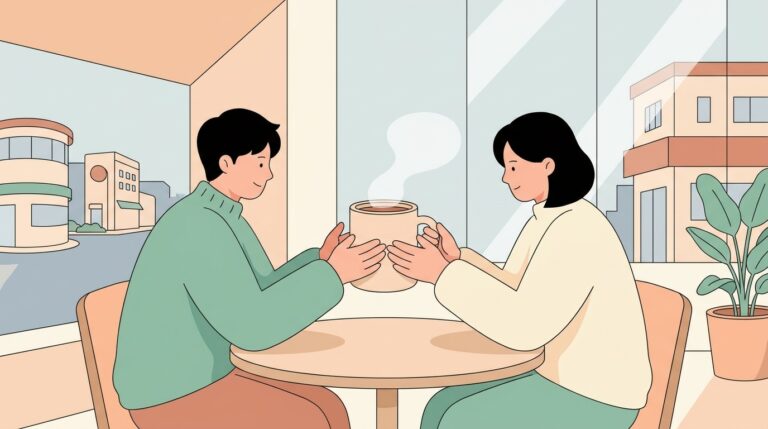
Phase 1: 공감 (Story Opening)
안녕하세요! 매일한글 에디터입니다.
Picture this: You are watching your favorite K-Drama. The main character has just worked a grueling 14-hour shift at an office in Gangnam, or maybe they just received heartbreaking news. Their best friend slides a warm canned coffee across the desk, looks into their eyes, and softly says, “힘내세요 (Him-nae-se-yo).” You can feel the warmth through the screen. But when you want to comfort a Korean friend, classmate, or favorite idol on Weverse, you might freeze. Should you say “Fighting”? Is “Himnaeseyo” too polite or too casual? How do you offer genuine comfort without sounding robotic or intrusive?
Offering sympathy and encouragement is one of the most heartfelt parts of Korean culture. In this guide—built directly on feedback from over 1,000 beginner Korean learners—you will learn exactly how to lift someone up with natural warmth, polite phrasing, and genuine cultural empathy. Let’s master the art of comforting others in Korean together!
Phase 2: 핵심 표현 3선 심층 분석 (Top 3 Core Expressions)
1. 힘내세요 (Him-nae-se-yo)
- Pronunciation: [Him-nae-se-yo] (Sounds like “Heem” + “meh” with an ‘n’ -> “Heem-neh-say-yo”)
- Meaning: Literally “Produce strength!” | Real Nuance: “Cheer up!”, “Stay strong!”, or “Hang in there!”
- K-Culture Moment: Seen in almost every workplace K-Drama (like Misaeng or Start-Up) when coworkers hand each other energy drinks during late-night projects.
- Editor’s Insight: 힘 (Him) means strength/energy, and 내다 (Naeda) means to bring forth or pull out. The polite ending -세요 (-seyo) makes it gentle and respectful. It is universally safe for coworkers, acquaintances, and elders.
- Situation Spectrum: Casual ⚠️ (use 힘내 [Him-nae] instead) | Semi-formal ✅ | Formal ✅
- 🤔 Think About It: In English, we often say “Cheer up” (focusing on mood) or “Hang in there” (focusing on endurance). Korean 힘내세요 encourages bringing out inner energy from within. How does this reflect the value of inner resilience in Korean society?
2. 파이팅 / 화이팅 (Pai-ting / Hwa-i-ting)
- Pronunciation: [Pai-ting] / [Hwa-i-ting] (Sounds like “Pie-ting” or “Hwah-ee-ting”)
- Meaning: Konglish derived from “Fighting!” | Real Nuance: “You can do it!”, “Go for it!”, or “Let’s do this!”
- K-Culture Moment: Shouted by K-Pop idols right before going on stage while putting their hands in the center for a team chant.
- Editor’s Insight: Although it originates from the English word ‘fight’, it carries zero violent meaning in Korean. It is purely celebratory, motivating, and energetic. 화이팅 is widely spoken, while 파이팅 is the official standard spelling.
- Situation Spectrum: Casual ✅ | Semi-formal ✅ | Formal ⚠️ (a bit too playful for very somber or strictly formal events)
- 🤔 Think About It: Why do you think a competitive word like “fighting” evolved into an everyday word of love and encouragement in modern Korea?
3. 괜찮아요 (Gwaen-chan-a-yo)
- Pronunciation: [Gwaen-chan-a-yo] (Sounds like “Gwen-chahn-ah-yo”)
- Meaning: Literally “It is fine.” | Real Nuance: “It’s okay”, “Don’t worry”, or “Everything will be alright.”
- K-Culture Moment: The classic comfort phrase when a friend makes a mistake or drops something at a café, accompanied by a soft, reassuring nod.
- Editor’s Insight: Depending on your intonation, it can be a statement (“I am okay”), a question (“Are you okay?”), or a comforting reassurance (“It’s going to be fine”).
- Situation Spectrum: Casual ⚠️ (use 괜찮아 [Gwaen-chan-a] with close friends) | Semi-formal ✅ | Formal ✅
- 🤔 Think About It: A single word serving three distinct conversational roles depending solely on intonation shows how heavily Korean relies on vocal emotion.
Phase 3: 교과서 한국어 vs 진짜 한국어 (Textbook vs. Real Korean)
Situation 1: Cheering on a friend before a big exam or presentation
- 📖 교과서 한국어 (Textbook): 용기를 내십시오. (Yong-gi-reul nae-sip-si-o. / “Have courage.”)
- 🗣️ 진짜 한국어 (Real-life): 파이팅! 잘할 수 있어요! (Pai-ting! Jal-hal su iss-eo-yo! / “Fighting! You can do it!”)
- 💡 왜 다를까? (Why the difference?): Nobody uses stiff military-style textbook endings like -십시오 in everyday life to cheer on friends. Koreans love short, punchy, optimistic phrases!
Situation 2: Comforting a coworker who looks totally burned out
- 📖 교과서 한국어 (Textbook): 기운을 차리세요. (Gi-un-eul cha-ri-se-yo. / “Regain your vigor.”)
- 🗣️ 진짜 한국어 (Real-life): 오늘 고생 많았어요. 힘내요! (O-neul go-saeng man-ass-eo-yo. Him-nae-yo! / “You worked so hard today. Cheer up!”)
- 💡 왜 다를까? (Why the difference?): In Korean culture, acknowledging someone’s hard work (고생 [Go-saeng]) before telling them to cheer up feels much more sincere and empathetic.
Phase 4: K-Culture 딥다이브 & 비언어적 매너 (Culture & Manner)
4-1. 눈치 (Nunchi) & Body Language
When saying 힘내세요 or 괜찮아요, body language is 80% of the message:
* Eye Contact & Soft Nod: Do not stare aggressively. Make gentle eye contact, soften your brow, and give a slow nod to show you truly understand their burden.
* The ‘Fighting’ Fist: When saying 파이팅!, make a light fist at chest level and give a single energetic pump.
* The Warm Drink Gesture: In Korea, words of sympathy are almost always accompanied by a small treat—a warm pouch drink, a vitamin drink (like Bacchus or Vita500), or an iced Americano.
4-2. Cultural Code: The Power of ‘Gosaeng’ (고생)
Foreigners often ask: “Why do Koreans always talk about suffering and hard work?” Phrases like 고생했어요 (Go-saeng-haess-eo-yo) acknowledge that life and work require genuine effort. When you pair 고생했어요 with 힘내세요, you validate their struggle first instead of just telling them to be happy immediately. It is the ultimate form of Korean 정 (Jeong – affection/bonding).
Phase 5: 실전 롤플레이 시나리오 (Real-Life Roleplay)
Setting: A quiet café in Sinchon, Seoul. You meet your Korean friend/classmate Minji (민지), who is slumped over a massive pile of study notes and looks completely exhausted.
- Turn 1 (Minji): 휴… 오늘 시험 진짜 너무 어려웠어요. (Hyu… o-neul si-heom jin-jja neo-mu eo-ryeo-woess-eo-yo.)
🎭 Sighing deeply and resting her forehead on the desk(Sigh… today’s exam was really so hard.) - Turn 2 (You): 진짜요? 민지 씨, 오늘 고생 많았어요. (Jin-jja-yo? Min-ji ssi, o-neul go-saeng man-ass-eo-yo.)
🎭 Handing her an iced latte with both hands(Really? Minji, you worked so hard today.) - Turn 3 (Minji): 고마워요… 근데 시험을 망친 것 같아요. 속상해요. (Go-ma-wo-yo… geun-de si-heom-eul mang-chin geot gat-a-yo. Sok-sang-hae-yo.)
🎭 Looking down with sad eyes(Thank you… but I think I messed up the exam. I’m so upset.) - Turn 4 (You): 너무 걱정하지 마세요. 다 괜찮을 거예요! (Neo-mu geok-jeong-ha-ji ma-se-yo. Da gwaen-chan-eul geo-ye-yo!)
🎭 Giving a reassuring, gentle smile(Don’t worry too much. Everything will be fine!) - Turn 5 (Minji): 그럴까요? 내일도 발표가 있는데 너무 피곤해요. (Geu-reol-kka-yo? Nae-il-do bal-pyo-ga it-neun-de neo-mu pi-gon-hae-yo.)
🎭 Rubbing her tired eyes(Do you think so? I have a presentation tomorrow too, and I’m so tired.) - Turn 6 (You): 힘내세요! 민지 씨는 잘할 수 있어요. (Him-nae-se-yo! Min-ji ssi-neun jal-hal su iss-eo-yo.)
🎭 Lightly pumping a fist at chest level(Cheer up! You can do great, Minji.) - Turn 7 (Minji): 와, 그렇게 말해줘서 진짜 힘이 나네요! (Wa, geu-reoh-ge mal-hae-jwo-seo jin-jja him-i na-ne-yo!)
🎭 Smiling brightly with renewed energy(Wow, hearing you say that really gives me strength!) - Turn 8 (You): 우리 오늘 맛있는 거 먹으러 가요. 파이팅! (U-ri o-neul mas-it-neun geo meog-eu-reo ga-yo. Pai-ting!)
🎭 Pointing towards the exit playfully(Let’s go eat something delicious today. Fighting!)
🔀 Interactive Branching Point
Minji says she is stressed about tomorrow’s presentation. What do you say?
* Option A: 힘내세요! 민지 씨는 잘할 거예요! (Him-nae-se-yo! Min-ji ssi-neun jal-hal geo-ye-yo! / Cheer up! You will do great!)
* Option B: 왜 그렇게 피곤해해요? 일찍 자요. (Wae geu-reoh-ge pi-gon-hae-hae-yo? Il-jjik ja-yo. / Why are you so tired? Just sleep early.)
* Option C: 용기를 내십시오. (Yong-gi-reul nae-sip-si-o. / Summon your bravery.)
- Feedback:
- Option A (BEST): Perfect! It combines respectful encouragement with heartfelt belief in her abilities.
- Option B (BAD): Too blunt and dismissive. It sounds like you’re blaming her for being tired.
- Option C (RISK): Grammatically correct, but sounds like an ancient king commanding a soldier before battle!
Phase 6: 10초 감정 섀도잉 드릴 (10-Sec Emotion Shadowing)
Practice reading these out loud with rhythm and proper emotion tags! The / indicates a brief micro-pause.
[🥺 Soft & Comforting]괜찮아요 / 다 잘 될 거예요. (Gwaen-chan-a-yo / da jal doel geo-ye-yo. / It’s okay / everything will turn out fine.)[💪 Warm & Encouraging]오늘 고생 많았어요 / 힘내세요! (O-neul go-saeng man-ass-eo-yo / him-nae-se-yo! / You worked hard today / stay strong!)[🔥 Bright & Cheerful]우리는 할 수 있어요 / 파이팅! (U-ri-neun hal su iss-eo-yo / pai-ting! / We can do this / fighting!)
Phase 7: K-Culture 미니 사전 (Mini Dictionary)
- 힘 (Him): [Noun] Physical or mental strength/energy. Used in phrases like 힘이 나요 (Him-i na-yo – I feel energized).
- 응원 (Eung-won): [Noun] Cheering, root for someone, support. E.g., 응원할게요! (Eung-won-hal-ge-yo! – I’ll be rooting for you!).
- 토닥토닥 (To-dak-to-dak): [Onomatopoeia] The sound and action of gently patting someone on the back to console them.
- 고생 (Go-saeng): [Noun] Hardship, struggle, or effort. Essential in the phrase 고생하셨습니다 (Go-saeng-ha-syeot-seum-ni-da – Thank you for your hard work).
Phase 8: 여행자를 위한 생존 키트 (Traveler’s Survival Kit)
TOP 3 Survival Phrases
- 힘내세요! (Him-nae-se-yo!) – Use this when your tour guide or a hardworking shopkeeper looks tired.
- 괜찮아요. (Gwaen-chan-a-yo.) – Say this when someone accidentally bumps into you on the Seoul subway or apologizes for a delay.
- 감사합니다, 파이팅! (Gam-sa-ham-ni-da, pai-ting!) – A fun, energetic way to thank friendly staff at convenience stores or youth hostels.
Editor’s Travel Note
When navigating Korea, knowing comforting phrases makes local interactions unforgettable! Make sure you complete your Naver Map app download to find late-night comfort food spots (포장마차 – Pojangmacha), where warm bowls of fishcake soup (어묵탕) and friendly encouragement are always waiting.
Phase 9: “한 발 더 깊이” (Cultural Reflection)
In Western cultures, comfort is often focused on the individual: “Take time for yourself” or “Don’t stress.” In Korean culture, comfort is inherently relational and collective. When you say 힘내세요, you aren’t just saying “get strong”; you are tacitly saying, “I see your effort, I recognize your burden, and I am lending you my energy.” Korean empathy creates a shared space where nobody has to struggle entirely alone.
💬 Your Turn: How do people comfort each other in your native culture? Do you focus on resting, cheering, or validating feelings? Share in the comments below!
Phase 10: FAQ & 흔한 실수 (FAQ Schema)
Q: Can I say “힘내세요” to someone who lost a loved one at a funeral?
A: No! At a Korean funeral, saying 힘내세요 or 파이팅 is inappropriate. Instead, say 삼가 고인의 명복을 빕니다 (Sam-ga go-in-ui myeong-bok-eul bim-ni-da – May the deceased rest in peace) or simply offer a silent bow.
Q: What is the difference between 파이팅 (Pai-ting) and 화이팅 (Hwa-i-ting)?
A: They mean the exact same thing! 파이팅 is the standard spelling according to the National Institute of Korean Language, but 화이팅 is used just as frequently in texting, TV shows, and daily speech.
Q: Can I use “힘내 (Him-nae)” with my boss or teacher?
A: Never! Dropping -세요 turns it into informal language (반말 – Banmal). Always use 힘내세요 (Him-nae-se-yo) or formal 힘내십시오 (Him-nae-sip-si-o) with elders and superiors.
🚨 Common Mistakes TOP 3
- Mistake: Shouting 파이팅! at somber or sad moments.
- Correct Action: Save 파이팅! for challenges/exams/sports, and use 힘내세요 for exhaustion or sadness.
- Mistake: Using 괜찮아요 when someone thanks you for a gift.
- Correct Action: Say 천만에요 (Cheon-man-e-yo) or 별말씀을요 (Byeol-mal-sseum-eul-yo – Don’t mention it) instead.
- Mistake: Pronouncing 힘 (Him) as “He-um” with two syllables.
- Correct Action: Keep it as one crisp syllable: Heem!
Phase 11: 액션 미션 & 참여 유도 (Action Missions)
- 🥉 Bronze Mission: Stand in front of the mirror, make a gentle fist, and say “힘내세요! (Him-nae-se-yo!)” with a warm smile 5 times.
- 🥈 Silver Mission: Leave an encouraging comment on your favorite K-Pop idol’s social media or Weverse post: “오빠/언니 힘내세요! 항상 응원해요! (Stay strong! I’m always cheering for you!)”.
- 🥇 Gold Mission: Next time you speak with a Korean friend, teacher, or language exchange partner who looks tired, hand them a virtual or real coffee and say “오늘 고생 많았어요. 힘내세요!”
🎮 K-Culture Mission: Watch an episode of any slice-of-life K-Drama (like Hospital Playlist or Weightlifting Fairy Kim Bok-joo) and spot at least one moment where 힘내 or 화이팅 is used!
Phase 12: 인터랙티브 퀴즈 챌린지 (Quiz Challenge)
1. Situation Judgment: Your coworker is stressed before a massive client presentation. Which phrase is the most natural?
* A) 괜찮아요 (Gwaen-chan-a-yo)
* B) 파이팅! 잘할 수 있어요! (Pai-ting! Jal-hal su iss-eo-yo!)
* C) 삼가 고인의 명복을 빕니다 (Sam-ga go-in-ui myeong-bok-eul bim-ni-da)
2. Fill in the Blank:
“오늘 ________ 많았어요. 힘내세요!” (You worked so hard today. Cheer up!)
* A) 고생 (Go-saeng)
* B) 노래 (No-rae)
* C) 사과 (Sa-gwa)
3. True or False:
파이팅 (Pai-ting) has an aggressive meaning in Korean because it comes from the English word ‘fight’. (True / False)
🔍 Click here to check the Answers & Explanations!
- Answer: B — 파이팅! 잘할 수 있어요! provides energetic encouragement right before an active challenge.
- Answer: A — 고생 (Go-saeng) means hard work/struggle. 오늘 고생 많았어요 is the natural pairing.
- Answer: False — In Korean, 파이팅 is 100% positive, meaning “You can do it!” or “Good luck!”






