

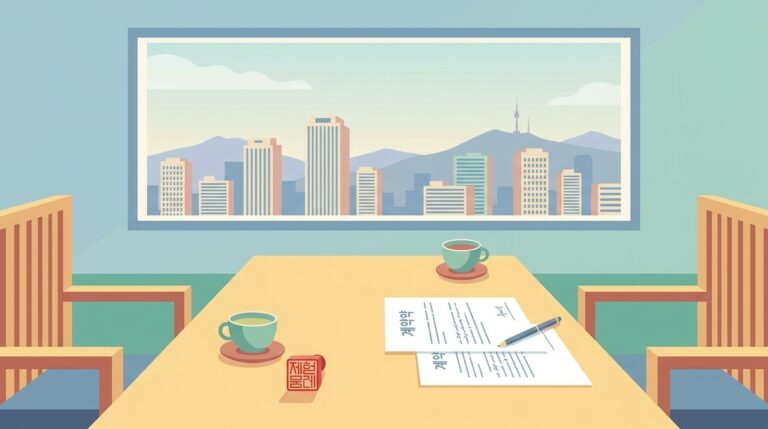
Phase 1: 공감 (Story-Immersive Opening)
안녕하세요! 매일한글 에디터입니다.
Picture this: You are sitting in a cozy, sunlit budongsan (부동산, certified real estate office) in Mapo-gu, Seoul. On the low glass table sits a hot cup of instant Maxim Mocha Gold coffee, a thick stack of certified land registries (deung-gi-bu deung-bon, 등기부등본), and the official standard purchase contract. You have spent months scouring neighborhood listings, calculating your mortgage limits, and finally found your dream apartment. But just as the broker pulls out the signature red stamp pad (injung, 인중), the seller casually mentions, “Oh, by the way, there is a minor water stain under the sink, and my existing bank mortgage will be settled sometime around moving day.”
Your heart skips a beat. In Korean contract culture, verbal assurances evaporate the second the final balance (jan-geum, 잔금) clears. If it is not explicitly written in the Special Terms Clause (teuk-yak-sa-hang, 특약사항), Korean civil law (Minbeop, 민법) will presume you accepted the property strictly as is (hyeon-si-seol-mul sang-tae, 현 시설물 상태).
Negotiating these clauses requires far more than basic Korean; it demands C1-level legal nuance, strategic politeness (nunchi, 눈치), and exact contractual phrasing. This guide is built on actual case files and consultations from our advanced learners who successfully secured properties in Korea without losing their deposits or sleep. Let’s master the art of writing ironclad real estate clauses together!
Phase 2: 핵심 표현 3선 심층 분석 (Top 3 Core Expressions)
1. 잔금 지급 시점까지 근저당권을 말소하기로 한다.
- Pronunciation: Jan-geum ji-geup si-jeom-kka-ji geun-jeo-dang-gwon-eul mal-so-ha-gi-ro han-da. (Sounds like: Zhan-geum jee-geup she-jeom-ggah-jee gun-juh-dahng-gwon-eul mahl-soh-hah-gee-roh hahn-dah)
- Meaning: Literal: “Decide to erase the collateral mortgage by the time of final balance payment.” / Actual Nuance: “The seller is legally bound to clear and discharge all existing mortgages/liens before receiving the final balance payment.”
- K-Culture Moment: In K-dramas dealing with dramatic real estate inheritance (like Penthouse or Agency), you often see buyers ruined because a sneaky seller took the balance while hidden liens (geun-jeo-dang, 근저당) were still attached. This exact clause prevents that nightmare.
- Editor’s Insight: Malsohada (말소하다) is formal legal vocabulary for official nullification/cancellation in public registries. Using this precise term leaves zero room for the seller to claim ambiguity.
- Situation Spectrum: Casual 🚫 | Semi-formal ⚠️ | Formal Legal Contract ✅
- 🤔 Think About It: In your home country, does the title company automatically verify mortgage discharge, or do you have to demand it explicitly in the purchase agreement as in Korea?
2. 현 시설물 상태에서의 매매 계약이나, 중대한 하자 발생 시 매도인이 수리 및 보수한다.
- Pronunciation: Hyeon si-seol-mul sang-tae-e-seo-ui mae-mae gye-yag-i-na, jung-dae-han ha-ja bal-saeng si mae-do-in-i su-ri mit bo-su-han-da. (Sounds like: Hyun she-sul-mool sahng-teh-eh-suh-ui meh-meh gyeh-yahg-ee-nah, joong-deh-hahn hah-jah bahl-seng she meh-doh-een-ee soo-ree meet boh-soo-hahn-dah)
- Meaning: Literal: “It is a sale contract in the current facility state, but upon occurrence of major defects, the seller repairs and restores.” / Actual Nuance: “While sold as inspected, the seller remains strictly liable for repairing major latent defects (e.g., core plumbing, structural water leaks, hidden heating failures).”
- K-Culture Moment: Seen in relatable slice-of-life dramas like Because This Is My First Life, where young buyers discover devastating water leaks during the first winter freeze and scramble to check what their contract stipulated.
- Editor’s Insight: Most Korean standard forms start with hyeon si-seol-mul sang-tae (as-is condition). Unless you append this counter-clause, standard civil claim periods (ha-ja-dam-bo-che-gim, 하자담보책임) can turn into lengthy, expensive civil mediations.
- Situation Spectrum: Casual 🚫 | Semi-formal ⚠️ | Formal Legal Contract ✅
- 🤔 Think About It: How does Korean law’s distinction between cosmetic wear-and-tear vs. jung-dae-han ha-ja (fundamental structural defect) reflect the communal standard of apartment living?
3. 본 계약은 매수인의 대출 미승인 시 위약금 없이 조건 없이 해제하고 계약금을 전액 반환한다.
- Pronunciation: Bon gye-yag-eun mae-su-in-ui dae-chul mi-seung-in si wi-yak-geum eop-si jo-geon eop-si hae-je-ha-go gye-yak-geum-eul jeon-aek ban-hwan-han-da. (Sounds like: Bohn gyeh-yahg-eun meh-soo-een-ui deh-chool mee-seung-een she wee-yahk-geum up-she joh-gun up-she heh-jeh-hah-goh gyeh-yahk-geum-eul juhn-ek bahn-hwahn-hahn-dah)
- Meaning: Literal: “This contract, upon unapproval of buyer’s loan, cancels without penalty without conditions and returns contract deposit in full.” / Actual Nuance: “Finance contingency clause: If the mortgage loan is rejected due to policy changes or appraisal limits, this contract is voided with zero penalty and the full 10% deposit is refunded immediately.”
- K-Culture Moment: With shifting government loan regulations (LTV/DSR mortgage ceilings in Seoul), you frequently hear news stories of buyers forfeiting 50,000,000 KRW deposits overnight. This clause is a buyer’s ultimate shield.
- Editor’s Insight: In Korean contract disputes, without the phrase wi-yak-geum eop-si (without penalty damages), standard civil law dictates that if the buyer cannot pay the remainder, the seller automatically keeps the gye-yak-geum (contract deposit).
- Situation Spectrum: Casual 🚫 | Semi-formal ⚠️ | Formal Legal Contract ✅
- 🤔 Think About It: Why is financial contingency (dae-chul mi-seung-in teuk-yak) not standard boilerplate in Korea, requiring the buyer to actively lobby for its insertion?
Phase 3: 교과서 한국어 vs 진짜 한국어 (Textbook vs. Real Native Korean)
Situation A: Requesting the broker to add a contingency clause during negotiations
- 📖 교과서 한국어 (Textbook):
- “제가 대출을 못 받으면 계약금을 돌려받고 싶으니 특약에 써 주세요.”
- (Je-ga dae-chul-eul mot bad-eu-myeon gye-yak-geum-eul dol-ryeo-bad-go sip-eu-ni teuk-yak-e sseo ju-se-yo.)
- “I want my deposit back if I can’t get a loan, so please write it in the special clause.”
- 🗣️ 진짜 한국어 (Real Professional Native):
- “금융권 정책 변동으로 인한 대출 미승인 시, 계약금을 원상환환하는 특약 문구를 하나 명기해 주시길 부탁드립니다.”
- (Geum-yung-gwon jeong-chaek byeon-dong-eu-ro in-han dae-chul mi-seung-in si, gye-yak-geum-eul won-sang-hwan-hwan-ha-neun teuk-yak mun-gu-reul ha-na myeong-gi-hae ju-si-gil bu-tak-deu-rim-ni-da.)
- “I kindly request that we explicitly stipulate a clause returning the deposit to its original state if mortgage approval fails due to banking policy shifts.”
- 💡 왜 다를까? (Why the difference?): Real estate transactions involve vast sums of money and high tension. Using objective institutional vocabulary (geum-yung-gwon jeong-chaek, myeong-gi-hae ju-si-gil) frames the request not as personal financial weakness, but as standard risk management, making the seller far more willing to agree.
Situation B: Inquiring about latent leakages (nusu) before signing
- 📖 교과서 한국어 (Textbook):
- “집에 물이 새면 집주인이 다 고쳐주나요?”
- (Jib-e mul-i sae-myeon jip-ju-in-i da go-cheo-ju-na-yo?)
- “If water leaks in the house, does the landlord fix everything?”
- 🗣️ 진짜 한국어 (Real Professional Native):
- “누수나 배관 같은 주요 하자는 잔금일 이후라도 매도인의 하자담보책임 범주에 포함되도록 특약 조정을 부탁드립니다.”
- (Nu-su-na bae-gwan gat-eun ju-yo ha-ja-neun jan-geum-il i-hu-ra-do mae-do-in-ui ha-ja-dam-bo-chaek-im beom-ju-e po-ham-doe-do-rok teuk-yak jo-jeong-eul bu-tak-deu-rim-ni-da.)
- “Please adjust the special terms so that fundamental defects such as plumbing and water leaks fall clearly under the seller’s legal warranty liability even post-settlement.”
- 💡 왜 다를까? (Why the difference?): Invoking legal concepts like ha-ja-dam-bo-chaek-im (statutory defect warranty under Korean Civil Code Art. 580) shifts the dialogue from an awkward personal demand into standard procedural diligence.
Phase 4: K-Culture 딥다이브 & 비언어적 매너 (Deep Dive & Non-Verbal Manners)
4-1. 눈치 (Nunchi) & Office Etiquette in Contract Negotiations
- The Power Dynamic of the Triangle: In Korea, the Gong-in-jung-gae-sa (공인중개사, Licensed Real Estate Broker) sits in the center between Buyer (Mae-su-in, 매수인) and Seller (Mae-do-in, 매도인). Never attack the seller directly with aggressive demands. Address your requests politely to the broker: “소장님, 계약의 안정성을 위해 이 문구 삽입을 중재해 주실 수 있을까요?” (Sojang-nim, gye-yak-ui an-jeong-seong-eul wi-hae i mun-gu sap-ip-eul jung-jae-hae ju-sil su iss-eul-kka-yo? – “Director, could you mediate inserting this clause for mutual transaction safety?”).
- Two-Handed Document Handling: Whenever reviewing the certified register (deung-gi-bu deung-bon) or presenting your personal seal (in-gam-do-jang, 인감도장) / ID card, always use both hands. Placing your stamp with firm, deliberate pressure shows serious commitment and legal respect.
4-2. Cultural Code Analysis: The Supremacy of “Teuk-yak” (특약)
In Korean society, interpersonal relationships are often governed by Jeong (정, warm relational affection), but the real estate market is governed by merciless procedural literalism. Standard pre-printed contracts (pyo-jun gye-yak-seo) favor the status quo. The blank box at the bottom titled 특약사항 (Special Provisions) overrides general boilerplate clauses. In legal disputes, Korean courts interpret teuk-yak as the purest reflection of true party intent (dang-sa-ja-ui jin-jeong-han ui-sa). Mastering teuk-yak is mastering self-protection in Korea.
Phase 5: 실전 롤플레이 시나리오 (Real-world Roleplay Scenario)
- Setting: Inside Hangang Central Realty in Yongsan, Seoul. The atmosphere is quiet, punctuated by the hum of the air conditioner and the ticking of an antique wall clock.
- Characters:
- You (매수인 / Buyer): Thorough, calm, and legally prepared.
- 박 소장 (Broker Park): Veteran real estate agent wearing thin gold-rimmed glasses.
- 최 대표 (Seller Choi): Experienced apartment investor who prefers quick, loose paperwork.
Turn 1 (Broker Park)
박 소장: 자, 등기부등본상 깨끗하고요, 특약은 통상적인 표준 문구로 넣었습니다. 여기 서명하시면 됩니다.
(Ja, deung-gi-bu-deung-bon-sang kkae-kkeut-ha-go-yo, teuk-yak-eun tong-sang-jeog-in pyo-jun mun-gu-ro neoh-eoss-seum-ni-da. Yeo-gi seo-myeong-ha-si-myeon doem-ni-da.)
"Well, the registry is clean, and I inserted the standard customary clauses. You can sign right here."
🎭 Pushes the open contract folder toward you with a pen.

Turn 2 (You)
매수인: 꼼꼼히 검토해 주셔서 감사합니다, 소장님. 다만 잔금일 전 기존 근저당권 전액 말소 건을 특약에 명시하고 싶습니다.
(Kkom-kkom-hi geom-to-hae ju-syeo-seo gam-sa-ham-ni-da, so-jang-nim. Da-man jan-geum-il jeon gi-jon geun-jeo-dang-gwon jeon-aek mal-so geon-eul teuk-yak-e myeong-si-ha-go sip-seum-ni-da.)
"Thank you for the thorough review, Director. However, I would like to explicitly specify in the special clauses the full discharge of existing mortgages prior to the settlement date."
🎭 Politely rests finger beside the special terms section without signing yet.

Turn 3 (Seller Choi)
최 대표: 아이고, 제가 잔금 받아서 당일 은행 가서 바로 갚을 텐데, 굳이 그런 빡빡한 문구까지 넣어야 합니까?
(Ai-go, je-ga jan-geum bad-a-seo dang-il eun-haeng ga-seo ba-ro gap-eul ten-de, gu-ji geu-reon ppak-ppak-han mun-gu-kka-ji neoh-eo-ya ham-ni-kka?)
"Oh come on, I'm going to pay off the bank immediately on that day once I receive the balance. Do we really need such rigid wording?"
🎭 Chuckles dismissively, leaning back on the sofa.

Turn 4 (You)
매수인: 대표님 말씀을 전적으로 신뢰합니다. 다만 쌍방의 법적 권리관계를 명확히 해두는 것이 매도인과 매수인 모두에게 안전하다고 생각합니다.
(Dae-pyo-nim mal-ssum-eul jeon-jeog-eu-ro sin-roe-ham-ni-da. Da-man ssang-bang-ui beop-jeok gwon-li-gwan-gye-reul myeong-hwak-hi hae-du-neun geos-i mae-do-in-gwa mae-su-in mo-du-e-ge an-jeon-ha-da-go saeng-gak-ham-ni-da.)
"I fully trust your word, Sir. However, clarifying the mutual legal rights ensures safety for both the seller and the buyer."
🎭 Maintains polite eye contact with a calm, reassuring smile.

Turn 5 (Broker Park)
박 소장: 최 대표님, 매수인 분 말씀이 법률적으로 맞습니다. '잔금 완납과 동시에 근저당권 말소 서류 일체를 교부한다'로 정리해 드리겠습니다.
(Choe dae-pyo-nim, mae-su-in bun mal-ssum-i beop-ryul-jeog-eu-ro maj-seum-ni-da. 'Jan-geum wan-nap-gwa dong-si-e geun-jeo-dang-gwon mal-so seo-ryu il-che-reul gyo-bu-han-da'ro jeong-ri-hae deu-ri-gess-seum-ni-da.)
"CEO Choi, what the buyer says is legally correct. I will formulate it as: 'Simultaneously with full payment of the balance, all mortgage discharge documents shall be surrendered.'"
🎭 Nods knowingly and begins typing on the computer.

Turn 6 (You)
매수인: 덧붙여, 중대한 누수 하자에 대한 매도인 하자담보책임 6개월 보장 조항도 함께 기재 부탁드립니다.
(Deot-bu-chyeo, jung-dae-han nu-su ha-ja-e dae-han mae-do-in ha-ja-dam-bo-chaek-im yuk-gae-wol bo-jang jo-hang-do ham-kke gi-jae bu-tak-deu-rim-ni-da.)
"Additionally, please include the clause guaranteeing the seller's 6-month defect warranty liability regarding major water leaks."
🎭 Hands a prepared checklist memo neatly to the broker.

Turn 7 (Seller Choi)
최 대표: 허허, 젊은 분이 부동산 계약을 아주 빈틈없이 잘 아시네. 좋습니다. 그렇게 명기하고 도장 찍읍시다.
(Heo-heo, jeolm-eun bun-i bu-dong-san gye-yak-eul a-ju bin-teum-eop-si jal a-si-ne. Joh-seum-ni-da. Geu-reoh-ge myeong-gi-ha-go do-jang jjik-eup-si-da.)
"Haha, you are extraordinarily thorough with real estate contracts! Fair enough. Let's write that in and stamp it."
🎭 Opens his seal box with newfound respect.

Turn 8 (Broker Park)
박 소장: 수정된 특약사항 출력했습니다. 양측 모두 조항 확인하시고 날인해 주십시오.
(Su-jeong-doen teuk-yak-sa-hang chul-ryeok-haess-seum-ni-da. Yang-cheuk mo-du jo-hang hwak-in-ha-si-go nal-in-hae ju-sip-si-o.)
"I have printed the revised special provisions. Both parties please verify the clauses and affix your seals."
🎭 Places the freshly printed legal contract on the desk.
🔀 인터랙티브 분기점 (Choose Your Action)
What would you do if the seller vehemently refused to include the loan contingency clause (dae-chul mi-seung-in teuk-yak)?
- Option A: Cave in and sign immediately so you don’t lose the apartment.
- Outcome (Bad): High financial risk. If bank mortgage policies tighten before settlement, you could forfeit 10% of the total purchase price (often 50M-100M KRW).
- Option B: Argue emotionally on the spot: “왜 제 말을 안 믿어주세요?” (“Why don’t you trust me?”).
- Outcome (Risk): Breaks nunchi harmony, causes emotional offense, and derails broker mediation.
- Option C (Best): Request a short 24-hour hold with a provisional deposit (ga-gye-yak-geum) while obtaining pre-underwriting approval from your bank branch manager, then finalize the formal clause.
- Feedback (Best Action): Demonstrates seasoned C1 negotiating maturity. Protects your capital while keeping the transaction alive.
Phase 6: 10초 감정 섀도잉 드릴 (10-Second Emotional Shadowing Drill)
Practice these high-stakes sentences with precise cadence and pausing (/).
[⚖️ 차분하고 단호한 권리 주장 / Calm & Firm assertion of rights]- “잔금 지급 시점까지 / 등기부상 근저당권은 / 매도인이 전액 말소하기로 / 약정합니다.”
- (Jan-geum ji-geup si-jeom-kka-ji / deung-gi-bu-sang geun-jeo-dang-gwon-eun / mae-do-in-i jeon-aek mal-so-ha-gi-ro / yak-jeong-ham-ni-da.)
[🤝 정중하지만 빈틈없는 방어 / Polite yet watertight safeguard]- “매수인의 귀책사유 없는 / 대출 거절 시에는 / 위약금 없이 / 계약을 무효로 처리해 주십시오.”
- (Mae-su-in-ui gwi-chaek-sa-yu eop-neun / dae-chul geo-jeol si-e-neun / wi-yak-geum eop-si / gye-yak-eul mu-hyo-ro cheo-ri-hae ju-sip-si-o.)
[🔍 명확한 사실 확인 요구 / Clear factual verification]- “육안으로 확인하기 어려운 / 누수 및 중대 하자는 / 인도일로부터 6개월간 / 담보책임을 집니다.”
- (Yuk-an-eu-ro hwak-in-ha-gi eor-yeo-un / nu-su mit jung-dae ha-ja-neun / in-do-il-lo-bu-teo yuk-gae-wol-gan / dam-bo-chaek-im-eul jim-ni-da.)
Phase 7: K-Culture 미니 사전 (Key Legal Terms)
- 특약사항 (Teuk-yak-sa-hang) | Special Contractual Provisions
- Custom contractual stipulations negotiated between buyer and seller that supersede general default rules in standard forms.
- 등기부등본 (Deung-gi-bu-deung-bon) | Certified Real Estate Register
- The official Supreme Court registry document verifying actual ownership (Gap-gu, 갑구) and encumbrances/liens (Eul-gu, 을구).
- 근저당권 (Geun-jeo-dang-gwon) | Collateral Maximum Mortgage Lien
- A security right registered by banks (usually 120% of the loan amount) securing real estate debts. Must be discharged upon purchase.
- 하자담보책임 (Ha-ja-dam-bo-chaek-im) | Defect Liability Warranty
- The legal obligation of the seller under Korean Civil Law to repair or compensate for hidden, critical property defects discovered within a specified timeframe.
Phase 8: 실전 생존 키트 (Legal Survival Kit)
Top 3 On-Site Phrases
- “등기부 을구에 설정된 근저당권 말소 서류는 잔금일에 확인하겠습니다.”
- (Deung-gi-bu eul-gu-e seol-jeong-doen geun-jeo-dang-gwon mal-so seo-ryu-neun jan-geum-il-e hwak-in-ha-gess-seum-ni-da.)
- Pro Tip: Use this to clarify that you will inspect official bank loan payoff verification receipts (wan-nap-jeung-myeong-seo) on moving day.
- “선순위 임차권이나 가압류가 없는 무하자 상태로 인도하는 조건입니다.”
- (Seon-sun-wi im-cha-gwon-i-na ga-am-ryu-ga eop-neun mu-ha-ja sang-tae-ro in-do-ha-neun jo-geon-im-ni-da.)
- Pro Tip: Guarantees the property is handed over clean without prior tenants or pre-seizures.
- “계약서 작성 전 구두 합의된 특약 문안을 문자로 먼저 보내주시겠습니까?”
- (Gye-yak-seo jak-seong jeon gu-du hap-ui-doen teuk-yak mun-an-eul mun-ja-ro meon-jeo bo-nae-ju-si-gess-seum-ni-kka?)
- Pro Tip: Always get draft clauses in writing via SMS or KakaoTalk before sitting at the contract table.
Editor’s Travel & Legal Tech Note
- Before stepping into any agency, access the official 대한민국 법원 인터넷등기소 열람 서비스 to issue a real-time certified copy of the property register on your mobile device on the very morning of signing.
- To research realistic market transactions and recent neighborhood deal comps, check 직방 및 호갱노노 부동산 실거래가 조회 rather than relying exclusively on broker-quoted prices.
Phase 9: “한 발 더 깊이” (One Step Deeper: Reflective Essay)
In traditional Korea, land transfers were often community affairs sealed with rice wine and mutual village trust. However, contemporary South Korea features one of the most compressed, highly-leveraged apartment markets in the world. This creates a fascinating cultural paradox: while initial negotiation relies heavily on warmth (jeong) and non-confrontational body language, the resulting contract must be engineered with clinical legal precision. The highest expression of linguistic mastery (C1) is not speaking coldly like a statute book, but effortlessly weaving hard legal terms into warm, deferential discourse.
💬 Your Turn: In your home country, how are latent property defects handled? Does the seller have mandatory defect disclosure statements, or is it strictly buyer-beware (caveat emptor)? Share your thoughts below!
Phase 10: FAQ & 흔한 실수 (FAQ & Common Mistakes)
Q: What is the difference between Gap-gu (갑구) and Eul-gu (을구) in a Korean property title?
A: Gap-gu (갑구) records legal ownership history, current title holders, and any legal ownership disputes (such as provisional seizures, ga-ap-ryu). Eul-gu (을구) lists security rights, mortgages (geun-jeo-dang), and leasehold rights. If Eul-gu is blank, there are no registered bank debts on the property.
Q: Can a verbal agreement (gu-du hap-ui) be enforced if it wasn’t written in the teuk-yak section?
A: While Korean Civil Law recognizes verbal agreements in theory, proving them in court without explicit audio recordings or written confirmation is exceptionally difficult. If an item matters to you, it must be inscribed in the teuk-yak-sa-hang box.
Q: Does the broker’s liability insurance (gong-je-jeung-seo) protect my entire deposit if something goes wrong?
A: No. Broker association insurance generally covers only up to 100M-200M KRW per agency across all claims in a given year, not per individual victim. You cannot rely solely on the broker’s insurance for major transaction safety.
🚨 Common Mistakes Warning Board
- Mistake 1: Assuming “as-is condition” (hyeon-si-seol-mul sang-tae) lets the seller off the hook for major hidden slab leaks.
- Correct Action: Always insert the explicit exception clause for latent defects (jung-dae-han nu-su mit ha-ja).
- Mistake 2: Relying on a title register printed yesterday.
- Correct Action: Insist on viewing a fresh deung-gi-bu deung-bon issued within 10 minutes of contract signing and again on final settlement day.
- Mistake 3: Paying the remainder (jan-geum) before visually checking that the seller has completely moved out and all utility bills are settled.
- Correct Action: Conduct a final walkthrough (hyeon-jang sil-sa) right before sending the final bank wire.
Phase 11: 액션 미션 (Action Missions)
- 🥉 Bronze Mission (Self Practice): Read Aloud Phase 6’s Shadowing sentences 5 times, focusing on clean pronunciation of legal compound words like geun-jeo-dang-gwon and ha-ja-dam-bo-chaek-im.
- 🥈 Silver Mission (Community / Social): Post in the comments or on your language diary one custom teuk-yak clause tailored to your ideal home (e.g., parking space guarantees or pet-friendly agreements in Korean).
- 🥇 Gold Mission (Real-life Execution): Next time you watch a real-estate themed K-Drama or talk to a Korean broker, identify whether the parties are discussing Gap-gu or Eul-gu issues and spot the negotiation cues!
🎮 K-Culture Mission: Watch an episode of a Korean variety show featuring house-hunting (such as MBC’s Where is My Home / 구해줘! 홈즈) and jot down how often the hosts check for water pressure (su-ap) and register status (deung-gi-bu)!
Phase 12: 인터랙티브 퀴즈 챌린지 (Interactive Quiz Challenge)
Q1. Situational Judgment: You are buying an apartment in Seoul and want to ensure you get your deposit back if government mortgage regulations prevent you from securing financing. Which phrase must be included?
* A) 현 시설물 상태로 인수하며 일체 이의를 제기하지 않는다.
* B) 매수인의 귀책사유 없는 대출 미승인 시 위약금 없이 본 계약을 무효로 하고 계약금을 전액 반환한다.
* C) 잔금 지급일에 은행에서 만나 대출 상담을 진행한다.
Q2. Fill in the Blank:
“등기부등본 을구에 설정된 ( )은/는 잔금 완납 시까지 매도인이 전액 말소하기로 한다.”
Q3. True or False:
Under standard Korean real estate custom, if you sign “현 시설물 상태에서의 계약” without any special provisions, the seller is automatically required to replace standard cosmetic wallpaper tears after move-in. (T/F)
👉 Click here for Answers & Explanations
- A1 Answer: B) Option B clearly states the loan contingency and zero-penalty deposit return. Option A strips your defect rights, and Option C carries no legal protection.
- A2 Answer: 근저당권 (Geun-jeo-dang-gwon / Collateral Maximum Mortgage Lien).
- A3 Answer: False (F). Standard wear and tear such as cosmetic wallpaper scratches is the buyer’s responsibility under “as-is” terms unless specifically negotiated in teuk-yak.







