

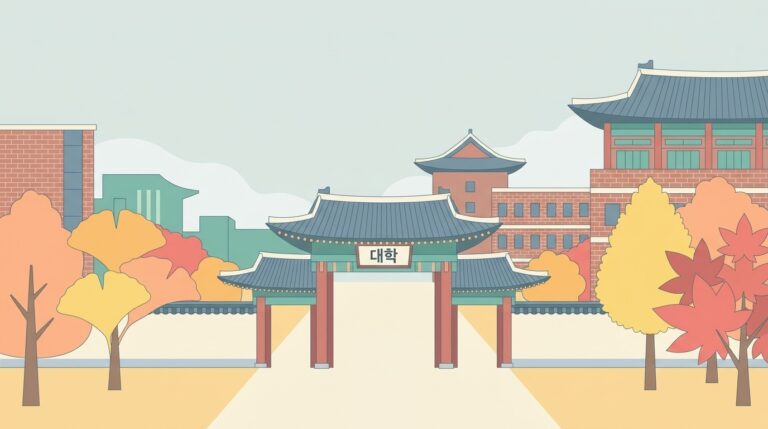
Navigating the Demographic Cliff: How to Discuss University Restructuring in C1 Korean
Phase 1: Empathy & Story Immersion
안녕하세요! 매일한글 에디터입니다. (Hello! I am your Daily Hangul editor.)
Picture this: You are sipping an iced Americano at a café near a provincial university in Gyeongsang-do. Unlike the bustling, neon-soaked student hubs of Sinchon or Hongdae in Seoul, the streets here are eerily quiet. A university banner hanging across the street announces an emergency faculty town hall. At the next table, two professors in tailored suits are leaning in, speaking in hushed, earnest tones: “이번 신입생 충원율 봤어요? 이러다 우리 과도 구조조정 칼바람을 못 피하겠어요.” (Did you see this year’s freshman enrollment rate? At this rate, our department won’t escape the harsh restructuring wind either.)
If you want to truly engage in high-level intellectual discussions, read Korean editorial pages, or work within Korean academia and public policy, you cannot avoid the single biggest crisis facing modern South Korea: the demographic cliff (인구 절벽) and the seismic restructuring of its higher education system. This C1-level guide moves beyond simplistic textbook dialogues. Designed using real feedback from advanced international scholars and bilingual professionals, this lesson will give you the vocabulary, cultural nuance, and analytical eloquence to debate Korea’s educational crisis like a seasoned insider.
Phase 2: Core Expressions In-Depth Analysis
1. 벚꽃 피는 순서대로 망한다 (Beotkkot pineun sunseodaero manghanda)
- Pronunciation: [Beot-kkot pi-neun sun-seo-dae-ro mang-han-da] (Think of ‘beot’ like ‘boat’ without the diphthong, and ‘mang’ sounding like the start of ‘manga’ with a deep nasal finish.)
- Meaning: Literal: “Universities will close down in the order the cherry blossoms bloom.” | Real-world nuance: A grim sociological aphorism describing how non-capital provincial universities (located in the warmer South where cherry blossoms bloom first) will shut down first due to hyper-concentration of students in Seoul.
- K-Culture Moment: Frequently quoted as headline banners on Korean current affairs programs like SBS Unanswered Questions (그것이 알고 싶다) and in JTBC economic debates analyzing provincial depopulation.
- Editor’s Insight: While this phrase is colloquial and somewhat cynical, policymakers, professors, and journalists use it freely in analytical contexts to highlight regional disparity.
- Situation Spectrum: Casual: ✅ | Semi-formal: ✅ | Formal (Academic Presentation): ⚠️ (In formal papers, use “지방대학의 연쇄적 위기” instead)
- 🤔 Think About It: Does your home country experience regional educational collapse due to urban centralization, or do regional flagships maintain prestige?
2. 정원 미달 (Jeong-won midal)
- Pronunciation: [Jeong-won mi-dal] (Sounds like ‘Jung-one me-dahl’)
- Meaning: Literal: “Below quota capacity.” | Real-world nuance: Under-enrollment; failing to fill the recruitment quota for freshmen admissions, which is the death knell for tuition-dependent universities.
- K-Culture Moment: Used heavily in university admissions dramas and news exposés showing admission officers frantically making cold calls to waitlisted applicants until the stroke of midnight.
- Editor’s Insight: When a university experiences 정원 미달, it triggers government funding cuts and emergency restructuring audits. Pairing this with the verb 사태가 발생하다 (an incident occurs) instantly elevates your academic register.
- Situation Spectrum: Casual: ✅ | Semi-formal: ✅ | Formal: ✅
- 🤔 Think About It: How does university funding in your home country handle under-enrollment compared to Korea’s student-quota-driven subsidies?
3. 학과 통폐합 (Hakgwa tongpyehap)
- Pronunciation: [Hak-gwa tong-pye-hap] (Flows like ‘Hahk-gwa tohng-pyay-hahp’)
- Meaning: Literal: “Department consolidation and abolition.” | Real-world nuance: The aggressive merging or shutting down of academic departments (especially humanities, pure sciences, and arts) in favor of high-employment fields like semiconductors or AI.
- K-Culture Moment: A frequent plot device in modern campus dramas where passionate literature or philosophy majors protest in front of the administration building with picket signs reading “일방적인 학과 통폐합 철회하라!” (Withdraw the unilateral department mergers!).
- Editor’s Insight: 통폐합 is a compound noun formed from 통합 (integration/merger) and 폐합 (abolition). Using this term demonstrates a nuanced grasp of administrative and institutional reforms.
- Situation Spectrum: Casual: ✅ | Semi-formal: ✅ | Formal: ✅
- 🤔 Think About It: Is the closure of humanities majors in favor of tech-driven vocational degrees a topic of fierce debate in your home country as well?
Phase 3: Textbook Korean vs. Real Korean
Situation 1: Discussing university closures in regional areas
- 📖 교과서 한국어 (Textbook):
학령인구 감소로 인해 지방 대학교들이 문을 닫고 있습니다.
(Hakryeong-ingu gamso-ro inhye jibang daehakgyodeuri muneul datgo itseumnida.)
“Due to the decrease in the school-age population, local universities are closing their doors.” - 🗣️ 진짜 한국어 (Real-world C1):
학령인구 급감 때문에 지방대는 줄도산 위기에 직면해서, 존폐의 기로에 서 있어요.
(Hakryeong-ingu geupgam ttaemune jibangdaeneun juldosan wigie jingmyeonhaeseo, jonpye-ui giroe seo isseoyo.)
“With the precipitous drop in the school-age population, provincial universities face a chain-bankruptcy crisis and stand at the crossroads of survival and extinction.” - 💡 왜 다를까?: Educated native speakers use vivid Sino-Korean idioms (줄도산 – chain bankruptcies, 존폐의 기로 – crossroads of survival or demise) to accurately capture the structural urgency of the issue.
Situation 2: Discussing forced restructuring inside faculties
- 📖 교과서 한국어 (Textbook):
대학들이 구조조정을 진행하고 있습니다.
(Daehakdeuri gujojojeong-eul jinhaenghago itseumnida.)
“Universities are carrying out restructuring.” - 🗣️ 진짜 한국어 (Real-world C1):
요즘 비인기 학과를 중심으로 구조조정 칼바람이 불어서 교수진과 학생들 반발이 거세지고 있어요.
(Yojeum bi-ingi hakgwareul jungsim-euro gujojojeong kalbarami bureoseo gyosujin-gwa haksaengdeul banbari geosejigo isseoyo.)
“Lately, a severe wave of restructuring is hitting unpopular departments, sparking intense backlash from faculty and students.” - 💡 왜 다를까?: The metaphor 칼바람이 불다 (a biting, razor-sharp wind blows) is universally used across Korean corporate and academic media to describe painful layoffs or restructuring.
Phase 4: K-Culture Deep Dive & Non-Verbal Manners
4-1. 눈치 (Nunchi) & Professional Mannerisms
When discussing university restructuring (대학 구조조정) in Korea, remember that you are touching upon people’s alma maters, job security, and regional pride.
* The Somber Head Nod (무거운 끄덕임): When listening to someone discuss their university’s restructuring or declining enrollment, maintain a serious facial expression and nod slowly. Lighthearted jokes about small regional schools (지잡대 – derogatory slang) are strictly taboo in respectful discourse.
* Tone Modulation: Maintain a measured, analytical pitch (분석적인 어조). Use qualifiers such as “구조적인 문제라 참 안타깝습니다” (It is truly regrettable as it is a structural dilemma) to show social empathy before delivering economic analysis.
4-2. Cultural Code: The “In-Seoul” Obsession vs. Regional Depopulation
In Korea, university admissions are not merely about academic interest; they are linked to the phenomenon of 인서울 (securing a spot in a university located within the Seoul metropolitan area). As South Korea’s birth rate fell to historic global lows, the total number of high school graduates dropped below the nationwide university quota. Yet, Seoul universities remain hyper-competitive, while prestigious regional national flagships (지거국 – 지방 거점 국립대) struggle with transfer-outs and unfilled seats. This dynamic mirrors the country’s broader demographic polarization.
Phase 5: Real-World Roleplay Scenario
Setting: A university seminar lounge at a Seoul research institute. Professor Park (Senior Higher Education Policy Analyst) and Ji-won (International Graduate Researcher) are analyzing government education reform whitepapers.
Characters:
* Professor Park: Veteran academic with a sharp, pragmatic perspective on education metrics.
* Ji-won: Ambitious C1-level graduate researcher specializing in public policy.
[1] 교수님 (Prof. Park):
지원 씨, 교육부의 최신 대학 기본역량진단 평가 보고서 검토해 봤어요?
(Jiwon-ssi, gyoyukbu-ui choesin daehak gibon-yeongnyang-jindan pyeongga bogoseo geomtohae bwasseoyo?)
"Ji-won, have you reviewed the Ministry of Education's latest University Basic Competency Assessment report?"
🎭 [안경을 고쳐 쓰며 보고서를 넘긴다 / Adjusts his glasses and flips through the report]

[2] 지원 (Ji-won):
네, 교수님. 학령인구 급감에 따른 정원 감축 권고안이 핵심이더군요.
(Ne, gyosunim. Hakryeong-ingu geupgam-e ttareun jeong-won gamchuk gwongowan-i haeksim-ideogun-yo.)
"Yes, Professor. The core recommendation centers on mandatory enrollment quota reductions due to the demographic drop."
🎭 [태블릿을 가리키며 진지한 표정으로 / Pointing at the tablet with a serious expression]

[3] 교수님 (Prof. Park):
맞아요. 이대로 가면 10년 안에 지방 사립대의 3분의 1 이상이 폐교 위기에 몰릴 겁니다.
(Maj-ayo. Idaero gamyeon simnyeon ane jibang saripdae-ui sambun-ui il isangi pyegyo wigie mollil geomnida.)
"Exactly. If things continue at this rate, over a third of regional private universities will face permanent closure within a decade."
🎭 [씁쓸한 표정으로 고개를 저으며 / Shaking his head with a bitter expression]

[4] 지원 (Ji-won):
결국 비인기 순수학문 분야부터 학과 통폐합 칼바람을 피하기 어렵겠네요.
(Gyeolguk bi-ingi sunsuhangmun bunyabuteo hakgwa tongpyehap kalbaram-eul pihagi eoryeopgenneyo.)
"In the end, it will be hard for non-mainstream pure academic fields to dodge the harsh winds of department mergers."
🎭 [공감하며 펜을 쥐고 메모한다 / Taking notes with an empathetic nod]

[5] 교수님 (Prof. Park):
안타깝지만 대학 재정 자립도를 생각하면 불가피한 선택이라는 시각도 팽배해요.
(Antakkapjiman daehak jaejeong jaripdoreul saenggakhamyeon bulgahpihan seontaeg-iraneun sigakdo paengbaehaeyo.)
"It's tragic, but the perspective that this is an inevitable choice given universities' financial independence is also prevalent."
🎭 [손깍지를 끼고 한숨을 쉰다 / Clasping hands together and letting out a sigh]

[6] 지원 (Ji-won):
하지만 무분별한 정원 축소는 지역 공동체 붕괴로 직결되지 않을까요?
(Hajiman mubunbyeolhan jeong-won chuksoneun jiyeok gongdongche bunggoero jikgyeol-doeji aneulkkayo?)
"However, wouldn't indiscriminate quota slashing lead directly to the collapse of regional local communities?"
🎭 [날카로운 눈빛으로 반론을 제기한다 / Raising a sharp, thoughtful counterargument]

[7] 교수님 (Prof. Park):
바로 그 지점이에요. 그래서 정부도 '글로컬 대학' 육성 사업으로 활로를 찾고 있죠.
(Baro geu jijeom-ieyo. Geuraeseo jeongbudo 'geullokeol daehak' yukseong saeobeuro hwalloreul chatgo itjyo.)
"That is the crux of the matter. That's why the government is seeking a breakthrough via the 'Glocal University' initiative."
🎭 [손가락으로 테이블을 톡톡 두드리며 / Tapping the table gently with a finger]

[8] 지원 (Ji-won):
단순한 생존 경쟁을 넘어 산학 협력을 통한 체질 개선이 필수적인 시점이네요.
(Dansunhan saengjon gyeongjaeng-eul neomeo sanhak hyeopryeok-eul tonghan chejil gaeseon-i pilsujeog-in sijeom-ineyo.)
"It seems we've reached a pivotal moment where structural transformation via industry-academic partnership is essential beyond mere survival."
🎭 [결론을 요약하며 미소 짓는다 / Summarizing the conclusion with an assured smile]
🔀 Interactive Branching: How would you reply to Professor Park in Turn 6?
- Choice A: “지방대는 어차피 경쟁력이 없으니 시장 논리에 맡겨 문을 닫게 해야 합니다.” (Provincial universities lack competitiveness anyway, so we should just leave them to market forces to shut down.)
- Feedback [Bad]: Too blunt and dismissive of the socioeconomic fallout on local economies; lacks policy nuance.
- Choice B: “하지만 무분별한 정원 축소는 지역 공동체 붕괴로 직결되지 않을까요?” (However, wouldn’t indiscriminate quota slashing lead directly to the collapse of regional local communities?)
- Feedback [Best]: Demonstrates balanced critical thinking linking education policy to regional sustainability.
- Choice C: “그럼 모든 대학생에게 학비를 전액 지원해주면 해결되지 않나요?” (Then wouldn’t the issue be solved if we provided full tuition subsidies to all college students?)
- Feedback [Risk]: Overly idealistic; overlooks the fundamental shortage of incoming students caused by low birth rates.
Phase 6: 10-Second Emotion Shadowing Drill
Practice matching the cadence, rhythmic pauses (/), and emotional tone of an educated professional.
[😰 씁쓸하고 진지하게 / Bittersweet and Serious]- “학령인구가 급감하면서 / 지방 사립대부터 / 연쇄 폐교 위기에 / 직면하고 있습니다.”
- (Hakryeong-inguga geupgamhamyeonseo / jibang saripdaebuteo / yeonswae pyegyo wigie / jingmyeonhago itseumnida.)
- “With the rapid drop in the school-age population, / starting with regional private colleges, / they are facing / a chain-closure crisis.”
[🧐 분석적이고 단호하게 / Analytical and Firm]- “단순한 정원 감축을 넘어서 / 과감한 학과 통폐합과 / 산학 협력이 / 선행되어야 합니다.”
- (Dansunhan jeong-won gamchug-eul neomeoseo / gwagamhan hakgwa tongpyehapgwa / sanhak hyeopryeog-i / seonhaengdoeeoya hamnida.)
- “Going beyond simple quota reductions, / decisive department mergers / and industry-university cooperation / must take precedence.”
[🥺 안타깝고 공감하며 / Empathetic and Regretful]- “지역 거점 대학마저 흔들리면 / 지방 소멸 속도는 / 걷잡을 수 없이 / 빨라질 수밖에 없어요.”
- (Jiyeok geojeom daehakmajeo heundeullimyeon / jibang somyeol sokdoneun / geotjabeul su eopsi / ppallajil subakke eopseoyo.)
- “If even regional flagship universities falter, / the pace of regional extinction / will inevitably accelerate / out of control.”
Phase 7: K-Culture Mini Dictionary
- 인구 절벽 (Ingu Jeolbyeok): The Demographic Cliff. Refers to the steep decline in the working and schooling population resulting from prolonged ultra-low birth rates.
- 인서울 (In-Seoul): The social and academic status symbol of attending a four-year university within the city limits of Seoul, heavily driving nationwide high school admissions strategy.
- 폐교 (Pye-gyo): Permanent school closure. An administrative act where an educational institution dissolves its charter due to financial insolvency or zero enrollments.
- 글로컬 대학 (Glocal Daehak): “Glocal (Global + Local) University.” A flagship South Korean government subsidy initiative granting 100 billion KRW to select innovative regional institutions to foster local survival and international competitiveness.
Phase 8: Expat Survival Kit & Navigation
Survival Expressions for Higher-Ed Environments:
- “이번 학기 등록률이 어떻게 나왔나요?” (Ibeon hakgi deungrokyuri eotteoke nawannayo?)
- Meaning: “What did this semester’s enrollment rate look like?”
- Pro Tip: Use this when conversing with administrative colleagues to inquire politely about student headcount numbers.
- “저희 학과도 통폐합 대상에 포함되나요?” (Jeohui hakgwado tongpyehap daesange pohamdoenayo?)
- Meaning: “Is our department included in the merger/restructuring scope?”
- Pro Tip: Crucial phrasing for international instructors and researchers tracking faculty reorganization.
- “혁신 지원 사업 선정 결과를 기다리고 있어요.” (Hyeoksin jiwon saeop seonjeong gyeolgwaryeul gidarigo isseoyo.)
- Meaning: “We are awaiting the selection results for the university innovation grant.”
- Pro Tip: Shows deep familiarity with university operational milestones.
Editor’s Expat Note:
To keep track of higher education restructuring metrics, bookmark the Higher Education in Korea Information Portal (대학알리미). It provides public disclosures on faculty-to-student ratios, actual enrollment rates, and financial status for every tertiary campus across the peninsula.
Phase 9: “One Step Deeper” (Reflective Essay)
South Korea’s university restructuring debate reveals an intricate collision between centuries-old social prestige and 21st-century demographic reality. In traditional Korean society, higher education served as the quintessential ladder for social mobility, fostering an academic credentialism (학벌주의) that concentrated elite capital exclusively within Seoul. Today, as demographic contraction forces the closure of regional campuses, South Korea is forced to ask whether universities exist merely as vocational stepping stones or as indispensable anchors for regional civilization and civic life.
💬 Your Turn: How does your home society balance the preservation of traditional academic disciplines against shifting job markets and demographic shifts? Share your thoughts below in Korean or English!
Phase 10: FAQ & Avoiding Misunderstandings
Q: Is using the term ‘지잡대’ acceptable when analyzing regional universities?
A: Absolutely not. 지잡대 (short for 지방 잡다한 대학교) is a deeply derogatory, classist slur. In polite, professional, and academic contexts, always use respectful terms such as 지방 사립대 (regional private university), 지방 거점 국립대 (regional flagship national university), or 비수도권 대학 (non-capital area university).
Q: Does ‘구조조정’ (restructuring) always mean firing professors?
A: In university contexts, 구조조정 refers primarily to reducing student recruitment quotas (정원 감축), merging overlapping departments (학과 통폐합), or converting underperforming curricula into practical industry-oriented majors. While faculty hiring freezes occur, outright tenured dismissals involve complex legal processes in Korea.
Q: What is the difference between ‘폐과’ and ‘폐교’?
A: 폐과 (Pye-gwa) refers to the closure of a single academic department within an active university, whereas 폐교 (Pye-gyo) refers to the complete shutdown and legal dissolution of the entire institution.
🚨 Common Mistakes Warning Board
- Calling all schools outside Seoul ‘시골 대학’ (countryside universities):
- Correct Action: Use 지방 소재 대학 (regionally located universities) or 비수도권 대학.
- Confusing ‘정원’ (quota) with ‘학생 수’ (number of students):
- Correct Action: Say 정원을 감축하다 (reduce official quota capacity) rather than 학생 수를 감축하다.
- Using overly informal verbs like ‘대학이 망했다’ in professional papers:
- Correct Action: Upgrade your diction to 대학이 재정 위기로 폐교되었다 or 구조개혁 대상에 지정되었다.
Phase 11: Action Missions
- 🥉 Bronze Level Mission (Solo Practice): Read the three Phase 6 shadowing sentences aloud 5 times each, focusing on the cadence of Sino-Korean compounds.
- 🥈 Silver Level Mission (Social Sharing): Write a 3-sentence Korean opinion post on social media explaining the term 인구 절벽 and how it impacts regional schools.
- 🥇 Gold Level Mission (Real Application): Find an article on 대학 구조조정 from a major Korean daily (e.g., Hankyoreh, Chosun Ilbo, or JoongAng Ilbo), highlight 3 words from this lesson, and summarize the article’s thesis in Korean.
🎮 K-Culture Mission: Watch an episode of a Korean documentary or educational debate show on YouTube (search: 대학 구조조정 지방대 위기), and identify when the panelists use the phrase 줄도산 or 통폐합!
Phase 12: Interactive Quiz Challenge
1. Situation Judgment Quiz
You are giving an analytical presentation on Korean higher education reform to a university committee. Which phrase is the most appropriate and professional?
* (A) 벚꽃 피는 순서대로 지방대가 망하는 건 당연한 이치입니다.
* (B) 학령인구 급감에 대응하기 위한 선제적 정원 조정과 체질 개선이 시급합니다.
* (C) 비인기 학과는 쓸모가 없으니 빨리 칼바람을 불어넣어야 합니다.
2. Fill-in-the-Blank
“대학들이 위기를 극복하기 위해 유사한 전공들을 하나로 합치거나 없애는 조치를 (________)(이)라고 부릅니다.”
3. Cultural True or False
- Statement: ‘지거국’ (지방 거점 국립대) are small private vocational colleges that have no government backing.
- (True / False)
👉 Click to reveal answers & explanations!
- Answer: (B)
- Explanation: (B) uses sophisticated policy terminology (선제적 정원 조정, 체질 개선). Options (A) and (C) rely on overly cynical, colloquial, or offensive framing.
- Answer: 학과 통폐합 (Department Consolidation/Abolition)
- Explanation: Merging and closing similar majors to optimize efficiency is termed 학과 통폐합.
- Answer: False
- Explanation: ‘지거국’ stands for Regional Flagship National Universities (like Pusan National University, Kyungpook National University, Chonnam National University), which are prestigious, large-scale public institutions supported directly by the central government.
- Explanation: ‘지거국’ stands for Regional Flagship National Universities (like Pusan National University, Kyungpook National University, Chonnam National University), which are prestigious, large-scale public institutions supported directly by the central government.






