

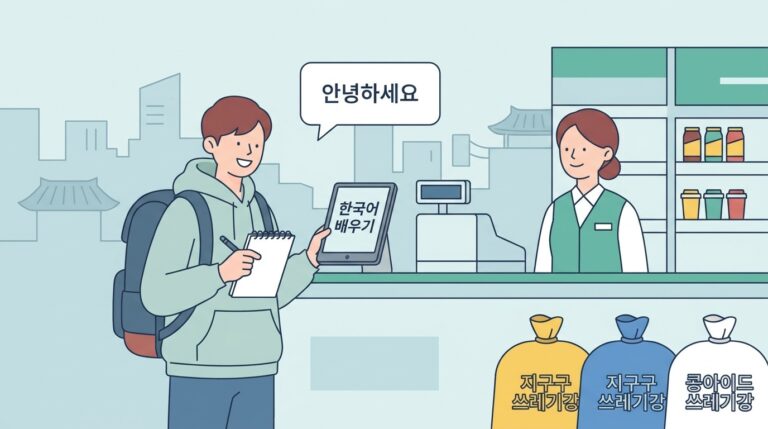
Master Korea’s General Trash Bags: The Beginner’s Survival Guide
Phase 1: Empathy & Story Opening
안녕하세요! 매일한글 에디터입니다. (Annyeonghaseyo! I am your Daily Hangul editor.)
Imagine this: You have just moved into a cozy one-room studio in Seoul or checked into a lovely Airbnb in Hongdae. After a late-night feast of Korean fried chicken and convenience store snacks, you bag up your leftovers in a plain black grocery bag and leave it outside. The next morning, you wake up to an angry red warning sticker stuck to your bag—or worse, a stern note from your building manager (ajussi)!
If you have felt panicked standing in front of the counter at CU or GS25, trying to remember what those official trash bags are called, take a deep breath. Korea takes waste management very seriously through the Jongnyangje (volume-rate waste fee) system. Using the wrong bag can lead to municipal fines up to 100,000 KRW! But don’t worry—with just a couple of simple, beginner-friendly Korean phrases, you will walk into any convenience store, buy the exact bag you need, and dispose of your trash like a seasoned local. This guide is crafted from real feedback from hundreds of beginner expats and travelers just like you. Let’s master it together!
Phase 2: Top 3 Core Expressions Breakdown
1. 일반 쓰레기 봉투 주세요. (Ilban sseuregi bongtu juseyo.)
- Pronunciation: Eel-bahn sseu-reh-gee bong-too joo-seh-yo (Think “Eel-Barn” + “Sew-Reggie” + “Bong-Too” + “Juice-Say-Yo”)
- Meaning: “Please give me a general trash bag.” (Literal: General + waste + plastic bag + please give)
- K-Culture Moment: In K-Dramas like Fight for My Way or My First First Love, you often see college students moving into rooftop apartments (oktapbang) and immediately running down to the corner store to ask for these bags.
- Editor’s Insight: Ilban sseuregi (일반 쓰레기) refers strictly to non-recyclable, non-food household waste. Adding juseyo makes you sound polite and friendly.
- Situation Spectrum: Casual ⚠️ | Semi-formal ✅ | Formal ✅
- 🤔 Think About It: In many Western countries, garbage bags are sold in rolls in the supermarket aisle. In Korea, you must ask the cashier behind the counter because they are official government-regulated items! How does your country regulate household waste?
2. 10리터(십 리터)짜리 한 장 주세요. (Sip-riteo-jjari han jang juseyo.)
- Pronunciation: Ship-lee-tuh-jjah-ree hahn jahng joo-seh-yo (Sounds like “Ship” + “Leader” + “Jah-ree” + “Hahn” + “Jang” + “Juice-say-yo”)
- Meaning: “Please give me one 10-liter bag.”
- K-Culture Moment: Solo living (Honjok) culture in Korea means people rarely buy gigantic 50L bags. Asking for 10-liter or 20-liter bags single-sheet (han jang) is the ultimate mark of an independent Seoul resident.
- Editor’s Insight: The counter jang (장) is used for flat paper or plastic items. For beginners, if remembering numbers is tough, you can simply show two fingers or say “10(Ship) liter OK!”
- Situation Spectrum: Casual ⚠️ | Semi-formal ✅ | Formal ✅
- 🤔 Think About It: Korea measures bags in liters (리터) rather than gallons or pounds. Does your native language use special counting units (like jang for flat sheets)?
3. 이거 어디에 버려요? (Igeo eodie beoryeoyo?)
- Pronunciation: Ee-guh uh-dee-eh buh-ryuh-yo (Sounds like “E-Go” + “Uh-Dee-Air” + “Buh-Ree-Uh-Yo”)
- Meaning: “Where do I throw this away?”
- K-Culture Moment: In reality variety shows like I Live Alone (나 혼자 산다), cast members frequently ask neighbors or security guards where designated trash drop-off zones are located.
- Editor’s Insight: Igeo (이거) means “this”, eodie (어디에) means “where”, and beoryeoyo (버려요) is the polite form of “to discard”.
- Situation Spectrum: Casual ⚠️ | Semi-formal ✅ | Formal ✅
- 🤔 Think About It: In Korea, public trash cans are rare on streets to prevent illegal dumping. Asking this question politely shows high cultural respect (Nunchi).
Phase 3: Textbook Korean vs. Real Korean
Situation 1: Asking if they sell general waste bags
- 📖 교과서 한국어 (Textbook): “종량제 규격 쓰레기 봉투를 판매하십니까?” (Jongnyangje gyugyeok sseuregi bongtureul panmaehasimnikka? / Do you sell official standard volume-rate garbage bags?)
- 🗣️ 진짜 한국어 (Real-life): “일반 쓰레기 봉투 있어요?” (Ilban sseuregi bongtu isseoyo? / Do you have general trash bags?)
- 💡 Why the difference? The textbook phrase is overly legalistic and robotic. Convenience store staff understand “일반 쓰레기 봉투” immediately.
Situation 2: Asking for one 10-liter size bag
- 📖 교과서 한국어 (Textbook): “십 리터 용량의 봉투 한 개를 주시기 바랍니다.” (Sip riteo yongnyangui bongtu han gaereul jusigi baramnida. / I request that you provide one unit of 10-liter capacity bag.)
- 🗣️ 진짜 한국어 (Real-life): “10리터짜리 하나 주세요!” (Sip-riteo-jjari hana juseyo! / Give me one 10-liter one, please!)
- 💡 Why the difference? Adding -jjari (짜리) is how Koreans naturally specify sizes, prices, or denominations in spoken everyday transactions.
Phase 4: K-Culture Deep Dive & Non-Verbal Manners
4-1. 눈치 (Nunchi) & Body Gestures at the Counter
When purchasing trash bags at a Korean convenience store:
* Two-Handed Respect: When handing your payment card or receiving your folded trash bag from the clerk, support your right forearm or wrist lightly with your left hand, accompanied by a slight 15-degree head bow.
* District Awareness (Gu check): General trash bags are color-coded by municipal district (e.g., Mapo-gu, Gangnam-gu, Yongsan-gu). Cashiers will automatically give you bags valid for that specific district. Never bring bags bought in Hongdae (Mapo-gu) to use in Gangnam!
4-2. Cultural Code: The Art of Korean “Bunrisugeo” (분리수거)
South Korea has one of the world’s highest recycling rates (over 60%). The Pay-As-You-Throw Jongnyangje system was introduced in 1995. Trash bags aren’t free because the price includes the waste processing tax. Every Korean learns from childhood that transparent plastics, food waste, and general waste must never mix. Using proper trash bags is considered the most fundamental civic etiquette (Simin-uisik).
Phase 5: Real-Life Roleplay Scenario
Setting: A brightly lit GS25 convenience store in Sinchon at 9:00 PM.
Characters:
* Sarah (A1 Learner): An international student holding an empty delivery box.
* Min-woo (Store Clerk): A helpful college student working the evening shift.
- Turn 1 (Sarah): 안녕하세요! 일반 쓰레기 봉투 있어요? (Annyeonghaseyo! Ilban sseuregi bongtu isseoyo?)
- 🎭 Action: Approaches the counter and makes eye contact with a warm smile.
- “Hello! Do you have general trash bags?”
- Turn 2 (Min-woo): 네, 있어요! 몇 리터짜리 드릴까요? (Ne, isseoyo! Myeot riteo-jjari deurilkkayo?)
- 🎭 Action: Reaches behind the cash register where bags are neatly stacked.
- “Yes, we do! What size (how many liters) should I give you?”
- Turn 3 (Sarah): 음… 혼자 쓰는데, 보통 뭐 써요? (Eum… honja sseuneunde, botong mwo sseoyo?)
- 🎭 Action: Tilts head slightly, asking for advice.
- “Um… I live alone, what size do people usually use?”
- Turn 4 (Min-woo): 혼자 사시면 보통 10(십) 리터나 20(이십) 리터 많이 써요. (Honja sasimyeon botong sip riteona isip riteo mani sseoyo.)
- 🎭 Action: Holds up a white 10L bag to demonstrate the size.
- “If you live alone, people usually use 10L or 20L a lot.”
- Turn 5 (Sarah): 아, 그럼 10리터짜리 두 장 주세요! (A, geureom sip-riteo-jjari du jang juseyo!)
- 🎭 Action: Raises two fingers cheerfully.
- “Ah, then please give me two 10-liter bags!”
- Turn 6 (Min-woo): 네, 현금 결제하세요, 카드 결제하세요? (Ne, hyeongeum gyeoljehaseyo, kadeu gyeoljehaseyo?)
- 🎭 Action: Beeps the barcode on the screen.
- “Alright, are you paying with cash or card?”
- Turn 7 (Sarah): 카드로 계산할게요. (Kadeuro gyesanhalkkeyo.)
- 🎭 Action: Hands the debit card over using both hands.
- “I will pay by card.”
- Turn 8 (Min-woo): 네, 결제 완료되었습니다. 감사합니다! (Ne, gyeolje wanryeodoeeotsseumnida. Gamsahamnida!)
- 🎭 Action: Hands the two folded bags back with a polite nod.
- “Payment completed. Thank you!”
🔀 Interactive Choice Point
You exit the store with your 10L bag, pack your trash, and head downstairs to the building’s disposal corner. You see three different bins. What do you do?
- Choice A: Put all your chicken bones, empty beer cans, and paper napkins together into the 10L bag and tie it tightly.
- Choice B: Separate the beer cans into the recycling bin, but put chicken bones and used paper napkins into the 10L general waste bag.
- Choice C: Put chicken bones into the yellow Food Waste bag, and napkins into the 10L general waste bag.
-
Feedback Breakdown:
- 🚫 Choice A (Risk – Fine Alert): Putting cans inside general trash bags violates recycling laws. You may receive a warning notice!
- ⚠️ Choice B (Bad): Almost right, but chicken bones are hard bones and not food waste, so putting them in general trash is correct, while recyclable cans must go into the can bin. (This choice is actually close, but look at C!)
- ✅ Choice C (Best Practice!): Wait! In Korea, chicken bones, eggshells, and fruit pits are classified as General Waste (일반 쓰레기), NOT food waste! Therefore, chicken bones go into your 10L general bag, and cans go to recycling. You passed the test!
Phase 6: 10-Second Emotion Shadowing Drill
Practice these lines out loud with the emotional cues and pauses (/ indicates a short breath pause):
[🙋♀️ Bright & Friendly]
일반 쓰레기 봉투 / 있어요?
(Ilban sseuregi bongtu / isseoyo?)-
[🤔 Decisive & Polite]
10리터짜리 / 한 장 주세요!
(Sip-riteo-jjari / han jang juseyo!) -
[🙏 Respectful & Clear]
카드로 / 계산할게요!
(Kadeuro / gyesanhalkkeyo!)
Phase 7: K-Culture Mini Dictionary
- 종량제 봉투 (Jongnyangje bongtu)
- Definition: Volume-rate official trash bag.
- Usage: The umbrella legal term for government-approved trash bags sold at supermarkets and convenience stores.
- 분리수거 (Bunrisugeo)
- Definition: Waste separation & recycling.
- Usage: Everyday routine in Korea where plastics, vinyl, paper, glass, and cans are sorted into designated color-coded bins.
- 음식물 쓰레기 (Eumsikmul sseuregi)
- Definition: Food waste.
- Usage: Soft organic food waste disposed of in separate yellow/orange food waste bags or RFID electronic bins.
- 배출 요일 (Baechul yoil)
- Definition: Designated garbage disposal day.
- Usage: Most residential neighborhoods in Korea only permit taking trash out on specific days of the week (e.g., Sun/Tue/Thu evenings).
Phase 8: Survival Kit for Travelers
TOP 3 Emergency Phrases:
- 1. 종량제 봉투 (Jongnyangje bongtu) — “Official trash bag”
- Pro Tip: If the cashier looks confused when you say “trash bag”, simply show them this written word on your phone screen.
- 2. 20리터짜리 주세요. (Isip-riteo-jjari juseyo.) — “Please give me a 20-liter one.”
- Pro Tip: 20L is the standard size for a small family or for a weekly clean-up of a studio apartment.
- 3. 어디에 둬요? (Eodie dwoyo?) — “Where do I leave it?”
- Pro Tip: Ask this to your guesthouse host or Airbnb host to locate the outdoor collection point.
Editor’s Travel Note:
When looking for waste drop-off zones or local convenience stores, search on Naver Map App Download Guide instead of Google Maps, which often lacks precise building-level trash depot notations in Korean alleys.
Phase 9: “One Step Deeper” (Cultural Reflection)
In South Korea, sorting trash is not just a legal obligation; it reflects the deep-rooted cultural value of Gongdongche Uisik (공동체 의식 – community consciousness). When someone leaves unsorted trash in an unmarked bag, it forces neighbors or elderly building custodians (Gwanri-in) to hand-sort the refuse, causing collective embarrassment (Minpye). Learning to buy the proper bag is your first step toward embracing Korean neighborhood harmony.
💬 Your Turn: Have you ever experienced a culture shock with recycling rules in another country? Share your story in the comments below!
Phase 10: FAQ & Common Mistakes
Q: Can I use a general trash bag bought in Mapo-gu (Hongdae) in Gangnam-gu?
A: No. Each district (Gu) manages its own waste processing facilities. Bags bought in Mapo-gu will not be collected by Gangnam municipal trucks and may incur a fine. Always buy bags in your own neighborhood.
Q: Can I buy just a single trash bag at a convenience store?
A: Yes! You do not have to buy a pack of 10 or 20. Just say “한 장 주세요 (Han jang juseyo)” to purchase a single sheet for around 250–500 KRW.
Q: Are chicken bones, clamshells, and fruit pits considered food waste?
A: No. Anything hard that cannot be processed into animal livestock feed (e.g., pork/beef bones, hard fruit seeds, eggshells, onion skins) belongs in the 일반 쓰레기 봉투 (General Trash Bag).
🚨 Common Mistakes Alert:
- Mistake: Throwing trash in regular white or black plastic shopping bags.
- Correct Action: Always purchase the official district-stamped Jongnyangje bag.
- Mistake: Putting leftover soups and wet foods into the general trash bag.
- Correct Action: Drain all moisture and dispose in designated food waste bags (Eumsikmul bongtu).
- Mistake: Dumping trash during the daytime.
- Correct Action: In most residential areas, trash must be placed outside between sundown (7:00 PM) and midnight.
Phase 11: Action Missions
- 🥉 Bronze Mission (Solo Practice): Stand in front of your mirror and practice saying “일반 쓰레기 봉투 10리터짜리 하나 주세요” three times with a confident smile.
- 🥈 Silver Mission (Community Share): Take a photo of the trash bags you bought or your sorted bins in Korea and post it on Instagram/X with the hashtag
#DailyHangulWasteGuide. - 🥇 Gold Mission (Real-life Execution): Walk into a nearby convenience store, greet the clerk with 안녕하세요, purchase one general trash bag using Korean, and say 감사합니다!
- 🎮 K-Culture Mission: Watch an episode of a Korean variety show (like Three Meals a Day or I Live Alone) and spot how many times cast members mention Bunrisugeo (분리수거)!
Phase 12: Interactive Quiz Challenge
1. Situation Judgment
You need a garbage bag for your small room. Which sentence is most natural at the counter?
* (A) 종량제 기계를 주세요. (Jongnyangje gigyereul juseyo.)
* (B) 일반 쓰레기 봉투 10리터짜리 하나 주세요. (Ilban sseuregi bongtu sip-riteo-jjari hana juseyo.)
* (C) 쓰레기를 가져가세요. (Sseuregireul gajyeogaseyo.)
2. Fill in the Blank
“Please give me one bag.” -> “봉투 한 ____ 주세요.”
* (A) 명 (Myeong)
* (B) 개 (Gae)
* (C) 장 (Jang)
3. True / False Cultural Check
(True/False) In Korea, you can use general trash bags purchased anywhere in the country as long as they are white.
👉 Click here to reveal Answers & Explanations!
- Answer: (B)
- Explanation: Option (B) is the exact natural phrase to ask for a 10L general waste bag. Option (A) asks for a “volume-rate machine”, and (C) commands the clerk to “take away my trash”!
- Answer: (C) 장 (Jang)
- Explanation: Flat thin objects like paper and plastic bags take the counter 장 (Jang).
- Answer: False
- Explanation: General trash bags are valid only within the municipal district (Gu) where they were purchased.
- Explanation: General trash bags are valid only within the municipal district (Gu) where they were purchased.






