

Warm Up Your Winter: How to Order Roasted Chestnuts in Korea Like a Local
Phase 1: 공감 (Story-Driven Opening)
안녕하세요! 매일한글 에디터입니다. (Hello! This is your Daily Hangul editor.)
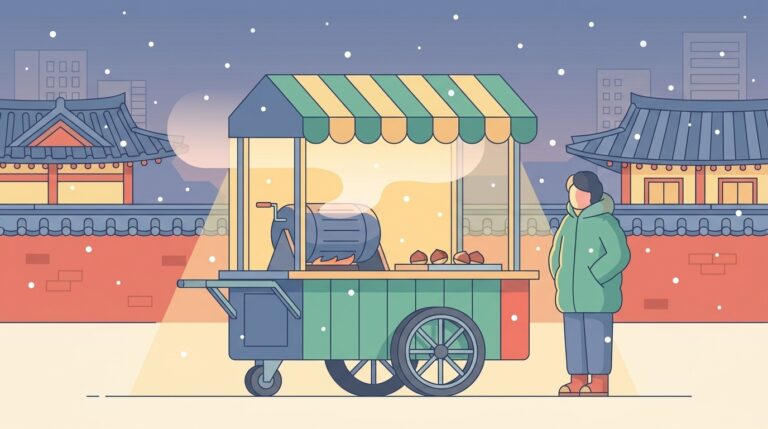
Picture this: It is a brisk December evening in Seoul. The temperature has plunged below freezing, your breath forms tiny clouds in the crisp air, and your hands are tucked deep into your coat pockets. Suddenly, a rich, sweet, and nutty aroma drifts through the street corner near the subway exit. You follow your nose and spot a vendor standing beside a spinning black metal drum with sparks of warmth and a wooden cart piled high with yellow, toasty chestnuts—gunbam (군밤).
Your mouth waters, and you step closer, eager to warm your freezing fingers on a fresh paper bag. But then panic hits: How do I order? Do they take cards? What if I use the wrong words and freeze in front of the vendor? Many beginner learners tell us they end up walking away simply because street vendor interactions feel fast-paced and intimidating. Don’t worry! This guide is built specifically for A1 beginners using real-world field tips. By the end of this lesson, you will confidently stride up to any winter street stall and order hot, delicious roasted chestnuts like a Seoulite!
Phase 2: 핵심 표현 3선 심층 분석 (Top 3 Core Expressions)
1. 군밤 한 봉지 주세요. (Gunbam han bongji juseyo.)
- Pronunciation: [Goon-bahm hahn bong-jee joo-seh-yo] (Sounds like goon + bomb, followed by han bong-jee joo-say-yo)
- Meaning: Literal: “Roasted chestnuts one bag please.” / Nuance: “Can I get one paper bag of roasted chestnuts, please?”
- K-Culture Moment: You will see this phrase in every cozy winter K-drama scene where the main leads share warm snacks while strolling down an illuminated alleyway.
- Editor’s Insight: In Korea, roasted chestnuts are pre-portioned and sold in brown paper bags called bongji (봉지). Instead of counting individual chestnuts, you simply ask for han bongji (one bag) or du bongji (two bags).
- Situation Spectrum: Casual ✅ | Semi-formal ✅ | Formal ⚠️
- 🤔 Think About It: In English, we often ask “Can I have…?” as a question. In Korean, adding juseyo (주세요 – please give) turns a direct statement into a polite, natural request. How does shifting from a question to a polite request change the vibe of ordering?
2. 얼마예요? (Eolmayeyo?)
- Pronunciation: [Uhl-mah-yeh-yo] (Sounds like all-ma-yay-yo)
- Meaning: Literal: “How much is it?” / Nuance: “How much does this cost?”
- K-Culture Moment: The universal survival phrase heard across traditional markets in variety shows like Amazing Saturday whenever guests explore local street vendors.
- Editor’s Insight: This is the most versatile phrase in the Korean language for shopping. Even if street carts have no printed price tags, saying Eolmayeyo? with an inquiring tone will get you a quick, friendly answer.
- Situation Spectrum: Casual ⚠️ | Semi-formal ✅ | Formal ✅
- 🤔 Think About It: Notice that Korean skips the word “this” (이거) when the context is obvious. In Korean culture, context does half the talking!
3. 카드 돼요? (Kadeu dwaeyo?)
- Pronunciation: [Kah-deu dwae-yo] (Sounds like car-dew dway-yo)
- Meaning: Literal: “Card works?” / Nuance: “Do you take credit cards?”
- K-Culture Moment: Modern K-vlogs and reality shows show people using this quick sentence before pulling out their wallet at open-air night markets.
- Editor’s Insight: Many street snack stalls are cash-preferred or take direct bank transfers (gyejwa-iche), though some in tourist areas now accept credit cards. Asking this before the vendor bags your snack shows great manners.
- Situation Spectrum: Casual ✅ | Semi-formal ✅ | Formal ⚠️
- 🤔 Think About It: Dwaeyo? comes from the verb doeda (to become / to work / to be possible). It is a magic beginner word meaning “Is it okay / Does it work?”
Phase 3: 교과서 한국어 vs 진짜 한국어 (Textbook vs. Real Korean)
Situation 1: Asking for the price of the snack
- 📖 교과서 한국어 (Textbook): 이것은 얼마입니까? (Igeoseun eolmaimnikka? – How much is this?)
- 🗣️ 진짜 한국어 (Real Korean): 이거 얼마예요? (Igeo eolmayeyo? – How much is this?)
- 💡 왜 다를까? (Why different?): Formal -imnikka endings sound overly stiff and robotic at a casual street cart. The everyday polite ending -eyo (eolmayeyo) is warm, natural, and friendly.
Situation 2: Ordering one bag
- 📖 교과서 한국어 (Textbook): 군밤을 한 개 주십시오. (Gunbameul han gae jusipsio. – Please grant me one unit of roasted chestnuts.)
- 🗣️ 진짜 한국어 (Real Korean): 군밤 한 봉지 주세요. (Gunbam han bongji juseyo. – One bag of roasted chestnuts, please.)
- 💡 왜 다를까? (Why different?): Chestnuts are sold by the paper bag (bongji), not as single pieces (gae). Using juseyo instead of jusipsio makes you sound like an approachable local.
Phase 4: K-Culture 딥다이브 & 비언어적 매너 (Culture Deep Dive & Non-Verbal Manners)
4-1. 눈치 (Nunchi) & Street Food Gestures
When interacting at a street cart in Korea:
* Two-Handed Courtesy: When handing cash or your card to the vendor (often an older auntie Imo or grandfather Harabeoji), gently support your right forearm or wrist with your left hand. This classic Korean gesture conveys deep respect.
* Steaming Bag Care: When handed the piping hot paper bag, accept it with both hands and give a small, grateful nod. Be careful—fresh gunbam can be burning hot!
4-2. Culture Code: The Warmth of Korean Winter Snacks
Street food in Korea is not just fast food; it is seasonal comfort (chueok / 추억). Alongside roasted sweet potatoes (gun-goguma) and fish-shaped pastries (bungeoppang), gunbam represents traditional winter warmth. In historical times, chestnuts were carefully scored with a blade before roasting over charcoal so they would pop open easily without bursting. Eating roasted chestnuts while standing beside a warm roasting drum is a quintessential Seoul winter memory.
Phase 5: 실전 롤플레이 시나리오 (Interactive Role-play Scenario)
Setting: A snowy evening near Jongno 3-ga Station. You walk up to a glowing street stall where a friendly vendor (Imo) is turning a roaster filled with steaming chestnuts.
- Turn 1 (Learner): 안녕하세요! (Annyeonghaseyo! – Hello!)
🎭 Smiling and stepping toward the cart - Turn 2 (Vendor): 어서 와요! 날씨 춥죠? (Eoseo wayo! Nalssi chupjyo? – Welcome! Cold weather, isn’t it?)
🎭 Stirring the warm chestnuts - Turn 3 (Learner): 네, 추워요! 군밤 이거 얼마예요? (Ne, chuwoyo! Gunbam igeo eolmayeyo? – Yes, it is cold! How much are these roasted chestnuts?)
🎭 Pointing gently toward the chestnuts - Turn 4 (Vendor): 한 봉지에 오천 원이에요. (Han bongjie ocheon-wonieyo. – It’s 5,000 won per bag.)
🎭 Holding up a brown paper pouch - Turn 5 (Learner): 군밤 한 봉지 주세요. (Gunbam han bongji juseyo. – One bag of roasted chestnuts, please.)
🎭 Holding up one finger politely - Turn 6 (Vendor): 네, 따끈따끈한 걸로 줄게요! (Ne, ttakkeun-ttakkeunhan geollo julgeyo! – Sure, I will give you a piping hot one!)
🎭 Scooping fresh chestnuts into the bag - Turn 7 (Learner): 감사합니다! 카드 돼요? (Gamsahamnida! Kadeu dwaeyo? – Thank you! Do you take card?)
🎭 Holding wallet ready - Turn 8 (Vendor): 여긴 현금이나 계좌이체만 돼요! (Yeogin hyeongeumina gyejwai-cheman dwaeyo! – Here, we only take cash or bank transfer!)
🎭 Pointing gently to the cash box
🔀 Interactive Choice Point
You realize you want to pay with cash. What do you say and do next?
* Option A: Give 5,000 won with one hand and say “여기.” (Yeogi.)
* Option B: Hand the 5,000 won bill with both hands and say: “여기 현금 오천 원 있어요! 감사합니다.” (Yeogi hyeongeum ocheon-won isseoyo! Gamsahamnida. – Here is 5,000 won cash! Thank you.)
* Option C: Say nothing, put the chestnut back, and run away.
Feedback:
* Option A (Risk): Handing money with one hand to elders can appear rude or dismissive in Korean etiquette.
* Option B (Best Choice): Perfect! Using two hands with a polite expression (Gamsahamnida) shows wonderful manners and will make the vendor smile.
* Option C (Bad): Street vendors are very friendly! Even if you do not have cash, you can politely say “죄송합니다, 다음에 올게요!” (Sorry, I will come next time!).
Phase 6: 10초 감정 섀도잉 드릴 (10-Second Emotion Shadowing Drill)
Practice reading these lines aloud with the indicated pause (/) and emotional tone!
[😊 Friendly and inquiring]
안녕하세요! / 군밤 한 봉지 / 얼마예요?
(Annyeonghaseyo! / Gunbam han bongji / eolmayeyo?)-
[😋 Excited and hungry]
군밤 한 봉지 / 주세요!
(Gunbam han bongji / juseyo!) -
[🙏 Polite and considerate]
감사합니다! / 카드 / 돼요?
(Gamsahamnida! / Kadeu / dwaeyo?)
Phase 7: K-Culture 미니 사전 (Mini Dictionary)
- 군밤 (Gunbam) | Roasted Chestnuts | The word combines gun (roasted/baked, from gupda) and bam (chestnut). Essential winter street delicacy.
- 봉지 (Bongji) | Plastic or paper bag/pouch | Used as a counter for bagged goods: Han bongji (1 bag), Du bongji (2 bags).
- 길거리 음식 (Gilgeori eumsik) | Street Food | Covers everything from winter carts (gunbam, bungeoppang) to tent bars (pojangmacha).
- 현금 (Hyeongeum) | Cash | Useful vocabulary when browsing traditional markets or pop-up street stalls.
Phase 8: 여행자를 위한 생존 키트 (Traveler’s Survival Kit)
Survival Expressions TOP 3
- 현금 있어요. (Hyeongeum isseoyo.) — “I have cash.”
- Pro Tip: Keep 1,000 won and 5,000 won bills handy in your coat pocket for street carts.
- 덜 뜨거운 걸로 주세요. (Deol tteugeoun geollo juseyo.) — “Please give me one that is less hot.”
- Pro Tip: Useful if you are buying snacks for children.
- 많이 파세요! (Mani paseyo!) — “Sell a lot! (Have great business!)”
- Pro Tip: Say this as a warm goodbye to street vendors; it is the ultimate Korean local greeting!
Editor’s Travel Note
Before wandering down the street food alleys of Jongno, Insadong, or Myeongdong, check your routes using the official Naver Map Navigation Guide. Remember that while almost all brick-and-mortar stores in Korea are 100% cashless, outdoor sidewalk carts for winter snacks often rely on cash (1,000 to 5,000 KRW) or domestic bank transfer.
Phase 9: 한 발 더 깊이 (One Step Deeper)
In Korea, buying street food on a freezing winter night is wrapped in the concept of Jeong (정)—a feeling of warm affection, communal connection, and unspoken care. When a vendor hands you a paper bag filled with hot chestnuts, they often add an extra piece and tell you to “watch out for the cold.” Food in Korean society is a vehicle for warmth and human connection. Next time you order gunbam, you aren’t just buying food; you are partaking in a shared cultural tradition of beating the winter chill together.
💬 Your Turn: Have you ever tried street food in Korea or your hometown during winter? What is your favorite comfort food when it snows? Share your thoughts in the comments below!
Phase 10: FAQ & 오해 방지 (FAQ & Common Mistakes)
Q: Do all street vendors in Korea accept T-Money or foreign credit cards?
A: Most small traditional carts selling roasted chestnuts and sweet potatoes do not have card readers or T-money transit scanners. It is always wise to keep 5,000 to 10,000 KRW in physical cash when street food hunting.
Q: How do I peel roasted chestnuts without burning my fingers?
A: Korean gunbam vendors roast chestnuts that have already been pre-slit or fully peeled before roasting! Most modern gunbam is served kkakk-eun gunbam (peeled roasted chestnuts) or pops open effortlessly with a gentle squeeze.
Q: Can I say “이거 줘” (Igeo jwo) to order quickly?
A: No! Igeo jwo is informal (banmal) and considered impolite to strangers and elders. Always remember to attach juseyo (Igeo juseyo).
🚨 Common Mistakes TOP 3
- Mistake: Counting individual chestnuts (Gunbam hana juseyo = Give me one single chestnut).
- Correct Action: Order by the bag: Gunbam han bongji juseyo (군밤 한 봉지 주세요).
- Mistake: Using one hand to pass credit cards or money to elder merchants.
- Correct Action: Hold the card/cash with your right hand while lightly touching your right arm with your left hand.
- Mistake: Leaving without saying a closing greeting.
- Correct Action: Say Gamsahamnida! (감사합니다!) or Mani paseyo! (많이 파세요!).
Phase 11: 액션 미션 & 참여 유도 (Action Missions)
- 🥉 Bronze Mission (Solo Practice): Stand in front of your mirror and practice saying: “안녕하세요! 군밤 한 봉지 주세요!” with two-handed gestures three times.
- 🥈 Silver Mission (Social Share): Share a photo of your favorite winter snack on Instagram or TikTok and tag our community with the caption: #Gunbam #DailyHangul #KoreanStreetFood.
- 🥇 Gold Mission (Real Life Action): Visit a Korean market or Asian supermarket, spot chestnuts or warm snacks, and order using “~ 주세요” (juseyo)!
- 🎮 K-Culture Mission: Watch a winter scene in a K-drama (like Weightlifting Fairy Kim Bok-joo or Goblin) and spot which winter snacks the characters are eating on the street!
Phase 12: 인터랙티브 퀴즈 챌린지 (Interactive Quiz Challenge)
1. Situation Quiz: You are at a street cart and want to politely ask if you can pay with a card. Which phrase should you say?
* (A) 카드 있어요? (Kadeu isseoyo?)
* (B) 카드 돼요? (Kadeu dwaeyo?)
* (C) 카드 주세요. (Kadeu juseyo.)
2. Fill-in-the-Blank Quiz: Complete the sentence to order two bags of roasted chestnuts:
* 군밤 두 _______ 주세요. (Gunbam du _______ juseyo.)
3. True / False Culture Quiz: It is standard Korean street etiquette to use informal speech (banmal) with street food vendors because they are outdoors.
* (A) True
* (B) False
🔍 Click to reveal answers and explanations
- Answer: (B) 카드 돼요? (Kadeu dwaeyo?)
- Explanation: Dwaeyo? asks if something is possible or accepted. (A) means “Do you have a card?” and (C) means “Please give me a card.”
- Answer: 봉지 (bongji)
- Explanation: Bongji is the counter word for paper/plastic bags. Gunbam du bongji juseyo means “Please give me two bags of roasted chestnuts.”
- Answer: (B) False
- Explanation: Always use polite language (jondae-mal, like ending sentences in -yo or -juseyo) when speaking to vendors and elders!
- Explanation: Always use polite language (jondae-mal, like ending sentences in -yo or -juseyo) when speaking to vendors and elders!







