

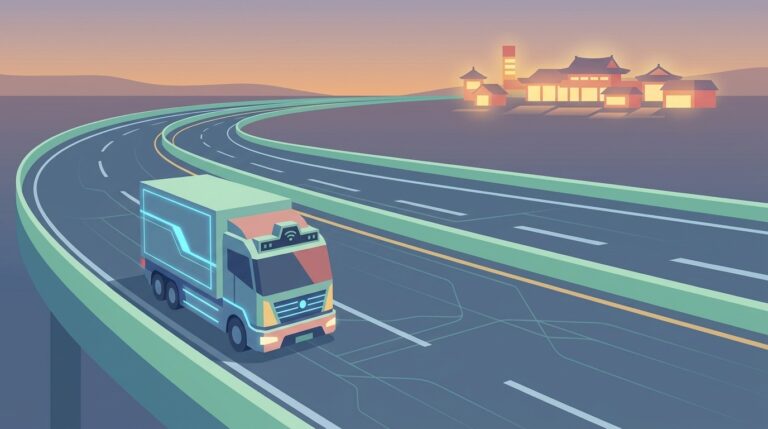
Will Autonomous Trucks Take Over? How Korean Truckers Are Reskilling in the Age of AI
Phase 1: Empathy (Story-Driven Opening)
안녕하세요! 매일한글 (Daily Hangul) editor here!
Picture this: It’s 2:00 AM at the bustling Okcheon Service Area (옥천휴게소) along Korea’s arterial Gyeongbu Expressway. The air smells of rich dwaeji gukbap (pork soup) and steaming instant maxim mocha gold coffee. At the counter, seasoned freight truckers (hwamul gisa-nim) huddle around a smartphone screen. They aren’t watching K-dramas—they are staring intently at live test footage of Level 4 autonomous container trucks smoothly cruising the highway between Busan Port and the Seoul Metropolitan Area without a human hand on the steering wheel.
Korea is modernizing at breakneck speed. While the tech industry celebrates logistics automation as the pinnacle of the Fourth Industrial Revolution, for thousands of veteran logistics workers, it brings palpable anxiety over vocational survival. If you are aiming for true C2-level proficiency, mastering casual conversational Korean is not enough. You need the sociolinguistic agility to debate complex macroeconomic transitions, workplace automation, structural unemployment, and the cultural nuances of labor reskilling. Drawing directly from real-world discussions with Korean logistics professionals and advanced learners, this guide equips you with high-register idiomatic frameworks to articulate technological displacement with profound empathy and analytical depth.
Phase 2: In-Depth Analysis of 3 Core C2 Expressions
1. 밥그릇을 빼앗기다 (Bap-geureut-eul ppae-at-gi-da)
- Pronunciation: [Bap-geu-reut-eul ppae-at-gi-da] (Analogy: Think of ‘bap’ like ‘bop’, ‘geureut’ like ‘goo-root’ with a crisp flat vowel, and ‘ppae’ as an explosive ‘peh’ sound).
- Meaning: Literally: “To have one’s rice bowl stolen.” | Actual Nuance: To have one’s livelihood, economic territory, or job encroached upon by technology or competitors.
- K-Culture Moment: Heard frequently in investigative journalism shows like SBS Unanswered Questions (그것이 알고 싶다) or socioeconomic K-dramas when blue-collar workers confront corporate modernization.
- Editor’s Insight: In Korean culture, bap (rice) is synonymous with survival, dignity, and family sustenance. Referring to someone’s job as their bap-geureut elevates career loss from a mere contractual termination to an existential crisis.
- Situation Spectrum: Casual: ✅ | Semi-formal: ✅ | Formal/Academic: ⚠️ (In formal policy briefs, use ‘생존권을 위협받다’ [livelihood threatened] instead).
- 🤔 Think About It: How does your native language conceptualize the loss of livelihood? Does it invoke fundamental food symbolism like Korea’s “rice bowl” or “breadwinning” in English?
2. 직종 전환의 기로에 서다 (Jik-jong jeon-hwan-ui giro-e seoda)
- Pronunciation: [Jik-jjong jeon-hwan-ui gi-ro-e seo-da] (Analogy: ‘Giro’ sounds like ‘key-row’—an inflection point where pathways diverge).
- Meaning: Literally: “To stand at the crossroads of occupational transition.” | Actual Nuance: Facing a critical, inevitable turning point where one must retrain and pivot careers to survive industrial shifts.
- K-Culture Moment: Used by labor analysts and news anchors on KBS News when reporting on government-funded vocational reskilling programs for aging drivers.
- Editor’s Insight: Giro (기로) denotes a decisive junction where delaying a decision leads to stagnation. It pairs naturally with macro-level technological pressures like generative AI and self-driving systems.
- Situation Spectrum: Casual: ⚠️ | Semi-formal: ✅ | Formal: ✅
- 🤔 Think About It: Notice how Korean spatial metaphors frame professional crossroads not merely as personal choices, but as systemic intersections forced by societal evolution.
3. 시대의 흐름을 거스를 수 없다 (Si-dae-ui heu-reum-eul geo-seu-reul su eopda)
- Pronunciation: [Si-dae-ui heu-reu-meul geo-seu-reul su eop-tta] (Analogy: ‘Geoseureul’ sounds like ‘guh-soo-reul’—resisting a powerful river current).
- Meaning: Literally: “One cannot go against the flow of the times.” | Actual Nuance: A fatalistic yet pragmatic acknowledgment that technological progress is inevitable, necessitating adaptation rather than denial.
- K-Culture Moment: Delivered by corporate executives or pragmatic labor representatives in tech-noir series or economic podcasts when discussing industrial restructuring.
- Editor’s Insight: This phrase balances philosophical resignation with strategic realism. It conveys high cognitive maturity—acknowledging unavoidable disruption before shifting the focus to proactive reskilling.
- Situation Spectrum: Casual: ✅ | Semi-formal: ✅ | Formal: ✅
- 🤔 Think About It: Does acknowledging the “inevitable tide” imply surrender in your culture, or does it signal high emotional intelligence and adaptability?
Phase 3: Textbook Korean vs. Real Korean
Situation 1: Expressing Fear of AI Taking Over Logistics Jobs
- 📖 교과서 한국어 (Textbook Korean):
자율 주행 기술의 발전으로 인해 트럭 운전사들의 일자리가 감소할 것으로 예상됩니다.
(Jayul juhaeng gisurui baljeoneuro inhae teureok unjeonsadeurui iljariga gamsohal geoseuro yesangdoemnida.)
“Due to the development of autonomous driving technology, it is expected that truck drivers’ jobs will decrease.” - 🗣️ 진짜 한국어 (Real Native C2 Korean):
자율주행 상용화되면 우리 바닥도 판이 완전히 갈아엎어질 텐데, 언제까지 버틸 수 있을지 막막하네요.
(Jayuljuhaeng sang-yonghwadoemyeon uri badakdo pani wanjeonhi gara-eopeojil tende, eonjekkaji beotil su isseulji mangmakhane-yo.)
“Once autonomous driving is commercialized, our entire industry landscape will be upended; I feel helpless wondering how long we can hold out.” - 💡 왜 다를까? (Cultural Insight): Native professionals rarely use sterile statistical terms like gamso (decrease) when discussing their own livelihood. They use idiomatic domain terms like uri badak (our sector/ground) and pani gara-eopeojida (the game board being overturned), evoking visceral vulnerability.
Situation 2: Emphasizing the Urgency of Vocational Retraining
- 📖 교과서 한국어 (Textbook Korean):
정부의 재교육 프로그램을 통해 새로운 전문 기술을 습득해야 합니다.
(Jeongbu-ui jaegyoyuk peurogeuraemeul tonghae saeroun jeonmun gisureul seupdeukhaeya hamnida.)
“We must acquire new technical skills through government retraining programs.” - 🗣️ 진짜 한국어 (Real Native C2 Korean):
마냥 손 놓고 있다간 도태되기 십상이니, 관제 시스템이든 뭐든 배워서 몸값 다시 올려야죠.
(Manyang son nokko itdagan dotaedoegi sipsang-ini, gwanje siseutem-ideun mwodeun baewoseo momgap dasi ollyeoyajyo.)
“If we just sit on our hands, we’re bound to become obsolete; we need to learn fleet monitoring systems or whatever it takes to boost our market value again.” - 💡 왜 다를까? (Cultural Insight): Real Korean employs vibrant action idioms like son 놓고 있다 (sitting idly) and dotaedoeda (falling behind in natural selection), along with the commercial labor metaphor momgapseul ollida (raising one’s market value).
Phase 4: K-Culture Deep Dive & Non-Verbal Manners
4-1. 눈치 (Nunchi) & Somber Physical Etiquette in Industrial Discussions
When discussing job insecurity with Korean professionals, especially middle-aged freight operators or industrial workers:
* The Heavy Nod and Subdued Gaze: Avoid aggressive eye contact. When an interlocutor vents about technological displacement, lower your chin slightly, tilt your head down, and maintain a contemplative gaze while softly emitting “아이고… 그러게요” (Aigo… geureogeyo).
* Two-Handed Beverage Handling at Rest Stops: In informal settings like highway rest areas (hyugeso) or gisa sikdang (drivers’ diners), when someone hands you canned coffee, always receive it with both hands to communicate solidarity and generational deference.
4-2. Cultural Codes: The Myth of the Trucker and the 4th Industrial Revolution
In Korea, long-haul trucking (hwamul unssong) has historically been the backbone of the nation’s export miracles, memorialized through the active solidarity of the Hwamul Yeondae (Truckers Solidarity Union). Unlike Western individualist trucking subcultures, Korean truckers operate within dense familial networks and regional dispatch cooperatives. AI-driven logistics disruption in Korea is viewed not just as technological modernization, but as a generational reckoning that impacts local regional hubs like Ulsan, Pyeongtaek, and Busan.
Phase 5: Real-World Roleplay Scenario
- Setting: Late night at Okcheon Rest Area. Steam rises from two paper cups of vending machine black coffee.
- Characters:
- Mr. Park (박 기사님): A 54-year-old veteran container driver with 25 years on the Gyeongbu Expressway.
- Min-woo (민우 / You): A forward-thinking logistics operations coordinator specializing in AI-integrated fleet transitions.
- Mr. Park: 🎭 (Staring into his coffee with a bitter smile)
민우 씨, 뉴스 봤어요? 부산-의왕 구간에 자율주행 대형 트럭 시범 운행 들어갔다면서요?
(Min-woo ssi, nyuseu bwasseoyo? Busan-Uiwang gugane jayuljuhaeng daehyeong teureok sibeom unhaeng deureogatdamyeonseoyo?)
“Min-woo, did you see the news? They say Level 4 autonomous heavy trucks started pilot runs on the Busan-Uiwang route?” -
Min-woo (You): 🎭 (Sighs softly, matching his somber tone)
네, 기사님. 기술 발전 속도가 생각보다 빨라서 현장에 계신 분들 심정이 참 복잡하실 것 같습니다.
(Ne, gisa-nim. Gisul baljeon sokdoga saenggakboda ppallaseo hyeonjange gyesin bundeul simjeongi cham bokjaphasil geot gatseumnida.)
“Yes, Mr. Park. The pace of technology is faster than expected, so I imagine everyone in the field feels deeply conflicted.” -
Mr. Park: 🎭 (Tapping his calloused hands on the table)
복잡한 수준이 아니지. 젊은 애들은 몰라도 우리 같은 50대는 당장 밥그릇 빼앗기는 기분이에요. 핸들 놓으면 뭘 먹고살아야 하나.
(Bokjaphan sujuni aniji. Jeolmeun aedeureun mollado uri gateun osipdaeneun dangjang bapgeureut ppaeatgineun gibunieyo. Haendeul noeumyeon mwol meokgosaraya hana.)
“It’s beyond conflicted. Younger folks might adapt, but for us in our 50s, it feels like our rice bowls are being snatched overnight. If I let go of the wheel, how do I make a living?” -
Min-woo (You): 🎭 (Leaning forward, speaking with measured conviction)
충분히 공감합니다. 하지만 기사님의 25년 현장 노하우는 단순 AI 알고리즘이 단기간에 대체할 수 없는 자산입니다.
(Chungbunhi gonggamhamnida. Hajiman gisa-nimui isibonyeon hyeonjang nohawuneun dansun AI algorijeumi dangigane daechehal su eomneun jasan-imnida.)
“I completely empathize. However, your 25 years of on-the-road field know-how is an asset that simple AI algorithms cannot replace in the short term.” -
Mr. Park: 🎭 (Looking up with a mix of doubt and curiosity)
노하우가 있으면 뭐 해요? 결국 기계가 알아서 차선 맞추고 주행하는 세상인데.
(Nohawuga isseumyeon mwo haeyo? Gyeolguk gigyega araseo chaseon matchugo juhaenghaneun sesang-inde.)
“What good is know-how? In the end, it’s a world where machines stay in lane and drive all by themselves.” -
Min-woo (You): 🎭 (Nodding gently)
그래서 지금이 직종 전환의 기로인 것 같습니다. 직접 운전대를 잡는 대신, 원격 군집 주행 관제사나 스마트 물류 관리자로 업스킬링하는 재교육 코스가 신설되고 있거든요.
(Geuraeseo jigeumi jikjong jeonhwan-ui giro-in geot gatseumnida. Jikjeop unjeondaereul jamneun daesin, won-gyeok gunjip juhaeng gwanjesana seumateu mullyu gwallijaro eopseukillinghaneun jaegyoyuk koseuga sinseoldoego itgeodeunyo.)
“That’s precisely why this is a turning point for career transition. Instead of gripping the wheel directly, new upskilling courses are emerging for remote platooning fleet controllers and smart logistics coordinators.” -
Mr. Park: 🎭 (Pausing thoughtfully, exhaling slowly)
시대의 흐름을 거스를 수는 없다는 건 아는데… 나이 먹고 소프트웨어니 관제니 새로 배우는 게 솔직히 두렵긴 해요.
(Sidae-ui heureumeul geoseureul suneun eopdaneun geon aneunde… Nai meokgo sopeuteuweeoni gwanjeni saero baeuneun ge soljikhi duryeopgin haeyo.)
“I know one cannot go against the flow of the times… but honestly, learning software and fleet monitoring at my age is terrifying.” -
Min-woo (You): 🎭 (Placing a reassuring hand near his cup)
그 두려움은 당연합니다. 정부 지원 전환 교육 과정에서 기사님 같은 베테랑들의 실무 지식을 반영하는 튜터링 과정도 있으니, 제가 첫걸음부터 함께 알아봐 드릴게요.
(Geu duryeoumeun dang-yeonhamnida. Jeongbu jiwon jeonhwan gyoyuk gwajeong-eseo gisa-nim gateun beteraengdeurui silmu jisigeul banyeonghaneun tyuteoring gwajeongdo isseuni, jega cheotgeoreumbuteo hamkke arabwa deurilgeyo.)
“That fear is completely natural. Government transition programs now include peer-tutoring tracks that value veteran field experience, so I will gladly help you explore the first steps.”
🔀 Interactive Choice Point
How would you respond if Mr. Park skeptically says: “정부 교육 받아봤자 현장 써먹지도 못하는 껍데기 교육 아니에요?” (Isn’t government training just useless fluff that can’t be used on the ground?)
- Option A: “시대가 바뀌었으니 불평만 하셔서는 안 됩니다. 무조건 수료하셔야 해요.” (You shouldn’t just complain when times have changed. You must complete it no matter what.)
- Feedback (Bad): 🚫 Tone-deaf and culturally abrasive. In Korean professional ethics, dismissing a senior’s legitimate skepticism damages relational trust (rapport).
- Option B: “맞아요, 정부 정책은 늘 현실과 동떨어져 있어서 그냥 포기하는 게 낫습니다.” (You’re right, government policies are always detached from reality, so it’s better to just give up.)
- Feedback (Risk): ⚠️ Overly nihilistic. Fails to offer constructive professional navigation or advanced communicative leadership.
- Option C: “기존 이론 교육의 한계에 대한 우려는 지극히 타당합니다. 다만 이번 산학연계 모델은 실무 관제 시뮬레이터를 직접 다루는 맞춤형 과정이라 실효성이 높습니다.” (Your concern regarding theoretical training is entirely valid. However, this industry-academia model focuses on practical simulator operations, ensuring immediate relevance.)
- Feedback (Best): ✅ Masterclass C2 Korean. Validates the skepticism with formal empathy (지극히 타당합니다) and counters with clear structural evidence (산학연계 모델).
Phase 6: 10-Second Emotional Shadowing Drill
Practice reading these lines aloud with the specified pause marks (/) and emotional tone indicators:
[😟 깊은 고뇌와 현실적 막막함을 담아 / With deep angst and raw vulnerability]
“자율주행이 본격화되면 / 수십 년간 고속도로를 누비던 우리 같은 사람들은 / 어디로 밀려나야 합니까?”
(Jayuljuhaeng-i bongyeokhwa-doemyeon / susip nyeon-gan gosokdororeul nubideon uri gateun saramdeureun / eodiro millyeonaya hamnikka?)-
[🔥 결연하고 설득력 있는 비장함으로 / With resolute conviction and persuasive clarity]
“기술의 진보를 막을 수 없다면, / 현장 실무자가 관제와 안전 시스템의 주역으로 거듭나도록 / 제도적 사다리를 놓아야 합니다.”
(Gisurui jinboreul mageul su eopdamyeon, / hyeonjang silmujaga gwanjewa anjeon siseutem-ui juyeogeuro geodeubnadorok / jedojeok sadarireul no-aya hamnida.)
Phase 7: K-Culture Mini Dictionary
- 화물연대 (Hwa-mul Yeon-dae) | Korean Truckers Solidarity Union
- Usage: Essential socio-political vocabulary when discussing collective bargaining, freight rate guarantees (안전운임제), and organized driver advocacy against unilateral automation.
- 일자리 잠식 (Il-ja-ri Jam-sik) | Labor Erosion / Job Cannibalization
- Usage: High-level economic term used in business editorials describing how AI platforms incrementally absorb traditional employment domains.
- 업스킬링 및 재교육 (Eop-seu-kil-ling mit Jae-gyo-yuk) | Upskilling and Vocational Retraining
- Usage: Crucial term for government initiatives like the Tomorrow Learning Card (국민내일배움카드) aimed at repositioning manual workers into technical supervisors.
- 상생 모델 (Sang-saeng Mo-del) | Mutual Coexistence / Win-Win Paradigm
- Usage: A core cultural pillar in Korean corporate social responsibility, balancing technological implementation with worker retention guarantees.
Phase 8: Cultural Survival Kit & Field Notes
Top 3 Field Expressions
- 한숨 돌리다 (Han-sum dol-li-da) | To catch one’s breath / To find a brief respite
- Pro Tip: Use this when taking a break at rest stops after intensive driving or high-stress negotiations.
- 첫술에 배부르랴 (Cheot-sur-e bae-bu-reu-rya) | Rome wasn’t built in a day (Lit: Can one be full from the first spoonful?)
- Pro Tip: Perfect idiom to encourage an older coworker struggling with initial tech retraining.
- 노사정 대타협 (No-sa-jeong Dae-ta-hyeop) | Tripartite Grand Compromise (Labor-Management-Government)
- Pro Tip: Essential for formal discussions on high-tech policy and regulatory rollouts.
Editor’s Field Note
When researching Korean transport logistics or experiencing highway culture firsthand, track live route traffic and rest-stop facilities using the Korea Expressway Corporation Hi-Pass and Rest Area Information System. If you converse with veteran drivers at rest stops, remember that calling them gisa-nim (기사님 – respected engineer/driver) is mandatory; never use generic pronouns like dangsin (당신) or casual terms.
Phase 9: “A Step Deeper” (Societal Reflection)
South Korea’s socio-economic fabric is defined by an intriguing paradox: the collective pride in leading global digital innovation (IT 강국) versus the profound social commitment to mutual protection (상생). When algorithmic disruption enters traditionally blue-collar environments, the friction is rarely just about wages—it touches the Confucian dignity of lifetime craftmanship (장인 정신). In Korea, career reskilling cannot simply be an individual burden; it is framed as a societal compact where the state and enterprise must build a “structural ladder” (제도적 사다리) for those displaced by the algorithms of the future.
💬 Your Turn: How does your home country handle the ethical tension between self-driving automation and blue-collar labor survival? Share your thoughts in advanced Korean below!
Phase 10: FAQ & Common Mistakes (SEO Structured)
Q: What is the most natural way to refer to technological unemployment in advanced Korean?
A: While sil-jik (실직 – job loss) is standard, C2-level speakers prefer sophisticated conceptual phrases like 기술적 실업 (technological unemployment), 인공지능에 의한 일자리 잠식 (job encroachment by AI), or idiomatic expressions like 일터에서 밀려나다 (to be pushed out of the workplace).
Q: Can I use the word ‘운전수 (Unjeonsu)’ to address a professional trucker?
A: No. Unjeonsu (운전수) carries an outdated, condescending nuance. Always address drivers respectfully as 기사님 (Gisa-nim) or use formal professional terms like 화물차 운송 종사자 (Freight transport professional) in written reports.
Q: How do I diplomatically express that resistance to automation is futile without sounding rude?
A: Use pragmatic mitigation markers: “기술적 진보 자체를 원천 차단하기는 현실적으로 어렵겠지만…” (“While realistically preventing technological progress entirely is difficult…”) followed by solutions focusing on transition safety nets (충격을 완화할 안전망).
🚨 Common Mistakes Warning Board
- Mistake: Saying “AI가 당신의 직업을 죽입니다” (Direct literal translation of “AI kills your job”).
- Correct Action: Use natural economic verbs: “AI가 일자리를 대체하고 있습니다” (AI is replacing jobs) or “고용 시장을 잠식하고 있습니다”.
- Mistake: Misusing 밥그릇 (Rice bowl) in formal academic presentations.
- Correct Action: Reserve 밥그릇 for empathetic spoken dialogues or editorial essays; use 생존권 (Right to survival) or 직업적 지위 (Occupational status) in academic or policy settings.
- Mistake: Overusing basic transition words like 하지만 (But) in high-level debates.
- Correct Action: Upgrade to C2 discourse connectives like “그럼에도 불구하고” (Nevertheless), “이에 반해” (In contrast to this), or “현실적인 측면을 고려할 때” (When considering practical dimensions).
Phase 11: Action Missions
- 🥉 Bronze Mission (Solo Mastery): Record yourself reading the Phase 6 Shadowing Drill twice. Focus on lowering your tone to express emotional gravity without sounding artificial.
- 🥈 Silver Mission (Social Expansion): Write a 3-sentence opinion in Korean about autonomous vehicles using at least two core phrases (밥그릇을 빼앗기다, 시대의 흐름을 거스를 수 없다) and share it on your language-learning feed.
- 🥇 Gold Mission (Real-world Immersion): Watch a Korean news debate on YouTube regarding 자율주행 화물차 도입 (Introduction of autonomous freight trucks) and identify at least three expressions related to 재교육 (reskilling) or 상생 (coexistence).
- 🎮 K-Culture Mission: Search for articles covering the Korean 국민내일배움카드 (Tomorrow Learning Card) system and summarize how AI upskilling is funded for mid-career workers.
Phase 12: Interactive Quiz Challenge
Question 1: Situation Judgment
Which of the following responses is the most culturally empathetic and linguistically refined when an experienced trucker expresses fear over autonomous freight trials?
* A) 자율주행이 더 안전하니 받아들이셔야 합니다.
* B) 밥그릇 빼앗긴다고 화만 내시면 발전이 없어요.
* C) 현장의 우려는 당연합니다. 다만 축적된 실무 지식을 관제 역량으로 전환할 상생 방안을 모색해야 합니다.
👉 Click to view Question 1 Answer & Explanation
- Correct Answer: C
- Explanation: Choice C impeccably exemplifies C2 communication: it validates emotional anxiety (현장의 우려는 당연합니다), honors professional capital (축적된 실무 지식), and pivots to constructive institutional problem-solving (상생 방안을 모색해야 합니다).
Question 2: Fill in the Blank
Complete the C2-level sentence with the most natural idiom:
“물류 자동화가 가속화되는 현시점에서, 우리는 기술 혁신과 고용 안정이라는 두 갈래 ________ 서 있습니다.”
(At this point of accelerated logistics automation, we stand at the ________ of technological innovation and employment security.)
👉 Click to view Question 2 Answer & Explanation
- Correct Answer: 기로에 (Giro-e)
- Explanation: The full idiom is 기로에 서다 (to stand at the crossroads of a decisive turning point).
Question 3: True / False Cultural Nuance
Statement: In Korean business and labor discourse, referring to one’s livelihood as 밥그릇 is considered impolite in all conversational settings.
👉 Click to view Question 3 Answer & Explanation
- Correct Answer: False
- Explanation: While 밥그릇 is unsuitable for dry governmental legal documents, it is an evocative and accepted idiom in journalistic editorials, union solidarity dialogues, and empathetic professional conversations between colleagues.







