

Master Korean Traditional Market Souvenir Shopping Like a Local
Phase 1: 공감 (Story-Immersive Opening)
안녕하세요! 매일한글 에디터입니다.
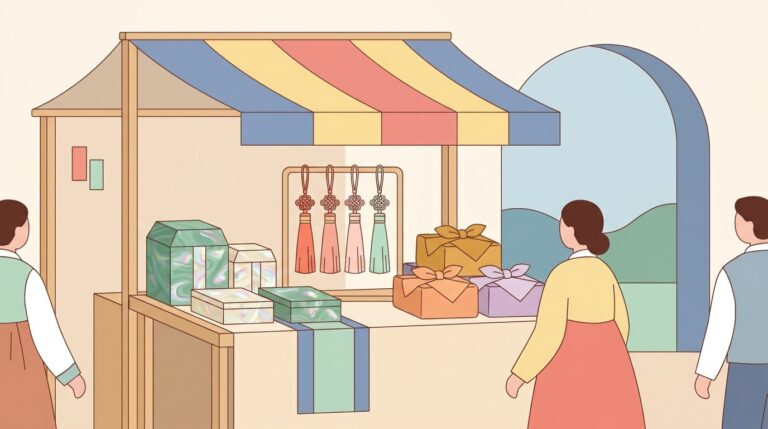
Picture this: You are wandering through the lively, vibrant alleys of Namdaemun or Gwangjang Market. The air is rich with the aroma of freshly made bindaetteok and traditional herbal teas. Colorful silk norigae tassels sway gently in the breeze, and shimmering mother-of-pearl (jagae) craft boxes catch your eye. You want to buy authentic souvenirs for your loved ones back home, but suddenly, panic strikes. Do you just point awkwardly and use calculator apps to haggle? Or do you end up buying mass-produced factory keychains because you didn’t know how to ask for authentic, locally made craftwork?
Many intermediate Korean learners hit an invisible communication wall at traditional markets (jeontong sijang). Textbooks teach formal sentences like “이것은 얼마입니까?” (How much is this?), but real marketplace dynamics operate on warmth, rapport (jeong), and street-smart etiquette. When you speak with the right nuance, market aunties (Imo) and shop owners (Sajangnim) will not only smile and give you genuine advice, but they might even wrap your gift in elegant bojagi and throw in extra gifts (deom)! Based on actual feedback from hundreds of our intermediate learners, this guide equips you with the authentic, natural expressions and cultural insights needed to navigate Korean souvenir hunting with total confidence.
Phase 2: 핵심 표현 3선 심층 분석 (Deep Dive into 3 Core Expressions)
1. 선물용으로 추천해 주실 만한 것 있나요? (Seonmulyong-euro chucheonhae jusil manhan geot innayo?)
- Pronunciation: [Seon-mul-yong-eu-ro chu-cheon-hae ju-sil man-han geot in-na-yo?] (Think of saying “sun-mool-yong” with a smooth gliding ‘r’ into “chu-cheon”)
- Meaning: Literal: “Is there anything worthy of recommendation for gift purposes?” | Real Nuance: “Could you recommend something great as a souvenir/gift?”
- K-Culture Moment: Commonly heard in lifestyle K-Dramas when characters visit artisan alleys in Insadong or craft quarters in traditional markets looking for housewarming or overseas gifts.
- Editor’s Insight: Adding ~용으로 (~yong-euro, for the purpose of) instantly upgrades your Korean from beginner to polished intermediate (B2). It signals that you have a specific recipient in mind, prompting vendors to show their highest-quality artisan items rather than generic tourist trinkets.
- Situation Spectrum: Casual ⚠️ | Semi-formal ✅ | Formal ✅
- 🤔 Think About It: In English, we often ask “What sells best?” In Korean culture, framing the purchase around the recipient’s honor (선물용) invites the seller into a communal role of curating respect.
2. 이거 여러 개 사면 조금 깎아주실 수 있어요? (Igeo yeoreo gae samyeon jogeum kkakka-jusil su isseoyo?)
- Pronunciation: [Ee-geo yeo-reo gae sa-myeon jo-geum kka-kka-ju-sil su iss-eo-yo?] (The double ‘kk’ sounds like a sharp, crisp ‘k’ sound as in “sky”)
- Meaning: Literal: “If I buy multiple of this, can you cut the price a bit?” | Real Nuance: “Could I get a small bundle discount if I pick up a few of these?”
- K-Culture Moment: A quintessential scene in Korean travel variety shows where cast members buy bulk traditional snacks or handcrafted bookmarks for the production crew.
- Editor’s Insight: Direct bargaining can feel confrontational in modern Korea, but market vendors love bundle sales. Using 여러 개 사면 (if I buy several) provides a legitimate win-win reason for a discount, softening the request with polite grammar (~주실 수 있어요?).
- Situation Spectrum: Casual ⚠️ | Semi-formal ✅ | Formal 🚫
- 🤔 Think About It: Why is conditional bargaining considered polite in market contexts, while asking for a flat discount on a single low-priced item might be frowned upon?
3. 포장도 예쁘게 해주실 수 있나요? (Pojangdo yeppeuge hae jusil su innayo?)
- Pronunciation: [Po-jang-do yep-peu-ge hae ju-sil su in-na-yo?]
- Meaning: Literal: “Can you also do the wrapping prettily?” | Real Nuance: “Could you gift-wrap this nicely for me?”
- K-Culture Moment: Seen when protagonists prepare bespoke gifts using traditional Korean patterned boxes or silk bojagi cloths.
- Editor’s Insight: Korean gift culture places immense aesthetic value on presentation. Traditional market vendors often carry traditional wrapping paper, ribbon tassels, or fabric cases behind the counter that they offer upon request.
- Situation Spectrum: Casual ⚠️ | Semi-formal ✅ | Formal ✅
- 🤔 Think About It: How does the visual presentation of a gift reflect Korean social manners (ye-ui) compared to wrapping customs in your home culture?
Phase 3: 교과서 한국어 vs 진짜 한국어 (Textbook vs. Real Korean)
Situation 1: Inquiring if an item is handmade craftwork
- 📖 교과서 한국어 (Textbook): 이것은 수공예품입니까? (Igeoseun sugong-yepum-imnikka? – Is this a piece of handicraft?)
- 🗣️ 진짜 한국어 (Real Korean): 사장님, 이거 직접 만드신 거예요? (Sajangnim, igeo jikjeop mandeusin geoyeyo? – Boss, did you make this by hand yourself?)
- 💡 왜 다를까?: Textbook phrasing sounds like an official inspection query. Real shoppers build rapport with the shopkeeper (Sajangnim) by asking about their personal craftmanship, which opens the door for warm storytelling.
Situation 2: Asking for a complimentary gift or market perk
- 📖 교과서 한국어 (Textbook): 사은품을 주실 수 있습니까? (Sa-eun-pumeul jusil su isseumnikka? – Can you provide a promotional giveaway?)
- 🗣️ 진짜 한국어 (Real Korean): 사장님, 덤으로 하나만 더 챙겨주세요~ (Sajangnim, deom-euro hanaman deo chaeng-gyeo-juseyo~ – Boss, could you toss in a little extra bonus?)
- 💡 왜 다를까?: Traditional markets run on the culture of 덤 (deom)—an affectionate extra token given freely. Asking playfully for a deom creates a friendly, nostalgic connection that rigid corporate vocabulary completely destroys.
Phase 4: K-Culture 딥다이브 & 비언어적 매너 (Culture Deep Dive & Non-Verbal Manners)
4-1. 눈치 (Nunchi) & Marketplace Body Language
- Two-Handed Transaction: When handing over cash, cards, or receiving your packaged souvenir, always hold the item with both hands or support your right forearm with your left hand. This demonstrates deep respect.
- Reading the Vibe (Nunchi): If a market vendor is busy packing wholesale boxes or speaking to another regular customer, avoid aggressive haggling. Wait for eye contact and a gentle nod before starting your conversation.
- Gentle Voice Pitch: A slightly softened sentence ending (e.g., “~주시면 감사해요!”) works wonders compared to flat, blunt declarative questions.
4-2. Cultural Codes: The Resurgence of Traditional Crafts in Modern K-Media
Traditional souvenirs are no longer viewed as dusty relics. Thanks to historical fantasy dramas and idol stage concepts, items like 자개 (jagae, mother-of-pearl) phone cases, 노리개 (norigae) keyrings attached to luxury bags, and 보자기 (bojagi) eco-wraps have become high-fashion aesthetic statements among Gen Z and global travelers alike. When you shop in traditional markets, you are taking part in a living cultural renaissance.
Phase 5: 실전 롤플레이 시나리오 (Real-World Roleplay Scenario)
Setting: Gildong Craft Workshop in a cozy alley of a Seoul traditional market. Beautiful handmade silk pouches and mother-of-pearl mirrors line the wooden stalls.
Characters:
* Learner (Alex): A thoughtful traveler searching for authentic Korean gifts.
* Shopkeeper (Sajangnim): An experienced, warm artisan in her 60s.
- Alex: 🎭 [Politely looking around, bowing slightly] 사장님, 안녕하세요! 외국인 친구들한테 선물할 만한 거 보고 있는데요. (Sajangnim, annyeonghaseyo! Oegugin chingudeulhante seonmulhal manhan geo bogo inneundeyo. / Hello, Boss! I’m looking for something nice to gift to my friends abroad.)
- Shopkeeper: 🎭 [Smiling warmly and pointing to a velvet display tray] 어서 와요! 외국인 친구들이면 이 자개 손거울이나 실크 노리개 키링이 제일 인기가 많아요. (Eoseo wayo! Oegugin chingudeurimyeon i jagae son-geourina silkeu norigae kiring-i jeil ingiga manayo. / Welcome! For foreign friends, these mother-of-pearl hand mirrors and silk norigae keyrings are the most popular.)
- Alex: 🎭 [Picking up a mirror gently with two hands] 와, 영롱하고 진짜 예쁘네요. 이거 직접 만드신 거예요? (Wa, yeongnonghago jinjja yeppeuneyo. Igeo jikjeop mandeusin geoyeyo? / Wow, it’s so luminous and pretty. Did you make this by hand yourself?)
- Shopkeeper: 🎭 [Proudly adjusting the display] 그럼요, 우리 공방에서 천연 조개껍데기로 다 수작업한 거예요. 변색도 안 돼요. (Geureomyo, uri gongbang-eseo cheon-yeon jogae-kkeopdegiro da sujag-eophan geoyeyo. Byeonsaekdo an dwaeyo. / Of course! It’s completely handcrafted in our workshop using natural seashells. It never discolors.)
- Alex: 🎭 [Checking the quantity] 마음에 쏙 들어요! 이거 다섯 개 사면 조금 깎아주실 수 있어요? (Maeume ssok deureoyo! Igeo daseot gae samyeon jogeum kkakka-jusil su isseoyo? / I love them! If I buy five of these, could you give me a small discount?)
- Shopkeeper: 🎭 [Chuckling good-naturedly] 다섯 개나 사면 당연히 깎아줘야지! 개당 2천 원씩 빼줄게요. (Daseot gaena samyeon dang-yeonhi kkakka-jwoyaji! Gaedang icheon-wonssik bbaejulgeyo. / If you buy five, of course I should give a discount! I’ll take off 2,000 won per item.)
- Alex: 🎭 [Delighted] 감사합니다! 혹시 선물용인데 예쁘게 개별 포장도 해주실 수 있나요? (Gamsahamnida! Hoksi seonmulyong-inde yeppeuge gaebyeol pojangdo hae jusil su innayo? / Thank you so much! Since they’re gifts, could you package them individually and nicely?)
- Shopkeeper: 🎭 [Taking out traditional silk packaging pouches] 전통 한지 상자에 담아서 예쁜 끈으로 묶어줄게요, 학생! (Jeontong hanji sangja-e damaseo yeppeun kkeun-euro mukkeojulgeyo, haksaeng! / I will pack them in traditional Hanji paper boxes and tie them with pretty cords for you, dear!)
🔀 인터랙티브 분기점 (Interactive Choice Point)
After the shopkeeper offers the discount and lovely packaging, what is your best response?
- Choice A: “사장님 최고예요! 다음에도 친구들이랑 꼭 다시 올게요.” (Boss, you’re the best! I’ll definitely come back with my friends next time.)
- 👉 Feedback [BEST]: Perfect intermediate response! It shows gratitude and market jeong, guaranteeing top-tier service and perhaps an extra souvenir bookmark (deom).
- Choice B: “더 깎아주세요. 만 원에 다 주세요.” (Discount more. Give all of them to me for 10,000 KRW.)
- 👉 Feedback [BAD]: Excessive haggling after an already generous offer and free gift-packaging is considered disrespectful and breaks market rapport.
- Choice C: “그냥 포장 박스만 따로 주세요. 제가 할게요.” (Just give me the boxes separately. I will wrap them myself.)
- 👉 Feedback [RISK]: While not rude, turning down an artisan’s dedicated gift-wrapping offer misses out on an authentic cultural exchange experience.
Phase 6: 10초 감정 섀도잉 드릴 (10-Second Emotion Shadowing Drill)
Practice these natural rhythm pauses (/) and embody the emotional stage cues:
[✨ 호기심과 정중함을 담아 / Curiously & Politely]- 사장님, / 외국인 친구 선물용으로 / 추천해 주실 만한 거 / 있을까요?
(Sajangnim, / oegugin chingu seonmulyong-euro / chucheonhae jusil manhan geo / isseulkkayo?)
- 사장님, / 외국인 친구 선물용으로 / 추천해 주실 만한 거 / 있을까요?
[😊 애교와 협상력을 섞어서 / With Friendly Charm & Tact]- 이거 디자인별로 / 세 개 살 건데, / 조금만 에누리 / 해주실 수 있어요?
(Igeo dijain-byeollo / se gae sal geonde, / jogeumman enuri / hae jusil su isseoyo?)
- 이거 디자인별로 / 세 개 살 건데, / 조금만 에누리 / 해주실 수 있어요?
[🙏 감사의 마음과 기대감 / Grateful & Anticipatory]- 포장까지 신경 써주셔서 / 정말 감사해요! / 소중하게 / 선물할게요.
(Pojang-kkaji singyeong sseojusyeoseo / jeongmal gamsahaeyo! / Sojunghage / seonmulhalgeyo.)
- 포장까지 신경 써주셔서 / 정말 감사해요! / 소중하게 / 선물할게요.
Phase 7: K-Culture 미니 사전 (Key Souvenir Vocabulary)
- 자개 (Jagae) | Mother-of-Pearl Craft
- Handcrafted iridescent lacquerware. A signature Korean traditional craft souvenir seen in jewelry boxes, mirrors, and modern stationery.
- 노리개 (Norigae) | Traditional Hanbok Tassel / Ornament
- Historically worn on traditional garments; today, it is universally loved as an aesthetic charm for tote bags, car mirrors, and keyrings.
- 덤 (Deom) | Complimentary Bonus / Market Extra
- The quintessential traditional market custom of adding a free extra item or portion out of mutual affection and hospitality.
- 보자기 (Bojagi) | Traditional Wrapping Cloth
- Reusable, geometric fabric used for wrapping gifts. Represents wishing good fortune (bok) upon the gift recipient.
Phase 8: 여행자를 위한 생존 키트 (Traveler’s Survival Kit)
Top 3 Survival Phrases
- 카드 결제도 되나요? (Kadeu gyeoljedo doenayo? – Can I pay by card?)
- 💡 Pro Tip: While almost all vendors accept cards, paying cash or bank transfer (gyejwa-iche) often makes sellers much more open to discounts or giving deom.
- 깨지지 않게 뽁뽁이로 잘 싸주세요. (Kkaejiji anke ppokppogiro jal ssa-juseyo. – Please wrap it securely in bubble wrap so it won’t break.)
- 💡 Pro Tip: Essential when purchasing ceramic teaware, lacquerware, or fragile jagae crafts for luggage storage.
- 영수증이나 면세 처리 되나요? (Yeongsujeung-ina myeonse cheori doenayo? – Can I get a receipt or tax refund processing?)
- 💡 Pro Tip: Large designated tourist markets often have immediate Tax Free kiosks near main entrance gates.
Editor’s Travel Note
- Navigation: Always install and use the [Naver Map navigation application] rather than global map engines for real-time market alleyway locating and stall tracking.
- Transit & Cash: Carry a topped-up transit card and around 30,000–50,000 KRW in physical cash when exploring deep alley stalls for smooth negotiations.
Phase 9: “한 발 더 깊이” (Cultural Essay & Critical Thinking)
In hyper-digitalized modern Korea, where same-day delivery and automated self-checkout counters dominate daily life, traditional markets remain the living sanctuaries of 정 (Jeong, relational warmth) and 흥 (Heung, communal joy). A transaction in a traditional market is rarely just an exchange of currency for merchandise; it is a miniature social contract. When a merchant wraps your souvenir in delicate paper and tucks an extra trinket into your bag, they are sharing their personal hospitality with a guest from afar.
💬 Your Turn: Which traditional Korean souvenir catches your interest the most—shimmering jagae lacquerware, silk norigae charms, or artisan traditional tea? Let us know in the comments below!
Phase 10: FAQ & Common Mistakes
Q: Is bargaining acceptable in all Korean traditional markets?
A: Light, friendly bargaining is welcome when buying multiple handcrafted items, clothing, or bulk souvenirs. However, bargaining over fixed-price street food (like tteokbokki or hotteok) or single low-cost items under 5,000 KRW is generally not customary.
Q: What should I call the stall owner politely?
A: Use 사장님 (Sajangnim, lit. business president/boss) for any male or female shopkeeper. For older female food or craft stall owners with whom you have built a warm connection, 이모님 (Imonim, auntie) is affectionate and beloved.
Q: Are items in traditional markets cheaper than airport duty-free shops?
A: Yes, traditional craft items in markets like Namdaemun, Dongdaemun, or regional markets like Busan Gukje Market are often 30% to 50% cheaper than airport shops, with a vastly wider selection of unique handmade designs.
🚨 흔한 실수 (Common Mistakes) Notice Board
- ❌ Mistake: Saying “깎아줘” (Kkakka-jwo) directly in informal/banmal form.
- ✅ Correct Action: Always use polite honorifics: “조금만 깎아주실 수 있어요?” (Jogeumman kkakka-jusil su isseoyo?)
- ❌ Mistake: Touching delicate mother-of-pearl crafts or silk hanbok fabric with food-greasy hands.
- ✅ Correct Action: Finish your market snacks first, wipe your hands, and ask politely: “만져봐도 될까요?” (Manjyeobwado doelkkayo? – May I touch this?).
- ❌ Mistake: Demanding a steep discount on a single handmade artisan item.
- ✅ Correct Action: Propose a bundle deal first (“세 개 사면…”) to show mutual consideration.
Phase 11: 액션 미션 & 참여 유도 (Action Missions)
- 🥉 Bronze Mission: Stand in front of a mirror and practice Phase 6’s 10-second shadowing drill with bright facial expressions 3 times.
- 🥈 Silver Mission: Leave a comment below using the pattern: “[Item Name] 선물용으로 추천해 주실 만한 것 있나요?”
- 🥇 Gold Mission: Visit a Korean market or online traditional boutique and successfully inquire about bundle items and gift packaging in natural Korean!
- 🎮 K-Culture Mission: Spot a norigae or jagae craft item in your favorite K-Drama or idol music video, and identify how it is styled in modern fashion.
Phase 12: 인터랙티브 퀴즈 챌린지 (Interactive Quiz Challenge)
Q1. Situational Judgment
You are buying 4 sets of traditional Korean metal chopstick-and-spoon (sujeo) sets for your family. Which sentence is the most natural and polite way to ask for a bundle discount?
* A) 더 싸게 해. (Deo ssage hae.)
* B) 사장님, 네 개 살 건데 조금 에누리 해주실 수 있나요? (Sajangnim, ne gae sal geonde jogeum enuri hae jusil su innayo?)
* C) 디스카운트 플리즈. (Diseukaunteu peurijeu.)
🔍 Click to reveal the Answer & Explanation
Correct Answer: B
* Explanation: Choice B uses the respectful title Sajangnim, clearly establishes the bundle premise (네 개 살 건데), and utilizes polite honorific request grammar (~주실 수 있나요?). Choice A is disrespectful informal speech (banmal), and Choice C misses the opportunity to use real Korean!
Q2. Fill-in-the-Blank
Complete the sentence to politely ask for gift packaging:
“외국인 친구에게 줄 건데, 예쁘게 ( )도 해주실 수 있나요?”
* A) 배송 (Baesong – Shipping)
* B) 포장 (Pojang – Wrapping/Packaging)
* C) 교환 (Gyohwan – Exchange)
🔍 Click to reveal the Answer & Explanation
Correct Answer: B (포장)
* Explanation: 포장 (Pojang) means wrapping or packaging. Asking for Pojang turns a standard item into a beautifully presented gift.
Q3. True or False Culture Check
Statement: In Korean traditional markets, receiving a “덤 (Deom)” means you are being charged an extra service fee.
* [True / False]
🔍 Click to reveal the Answer & Explanation
Correct Answer: False
* Explanation: 덤 (Deom) is a traditional Korean market custom of giving a free complimentary extra item to show warm hospitality (Jeong). It never costs extra!







