

Phase 1: 공감 (Story-Immersed Opening)
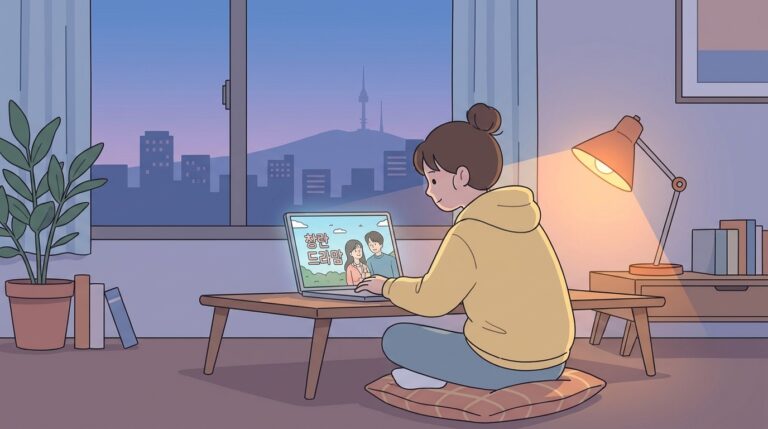
안녕하세요! 매일한글 에디터입니다. Have you ever been hooked on a gripping K-drama like My Liberation Notes, Misaeng, or Queen of Tears, only to find yourself pausing the screen because the English subtitle felt a bit… incomplete? You see a weary office worker staring blankly at the Han River after a brutal day of overtime, sighing a single phrase that makes all the Korean viewers in the comment section burst into empathetic tears. You look up the individual words in your standard dictionary, but the literal translation barely scratches the surface of why everyone felt so emotionally devastated.
Learning Korean at an intermediate (B2) level means moving past basic grammar drills and unlocking the invisible social fabric woven into everyday speech. In Korean dramas, dialogue is rarely just about exchanging information; it reflects intense societal expectations, collective unspoken rules, and deep generational shifts. As an editor who has coached hundreds of international learners over the last ten years, I can tell you this: once you master the cultural subtext behind drama dialogues, your listening comprehension leaps from simple transcription to true empathy. Let’s break down the real Korean society hidden behind your favorite drama scenes!
Phase 2: 핵심 표현 3선 심층 분석 (Core Expressions Deep Dive)
1. 현타 오다 (Hyeonta oda)
- Pronunciation: [Hyeon-ta o-da] (Sounds like ‘hyon-tah oh-dah’, with ‘ta’ crisp like the English word ‘tap’)
- Meaning: Literal: “A moment of reality hits” | Actual Nuance: A sudden, hollow crash back to reality after realizing how much futile effort or false expectation you spent on something.
- K-Culture Moment: In My Liberation Notes, Yeom Mi-jeong stands on a packed commuter subway after spending two exhausting hours traveling just to attend an optional company dinner. She stares at the window reflection and mutters that “현타가 왔다” (reality just hit her hard).
- Editor’s Insight: Short for 현실 자각 타임 (hyeonsil jagak taim / Reality Realization Time). It describes the modern burnout culture and intense social comparison in South Korea. It is the bittersweet psychological state when social illusions shatter.
- Situation Spectrum: Casual (✅) | Semi-formal (⚠️ – among close colleagues) | Formal (🚫)
- 🤔 Think About It: Does your native language have a word for the exact second when high ambition instantly turns into existential emptiness? How does Korean hyper-competition shape this phrase?
2. 눈치 챙겨 (Nunchi chaenggyeo)
- Pronunciation: [Nun-chi chaeng-gyeo] (Sounds like ‘noon-chee cheng-gyuh’)
- Meaning: Literal: “Pack your social sense” | Actual Nuance: “Read the room!” or “Stop being oblivious to the social atmosphere.”
- K-Culture Moment: In Hospital Playlist, when an enthusiastic junior doctor suggests doing a weekend team retreat while the senior professor is clearly suffocating under back-to-back surgeries, his colleague nudges him under the desk and whispers: “제발 눈치 좀 챙겨!” (Please, read the room!).
- Editor’s Insight: Nunchi is not just intuition; it is the high-context survival mechanism of Korean social hierarchy. Telling someone to “챙기다” (pack/gather) their nunchi means their current behavior is actively disrupting group harmony.
- Situation Spectrum: Casual (✅) | Semi-formal (🚫) | Formal (🚫)
- 🤔 Think About It: In your culture, is explicit verbal clarity preferred over reading unspoken cues? Why might indirect atmospheric reading be prized in Korean group dynamics?
3. 스펙을 쌓다 (Seupeg-eul ssata)
- Pronunciation: [Seu-peg-eul ssa-ta] (‘Seupeg’ rhymes with ‘tech’ + ‘sata’ with a reinforced double ‘ss’)
- Meaning: Literal: “To stack specifications” | Actual Nuance: Grinding relentlessly to accumulate measurable credentials (TOEIC scores, certificates, internships, study abroad records) for employment.
- K-Culture Moment: In Start-Up or Record of Youth, young characters sacrifice sleep to study for licenses and internships while competing against candidates with prestigious family backgrounds, discussing whether their “스펙” is enough to pass the resume screening.
- Editor’s Insight: Borrowed from engineering hardware “specifications,” this phrase reveals how Korean society views the job market as a high-stakes engineering puzzle where the individual must upgrade their human ‘specs’ to survive.
- Situation Spectrum: Casual (✅) | Semi-formal (✅) | Formal (✅)
- 🤔 Think About It: How does treating human qualifications like hardware specifications reflect modern corporate values across different countries?
Phase 3: 교과서 한국어 vs 진짜 한국어 (Textbook vs. Real-World Korean)
Situation 1: Expressing Extreme Work Fatigue & Craving an After-Work Drink
- 📖 교과서 한국어 (Textbook): “오늘 업무가 너무 많아서 정말 피곤합니다. 같이 술 한잔하시겠습니까?” (Oneul eommuga neomu manhaseo jeongmal pigonhamnida. Gachi sul hanjanhasi-gesseumnikka? / Today’s work is excessive, so I am truly fatigued. Would you care for a glass of alcohol together?)
- 🗣️ 진짜 한국어 (Real Korean): “오늘 진짜 멘탈 탈탈 털렸다… 이따 삼겹살에 소주 각인데?” (Oneul jinjja mental tal-tal teollyeotda… itta samgyeopsare soju gag-inde? / My mental state got completely shredded today… We definitely need pork belly and soju later!)
- 💡 왜 다를까? (Why the difference?): Textbook phrasing relies on formal written syntax, whereas real-life Koreans use vibrant physical metaphors (멘탈이 털리다 = mind shaken out like dust) and trendy slang suffix -각 (it’s the exact moment/angle for something) to form immediate emotional solidarity.
Situation 2: Encouraging a Friend Struggling with Societal Comparison
- 📖 교과서 한국어 (Textbook): “다른 사람들의 시선을 너무 신경 쓰지 마시고 자신만의 길을 가세요.” (Dareun saramdeurui siseoneul neomu singyeong sseuji masigo jasinmanui gireul gaseyo. / Do not mind other people’s gazes excessively and walk your own path.)
- 🗣️ 진짜 한국어 (Real Korean): “남들 시선 때문에 눈치 보지 마. 그냥 네 줏대대로 마이웨이 해!” (Namdeul siseon ttaemune nunchi boji ma. Geunyang ne jutdaedaero maiwei hae! / Don’t shrink back because of others’ eyes. Just stick to your core principles and do your own thing!)
- 💡 왜 다를까? (Why the difference?): In daily speech, younger generations blend loanwords like 마이웨이 (my way) with deep traditional terms like 줏대 (backbone/core conviction) to push back against intense collective pressure.
Phase 4: K-Culture 딥다이브 & 비언어적 매너 (Deep Dive & Non-Verbal Codes)
4-1. 눈치 (Nunchi) & Body Language Protocols
- The Two-Handed Pour & Shield: In corporate and social drama scenes, notice how junior characters hold the bottle with two hands (right hand gripping the bottle, left hand supporting the right wrist or chest) and turn their torso away from elders when taking a sip. Facing a superior straight-on while drinking alcohol can be seen as an aggressive challenge to social hierarchy.
- The 15-Degree Nod vs. The 90-Degree Bow: When passing a senior colleague in the hallway, a casual nod is rude. A crisp 15-to-30-degree bow with hands neatly pinned to your sides signals immediate respect without interrupting their walking pace.
4-2. Cultural Code Analysis: The Reality of ‘Hoesik’ (회식) and ‘Hell Joseon’ (헬조선)
- In classic workplace dramas (Misaeng), the after-work gathering (회식) is portrayed not merely as a fun social hour, but as an extended emotional arena where corporate loyalty is tested.
- Modern dramas frequently critique the social phenomenon known as N포세대 (N-po sedae / the generation that gave up ‘N’ number of life milestones like dating, marriage, homeownership) and 갑질 (gapjil / abuse of power by those in dominant positions). Understanding these tensions allows you to see why characters celebrate small rebellions—like leaving work precisely at 6:00 PM on the dot (칼퇴, kaltwoe).
Phase 5: 실전 롤플레이 시나리오 (Real-World Roleplay Scenario)
Setting: A steamy Pocha (street tent bar) near Yeouido Financial District at 8:30 PM. Rain is pattering on the orange plastic tarp. You are sitting with Minji, a stressed third-year marketing associate.
- 민지 (Minji): “아, 오늘 김 부장님 잔소리 때문에 하루 종일 현타 왔잖아.”
(A, oneul Gim bujangnim jansori ttaemune haru jong-il hyeonta watjana.)
(🎭 Sighs deeply while spinning an empty soju glass on the table)
“Ah, Manager Kim’s nagging gave me a total reality crash all day.” -
나 (You): “김 부장님 또 시작하셨어? 이번엔 무슨 일인데?”
(Gim bujangnim tto sijakhasyeosseo? Ibeonen museun irinde?)
(🎭 Leaning forward with genuine concern, pouring water into her glass)
“Did Manager Kim start up again? What happened this time?” -
민지 (Minji): “기획안 보시더니 요즘 애들은 스펙만 좋고 눈치가 없다면서 대놓고 면박 주는 거 있지?”
(Gihwegan bosideoni yojeum aedeureun seupegman joko nunchiga eopdamyeonseo daenoko myeonbak juneun geo itji?)
(🎭 Rolling her eyes and throwing her hands up in frustration)
“He looked at my proposal and publicly humiliated me, saying young folks only have flashy specs but zero social tact!” -
나 (You): “와, 진짜 선 넘으셨네. 팀원들 다 있는 자리에서 그런 거야?”
(Wa, jinjja seon neomeosyeonne. Timwondeul da inneun jarieseo geureon geoya?)
(🎭 Shaking your head in disbelief)
“Wow, he seriously crossed the line. Did he say that right in front of the whole team?” -
민지 (Minji): “응. 다들 분위기 얼어붙어서 아무 말도 못 하고 눈치만 보더라.”
(Eung. Dadeul bun-wigi eoreobuteoseo amu maldo mot hago nunchiman bodeora.)
(🎭 Resting her chin on her palm, looking exhausted)
“Yeah. The entire room froze, and everyone just stayed silent, reading the room anxiously.” -
나 (You): “민지 씨 기획안 진짜 탄탄했잖아. 부장님 꼰대 마인드 때문이니까 너무 자책하지 마.”
(Minji ssi gihwegan jinjja tantanhaetjana. Bujangnim kkondae maindeu ttaemun-inikka neomu jachaekhaji ma.)
(🎭 Tapping the table gently to comfort her)
“Your proposal was rock solid, Minji. It’s just his outdated mentality, so don’t blame yourself.” -
민지 (Minji): “고마워… 진짜 오늘은 매운 닭발에 소주로 스트레스 확 풀어야겠어.”
(Gomawo… jinjja oneureun maeun dakbare sojuro seuteureseu hwak pureoyagesseo.)
(🎭 Picking up chopsticks with a slight smile returning to her face)
“Thanks… I seriously need to blow off this stress with spicy chicken feet and soju tonight.” -
나 (You): “좋아, 오늘 밤은 회사 얘기 잊고 마이웨이로 달리자!”
(Joha, oneul bameun hoesa yaegi itgo maiweiro dallija!)
(🎭 Clinking your glass against hers cheerfully)
“Great, let’s forget work talk tonight and just have fun our own way!”
🔀 인터랙티브 분기점 (Interactive Branching)
Minji’s boss suddenly sends a KakaoTalk message into the team group chat: “Can someone compile the updated Q3 report by 9 AM tomorrow?”
- Choice A: “부장님, 지금 퇴근 시간 이후니까 내일 아침에 확인하겠습니다!”라고 당당하게 보낸다.
(Reply boldly: “Manager, it is after working hours, so I will check this tomorrow morning!”)
👉 [BAD – High Social Fallout]: In Korean corporate culture, a direct refusal in a group chat is seen as a public rebellion. You will likely become the target of severe office friction. -
Choice B: 일단 모른 척하고 단체 채팅방 1이 사라지지 않게 안 읽은 상태로 둔다.
(Intentionally do not open the message so the unread ‘1’ badge remains.)
👉 [BEST – Realistic Tactical Nunchi]: The universally accepted modern defense! Maintaining plausible deniability (“I fell asleep early”) avoids immediate conflict while protecting personal time. -
Choice C: “제가 지금 바로 노트북 켜서 작성해서 올리겠습니다!”라고 자원한다.
(Volunteer: “I will open my laptop right now and complete it!”)
👉 [RISK – Endless Exploitation]: You might get praise once, but you cement yourself as the go-to person for unpaid overtime, guaranteeing continuous burnout (현타).
Phase 6: 10초 감정 섀도잉 드릴 (10-Second Emotion Shadowing Drill)
Practice reading these lines aloud with the emotional cues and rhythmic breath pauses marked by /.
- [😮💨 Exhausted & Heavy Sigh]:
“진짜 오늘 하루 종일 / 현타 와서 / 아무것도 손에 안 잡히더라.”
(Jinjja oneul haru jong-il / hyeonta waseo / amugeotdo sone an japwideora.)
“Seriously, all day long / reality hit me so hard / I couldn’t concentrate on a single thing.” -
[🔥 Reassuring & Warm]:
“남들 기준에 맞추느라 / 눈치 보지 말고 / 네 페이스대로 가!”
(Namdeul gijune matchuneura / nunchi boji malgo / ne peiseudaero ga!)
“Don’t watch others’ reactions / trying to match their standards / just go at your own pace!” -
[😤 Frustrated & Determined]:
“스펙 쌓는 것도 지쳤어. / 이제는 진짜 내가 하고 싶은 거 / 도전해 볼래.”
(Seupeg ssaenneun geotdo jichyeosseo. / Ijeneun jinjja naega hago sipeun geo / dojeonhae bollae.)
“I’m exhausted from building specs. / Now I truly want to try / what I actually love.”
Phase 7: K-Culture 미니 사전 (4 Essential Social Terms)
-
갑질 (Gapjil)
- Translation: Power tripping / Abuse of superior social or contractual status.
- Usage: Originating from legal contracts denoting party ‘Gap’ (dominant) and ‘Eul’ (subordinate). Used in dramas and news whenever a customer berates a clerk, or an executive mistreats an employee.
- 꼰대 (Kkondae)
- Translation: An authoritarian, out-of-touch person (often older) who forces unsolicited advice.
- Usage: Used when someone says “라떼는 말이야…” (Back in my day…) to invalidate younger people’s current struggles.
- N포세대 (N-po Sedae)
- Translation: The generation giving up ‘N’ number of life milestones.
- Usage: Sociological term used to describe youth facing economic stagnation who postpone dating, marriage, homebuying, and career dreams.
- 칼퇴 (Kaltwoe)
- Translation: Knife-like prompt departure from work (leaving the second the clock strikes 6:00).
- Usage: Short for 칼퇴근. In high-pressure offices, achieving a clean 칼퇴 is treated like a tactical victory.
Phase 8: 여행자를 위한 생존 키트 (Traveler’s Survival Kit)
TOP 3 Real-World Survival Expressions
- “혹시 추천 메뉴나 잘나가는 거 있을까요?”
(Hoksi chucheon menyuna jalnaganeun geo isseulkkayo?)
Pro Tip: At crowded trendy restaurants, asking what is “well-selling” (잘나가는 거) taps into Korean high-turnover signature dishes instantly. -
“저희 사진 한 장만 찍어주실 수 있나요?”
(Jeohui sajin han jangman jjigeojusil su innayo?)
Pro Tip: Hand your phone to a young Korean woman or couple near scenic spots; Koreans are legendary for taking photo angles with extreme dedication! -
“영수증은 버려주셔도 돼요!”
(Yeongsujeungeun beoryeojusyeodo dwaeyo!)
Pro Tip: Say this at convenience stores or cafes to politely decline paper receipts with seamless natural cadence.
Editor’s Travel Note: Navigating Korean Social Spaces
When traveling across Seoul’s busy metro stations and cafes, convenience is driven by digital integration. To avoid getting lost in sprawling transit stations, be sure to complete your Naver Map app installation before arriving, as standard international maps often lack precise walking pathways in Korea. For fast transit without physical cash, pick up a climate card or T-Money card at any subway kiosk.
Phase 9: 한 발 더 깊이 (Reflections on Relational Identity)
In Western linguistics, identity is largely individualistic—”I think, therefore I am.” In Korea, identity is profoundly relational. You are rarely just yourself; you are a sunbae, a hoobae, a team member, a daughter, or a neighbor. This relational dynamic explains why words like 눈치 (nunchi) and 현타 (hyeonta) carry such emotional gravity in K-dramas. When characters struggle, they are often wrestling between their duty to the group and their longing for individual freedom.
💬 Your Turn: Have you ever noticed this tension in a specific K-drama scene? Which drama character’s social struggle resonated with your own life experiences the most? Drop your thoughts in the comments below!
Phase 10: FAQ & 오해 방지 (FAQ Schema & Pitfalls)
Q: Can I use “현타 오다” (Hyeonta oda) in a formal job interview?
A: Absolutely not! While it is a common cultural expression, it is slang. Using it with an interviewer or executive will make you sound unprofessional. Instead, use formal phrases like “현실적인 한계를 절감했습니다” (I keenly realized the practical limitations).
Q: Is calling someone a “꼰대” (Kkondae) playful or offensive?
A: It is inherently critical and offensive if said directly to someone’s face. You should only use it behind closed doors with very close friends when venting, or jokingly with peers of the exact same age who admit their own rigid habits.
Q: How do I reply if someone asks if I have “눈치” (Nunchi)?
A: If a friend playfully teases you, you can laughingly say: “저 눈치 백 단이거든요!” (Jeo nunchi baek dan-igeodeunyo! / I’m actually a 100th-degree black belt in nunchi!). It diffuses the tension with humor.
🚨 Common Mistakes (흔한 실수 TOP 3)
| ❌ Wrong Expression / Action | ⚠️ Why It Fails | ✅ Correct Action / Nuanced Phrase |
|---|---|---|
| Saying “눈치 없으시네요” to a boss | Extremely disrespectful to superiors | Keep silent or phrase indirectly: “부장님, 다른 의견도 들어보면 어떨까요?” |
| Using “스펙” for human character traits | 스펙 only applies to measurable credentials | Use “성품이 좋다” or “역량이 뛰어나다” for personal character |
| Refusing an elder’s drink flatly: “안 마셔요” | Breaks relational harmony instantly | Accept the cup with two hands, place it down politely, or take a tiny courtesy sip |
Phase 11: 액션 미션 & 참여 유도 (Action Missions)
- 🥉 Bronze Level: Say “현타 온다…” out loud next time you misplace your keys or spend 40 minutes scrolling social media.
- 🥈 Silver Level: Leave a short review of your favorite K-drama episode on Instagram or X using the phrase: “이 장면 보고 완전 현타 왔어요!”
- 🥇 Gold Level: In your next 1:1 conversation with a Korean language exchange partner, ask them what their biggest pet peeve regarding 꼰대 behavior is in Korea!
- 🎮 K-Culture Mission: Watch Episode 1 of Misaeng or My Liberation Notes and count how many times characters turn their heads while drinking or avoid eye contact during tense workplace silence.
Phase 12: 인터랙티브 퀴즈 챌린지 (Interactive Quiz)
1. [Situation Judgment]
Your team manager is visibly furious because of a botched client presentation. A rookie intern happily steps forward and asks, “Manager, should we order fried chicken or pizza for the office party tonight?” What is the most accurate cultural assessment of this intern?
* A) 스펙이 아주 뛰어나다 (Has outstanding specs)
* B) 눈치가 전혀 없다 (Has absolutely no nunchi)
* C) 칼퇴를 준비하고 있다 (Is preparing for prompt departure)
2. [Fill in the Blank]
After studying 14 hours a day for two years, Min-woo failed the civil service exam by just 1 point. Staring at his books, he sighs:
“진짜 내 청춘 다 바쳤는데 갑자기 엄청난 ( )가 오네…”
3. [True / False Cultural Check]
True or False: When having drinks with a Korean colleague older than you, drinking directly facing them while maintaining firm eye contact is considered a sign of honest confidence and good etiquette.
👉 Click here to reveal answers & explanations!
Answer Key:
1. B) 눈치가 전혀 없다 — Asking about a celebratory party menu when the boss is furious demonstrates a severe lack of situational awareness (눈치).
2. 현타 (Hyeonta) — Sudden existential emptiness after huge unrewarded effort is the textbook definition of 현타.
3. False — Turning your head slightly away and covering your mouth/glass with your hand when drinking with seniors is the standard cultural etiquette in Korea.







