

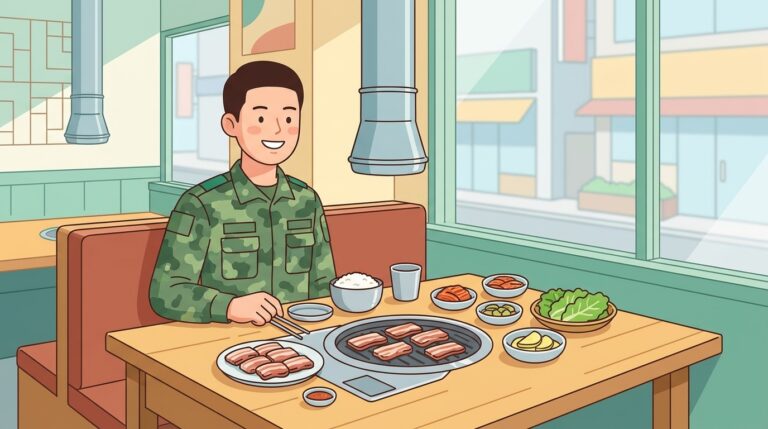
Phase 1: Empathy (Story-Immersive Opening)
안녕하세요! (Hello!) I am your Daily Hangul editor and your personal Korean culture navigator!
Imagine this: You are sitting at a bustling Korean BBQ restaurant in Hongdae on a Friday evening. At the table next to you sits a young guy with a sharp buzz cut, wearing a crisp camouflage military uniform. He is devouring pork belly like it is the greatest feast on Earth. Suddenly, an older gentleman at another table quietly walks up to the cashier, points at the young soldier’s table, and whispers: “The soldier’s meal is on me.” Before the soldier can even realize what happened, the bill is paid, and the stranger leaves with a warm nod and a smile.
If you have spent time in Korea or watched K-dramas like D.P. or Crash Landing on You, you have probably noticed this touching tradition: Koreans love treating soldiers on leave (휴가 나온 군인) to food.
Because mandatory military service is a shared rite of passage for almost all young Korean men, society shares an unspoken debt of gratitude for their sacrifice. But when you meet a Korean friend on military leave—or when you want to show kindness to a soldier in uniform—what exactly should you say? How do you offer to pay without making them feel awkward or indebted?
Don’t worry! Based on real feedback from intermediate learners and our community members, this guide gives you the exact, natural phrases to warm a soldier’s heart and bond over a hearty meal like a true local.
Phase 2: Core 3 Expressions In-Depth
1. 오늘 밥은 내가 쏠게!
- Pronunciation: Oneul babeun naega ssolge! (Sounds like “oh-neul bah-beun neh-gah SSOHL-geh” — ssol pops with energy, like shooting an arrow!)
- Meaning: Literal: “I will shoot the meal today!” | Actual Nuance: “Today’s meal is totally on me!”
- K-Culture Moment: In youth dramas, whenever a friend visits from the army base with an empty stomach, the older friend or bestie proudly slaps down their card at a barbecue place saying this exact line.
- Editor’s Insight: The verb 쏘다 (ssoda) literally means “to shoot,” but in casual slang, it means to treat someone generously. It sounds far warmer, punchier, and friendlier than the textbook “제가 계산할게요” (I will pay).
- Situation Spectrum:
- Casual (Friends/Peers): ✅
- Semi-formal (Acquaintances/Juniors): ✅
- Formal (Bosses/Elders): 🚫 (Sounds too playful for elders!)
- 🤔 Think About It: In English, you might say “It’s on me” or “My treat.” How does the Korean metaphor of “shooting (쏘다)” express sudden, enthusiastic generosity?
2. 고생 많지? 맛있는 거 많이 먹어.
- Pronunciation: Gosaeng manchi? Masinneun geo mani meogeo. (Sounds like “goh-seng mahn-chee? mah-sheen-neun guh mah-nee muh-guh.”)
- Meaning: Literal: “You have a lot of hardship, right? Eat lots of delicious things.” | Actual Nuance: “You’ve been through so much out there! Eat up and treat yourself.”
- K-Culture Moment: When a mom, older brother, or close friend hugs a soldier returning home for his first 100-day leave (백일휴가), this phrase is spoken with deep affection while pushing plates of beef toward them.
- Editor’s Insight: 고생 (gosaeng) translates to “hardship” or “suffering,” but Koreans use it routinely to validate someone’s dedication and labor. Combining 고생 많지 with an invitation to eat 많이 (a lot) represents the quintessential Korean way of showing care.
- Situation Spectrum:
- Casual (Close friends/Siblings): ✅
- Semi-formal (Polite form: 고생 많으시죠? 맛있는 거 많이 드세요): ✅
- Formal (High military rank/Formal speech): ⚠️ (Adjust to honorifics)
- 🤔 Think About It: Why is offering hearty food the most common way Koreans express comfort and sympathy instead of just saying “I am sorry you work hard”?
3. 군 생활 얼마 남았어?
- Pronunciation: Gun saenghwal eolma namasseo? (Sounds like “goon seng-hwahl uhl-mah nah-mah-ssuh?”)
- Meaning: Literal: “How much of your military life is left?” | Actual Nuance: “How much time do you have left until your discharge (D-day)?”
- K-Culture Moment: Whenever a soldier sits down with old university classmates, this is universally the first or second question asked, usually followed by calculating remaining vacation days on phone apps.
- Editor’s Insight: Soldiers count their remaining service down to the exact single digit! Asking this shows genuine interest in their milestone. However, if they just enlisted last week, asking this might make them sigh playfully, so pair it with cheering words like “금방 지나갈 거야!” (It’ll fly by!).
- Situation Spectrum:
- Casual (Peers/Younger friends): ✅
- Semi-formal (군 생활 얼마나 남으셨어요?): ✅
- Formal (Official military context): 🚫
- 🤔 Think About It: In your culture, do people track mandatory milestones (like university semesters or contract ends) with countdown apps the way Korean soldiers track 전역일 (discharge date)?
Phase 3: Textbook Korean vs. Real-World Korean
Scenario 1: Offering to pay for a friend in the military
- 📖 Textbook Korean: 제가 식사 비용을 지불하겠습니다. (Jega siksa biyong-eul jibulhagesseumnida. / “I shall pay for the meal cost.”)
- 🗣️ Real Korean: 오늘 형/누나가 시원하게 쏠 테니까 배 터지게 먹어! (Oneul hyeong/nunaga siwonhage ssol tenikka bae teojige meogeo! / “I’m treating today, so eat till your belly bursts!”)
- 💡 Why is it different?: Textbook phrasing sounds like a corporate accountant settling an invoice! Real Korean uses affectionate family titles (형/누나/언니/오빠) and lively idioms (배 터지게 – until stomach bursts) to make the soldier feel pampered.
Scenario 2: Comforting a soldier about military duty
- 📖 Textbook Korean: 군 복무를 열심히 하십시오. (Gun bongmureul yeolsimhi hasipsio. / “Please perform your military service diligently.”)
- 🗣️ Real Korean: 나라 지키느라 고생이 많다. 건강하게만 전역하자! (Nara jikineura gosaeng-i manta. Geonganghageman jeonyeokhaja! / “Thank you for protecting the country. Just stay healthy until your discharge!”)
- 💡 Why is it different?: Korean society recognizes that mental and physical safety (건강하게만 – just staying healthy and uninjured) is far more important than sterile encouragement to “work hard.”
Phase 4: K-Culture Deep Dive & Non-Verbal Manners
4-1. 눈치 (Nunchi) & Stealth Manners at the Restaurant
- The ‘Ninja Payment’ Trick (계산대 슬쩍 가기): If you are treating a soldier friend or a random soldier at a diner, never announce “Hey, I’m going to pay now!” while standing up. Korean soldiers will instinctively jump up, wave their hands in embarrassment, and try to stop you. Instead, excuse yourself to “go to the restroom” midway through the meal, discreetly head to the cashier, and pay quietly.
- Avoid Heavy Military Gossip: Don’t pry into confidential details or stressful hierarchy drama unless they bring it up first. Keep the focus on delicious food, K-pop trends, gaming, and relaxing civilian life.
- Shoulder Pat (토닥토닥): A light, reassuring pat on the shoulder accompanied by “힘내!” (Stay strong!) creates immediate warmth and brotherhood.
4-2. Cultural Code: The Evolution of ‘군인 아저씨’ to ‘군인 동생’
In the 1990s and 2000s, Korean elementary school kids wrote letters to soldiers addressing them as “군인 아저씨 (Mister Soldier)”, viewing them as mature adult protectors. Today, because people view 20-year-old soldiers as younger brothers, sons, and friends (군인 동생), the societal mood has shifted from formal awe to protective affection. Treating a soldier to a warm bowl of 국밥 (pork soup) or fried chicken is considered a civic gesture of care.
Phase 5: Real-Life Roleplay Scenario
Setting: You meet your Korean friend Min-woo (민우), who is out on his first official military leave (휴가), at a bustling Samgyeopsal (pork belly) restaurant near Gangnam Station. He looks slim, tanned, and has a very short crew cut.
민우: 와, 진짜 오랜만이다! 사회 공기 마시니까 살 것 같아!
(Wa, jinjja oraenmanida! Sahoe gonggi masinikka sal geot gata!)
"Wow, it's been so long! Breathing civilian air makes me feel alive!"
🎭 [Takes a huge deep breath and grins from ear to ear]

당신 (You): 민우야! 얼굴 보니까 너무 반갑다. 오늘 밥은 내가 쏠게!
(Min-u-ya! Eolgul bonikka neomu bangapda. Oneul babeun naega ssolge!)
"Min-woo! So good to see your face. Today's meal is totally on me!"
🎭 [Slaps the table playfully and hands him the menu]

민우: 에이, 아니야! 너도 바쁜데 내가 사야지, 어떻게 얻어먹어.
(Ei, aniya! Neodo bappeunde naega sayaji, eotteoke eodeomeogeo.)
"No way! You're busy too, I should treat you. How can I get a free meal?"
🎭 [Waves both hands in polite protest while blushing]

당신 (You): 무슨 소리야! 나라 지키느라 고생 많았잖아. 삼겹살 3인분 먼저 시키자.
(Museun soriya! Nara jikineura gosaeng manatjana. Samgyeopsal sam-inbun meonjeo sikija.)
"Nonsense! You've worked so hard defending the country. Let's order 3 servings of pork belly first!"
🎭 [Waves down the server cheerfully]

민우: 고마워 ㅠㅠ 군대 짬밥만 먹다가 삼겹살 보니까 눈물 난다.
(Gomawo ㅠㅠ Gundae jjambapman meokdagwa samgyeopsal bonikka nunmul nanda.)
"Thank you so much ㅠㅠ Eating only military cafeteria food made me tear up looking at pork belly."
🎭 [Picks up tongs eagerly as meat sizzles]

당신 (You): 많이 먹어! 그런데 군 생활 얼마 남았어?
(Mani meogeo! Geureonde gun saenghwal eolma namasseo?)
"Eat lots! By the way, how much time do you have left in the service?"
🎭 [Pours a glass of cold soda for Min-woo]

민우: 이제 10개월 남았어! 시간 진짜 안 가.
(Ije sip-gaewol namasseo! Sigan jinjja an ga.)
"Still 10 months left! Time moves like a snail."
🎭 [Sighs humorously and checks his phone countdown app]

당신 (You): 금방 갈 거야! 다치지 말고 건강하게 전역하자.
(Geumbang gal geoya! Dachiji malgo geonganghage jeonyeokhaja.)
"It'll fly by before you know it! Just don't get hurt and finish your service healthy."
🎭 [Clinks glasses warmly with Min-woo]
🔀 Interactive Choice Point
At the end of the meal, the bill comes out to 45,000 KRW. What do you do?
- Option A: Say “민우야, 반반 내자 (Min-woo, let’s split 50/50)” and calculate down to 100 won on your phone calculator.
- Option B: Discreetly pay at the cashier counter while Min-woo ties his shoes, then hand him a canned iced coffee.
- Option C: Loudly shout across the restaurant: “사장님! 이 군인 불쌍하니까 할인해 주세요! (Owner! This soldier is pitiful, give him a discount!)”
Feedback:
* Option A (Bad): ❌ Asking a soldier on leave to split the bill ruins the warm sentiment of treating someone who sacrificed their freedom on low military pay.
* Option B (Best): 🌟 Perfect Nunchi! Min-woo avoids awkwardness, and the iced coffee is the classic Korean “finishing touch” (입가심).
* Option C (Risk): ⚠️ Calling a soldier “pitiful” in public causes major second-hand embarrassment (수치심).
Phase 6: 10-Second Emotional Shadowing Drill
Practice these natural rhythm pauses (/) with the designated emotion tags!
[😊 Proud & Generous]- 오늘 밥은 / 내가 쏠 테니까 / 배 터지게 먹어!
- Oneul babeun / naega ssol tenikka / bae teojige meogeo!
[🥺 Warm & Sympathetic]- 나라 지키느라 / 고생 많은데 / 맛있는 거 많이 먹어야지.
- Nara jikineura / gosaeng maneunde / masinneun geo mani meogeoyaji.
[💪 Cheerful & Encouraging]- 시간 금방 가니까 / 다치지 말고 / 건강하게 전역하자!
- Sigan geumbang ganikka / dachiji malgo / geonganghage jeonyeokhaja!
Phase 7: K-Culture Mini Dictionary
- 휴가 (Hyuga / Leave or Vacation): Military leave granted to soldiers (e.g., 위로휴가 – reward leave, 정기휴가 – regular leave). During this time, soldiers cherish civilian food and meeting friends.
- 짬밥 (Jjambap / Military Mess Food): Slang for military meals. Also metaphorically used in Korean workplaces to refer to years of work seniority (e.g., “짬에서 나오는 바이브” – experience vibes).
- 전역 (Jeonyeok / Military Discharge): The holy grail word for every soldier—completing mandatory service and returning to civilian life as a free person (민간인).
- 사회 (Sahoe / “Society” or Civilian World): Soldiers humorously refer to the world outside military fences as 사회 (Society), treating ordinary daily life like a magical paradise.
Phase 8: Survival Kit for Travelers
TOP 3 Express Survival Lines
- “군인이세요? 밥 맛있게 드세요!” (Gunin-iseyo? Bap masitge deuseyo!)
- Pro Tip: If you meet a uniformed soldier at a fast food spot, saying this with a smile makes their whole day!
- “영수증 버려주세요.” (Yeongsujeung beoryeojuseyo.)
- Pro Tip: When doing the ninja stealth payment at the counter, say this so the cashier discards the receipt without making a fuss.
- “얼마 안 남았네요, 파이팅!” (Eolma an namanne-yo, paiting!)
- Pro Tip: Use this when a soldier mentions they only have a few months left until discharge.
Editor’s Travel Note
- When exploring Korea, use Naver Map app download for finding military-friendly eateries to locate popular K-BBQ or Gukbap restaurants near major train hubs like Seoul Station or Yongsan Station where many soldiers gather.
- In Korea, most mobile card payments and KakaoPay transactions process in 2 seconds at the counter—making stealth payments fast and seamless!
Phase 9: “One Step Deeper” (Cultural Reflection)
In many Western cultures, dining etiquette leans heavily toward splitting the bill (going Dutch) to maintain personal independence. However, Korean food culture is fundamentally rooted in 밥상 공동체 (the dining table community). To Koreans, feeding someone who is enduring physical hardship is not charity—it is an affectionate declaration that says, “We share this burden together, and you are valued.” By offering a meal to a soldier, you step beyond being a mere tourist and participate in Korea’s deepest communal value: 정 (Jeong).
💬 Your Turn: Have you ever treated a service member, or experienced unexpected generosity in Korea? Share your story in the comments below!
Phase 10: FAQ & Common Mistakes
Q: Can I buy a meal for a complete stranger in military uniform?
A: Yes, absolutely! Many Koreans quietly pay for a soldier’s table at soup shops (순대국/설렁탕) or burger joints. Simply tell the cashier before you leave: “저쪽 군인 테이블 같이 계산해 주세요” (Please include that soldier’s table in my bill).
Q: Should I salute (충성!) to a soldier friend as a joke?
A: While friends might laugh, doing excessive salutes to soldiers in public can feel slightly awkward or childish for them in civilian spaces. A warm handshake, a high five, or a shoulder pat is much more natural.
Q: Is it okay to ask what weapons they shoot or military secrets?
A: Avoid asking for classified operational details. Keep questions light: ask about what civilian food they missed most (무슨 음식이 제일 먹고 싶었어?) or what K-pop girl group is currently most popular in the barracks!
🚨 Common Mistakes Alert (Top 3)
- Calling them ‘군인 아저씨’ when you are older: If you are older than 20, address young soldiers as 군인 분 (Polite Soldier) or by their name if they are friends.
- Insisting they pay when visiting on leave: Soldiers earn modest monthly stipends compared to full-time workers. Always treat or pay your share graciously.
- Making fun of their short haircut (빡빡이): Soldiers are often self-conscious about their mandatory buzz cuts. Compliment them instead: “군복 잘 어울린다!” (The uniform looks great on you!)
Phase 11: Action Missions
- 🥉 Bronze Level (Solo Practice): Stand in front of a mirror and practice saying “오늘 밥은 내가 쏠게!” with high energy 5 times.
- 🥈 Silver Level (Social Media Share): Tag a Korean friend on social media with a photo of Korean BBQ and caption: “다음에 내가 쏠게!”
- 🥇 Gold Level (Real-World Mission): Next time you visit a restaurant in Korea and see a soldier on leave, order an extra beverage or dessert for their table through the staff!
- 🎮 K-Culture Mission: Watch an episode of the drama D.P. or a military variety show and spot when characters use the slang 짬밥 (Jjambap)!
Phase 12: Interactive Quiz Challenge
Q1. Multiple Choice: Which sentence is the most natural and affectionate way to tell a soldier friend that you will pay for lunch?
A) 제가 이번 점심 비용을 송금하겠습니다.
B) 오늘 밥은 형/누나가 쏠 테니까 맛있게 먹어!
C) 식사 영수증을 저에게 전달하십시오.
Q2. Fill in the Blank: Complete the classic Korean encouragement.
“나라 지키느라 ______ 많지? 건강하게 전역하자!”
(Hint: A word meaning hardship/labor)
Q3. True or False: In modern Korea, young adults in their 20s still formally call 20-year-old soldiers ‘군인 아저씨’. (True / False)
👉 Click here to reveal answers & explanations!
Answers & Explanations:
1. Answer: B | 내가 쏠게 (I’m treating) is the vibrant colloquial expression used between friends and friendly seniors!
2. Answer: 고생 (Gosaeng) | 고생 많지? acknowledges their dedication and effort with deep empathy.
3. Answer: False | Today, soldiers are affectionately viewed as 군인 동생 (younger brother soldiers) or peers, rather than older 아저씨 (misters).







