

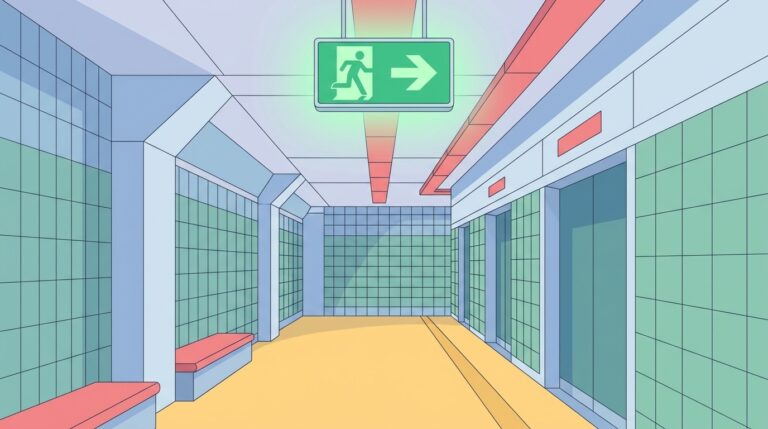
Phase 1: Empathy (Story-Immersive Opening)
안녕하세요! 매일한글 에디터입니다. (Hello! It’s your Daily Hangul editor!)
Picture this: You are having the absolute time of your life in Seoul—maybe screaming at the top of your lungs at a sold-out K-Pop concert in KSPO Dome, or sipping an iced Americano in a trendy underground café in Hongdae. Suddenly, the music cuts out, an unfamiliar alert chimes over the speakers, and flashing emergency lights fill the room. Your heart begins to race. You glance around, and every sign is written in Korean characters that blur together in the adrenaline rush. Where does that glowing green running-man sign lead? How do you ask a venue staff member where to go without freezing up?
As travelers and language lovers, we spend hours practicing how to order delicious tteokbokki or say sweet phrases to our favorite idols. But over my 10 years of guiding international friends across Korea, I have seen firsthand that basic disaster safety phrases are the ultimate superpower. When an unexpected situation occurs, having three simple, punchy A1 Korean phrases ready in your pocket transforms panic into instant calm. This guide is built directly from real learner experiences and local safety protocols to give you practical, life-saving confidence in any public space in Korea. Let’s master emergency exit Korean together—step by step, just like practicing with your Korean bestie!
Phase 2: Deep Dive into 3 Core Expressions
1. 비상구가 어디예요? (Bisang-gu-ga eodi-yeyo?)
- Pronunciation:
[Bee-sahng-goo-gah uh-dee-yay-yo?](Sounds like bee + song + goo + uh-dee-yay-yo) - Meaning: Literal: “Emergency exit where is it?” / Nuance: “Where is the emergency exit?”
- K-Culture Moment: In disaster blockbuster films like EXIT (엑시트) or thrilling survival dramas, characters scan smoke-filled buildings while desperately asking where the escape route is.
- Editor’s Insight:
비상구combines비상(emergency) and구(exit/gate). Pairing it with어디예요?(where is it?) gives you the most reliable question pattern in the Korean language. - Situation Spectrum: Casual: ⚠️ | Semi-formal: ✅ | Formal: ✅
- 🤔 Think About It: In English, people might specify “fire escape” or “emergency stairs.” In Korean,
비상구is the universal master word for every designated life-saving exit door.
2. 저쪽으로 가세요. (Jeojjok-euro gaseyo.)
- Pronunciation:
[Juh-jjok-eu-roh gah-say-yo](Sounds like judge-choke + oo-roh + gah-say-yo) - Meaning: Literal: “To that direction, please go.” / Nuance: “Please head over that way.”
- K-Culture Moment: Often heard during regular building safety drills or shouted by metro staff (역무원) guiding citizens toward safety paths.
- Editor’s Insight:
저쪽means “that direction over there,” and-으로indicates movement toward a goal. When staff members direct crowds, this is the exact phrase you will hear. - Situation Spectrum: Casual: ⚠️ | Semi-formal: ✅ | Formal: ✅
- 🤔 Think About It: Korean spatial directions split clearly between
이쪽(this way near me) and저쪽(that way over there). Listening for that initial “저” helps you move instantly without second-guessing!
3. 조심하세요! (Josim-haseyo!)
- Pronunciation:
[Joh-sheem-hah-say-yo!](Sounds like Joe-seam + ha-say-yo) - Meaning: Literal: “Do caution!” / Nuance: “Be careful! / Watch your step!”
- K-Culture Moment: Spoken frequently in everyday life—from subway announcements warning about wet steps on rainy days to dramatic staircase chases in K-Dramas.
- Editor’s Insight: This is a polite, caring command. In crowded emergency stairwells, safety personnel will often repeat
계단 조심하세요!(“Please be careful on the stairs!”). - Situation Spectrum: Casual: ⚠️ (To friends:
조심해!) | Semi-formal: ✅ | Formal: ✅ - 🤔 Think About It: Notice how Korean combines genuine concern and clear instruction into a single polite honorific ending (
-하세요).
Phase 3: Textbook Korean vs. Real Korean
Scenario 1: Asking where the exit is during an urgent moment
- 📖 교과서 한국어: 비상 탈출구가 어느 방향에 위치하고 있습니까? (Bisang talchulgu-ga eoneu banghyang-e wichi-hago itsseumnikka? / In which direction is the emergency escape route located?)
- 🗣️ 진짜 한국어: 비상구 어디예요? (Bisang-gu eodi-yeyo? / Where is the emergency exit?)
- 💡 왜 다를까?: In actual urgent situations, long grammatical structures are discarded. Native speakers use concise 3-word sentences so responders understand immediately.
Scenario 2: Guiding someone away from danger
- 📖 교과서 한국어: 신속하게 출구로 대피하십시오. (Sinsok-hage chulgu-ro daepi-hasipsio. / Evacuate swiftly toward the exit.)
- 🗣️ 진짜 한국어: 이쪽으로 빨리 나가세요! (Ijjok-euro ppalli nagaseyo! / Please go out quickly this way!)
- 💡 왜 다를까?: Real-life safety staff prioritize urgency by using direct action words like
빨리(fast/quickly) and나가세요(please exit) over formal Sino-Korean vocabulary.
Phase 4: K-Culture Deep Dive & Non-Verbal Manners
4-1. 눈치 (Nunchi) & Safety Gestures
In Korea, illuminated emergency exit signs are bright green with a running white silhouette. In newer subway stations and concert halls, you will also see glow-in-the-dark green floor strips called 피난유도선 (evacuation guidance lines). When asking staff for directions during an alert, extend an open hand toward the direction you are asking about rather than pointing aggressively with a single index finger. Keeping calm eye contact and displaying quick Nunchi (reading the situational flow) helps safety personnel assist you without delay.
4-2. Culture Code: Cinema & Subway Safety Culture
Before every single screening at major Korean cinema chains like CGV, Megabox, and Lotte Cinema, you will watch a mandatory evacuation animation. These high-energy clips often feature popular webtoon characters or K-Pop ambassadors demonstrating the theater’s exact exit doors, emergency flashlights, and smoke masks. Korea treats public emergency awareness as a shared civic habit!
Phase 5: Real-Life Roleplay Scenario
Setting: A bustling underground shopping complex near Gangnam Station during an unexpected building alarm test.
Characters: Alex (Traveler, A1 Korean learner) & Min-su (Mall Safety Staff)
- Turn 1 (Min-su): 🎭 [안내봉을 들고 침착하게 주변을 살피며] “여러분, 침착하게 이동해 주세요.” (Yeoreobun, chimchak-hage idong-hae juseyo. / “Everyone, please move calmly.”)
- Turn 2 (Alex): 🎭 [직원에게 다가가 정중하게 물으며] “저기요, 비상구가 어디예요?” (Jeogiyo, bisang-gu-ga eodi-yeyo? / “Excuse me, where is the emergency exit?”)
- Turn 3 (Min-su): 🎭 [오른쪽 녹색 표지판을 가리키며] “저쪽 초록색 문으로 가세요.” (Jeojjok choroksaek mun-euro gaseyo. / “Please go toward that green door over there.”)
- Turn 4 (Alex): 🎭 [손짓을 확인하며 다시 물으며] “초록색 문이요? 계단이에요?” (Choroksaek mun-iyo? Gyedan-ieyo? / “The green door? Is it the stairs?”)
- Turn 5 (Min-su): 🎭 [단호하지만 친절하게 안내하며] “네, 비상 계단이에요. 엘리베이터는 타지 마세요.” (Ne, bisang gyedan-ieyo. Ellibeiteo-neun taji maseyo. / “Yes, it is the emergency stairs. Please do not take the elevator.”)
- Turn 6 (Alex): 🎭 [안도하며 고개를 끄덕이며] “알겠습니다. 감사합니다!” (Algetseumnida. Gamsahamnida! / “Understood. Thank you!”)
- Turn 7 (Min-su): 🎭 [출구 쪽으로 Alex를 유도하며] “네, 계단 조심하세요!” (Ne, gyedan josim-haseyo! / “Yes, please watch your step on the stairs!”)
- Turn 8 (Alex): 🎭 [발걸음을 신속히 옮기며] “네, 조심해서 갈게요!” (Ne, josim-haeseo galgeyo! / “Yes, I will go carefully!”)
🔀 Interactive Choice Point
What should Alex do next upon reaching the crowded stairwell door?
* Choice A: Follow the illuminated green floor guide arrows while calmly walking down.
* Choice B: Rush back into the corridor to take the elevator to the ground floor.
* Choice C: Push past other shoppers while shouting loudly in English.
Detailed Feedback:
* Choice A (Best ⭐): Excellent! Following the green floor indicators (피난유도선) while staying composed is the safest standard evacuation procedure in Korea.
* Choice B (Risk ⚠️): Dangerous! During building fire alerts, elevators can lose power or trap passengers in smoke shafts. Never take elevators in an emergency.
* Choice C (Bad ❌): Pushing causes stampedes and mass panic. Orderly movement keeps everyone moving swiftly and safely.
Phase 6: 10-Second Emotion Shadowing Drill
Practice these lines out loud with your voice matched to the emotion tags!
[🚨 긴박하지만 침착하게 / Urgent yet calm]
“비상구가 / 어디예요?” (Bisang-gu-ga / eodi-yeyo?)
(Where is / the emergency exit?)-
[🙋♂️ 또박또박 안내하듯 / Clear and guiding]
“저쪽으로 / 가세요!” (Jeojjok-euro / gaseyo!)
(Please go / that way!) -
[🤝 다정하고 주의 깊게 / Caring and alert]
“계단 / 조심하세요!” (Gyedan / josim-haseyo!)
(Watch your step / on the stairs!)
Phase 7: K-Culture Mini Dictionary
- 비상구 (Bisang-gu) | Emergency Exit | The standard green illuminated sign located above doors in all public buildings, cinemas, and subways.
- 대피소 (Daepiso) | Evacuation Shelter / Safe Area | Designated safety shelters located inside underground subway stations and civic centers.
- 비상벨 (Bisang-bel) | Emergency Alarm Bell | Red push-buttons installed alongside fire extinguishers and on subway train walls.
- 소화기 (Sohwagi) | Fire Extinguisher | Red pressurized canisters placed on hallway corners and public transit platforms.
Phase 8: Survival Kit for Travelers
Top 3 Survival Phrases
- 도와주세요! (Dowajuseyo!) – “Please help me!”
Pro Tip: Shout this clearly while raising both hands if you require immediate physical assistance in a crowd. - 비상구가 어디예요? (Bisang-gu-ga eodi-yeyo?) – “Where is the emergency exit?”
Pro Tip: Pair this question with a swift glance toward building staff for priority guidance. - 계단으로 가요. (Gyedan-euro gayo.) – “Let’s go by the stairs.”
Pro Tip: Remind your travel companions to avoid lifts during building evacuation alarms.
Editor’s Travel Note
- Emergency App Guide: Before your trip, complete the Emergency Ready App (국민재난안전포털) download to receive official government disaster push notifications translated into English.
- Navigation Tip: In maps, use the Naver Map disaster shelter overlay search by typing
대피소to locate the nearest emergency bunkers and safe zones in Seoul. - Station Equipment: On subway platforms, look for metal cabinets labeled 구호용품 보관함 (Emergency Relief Supply Box), which contain gas masks and emergency flashlights.
Phase 9: “One Step Deeper” (Reflective Essay)
Korean disaster safety culture is deeply anchored in a powerful spirit of collective harmony (공동체 의식). While daily life in Seoul is famously fast-paced (빨리빨리 culture), emergency drills emphasize mutual patience, orderly single-file queuing, and looking out for children and travelers. When alarms sound, following safety guidelines is not just about personal survival—it is an act of communal respect and care for everyone sharing the space.
💬 Your Turn: Have you ever noticed emergency exit signs or unique safety animations while traveling or watching K-Dramas? Tell me your thoughts in the comments below!
Phase 10: FAQ & Avoiding Misunderstandings
Q: What do the different sign colors mean in Korean buildings?
A: Green signs (초록색) mark official emergency exits and direct escape paths that lead out of the building. White signs with green figures point you along the hallway toward the exit. Red signs (빨간색) mark fire equipment such as alarms and fire extinguishers.
Q: What should I say if I need someone to lead me to the exit?
A: You can say, “같이 가주세요!” (Gachi gajuseyo! / “Please come with me!”) or “출구 알려주세요!” (Chulgu allyeojuseyo! / “Please show me the exit!”).
Q: Does calling 119 in Korea offer English support?
A: Yes! When you dial 119 for fire/medical emergencies or 112 for police, an automated three-way interpretation service in English, Japanese, and Chinese is connected immediately.
🚨 Common Mistakes Warning Board
- Mistake 1: Confusing regular exit
출구with emergency exit비상구.- Correct Action: Use
출구(e.g., Exit 2) for everyday subway commuting, but always look for비상구during emergencies.
- Correct Action: Use
- Mistake 2: Running directly to the elevator when you hear an alarm.
- Correct Action: Always head toward the stairwell doors marked with green emergency exit signs.
- Mistake 3: Using blunt informal language like
어디야?(Where is it?) with safety staff.- Correct Action: Stick to polite A1 endings like
비상구가 어디예요?so personnel can assist you with full clarity.
- Correct Action: Stick to polite A1 endings like
Phase 11: Action Mission & Participation
- 🥉 Bronze Mission: Look around your current room or hotel lobby, spot the nearest exit door, and say aloud three times: “비상구가 어디예요?”
- 🥈 Silver Mission: Snap a photo of a green exit sign in your city, post it on your Instagram Story or X (Twitter), and tag your language journey with: “Today’s Korean word: 비상구 (Emergency Exit)! #DailyHangul”
- 🥇 Gold Mission: Next time you step into a Korean restaurant, subway station, or cinema, mentally locate the emergency exit and practice the phrase “저쪽으로 가세요!”
- 🎮 K-Culture Mission: Watch the opening safety clip of any Korean cinema release or transit vlog on YouTube and identify the word 비상구 on the screen!
Phase 12: Interactive Quiz Challenge
Q1. Situational Judgment: An alarm sounds in a shopping mall. Which is the most natural and polite A1 phrase to ask a staff member where to escape?
* (A) 비상구가 어디예요?
* (B) 엘리베이터 타요?
* (C) 출구가 뭐야?
Q2. Fill-in-the-Blank: Complete the direction sentence:
“저쪽_____ 가세요.” (Please go toward that direction.)
* (A) 에서
* (B) 으로
* (C) 하고
Q3. True or False: In Korea, green illuminated signs indicate emergency escape doors, while red fixtures represent fire alarms and extinguishers.
* (True / False)
👉 Click here to reveal the answers and explanations!
- (A) 비상구가 어디예요? – Correct! It is polite, concise, and immediately understandable in an emergency.
- (B) 으로 – Correct! The directional particle
으로is attached to저쪽to mean “toward that direction” (저쪽으로). - True – Correct! Green marks life-saving evacuation routes (비상구), and red marks fire-fighting equipment (소화기 / 비상벨).







