

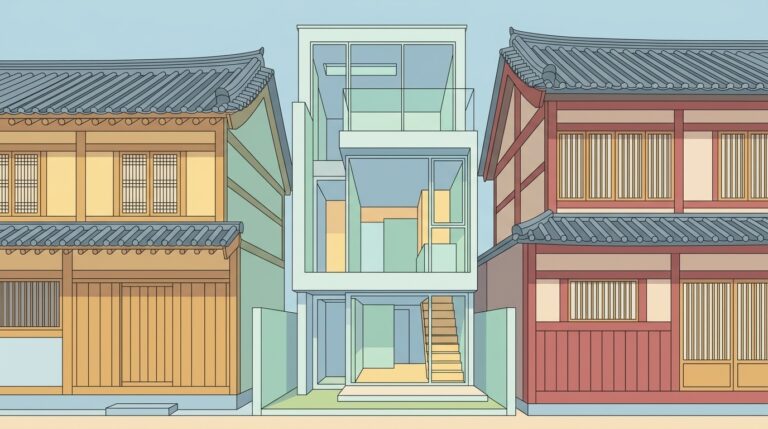
Beyond the High-Rise: Mastering Korean Architectural Nuances of Micro-Housing and Residual Urban Spaces
Phase 1: Empathy (Story-Driven Opening)
안녕하세요! 매일한글 에디터입니다. (Hello! This is your Daily Hangul editor.)
Picture this: You are wandering through the labyrinthine alleys of Huam-dong or the historic inclines of Seongbuk-dong in Seoul. Amidst the sea of standard red-brick multi-family villas (빌라) and towering mega-apartment complexes (아파트 단지), your eyes catch something extraordinary: a razor-thin, four-story building with dynamic asymmetrical windows elegantly slotted into an irregular 33-square-meter triangular plot. You are standing in front of a 협소 주택 (Hyeopso Jutaek – micro-house), Seoul’s brilliant architectural answer to sky-high land prices and rapid urban densification.
As a C2-level speaker, you aren’t just looking for simple directions or elementary vocabulary like “집이 작아요” (The house is small). When engaging with local architects, design-forward homeowners, or urban regeneration specialists, you need the sophisticated lexicon that captures spatial philosophy, legal zoning agility, and the cultural transformation of Seoul’s urban fabric. Master-level learners often struggle not with grammar, but with the subtle socio-linguistic vernacular surrounding real estate, spatial efficiency, and micro-architecture. Rooted in real fieldwork and curated with top architectural insights, this guide will elevate your discourse from mere fluency to genuine native-level sophistication.
Phase 2: Deep Dive into 3 Core Expressions
1. 자투리 땅을 활용하다 (Jaturi ttangeul hwalyonghada)
- Pronunciation: [Jaturi ttang-eul hwal-yong-ha-da] (Sound analogy: ‘Jaturi’ sounds like ‘jah-too-ree’, rhythmic and sharp; ‘ttang’ has a tense double ‘t’ like ‘st-ang’ without the ‘s’)
- Meaning: Literal: To utilize a leftover scrap of fabric/land | Real Nuance: To ingeniously repurpose irregular, neglected residual urban plots.
- K-Culture Moment: Seen frequently on lifestyle and architecture programs like EBS’s 건축탐구 집 (Architectural Exploration: House), where innovative architects transform neglected dead corners of old neighborhoods into award-winning architectural gems.
- Editor’s Insight: 자투리 originally refers to leftover scraps of cloth after cutting a garment. In urban discourse, 자투리 땅 represents odd-shaped, interstitial leftover parcels previously deemed unbuildable. Using this verb instantly signals your mastery of spatial vernacular.
- Situation Spectrum:
- Casual: ✅ (자투리 땅에 집 짓는 거 진짜 대단해!)
- Semi-formal: ✅ (자투리 땅을 활용한 공간 기획이 늘고 있습니다.)
- Formal: ✅ (도심 내 유휴 부지 및 자투리 땅 활용 방안을 발표하겠습니다.)
- 🤔 Think About It: In many Western contexts, building is dominated by spacious suburban plots or standardized lots. Why does Korean culture value extracting functional beauty from minuscule fragments (자투리)?
2. 공간의 효율성을 극대화하다 (Gongganui hyoyulseongeul geukdaehwahada)
- Pronunciation: [Gong-gan-ui hyo-yul-seong-eul geuk-dae-hwa-ha-da] (Sound analogy: ‘Geuk-dae-hwa’ flows with a decisive cadence, similar to ‘gook-day-hwa’)
- Meaning: Literal: To maximize spatial efficiency | Real Nuance: To architecturally orchestrate multi-functional layouts and vertical zoning in compact environments.
- K-Culture Moment: The design philosophy celebrated in MBC’s 구해줘! 홈즈 (Where is My Home), whenever an interior designer reveals hidden under-stair pantries, lofted mezzanines, or skip-floor configurations.
- Editor’s Insight: While intermediate speakers say “공간을 잘 쓰다” (to use space well), C2 speakers employ 공간의 효율성을 극대화하다 when discussing architectural intelligence, structural optimization, and bespoke interior partitioning.
- Situation Spectrum:
- Casual: ⚠️ (A bit stiff for everyday casual chat unless spoken jokingly: 내 방 공간 효율성 극대화했지!)
- Semi-formal: ✅
- Formal: ✅
- 🤔 Think About It: How does the obsession with vertical efficiency reflect the demographic transition from the nuclear family (4인 가구) to single-person households (1인 가구) in contemporary Korea?
3. 틈새 시장을 공략하다 (Teumsae sijangeul gongryeokhada)
- Pronunciation: [Teum-sae si-jang-eul gong-nyeok-ha-da] (Sound analogy: Notice the nasal assimilation where ‘gong-ryeok’ becomes ‘gong-nyeok’)
- Meaning: Literal: To attack a crack/crevice in the market | Real Nuance: To target an ultra-specific, underserved niche market.
- K-Culture Moment: Architectural business analyses highlighting young design studios thriving by specializing exclusively in compact buildings (꼬마빌딩) and micro-dwellings.
- Editor’s Insight: 틈새 refers to an aperture or crevice. Pairing it with 공략하다 (to target/capture strategically) demonstrates commanding business and real estate fluency.
- Situation Spectrum:
- Casual: ✅
- Semi-formal: ✅
- Formal: ✅
- 🤔 Think About It: Contrast the English concept of “niche marketing” with the visual, physical metaphor of 틈새 (the literal gap between tightly packed Korean structures).
Phase 3: Textbook Korean vs. Real Korean
Situation 1: Praising a compact, masterfully designed micro-house
- 📖 Textbook Korean: 집이 좁지만 공간 배치가 매우 효율적입니다. (Jibi jopjiman gonggan baechiga maeu hyoyuljeogimnida.) – The house is narrow, but the spatial arrangement is very efficient.
- 🗣️ Real Korean: 평수는 아담한데 공간 분리랑 동선 설계가 완전 예술이네요! (Pyeongssuneun adamhande gonggan bullirang dongseon seolgyega wanjeon yesurineyo!) – The square footage is compact, but the spatial zoning and flow of circulation are an absolute work of art!
- 💡 Why is it different? Native C2 discourse replaces dry metrics (좁다) with polite aesthetic terms (아담하다), specifies architectural elements (동선 설계 – circulation route design), and applies the idiomatic hyperbole 완전 예술이다 (it’s pure art).
Situation 2: Commenting on reviving unused leftover parcels in the city
- 📖 Textbook Korean: 도심의 남은 토지를 개발해야 합니다. (Dosimui nameun tojireul gaebalhaeya hamnida.) – We need to develop remaining land in the city center.
- 🗣️ Real Korean: 도심 속 죽은 자투리 땅을 기가 막히게 살려냈더라고요. (Dosim sok jugeun jaturi ttangeul giga makhige sallyeonaetdeoragoyo.) – They revived dead residual urban plots in such an extraordinarily ingenious way.
- 💡 Why is it different? Native speakers personify urban geography using 죽은 땅을 살려내다 (bringing dead land back to life) reinforced with the emotive adverb 기가 막히게 (astonishingly / brilliantly).
Phase 4: K-Culture Deep Dive & Non-Verbal Etiquette
4-1. Nunchi & Alleyway Mannerisms (골목길 에티켓)
When surveying micro-housing projects in residential Seoul districts (e.g., Yeonnam-dong, Ikseon-dong, or Itaewon), remember that these houses are integrated into intimate community webs.
* Gaze & Privacy Awareness: Avoid staring point-blank into adjacent traditional single-family homes (단독주택). Micro-houses frequently utilize frosted glass (불투명 유리) or diagonal louvers to comply with Korean civil solar rights (일조권) and neighbor privacy laws (사생활 보호).
* The Soft Step: In narrow alleys (골목길), stepping aside to let elderly residents pass with a subtle 15-degree nod (목례) demonstrates profound cultural sensitivity and respect for the neighborhood fabric.
4-2. Cultural Code: From “Republic of Apartments” to Hyper-Personalized Architecture
For decades, South Korea was labeled the “Republic of Apartments” (아파트 공화국), valuing uniform high-rise complexes for their liquid asset value and standard amenities. However, the rise of 협소 주택 marks a generational paradigm shift among MZ-generation Koreans. It signifies a move toward 개향 (individual taste), self-expression, and bespoke living. Rather than fitting their lives into standardized concrete boxes, young urbanites collaborate with boutique studios to construct vertical micro-mansions tailored to their personal values.
Phase 5: Real-Life Roleplay Scenario
Setting: Architect Park’s newly completed 4-story micro-house in an alleyway of Huam-dong overlooking Namsan Tower.
Characters:
* 소장님 박민우 (Architect Min-woo Park): A sharp, visionary boutique architect.
* You (C2 Korean Speaker): An architectural critic and international design consultant.
Dialogue:
1. 소장님 박: 어서 오세요! 대지 면적이 겨우 12평 남짓이라 처음엔 다들 고개를 내저었던 현장입니다. (Eoseo oseyo! Daeji myeonjeogi gyeou yeol-du-pyeong namjisira cheoeumen dadeul gogaereul naejeoeotdeon hyeonjang-imnida.)
🎭 Welcoming you with a proud sweep of his hand toward the sleek facade.
“Welcome! With a plot size of barely around 40 square meters, everyone initially shook their heads at this site.”
- You: 와, 소장님! 협소한 대지라는 한계를 스킵플로어 구조로 완벽하게 극복하셨네요. (Wa, sojangnim! Hyeopsohan daejiraneun hangyereul seukip-peullo-eo gujoro wanbyeokhage geukbokhasyeotneyo.)
🎭 Looking up through the vertical central lightwell with admiration.
“Wow, Director! You have brilliantly overcome the limitations of a micro-plot using a skip-floor structural layout.” -
소장님 박: 알아봐 주시니 기쁘네요. 층고를 높이고 계단실 하부를 수납공간으로 짜 넣었습니다. (Arabwa jusini gippeuneyo. Cheung-goreul nop-igo gyedansil habureul sunapgongganeuro jja neoeotseumnida.)
🎭 Tapping gently on the seamless oak built-in cabinetry beneath the stairs.
“I’m glad you noticed. We raised the ceiling height and crafted custom storage beneath the staircase.” -
You: 채광과 개방감까지 확보한 걸 보니 공간의 효율성을 극대화했다는 말이 절로 실감 납니다. (Chaegwang-gwa gaebang-gamkkaji hwakbohan geol boni gongganui hyoyulseongeul geukdaehwahaetdaneun mari jeollo silgam namnida.)
🎭 Glancing toward the top skylight that floods the interior with natural light.
“Seeing how you secured both natural illumination and an open feel, the phrase ‘maximizing spatial efficiency’ truly comes to life.” -
소장님 박: 하지만 인접 대지와의 일조권 사선제한 때문에 매스 디자인을 깎아내는 게 꽤 까다로웠죠. (Hajiman injeop daejiwaui iljogwon saseonjehando ttaemune maeseu dijaineul kkak-anaeneun ge kkwae kkadarroweotjyo.)
🎭 Tracing the angular geometry of the exterior wall with a thoughtful expression.
“However, carving the building mass due to the statutory solar right setbacks from adjacent lots was quite intricate.” -
You: 오히려 그 사선제한 덕분에 테라스 공간이 생겨서 입체적인 조형미가 돋보이는데요? (Ohiryeo geu saseonjehan deokbune teraseu gonggani saenggyeoseo ipchejeogin johyeongmiga dotboineundeyo?)
🎭 Nodding constructively with an appreciative smile.
“If anything, thanks to those setback restrictions, you gained terrace pockets, creating a striking sculptural aesthetic!” -
소장님 박: 하하, 정확한 분석이십니다. 앞으로 이런 자투리 땅을 활용한 도시재생 프로젝트가 더 활성화될 겁니다. (Haha, jeonghwakhan bunseogisimnida. Apeuro ireon jaturi ttangeul hwalyonghan dosijaesaeng peurojekteuga deo hwalseonghwadoel geomnida.)
🎭 Offering an architectural blueprint booklet with genuine respect.
“Haha, spot-on analysis! Moving forward, urban regeneration projects leveraging leftover urban plots will expand even further.” -
You: 네, 획일화된 아파트 문화 속에서 아주 신선한 틈새 시장을 개척하신 것 같습니다. (Ne, hoegilhwan-doen apateu munhwa sogeseo aju sinseonhan teumsae sijangeul gaecheokhasin geot gatseumnida.)
🎭 Receiving the document with both hands and affirming firmly.
“Indeed, amidst the homogenized apartment landscape, it seems you have pioneered a remarkably refreshing niche market.”
🔀 Interactive Decision Branch
What would you say to conclude the consultation when discussing project budget scaling?
- Option A (Best – Master Level): “초기 평당 공사비는 다소 높더라도, 중장기적 공간 효용과 독창성을 감안하면 충분히 상쇄되고도 남겠네요.” (Cho-gi pyeongdang gongsabineun daso nopdeorado, jungjanggijeok gonggan hyoyong-gwa dokchangseongeul gamanhamyeon chungbunhi sangswedoego-do namgetneyo.)
- Feedback: 🌟 Exceptional. Uses advanced professional terminology (평당 공사비 – cost per pyeong, 상쇄되다 – to offset), displaying effortless C2 command.
- Option B (Risk – A bit clumsy/casual): “근데 작아서 짓는 데 돈은 별로 안 들었죠? 싸게 지었겠네요.” (Geunde jagaseo jinneun de doneun byeollo an deureotjyo? Ssage jieotgetneyo.)
- Feedback: ⚠️ High Risk. Implies micro-houses are cheap. In reality, micro-houses require customized structural engineering and high labor costs, making the per-pyeong construction cost higher than regular buildings.
- Option C (Bad – Unnatural textbook literalism): “작은 땅에 건물을 세우는 것은 비경제적이라고 생각합니다.” (Jageun ttange geonmureul seuneun geoseun bigyeongjejeogirago saenggakhamnida.)
- Feedback: 🚫 Poor. Abrupt, overly textbook-academic, and dismissive of the architect’s contextual craftsmanship.
Phase 6: 10-Second Emotional Shadowing Drill
[🤩 Breathless admiration & intellectual awe]- “평수는 아담한데 / 공간 분리랑 동선 설계가 / 완전 예술이네요!”
- (Pyeongssuneun adamhande / gonggan bullirang dongseon seolgyega / wanjeon yesurineyo!)
[🧐 Sharp analytical confidence & deep affirmation]- “사선제한이라는 법적 한계를 / 입체적인 조형미로 / 기가 막히게 승화시키셨어요.”
- (Saseonjehaniraneun beopjeok hangyereul / ipchejeogin johyeongmiro / giga makhige seunghwasikisyeosseoyo.)
[💡 Visionary & forward-looking tone]- “도심 속 자투리 땅이야말로 / 미래 건축의 새로운 대안이자 / 틈새 시장의 핵심입니다.”
- (Dosim sok jaturi ttang-iyamallo / mirae geonchugui saeroun daean-ija / teumsae sijangui haeksim-imnida.)
Phase 7: K-Culture Mini Dictionary
- 협소 주택 (Hyeopso Jutaek) | Micro-House / Tiny Infill House
- Custom multi-story residences built on ultra-small land parcels (usually under 66㎡/20 pyeong). A symbol of young Koreans seeking bespoke vertical autonomy.
- 꼬마빌딩 (Kkoma Building) | Boutique Commercial Micro-Building
- Typically 3-to-5-story small commercial buildings owned by individual investors or boutique creative studios, popular in revitalized hip districts like Seongsu or Hannam.
- 용적률 (Yongjeongnyul) & 건폐율 (Geonpyeyul) | Floor Area Ratio (FAR) & Building Coverage Ratio (BCR)
- The holy grail metrics of Korean architecture and urban planning determining maximum buildable volume on tight city plots.
- 도시재생 (Dosijaesaeng) | Urban Regeneration / Infill Renewal
- The paradigm shifting away from total demolition (전면 철거) toward reviving the organic texture of historical neighborhoods by preserving alleyways and upgrading residual plots.
Phase 8: Survival Kit for Architecture Explorers
Top 3 Architectural Exploration Expressions
- 혹시 실례가 안 된다면 외관 사진 촬영이 가능할까요? (Hoksi sillyega an doendamyeon oegwan sajin chwaryeong-i ganeunghalkkayo?)
- Pro Tip: Always ask if you see an owner or architect nearby. In dense residential areas, photographing private property requires polite deference.
- 스킵플로어 방식으로 설계되어 내부 층고가 높아 보입니다. (Seukip-peullo-eo bangsigeuro seolgyedoeeo naebu cheung-goga nopa boimnida.)
- Pro Tip: Use this to initiate deep aesthetic conversations in design cafes converted from micro-houses.
- 협소 대지의 단점을 개방감으로 극복한 사례네요. (Hyeopso daejiui danjeomeul gaebang-gam-euro geukbokhan saryeneyo.)
- Pro Tip: A sophisticated critique phrase that establishes your credibility instantly.
Editor’s Travel Note
- Mapping Hidden Gems: Standard global maps struggle with Seoul’s tightest winding hillcrests. Make sure you use Naver Map App Download to search for micro-architectural walking routes in areas like Huam-dong (후암동), Haebangchon (해방촌), and Mullae-dong (문래동).
- Terrain Preparation: Wear sturdy footwear! Exploring residual-plot architecture often requires navigating 30-degree slopes and historic staircases where traditional urban life meets cutting-edge contemporary design.
Phase 9: “한 발 더 깊이” (Philosophical Reflection)
The phenomenon of Korean micro-housing (협소 주택) is far more than a response to real estate economics; it represents a profound philosophical reconciliation with urban memory. For decades, Korea’s compressed modernization flattened historical alley topologies in favor of hyper-standardized high-rises. In contrast, micro-housing embraces the irregular geometries of historical city parcels (자투리 땅), refusing to erase the organic grain of the neighborhood. It proves that human dignity and aesthetic richness are not proportional to square footage, but to the intentionality of spatial design.
💬 Your Turn: How does your home country handle leftover urban pockets (자투리 땅) compared to Korea’s vertical micro-houses? Leave your thoughts in the comments below in advanced Korean!
Phase 10: FAQ & Common Mistakes
Q: Is a “협소 주택” (Hyeopso Jutaek) the same as a “원룸” (One-room / Studio)?
A: Not at all. A 원룸 is a small, single-room rental unit inside a multi-family building. A 협소 주택 is an independent, customized, multi-story private house built entirely from ground up on a dedicated micro-plot of land.
Q: Why is the per-pyeong construction cost (평당 공사비) higher for micro-houses?
A: Because heavy construction machinery has difficulty entering narrow alleys (골목길), requiring manual labor. Furthermore, bespoke custom millwork, irregular foundation molds, and vertical plumbing significantly elevate specialized design costs.
Q: Can foreigners purchase and build on “자투리 땅” in Korea?
A: Yes. Under the Foreigner’s Land Acquisition Act, non-residents and foreigners can acquire urban land in Korea following standard real estate registration and reporting procedures.
🚨 Common Mistakes Alert
- Saying “집이 작아서 싸겠어요” (Because the house is small, it must be cheap):
- Correction: Say “규모는 아담해도 디테일과 공법에 공이 많이 들어갔겠어요.” (Though compact in scale, immense craftsmanship went into the details and construction methods).
- Confusing ‘건폐율’ (Building Coverage Ratio) and ‘용적률’ (Floor Area Ratio):
- Correction: 건폐율 is the ground footprint ratio; 용적률 is the total vertical building floor area ratio.
- Using plain ‘좁다’ (narrow/cramped) to describe an architect’s work:
- Correction: Use ‘콤팩트하다’ (compact), ‘아담하다’ (cozy/neat), or ‘공간 집약적이다’ (space-intensive/efficient).
Phase 11: Action Missions & Community
- 🥉 Bronze Mission (Self-Practice): Shadow the 3 intonation drills in Phase 6 three times out loud, focusing on emotional resonance.
- 🥈 Silver Mission (Social Engagement): Find an image of a Korean micro-building on Instagram or architectural portals and write a one-sentence critique using 자투리 땅 and 공간 효율성.
- 🥇 Gold Mission (Real-World Application): Visit an architectural cafe in Seoul (such as in Seongsu or Huam) and converse with the staff or patron using the phrase: “공간 분리가 정말 감각적이네요!”
🎮 K-Culture Mission: Watch an episode of EBS’s 건축탐구 집 or MBC’s 구해줘! 홈즈 and note down at least 3 architectural expressions describing compact spaces.
Phase 12: Interactive Quiz Challenge
1. Situation Judgment: You are complimenting an architect who built a stunning 3-story house on a tiny 40㎡ triangular lot. Which expression sounds most natural and sophisticated?
* (A) 땅이 좁아서 답답해 보입니다.
* (B) 자투리 땅의 한계를 뛰어넘은 공간 배치가 정말 경이롭습니다.
* (C) 아파트보다 작아서 살기 힘들 것 같아요.
2. Fill-in-the-Blank:
“협소 주택은 획일화된 주거 형태에서 벗어나 나만의 라이프스타일을 담아내는 ( ) 시장을 공략하고 있습니다.”
* Hint: Meaning ‘niche market’
3. True or False:
* In Korean architectural context, 자투리 땅 refers to vast suburban agricultural fields planned for mega-complexes. (T / F)
👉 Click to reveal answers & in-depth explanations!
- Answer: (B)
- Explanation: Option (B) demonstrates high praise using advanced vocabulary (자투리 땅의 한계를 뛰어넘다 – overcoming the limits of leftover land, 공간 배치 – spatial layout).
- Answer: 틈새 (Teumsae)
- Explanation: 틈새 시장을 공략하다 is the idiomatic standard for targeting a niche market.
- Answer: False (F)
- Explanation: 자투리 땅 specifically refers to small, irregular, leftover residual parcels in urban areas, not massive agricultural fields.
- Explanation: 자투리 땅 specifically refers to small, irregular, leftover residual parcels in urban areas, not massive agricultural fields.







