

Phase 1: Empathy (Immersive Storytelling Opening)
안녕하세요! I’m your Daily Hangul editor. Have you ever watched a high-stakes Korean medical drama like Hospital Playlist or Dr. Romantic and noticed the intense, synchronized rhythm when a crisis unfolds? Picture this: You are walking through the bustling underground terminal of Gangnam Station. Suddenly, a commotion breaks out near the ticket gate. An elderly passenger collapses. A bystander rushes over to begin chest compressions while pointing urgently at someone in the crowd: “저기 파란 셔츠 입으신 분, 119에 신고해 주시고 AED 가져다주세요!” (Jeogi paran syeocheu ibeusin bun, il-il-gue sin-gohae jusigo AED gajyeodajuseyo! / You in the blue shirt, please call 119 and bring the AED!).
Within seconds, someone hands you the bright red automated external defibrillator box. Your heart races. In high-pressure medical emergencies, you cannot rely on casual textbook phrases or hesitate over polite vagueness. You need clear, authoritative, and direct C1-level imperative commands to guide bystanders, attach the pads accurately, and clear the area before shock delivery. Many advanced learners freeze not because they lack empathy, but because Korean emergency directives require specific register shifts, direct vocal projection, and distinct medical terminology. Drawing from verified feedback from our foreign healthcare and emergency safety workshop participants in Seoul, this masterclass equips you with the exact linguistic and cultural authority needed to save a life when every second counts.
Phase 2: Core Expressions Deep Analysis
1. 패드를 오른쪽 빗장뼈 아래와 왼쪽 겨드랑이 아래에 부착해 주세요.
- Pronunciation: [Paedeureul oreunjjok bitjangppyeo araewa oenjjok gyeodeurangi araee buchakhae juseyo.] (Phonetic sound analogy: Think of ‘bit-jang-ppyeo’ as biting down on a crisp piece of ginger, matching the crisp ‘bb’ sound.)
- Meaning: Literal: “Please attach the pads below the right collarbone and below the left armpit.” / Nuance: Standard, clear directive for standard AED pad placement.
- K-Culture Moment: Frequently heard on public subway voice prompts and emergency response drills across Seoul Metro stations.
- Editor’s Insight: In medical emergencies, everyday anatomical terms like 쇄골 (swaegol, clavicle) often alternate with native Korean anatomical terms like 빗장뼈 (bitjangppyeo). Using ‘부착하다’ (buchakhada, to adhere/attach) instead of simple ‘붙이다’ (buchida) gives an authoritative, procedural clarity.
- Situation Spectrum: Casual 🚫 | Semi-formal ⚠️ | Formal/Emergency ✅
- 🤔 Think About It: Notice how Korean spatial directives prioritize relative body points (오른쪽 ~ 아래) systematically before the operative verb (부착해 주세요). How does this compare to urgent instructions in your native language?
2. 기계 음성 안내에 따라 환자에게서 떨어지세요.
- Pronunciation: [Gigye eumseong annaee ttara hwanjaege-eseo tteoreojiseyo.] (Phonetic sound analogy: ‘tteo-reo-ji-se-yo’ rolls off with an assertive downward cadence like ‘clear out’.)
- Meaning: Literal: “According to the machine’s voice guidance, please separate from the patient.” / Nuance: “Stand clear of the patient as the AED analyzes!”
- K-Culture Moment: The pivotal turning point in emergency scenes where the rescuer establishes a safety perimeter before ECG analysis.
- Editor’s Insight: ‘환자에게서 떨어지다’ is crucial because any physical contact disrupts heart rhythm analysis. At a C1 level, using ‘음성 안내에 따라’ (following voice guidance) validates why people must back off immediately without initiating arguments.
- Situation Spectrum: Casual 🚫 | Semi-formal ⚠️ | Formal/Emergency ✅
- 🤔 Think About It: Why does Korean retain honorific imperative endings (~세요) even during urgent, life-threatening directives?
3. 전기 충격 버튼을 누를 테니 모두 물러서세요!
- Pronunciation: [Jeon-gi chung-gyeok beoteuneul nureul teni modu mulleoseoseyo!] (Phonetic sound analogy: ‘nureul teni’ snaps quickly, creating an immediate conditional barrier.)
- Meaning: Literal: “I will press the electric shock button, so everyone step back!” / Nuance: “Clearing for shock! Stand back everyone!”
- K-Culture Moment: The iconic yell before defibrillation where clear vocal projection saves surrounding rescuers from unintended shocks.
- Editor’s Insight: The connective ending ‘~을/를 테니’ expresses firm intention combined with an immediate directive for the listener. It delivers high authority without sounding panicked.
- Situation Spectrum: Casual 🚫 | Semi-formal ⚠️ | Formal/Emergency ✅
- 🤔 Think About It: How does declaring one’s own immediate action (누를 테니) serve as a vital warning mechanism in team dynamics?
Phase 3: Textbook Korean vs Real Korean
Situation 1: Ordering bystanders to step away during AED analysis
- 📖 Textbook Korean: 기계가 분석 중이니 환자를 만지지 마십시오. (Gigyega bunseok jung-ini hwanjareul manjiji masipsio. / The machine is analyzing, so do not touch the patient.)
- 🗣️ Real Korean: 분석 중입니다! 다들 손 떼세요, 만지지 마세요! (Bunseok jung-imnida! Dadeul son tteseyo, manjiji maseyo! / Analyzing! Hands off everyone, don’t touch!)
- 💡 Why the Difference? In real-life resuscitation, short imperative clusters like 손 떼세요 (hands off) prevent hesitation far more effectively than theoretical, grammatically complex prohibitions.
Situation 2: Confirming pad placement on wet or sweaty skin
- 📖 Textbook Korean: 환자의 가슴에 땀이 있으면 닦아야 합니다. (Hwanjaui gaseume ttami isseumyeon dakkaya hamnida. / If there is sweat on the patient’s chest, you must wipe it.)
- 🗣️ Real Korean: 가슴에 물기나 땀 빠르게 닦고 패드 밀착시키세요! (Gaseume mulgina ttam ppareuge dakko paedeu milchaksikiseyo! / Wipe off water and sweat quickly and seal the pads tight!)
- 💡 Why the Difference? Real Korean in acute trauma care replaces passive obligations (~해야 합니다) with rapid procedural commands using action verbs like 밀착시키다 (make airtight/adhere firmly).
Phase 4: K-Culture Deep Dive & Non-Verbal Manners
4-1. Nunchi & Pointing Protocol in Korean Emergencies
In ordinary Korean culture, pointing directly at someone with an index finger is considered rude. However, in an emergency situation (응급 상황), Korean emergency protocol mandates Specific Individual Designation (지목 요청). If you shout diffusely to the crowd, “Somebody help!”, bystanders will freeze due to the bystander effect (방관자 효과).
- The Protocol: Lock direct eye contact, point firmly with your index finger or whole hand, describe specific clothing traits, and give a singular direct order:
- “거기 안경 쓰고 회색 후드티 입으신 남성분, 119에 신고해 주세요!” (Geogi an-gyeong sseugo hoesaek hudutee ibeusin namseongbun, il-il-gue sin-gohae juseyo! / You, the man wearing glasses and a gray hoodie, call 119!)
4-2. Cultural Code: The Good Samaritan Safeguard in Korea
Under Article 5-2 of the Emergency Medical Service Act (응급의료에 관한 법률 – 선한 사마리아인 조항), individuals who provide non-professional emergency care (like CPR and AED application) to an acute patient are legally protected from civil and criminal liability in the event of unintended injury or death. Korea has integrated AED units into all subway stations, train terminals, apartment complexes with over 500 units, and public government centers. When you step up, society expects decisive collective cooperation.
Phase 5: Real-Life Roleplay Scenario
- Location: Seoul Station KTX Concourse near Gate 3.
- Characters:
- 민우 (Min-woo): Station Safety Staff performing chest compressions.
- Learner (You): First responder operating the newly retrieved AED unit.
민우: 헉… 헉… 지금 30회 압박 끝났습니다! AED 바로 적용 가능한가요?
(Heok… heok… jigeum samsip-hoe abbak kkeun-nass-eumnida! AED baro jeok-yong ganeunghangayo?)
(Gasping… I just finished 30 compressions! Can we apply the AED right now?)
🎭 행동 지문: 이마에 땀을 흘리며 가슴 중앙에서 손을 떼지 않고 시선을 당신에게 고정한다.
You: 네, 전원 켰습니다. 제가 패드 부착할 테니 압박 계속하세요!
(Ne, jeon-won kyeosseumnida. Jega paedeu buchak-hal teni abbak gyeosokhaseyo!)
(Yes, power is on. I will attach the pads, so continue compressions!)
🎭 행동 지문: AED 기계의 덮개를 열고 녹색 전원 버튼을 누른 후 패드 커넥터를 확인한다.
민우: 알겠습니다! 오른쪽 쇄골 아래랑 왼쪽 옆구리 맞죠?
(Al-gesseumnida! Oreunjjok swaegol araerang oenjjok yeopguri matjyo?)
(Understood! Under the right collarbone and left flank, right?)
🎭 행동 지문: 박자에 맞춰 1초에 2회 속도로 침착하게 흉부 압박을 이어간다.
You: 맞습니다. 패드 그림대로 빗장뼈 아래와 겨드랑이 아래에 밀착했습니다.
(Matseumnida. Paedeu geurimdaero bitjangppyeo araewa gyeodeurangi araee milchakhaesseumnida.)
(Correct. I sealed them firmly beneath the collarbone and armpit as illustrated.)
🎭 행동 지문: 환자의 흉부 피부에 들뜸 없이 패드를 강하게 눌러 붙인다.
AED 기계 음성: “심장 리듬을 분석 중입니다. 환자에게서 떨어지세요.”
(AED Gigye Eumseong: “Simjang rideumeul bunseok jung-imnida. Hwanjaege-eseo tteoreojiseyo.”)
(AED Voice Prompt: “Analyzing heart rhythm. Stand clear of the patient.”)
🎭 행동 지문: 기계에서 주기적인 경고 신호음 삐- 소리가 울리기 시작한다.
You: 다들 주목하세요! 분석 중입니다! 환자에게서 모두 손 떼세요!
(Dadeul jumokhaseyo! Bunseok jung-imnida! Hwanjaege-eseo modu son tteseyo!)
(Everyone pay attention! Analyzing now! Hands off the patient, everyone!)
🎭 행동 지문: 두 팔을 양옆으로 크게 벌려 민우와 주변 시민들을 물리적으로 제지한다.
AED 기계 음성: “제세동이 필요합니다. 충전 중…”
(AED Gigye Eumseong: “Jesedong-i piryohamnida. Chungjeon jung…”)
(AED Voice Prompt: “Shock advised. Charging…”)
🎭 행동 지문: 고주파 충전음이 점차 높아지며 주황색 쇼크 버튼이 깜빡인다.
You: 전기 충격 들어갑니다! 아무도 닿지 않게 다 물러서세요!
(Jeon-gi chung-gyeok deureogamnida! Amudo datji an-ge da mulleoseoseyo!)
(Delivering shock! Everyone step back so no one touches!)
🎭 행동 지문: 환자의 전신을 육안으로 재확인한 후 깜빡이는 주황색 버튼을 단호하게 누른다.
🔀 Interactive Choice Point
The shock has been delivered. The AED announces: “즉시 심폐소생술을 다시 시작하십시오.” (Immediately resume CPR.) What is your next move?
- Option A: Wait 30 seconds to check if the patient opens their eyes before doing anything.
- Option B: Shout to Min-woo: “충격 끝났습니다! 즉시 가슴 압박 다시 시작해 주세요!” and guide chest placement immediately.
- Option C: Turn off the AED machine to save battery while monitoring the pulse.
[Feedback for Your Choice]
- Option A (Risk): In cardiac arrest, delaying compressions post-shock drastically reduces survival rates. Do not wait for spontaneous movement.
- Option B (Best!): Flawless C1 execution. Protocols require immediate chest compressions without pausing after shock delivery.
- Option C (Bad): Never power off the AED; it must remain on to re-analyze rhythm every 2 minutes automatically.
Phase 6: 10-Second Emotional Shadowing Drill
Master the rhythm, vocal pauses (/), and emotional projection required in real emergency interventions.
[🚨 긴급하고 단호하게 - Urgent & Authoritative]- “모두 물러서세요! / 지금 심장 리듬 / 분석 중입니다!”
- (Modu mulleoseoseyo! / Jigeum simjang rideum / bunseok jung-imnida!)
[⚡ 엄격하고 명확하게 - Strict & Clear Warning]- “전기 충격 버튼 / 누를 테니 / 환자 몸에서 / 손 떼세요!”
- (Jeon-gi chung-gyeok beoteun / nureul teni / hwanja mom-eseo / son tteseyo!)
[🤝 침착하고 신속하게 - Calm & Prompt Leadership]- “패드 부착 완료됐으니 / 119 대원 올 때까지 / 가슴 압박 교대하며 / 지속합시다!”
- (Paedeu buchak wanryodwaesseuni / il-il-gu daewon ol ttaekkaji / gaseum abbak gyodaehamyeo / jisokhapsida!)
Phase 7: K-Culture Mini Dictionary
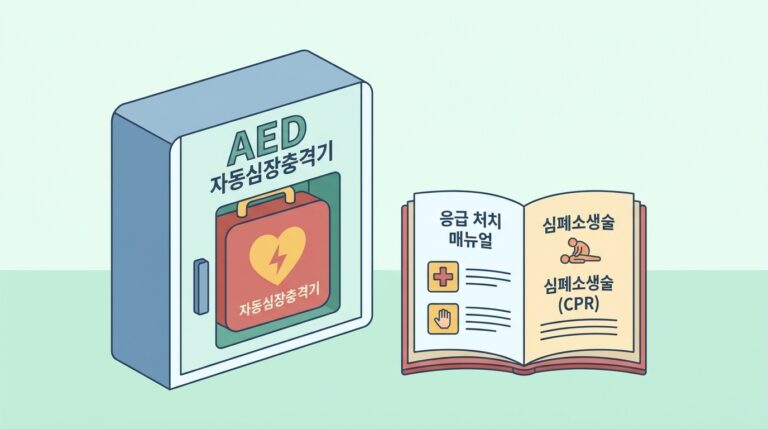
- 자동심장충격기 (Jadong-simjang-chung-gyeok-gi) | Automated External Defibrillator (AED)
- Usage: The official Korean legal and medical term for an AED, displayed prominently above emergency boxes in public stations.
- 심폐소생술 (Sim-pye-so-saeng-sul) | CPR (Cardiopulmonary Resuscitation)
- Usage: Widely abbreviated in speech as CPR, but official instructions and emergency dispatchers will frequently say 심폐소생술.
- 빗장뼈 / 쇄골 (Bit-jang-ppyeo / Swae-gol) | Clavicle / Collarbone
- Usage: 빗장뼈 is the pure Korean anatomical term used in AED diagrams, while 쇄골 is the Sino-Korean term used casually.
- 제세동 (Je-se-dong) | Defibrillation
- Usage: Medical jargon meaning “removal of fibrillation.” Heard in automatic prompts like “제세동을 시행합니다” (Administering defibrillation).
Phase 8: Survival Kit for Travelers
Top 3 Emergency Survival Phrases
- “여기 AED 위치가 어디인가요?” (Yeogi AED-ui wichiga eodi-in-gayo?)
- Pro Tip: Ask station staff or security guards immediately if the cabinet is not in plain view.
- “제가 패드 붙일 테니 119와 통화 유지해 주세요.” (Jega paedeu buchil teni il-il-gu-wa tonghwa yujihae juseyo.)
- Pro Tip: Keeps the bystander focused on emergency dispatch communication while you handle equipment.
- “패드가 피부에 잘 밀착되지 않으니 물기 좀 닦아주세요.” (Paeduega pibue jal milchakdoeji aneuni mulgi jom dakka-juseyo.)
- Pro Tip: Sweaty or wet surfaces cause pad detachment; use this command to delegate wiping.
Editor’s Travel Note
Before traveling in Korea, ensure you have the E-Gen Emergency Medical Information App Download installed on your smartphone. It provides real-time GPS locations of all registered public AED units and emergency rooms with English UI capabilities across South Korea.
Phase 9: Stepping Deeper
Korean communal ethics (우리 문화, the “We” collective identity) shine brightest during unexpected public crises. When an emergency alarm sounds in a subway or street corner, Korean citizens rarely walk past as mere spectators; they instinctively form supportive perimeters, shield victims with umbrellas, and take turns performing chest compressions until paramedics arrive. This collective civic responsibility is both culturally ingrained and legally fortified by emergency protection laws. Being able to command these situations in precise Korean transforms you from an isolated foreign traveler into an active, life-saving member of the community.
💬 Your Turn: Have you ever seen an AED in a Korean subway station or airport? How would your tone change between asking for directions versus commanding an emergency perimeter? Share your thoughts below!
Phase 10: FAQ & Common Mistakes
Q: Can I use 반말 (informal speech) if the situation is urgent?
A: Even in life-or-death emergencies, native speakers use clear honorific imperatives ending in ~세요 (e.g., 손 떼세요!, 물러서세요!). Dropping entirely into 반말 (e.g., 손 떼!, 비켜!) can cause momentary social shock or confusion among unfamiliar adult bystanders. Stick to urgent, punchy 해요체 / 하십시오체 commands.
Q: What if the AED prompt is purely in Korean and I miss a word?
A: Follow the flashing LED numbered lights on the machine casing (1: Power -> 2: Pad Connection -> 3: Shock Button). Key acoustic cues to listen for are “분석” (Analysis) and “충격” (Shock).
Q: Where are AEDs located in typical Korean apartment complexes?
A: By law, they are stationed in the security management office (관리사무소) or beside the primary lobby elevators of designated residential towers.
🚨 Common Mistakes in Korean Emergency Situations
- Mistake: Shouting “도와주세요!” (Help me!) without specific individual assignment.
- Correct Action: Make eye contact and pinpoint a person by visual marker: “파란 모자 쓰신 분, AED 가져다주세요!”
- Mistake: Hesitating to peel clothes due to cultural modesty.
- Correct Action: Pad adhesion to bare skin is non-negotiable. Declare firmly: “상의 탈의하겠습니다” and attach pads immediately.
- Mistake: Touching the patient while shouting “비키세요!”.
- Correct Action: Keep your own hands clearly in the air while shouting so bystanders see that physical contact is broken.
Phase 11: Action Missions
- 🥉 Bronze Mission (Solo Shadowing): Stand in front of a mirror and practice shouting the 3 core phrases from Phase 2 with firm hand gestures and clear vocal projection.
- 🥈 Silver Mission (Community Learning): Write out the 2 pad attachment locations in Korean (오른쪽 빗장뼈 아래, 왼쪽 겨드랑이 아래) on your social feed or study notes and tag @DailyHangul.
- 🥇 Gold Mission (Real-World Scouting): On your next walk through a Korean subway station or public building, locate the AED cabinet, read the Korean instructional diagram on the glass box, and memorize the station emergency phone number.
- 🎮 K-Culture Mission: Watch an episode of a Korean medical drama (e.g., Hospital Playlist) and listen for the exact moment the doctors command “충전 완료, 모두 물러서세요!”.
Phase 12: Interactive Quiz Challenge
1. Situational Judgment
During AED operation, the machine says “심장 리듬을 분석 중입니다.” What should you say to the crowd?
* A) “빨리 가슴 압박을 계속하세요!”
* B) “환자에게서 모두 물러서세요! 손 떼세요!”
* C) “AED 기계 전원을 즉시 끄세요!”
👉 Click to reveal answer and explanation
Correct Answer: B
Explanation: During analysis, any motion or touch interferes with the ECG sensor. You must immediately order everyone to step back and take their hands off the patient (손 떼세요).
2. Fill-in-the-Blank
Complete the standard AED pad placement instructions:
“패드는 오른쪽 [ 1 ] 아래와 왼쪽 [ 2 ] 아래에 부착합니다.”
👉 Click to reveal answer and explanation
Correct Answer: [ 1 ] 빗장뼈 (쇄골) / [ 2 ] 겨드랑이
Explanation: The right pad goes below the clavicle (빗장뼈 아래), and the left pad goes below the armpit along the mid-axillary line (겨드랑이 아래).
3. True / False Cultural Check
Statement: Under Korean law, you can be sued for criminal damages if you break a patient’s rib while performing CPR in good faith as an uncertified civilian.
👉 Click to reveal answer and explanation
Correct Answer: False
Explanation: Under the Good Samaritan provision (선한 사마리아인 법) in Korea’s Emergency Medical Service Act, emergency civilian responders are protected from civil and criminal liability for unavoidable harm caused during life-saving rescue efforts.







