

Phase 1: Empathy (Story-Immersive Opening)
안녕하세요! 매일한글 에디터입니다.
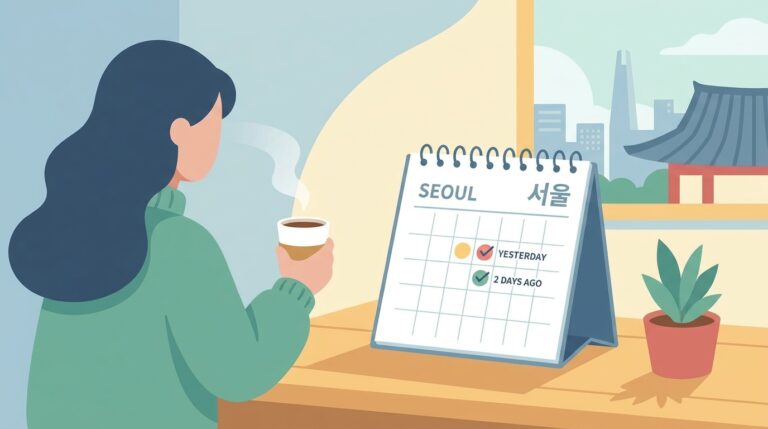
Picture this: You are sipping a fresh iced Americano in a trendy cafe in Seongsu-dong. The friendly barista asks when you arrived in Seoul. You want to say, “I arrived the day before yesterday!” but your brain freezes. Is it 어제 (Eoje)? Is it 오늘 (Oneul)? Or that tricky longer word with all the ‘j’ sounds? You end up pointing backwards and awkwardly muttering, “Two days… ago?”
Don’t worry—you are definitely not alone! Over the past decade tutoring hundreds of Korean language learners at Daily Hangul, we’ve seen this exact mix-up happen constantly. In English, we often rely on “yesterday” and “two days ago,” but in Korean, words like 어제 (Eoje) and 그저께 (Geujeokke) are woven into everyday chitchat, K-dramas, and pop songs.
Mastering these two essential time markers is your secret ticket to storytelling, casual banter with local friends, and tracking your travel memories without second-guessing yourself. Let’s make talking about the past feel completely effortless!
Phase 2: Deep Dive into 3 Core Expressions
1. 어제 (Eoje)
- Pronunciation: [Eoje] (Sounds like: “Uh-jay” — like the letter ‘U’ in ‘umbrella’ followed by the name ‘Jay’)
- Meaning: Literal: Yesterday | Nuance: Simple, direct reference to the previous calendar day.
- K-Culture Moment: In K-dramas, whenever two best friends meet up at a pojangmacha (street food tent), one inevitably asks: 어제 뭐 했어? (Eoje mwo haesseo? – What did you do yesterday?).
- Editor’s Insight: 어제 can act as both a noun (“Yesterday was fun”) and an adverb (“I worked yesterday”). You don’t even need a time particle like ‘에’ (at/on) attached to it in daily conversation!
- Situation Spectrum: Casual ✅ | Semi-formal ✅ | Formal ✅ (Universally used across all speech levels)
- 🤔 Think About It: In English, we say “on yesterday”? No, we just say “yesterday”! Korean treats 어제 with the same breezy independence.
2. 그저께 / 그제 (Geujeokke / Geuje)
- Pronunciation: [Geu-jeok-ke / Geu-je] (Sounds like: “Goo-juh-kay” / “Goo-jay”)
- Meaning: Literal: The day before yesterday | Nuance: Two days in the past.
- K-Culture Moment: You’ll hear K-pop idols on live streams saying: 그저께 콘서트 끝났어요! (Geujeokke konseoteu kkeutnasseoyo! – Our concert finished the day before yesterday!).
- Editor’s Insight: 그제 (Geuje) is simply the casual, contracted nickname for 그저께 (Geujeokke). Native Koreans use them interchangeably when sharing gossip or travel recaps.
- Situation Spectrum: Casual ✅ | Semi-formal ✅ | Formal ✅
- 🤔 Think About It: English requires four whole words (“the day before yesterday”), whereas Korean compresses that entire concept into just three neat syllables: 그저께!
3. 어제 왔어요 (Eoje wasseoyo)
- Pronunciation: [Eoje wasseoyo] (Sounds like: “Uh-jay wah-ssuh-yo”)
- Meaning: Literal: (I) came yesterday | Nuance: “I arrived yesterday!”
- K-Culture Moment: Essential check-in dialogue when meeting tour guides, guesthouse hosts, or fellow travelers in Korea.
- Editor’s Insight: Korean frequently drops pronouns like “I” or “you” when the context is obvious. Just combine 어제 with the past tense verb 왔어요 (came), and you’ve formed a complete, natural sentence.
- Situation Spectrum: Casual ⚠️ (어제 왔어) | Semi-formal ✅ (어제 왔어요) | Formal ✅ (어제 왔습니다)
- 🤔 Think About It: Why waste energy saying “I arrived yesterday” when you can deliver pure context in two punchy words?
Phase 3: Textbook Korean vs. Real-Life Korean
Situation 1: Asking what someone did yesterday
- 📖 Textbook Korean: 어제 무엇을 하였습니까? (Eoje mueoseul hayeosseumnikka?)
- 🗣️ Real-Life Korean: 어제 뭐 했어요? (Eoje mwo haesseoyo?)
- 💡 Why the difference? Textbook phrasing is stiff and overly ceremonial. Native speakers contract 무엇을 (what) into 뭐 and use the polite -했어요 ending for everyday warmth.
Situation 2: Stating when you bought something
- 📖 Textbook Korean: 저는 그것을 그저께에 샀습니다. (Jeoneun geugeoseul geujeokkee sasseumnida.)
- 🗣️ Real-Life Korean: (이거) 그저께 샀어요! ([Igeo] geujeokke sasseoyo!)
- 💡 Why the difference? In spoken Korean, dropping the pronoun (저는) and omitting the time particle (에) makes your speech flow instantly like a local.
Phase 4: K-Culture Deep Dive & Non-Verbal Manners
4-1. 눈치 (Nunchi) & Gestures
When Koreans recall past days during a chat, they often give a gentle head tilt upward-left while tapping their chin or counting backward on their thumb and index finger.
* Finger Counting Tip: In Korea, when counting backwards by days, touch your index finger for 어제 (yesterday) and middle finger for 그저께 (day before yesterday).
* Eye Contact: Keep soft eye contact with an open expression to show you’re actively reliving the memory with them.
4-2. K-Culture Code: The 24-Hour Drama Recap & Idol Schedules
Korean fandom culture moves at lightning speed! If a drama episode aired yesterday, fans on social media won’t say “the previous episode”—they simply post “어제 방송 (yesterday’s broadcast)”. If you want to join K-pop live comments or chat about the latest K-drama episode, knowing 어제 and 그저께 lets you jump right into the excitement without missing a beat.
Phase 5: Real-World Roleplay Scenario
Setting: A vibrant K-pop vinyl & photo-card shop in Hongdae, Seoul.
Characters:
* 민우 (Min-woo): Friendly, stylish shop staff who loves chatting with travelers.
* You: A traveler on the hunt for limited-edition souvenirs.
- 민우: 안녕하세요! 한국에 언제 오셨어요?
(Annyeonghaseyo! Hanguge eonje osyeosseoyo?)
“Hello! When did you arrive in Korea?”
🎭 Greets warmly with a cheerful bow and bright smile. -
You: 저 그저께 왔어요!
(Jeo geujeokke wasseoyo!)
“I arrived the day before yesterday!”
🎭 Smiles back and holds up two fingers playfully. -
민우: 와, 서울 여행 재미있으세요?
(Wa, Seoul yeohaeng jaemiisseuseyo?)
“Wow, are you having fun on your Seoul trip?”
🎭 Tilts head attentively. -
You: 네! 어제 명동에 갔어요.
(Ne! Eoje Myeongdonge gasseoyo.)
“Yes! Yesterday I went to Myeongdong.”
🎭 Nods enthusiastically. -
민우: 명동 좋죠! 어제 맛있는 거 많이 드셨어요?
(Myeongdong jotjyo! Eoje masinneun geo mani deusyeosseoyo?)
“Myeongdong is great! Did you eat a lot of delicious food yesterday?”
🎭 Makes a playful eating gesture. -
You: 길거리 음식 많이 먹었어요!
(Gilgeori eumsik mani meogeosseoyo!)
“I ate lots of street food!”
🎭 Rubs tummy happily. -
민우: 최고예요! 이 포토카드는 그저께 새로 들어온 거예요.
(Choegoyeyo! I photokadeuneun geujeokke saero deureoon geoyeyo.)
“Awesome! This photo-card just arrived brand new the day before yesterday.”
🎭 Hands you a shiny limited-edition card. -
You: 대박! 이거 어제부터 찾고 있었어요. 감사해요!
(Daebak! Igeo eojebuteo chatgo isseosseoyo. Gamsahaeyo!)
“Jackpot! I was looking for this since yesterday. Thank you!”
🎭 Receives the item with two hands politely.
🔀 Interactive Choice Point
Min-woo asks: “어제 K-pop 팝업스토어도 가보셨어요? (Did you also go to the K-pop pop-up store yesterday?)” How do you respond?
- Option A: 아니요, 그저께 갔어요! (Aniyo, geujeokke gasseoyo! – No, I went the day before yesterday!)
- Option B: 아니요, 내일 갈 거예요. (Aniyo, naeil gal geoyeyo. – No, I will go tomorrow.)
- Option C: 어제 먹었어요. (Eoje meogeosseoyo. – Yesterday I ate.)
🔍 Click to see the Feedback for your choice!
- Option A [BEST]: Perfect use of 그저께! You clearly explained the correct timeline and kept the conversation flowing naturally.
- Option B [GOOD / RISK]: Grammatically correct, but shifts the topic to the future instead of answering the past tense question.
- Option C [BAD]: Confusing! You answered “I ate” to a question about “going to a pop-up store.” Min-woo might wonder if you tried to eat the merchandise!
Phase 6: 10-Second Emotion Shadowing Drill
Read these lines out loud! Follow the rhythm pauses (/) and inject the specific emotion indicated in the brackets:
[😊 Bright & Friendly]
저 / 어제 / 서울에 도착했어요!
(Jeo / eoje / Seoure dochakhaesseoyo!)
“I / yesterday / arrived in Seoul!”-
[🤔 Thinking Back / Reflective]
음… 그거 / 그저께 / 샀어요!
(Eum… geugeo / geujeokke / sasseoyo!)
“Umm… that item / the day before yesterday / I bought!” -
[🤩 Super Excited & Relieved]
어제 / 콘서트 / 진짜 최고였어요!
(Eoje / konseoteu / jinjja choegoyeosseoyo!)
“Yesterday’s / concert / was truly the best!”
Phase 7: K-Culture Mini Dictionary
- 어제 (Eoje) | Yesterday | Used daily across all settings to recount past activities or timing.
- 그저께 (Geujeokke) | The day before yesterday | Also shortened to 그제 (Geuje) in casual banter.
- 어젯밤 (Eojetbam) | Last night | Combination of 어제 (yesterday) + 밤 (night) with a connective ‘ㅅ’. Perfect for asking 어젯밤 잘 잤어요? (Did you sleep well last night?).
- 엊그제 (Eotgeuje) | A couple of days ago / Just the other day | Used when you mean recent days generally: “It feels like just the other day!”
Phase 8: Traveler’s Survival Kit
Survival TOP 3 Phrases
- 어제 예약했어요. (Eoje yeyakhaesseoyo.) – “I made a reservation yesterday.”
Pro Tip: Show your booking screen while saying this at hotel front desks or restaurants. - 그저께 왔어요. (Geujeokke wasseoyo.) – “I came the day before yesterday.”
Pro Tip: Great icebreaker when locals ask how long you’ve been around. - 어제 샀는데 교환돼요? (Eoje sanneunde gyohwandoeyo?) – “I bought this yesterday; can I exchange it?”
Pro Tip: Keep your paper receipt ready!
Editor’s Travel Note
- When navigating public transit or checking historic visit logs, download and use the Naver Map app on your mobile device. It displays your daily saved places and search history neatly labeled as 어제 (Yesterday) and 오늘 (Today), giving you instant real-life reading practice!
Phase 9: “One Step Deeper” (Reflective Thought)
In Korean culture, sharing what you did 어제 or 그저께 isn’t just about sharing factual timestamps—it is an act of 정 (Jeong – relational warmth). Asking someone about their yesterday signals care and shared life context. When you tell a Korean friend what you did yesterday, you invite them into your personal rhythm.
💬 Your Turn: What is one fun thing you did yesterday? Try making a short Korean sentence in the comments below using 어제!
Frequently Asked Questions (FAQ)
Q: What does "어제 (Eoje)" mean in Korean and how do you pronounce it?
A: In Korean, "어제 (Eoje)" is pronounced [Eoje] and means: Literal: Yesterday | Nuance: Simple, direct reference to the previous calendar day.
Q: What does "그저께 / 그제 (Geujeokke / Geuje)" mean in Korean and how do you pronounce it?
A: In Korean, "그저께 / 그제 (Geujeokke / Geuje)" is pronounced [Geu-jeok-ke / Geu-je] and means: Literal: The day before yesterday | Nuance: Two days in the past.
Q: What does "어제 왔어요 (Eoje wasseoyo)" mean in Korean and how do you pronounce it?
A: In Korean, "어제 왔어요 (Eoje wasseoyo)" is pronounced [Eoje wasseoyo] and means: Literal: (I) came yesterday | Nuance: "I arrived yesterday!"







