

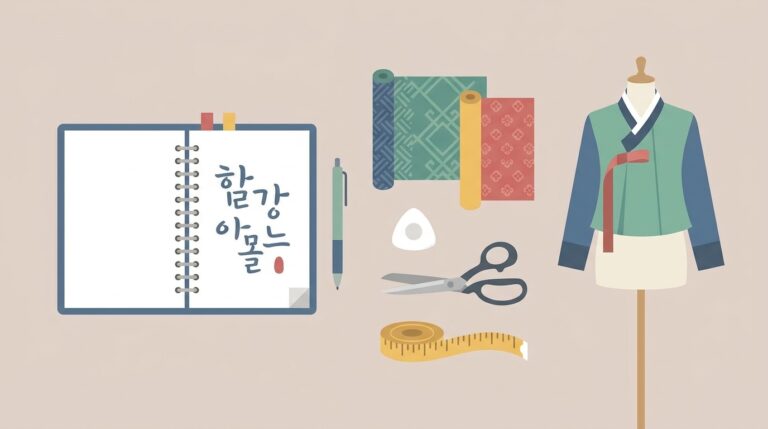
Master Korean Pattern Making and Sewing: The Ultimate Atelier Survival Guide
Phase 1: Empathy & Storytelling
안녕하세요! 매일한글 에디터입니다. (Hello! This is your Daily Hangul editor.)
Imagine this: You are standing in a sunlit, bustling garment atelier tucked inside the historic alleys of Sindang-dong, just five minutes away from Dongdaemun Design Plaza. Rolls of crisp Korean silk and structured wool surround you. Across the large cutting table stands Master Park (박 반장님), a veteran pattern maker with forty years of experience sculpting silhouettes for Seoul Fashion Week. You clutch your technical flat sketch, your heart racing. You want to explain that the armhole depth needs to be lowered by 1.5 cm and the shoulder dart needs a smoother curve without causing the neckline to gape.
You recall your standard textbook Korean: “이 옷의 구멍을 고쳐 주세요” (Please fix this hole in the clothes). Master Park tilts his head, squinting with tailor’s chalk in hand. The nuance is lost, and the collaborative momentum stalls.
Mastering garment construction in Korea isn’t just about translating English tailoring terms into Korean; it is about navigating the specialized lexicon of the Seoul garment district, blending professional technical vocabulary with the respectful, high-context interpersonal dynamics (Nunchi) of veteran artisans. Based on real feedback from international fashion students and indie designers working in Korea, this guide will empower you to communicate your design intent with absolute precision, mutual respect, and C1-level fluency.
Phase 2: Deep Dive into 3 Core Expressions
1. 시접을 넉넉하게 남겨 주세요 (Sijeob-eul neongneokhage namgyeo juseyo)
- Pronunciation: See-jeob-eul neong-neok-ha-gae nam-gyeo joo-sae-yo (Think of see-job smoothly gliding into neong-neok like “young knock”).
- Meaning: Literal: “Please leave generous seam allowances.” / Nuance: A proactive, professional request ensuring that future fitting adjustments or alterations remain structurally viable.
- K-Culture Moment: In fashion workplace K-Dramas like Record of Youth (청춘기록) or Now, We Are Breaking Up (지금, 헤어지는 중입니다), designers constantly remind their sample room sewists to secure seam allowances before cutting expensive imported textiles.
- Editor’s Insight: The word 시접 (Sijeop) refers strictly to the seam allowance. Using the adverb 넉넉하게 (Neongneokhage – generously/amply) signals that you understand sample fitting realities, preventing the nightmare of an over-trimmed seam.
- Situation Spectrum:
- Casual (with atelier peers): ✅ 시접 넉넉히 줘. (Sijeop neongneokhi jwo.)
- Semi-formal (Atelier Standard): ✅ 시접을 넉넉하게 남겨 주세요. (Sijeob-eul neongneokhage namgyeo juseyo.)
- Formal (Technical Spec Sheet / Contract): ⚠️ 봉제 시접 여유분 확보 요망. (Bongje sijeop yeoyubun hwakbo yomang.)
- 🤔 Think About It: Why does Korean tailoring favor flexible adverbs like 넉넉하게 over rigid millimeter measurements during initial draping conversations? How does this reflect relational trust between designer and artisan?
2. 실루엣(라인)을 다시 잡아봐야 할 것 같아요 (Silru-et-eul dasi jab-abwado hal geot gat-ayo)
- Pronunciation: Sheel-loo-et-eul da-shee ja-ba-bwa-ya hal geot gat-ah-yo (Sounds like “silhouette-eul” + “da-she” + “java-bwaya”).
- Meaning: Literal: “I think we need to catch the silhouette/line again.” / Nuance: “We need to re-sculpt or re-draft the contour lines because the current drape feels off.”
- K-Culture Moment: Seen in K-Style design reality shows where creative directors critique muslin mock-ups (가봉) on live fit models.
- Editor’s Insight: The verb 잡다 (Japda – to catch/hold) is the ultimate chameleon verb in Korean fashion. You “catch” fit (핏을 잡다), “catch” darts (다트를 잡다), and “catch” balance (균형을 잡다). Cushioning your opinion with ~할 것 같아요 (~I think/it seems) softens the critique while asserting clear artistic direction.
- Situation Spectrum:
- Casual: ✅ 라인 다시 잡자. (Rain dasi japja.)
- Semi-formal (Collaborative Atelier): ✅ 라인을 다시 잡아봐야 할 것 같아요. (Raineul dasi jababwaya hal geot gatayo.)
- Ultra-Formal: 🚫 (Sounds overly conversational for corporate production board meetings; use 패턴 수정 및 보정이 필요합니다 instead).
- 🤔 Think About It: How does indirect phrasing (~할 것 같아요) preserve the artisan’s face while still achieving strict quality control?
3. 가봉 단계에서 이음새가 울지 않게 처리해 주세요 (Gabong dangye-eseo ieumsaega ulji anke cheorihae juseyo)
- Pronunciation: Ga-bong dang-gye-eh-seo ee-eum-sae-ga ool-jee ank-ae cheo-ree-hae joo-sae-yo (ulji sounds like “wool-jee”).
- Meaning: Literal: “Please treat the seam so it doesn’t cry during the basting/fitting stage.” / Nuance: “Please ensure the seams remain completely flat without puckering or bubbling during the sample fitting.”
- K-Culture Moment: The vivid idiom 옷이 울다 (The clothes are crying) is universal in Korean tailoring to describe puckered, gathered, or rippled seams.
- Editor’s Insight: 가봉 (Gabong) is the preliminary fitting stage using temporary basting stitches. If your fabric puckers, telling the tailor “옷이 울어요” (The garment is crying) will immediately communicate puckering issues far better than any dry textbook translation like “주름이 생겼어요”.
- Situation Spectrum:
- Casual: ✅ 여기 이음새 좀 운다. (Yeogi ieumsae jom unda.)
- Semi-formal (Sample Workshop): ✅ 가봉 단계에서 이음새가 울지 않게 신경 써 주세요. (Gabong dangye-eseo ieumsaega ulji anke singyeong sseo juseyo.)
- Technical Spec: ⚠️ 봉제 부위 퍼커링(Puckering) 발생 방지 요망. (Bongje buwi peokeoring balsaeng bangji yomang.)
- 🤔 Think About It: Personifying flawed seams as “crying” reveals how Korean artisans view garments as living, breathing forms rather than inanimate pieces of cut fabric.
Phase 3: Textbook Korean vs. Real Atelier Korean
Situation 1: Requesting a Pattern Adjustment on the Armhole
- 📖 Textbook Korean: 이 옷의 겨드랑이 둘레 패턴을 더 크게 잘라 주시겠습니까? (I os-ui gyeodeurang-i dulle paeteon-eul deo keuge jalla jusigesseumnikka? / Would you please cut the armpit circumference pattern larger?)
- 🗣️ Real Korean: 반장님, 암홀 라인 1인치만 더 파고 가다(패턴) 다시 떠 주세요. (Banjang-nim, amhol rain il-inchi-man deo pago gada(paeteon) dasi tteo juseyo. / Master, let’s carve out the armhole line by 1 inch and draft the pattern anew.)
- 💡 Why is it different? Real ateliers use technical loanwords like 암홀 (Armhole) and dynamic action verbs like 파다 (Pada – to hollow out/scoop) and 패턴을 뜨다 (Paeteon-eul tteuda – to draft/lift a pattern). The heritage term 가다 (from Japanese kata, pattern mould) is still colloquially heard among seasoned artisans alongside 패턴.
Situation 2: Asking for Final Pressing and Clean Finishing
- 📖 Textbook Korean: 바느질을 끝내고 다림질을 완벽하게 해 주십시오. (Baneujil-eul kkeutnaego darimjil-eul wanbyeokhage hae jusipsio. / Please finish sewing and iron it perfectly.)
- 🗣️ Real Korean: 시야기 깔끔하게 꺾어서 스팀 쏴 주세요. (Siyaki kkalkkeumhage kkeokkeoseo seuteim sswa juseyo. / Please press the edges sharp and clean, and steam it out thoroughly.)
- 💡 Why is it different? In Seoul’s garment district (Dongdaemun/Changsin-dong), the finishing pressing stage is widely called 시야기 (Finishing/Ironing). Designers specify 꺾다 (Kkeokda – to crease/break the fold cleanly) and 스팀 쏘다 (Seuteim ssoda – to shoot steam) for crisp tailoring.
Phase 4: K-Culture Deep Dive & Non-Verbal Manners
   [ Korean Atelier Etiquette: Respect & Technical Precision ]
   ┌─────────────────────────────────────────────────────────┐
   │ 1. Address Masters as "반장님" (Banjang-nim) or          │
   │    "기사님" (Gisa-nim), never just "선생님" or by name. │
   │ 2. Use two hands when passing shears or rolled patterns.│
   │ 3. Pinch the fabric drape gently to demonstrate ease;   │
   │    never aggressively yank garments off the dress form. │
   └─────────────────────────────────────────────────────────┘
4-1. Nunchi & Atelier Body Language
- The Measuring Tape Posture: When discussing patterns, hold your measuring tape (줄자) with both hands or drape it respectfully around your neck. Pointing with tailor’s chalk or the flat pad of your index finger at the grainline (식서 방향) signals deep industry training. Pointing abruptly with scissors or pens is considered careless and disrespectful.
- The “Pinch and Nod” (Nunchi in Action): When the pattern maker proposes a dart modification, lightly pinch the surplus fabric (군살/여유분) on the mannequin, nod deliberately, and say, “아, 반장님 말씀대로 이쪽을 잡으니까 실루엣이 훨씬 사네요!” (Ah, catching it here like you suggested brings the silhouette to life!). Validating their technical mastery before proposing further tweaks builds instant trust.
4-2. Cultural Insight: The 24-Hour Dongdaemun Production Ecosystem
Seoul’s fashion engine runs at unmatched velocity. In Dongdaemun’s sample rooms, a design sketched at 10:00 AM can be pattern-drafted (패턴 뜨기), fabric-sourced (동대문종합시장 원단 사입), basted (가봉), and sewn (봉제) by the next morning. This miraculous speed relies heavily on 공동체적 신뢰 (Communal trust) and condensed, highly precise industry jargon. Understanding their lingo is your passport into this elite production network.
Phase 5: Real-World Atelier Roleplay Scenario
- Setting: A high-end pattern development studio in Sindang-dong.
- Characters:
- 박 반장님 (Master Park): 62-year-old veteran pattern maker, blunt yet deeply caring.
- 사라 (Sarah): Creative Director preparing an avant-garde oversized blazer for a boutique launch.
- 사라: 반장님, 지난번에 떠 주신 오버핏 재킷 1차 가봉 샘플 나왔는데요, 라인 한번만 봐주실 수 있으세요?
(Banjang-nim, jinanbeon-e tteo jusin obeopit jaekit il-cha gabong saemple nawatneundeyo, rain hanbeonman bwajusil su isseuseyo?)
🎭 Sarah gently places the muslin sample on the dress form, stepping back with a respectful slight bow.
“Master Park, the first basted sample for the oversized jacket you drafted is ready; could you take a look at the lines?” -
박 반장님: 어디 봐. 흠… 어깨 드롭은 기가 막히게 떨어졌는데, 앞판 여밈 쪽이 살짝 뜨네. 원단이 도톰해서 그래.
(Eodi bwa. Heum… eokkae deuropeun giga makhige tteoreojyeotneunde, ap-pan yeomim jjogi saljjak tteune. Weondani dotomhaeseo geurae.)
🎭 Master Park taps the lapel with his tailoring ruler and squints at the chest drape.
“Let me see. Hmm… The dropped shoulder falls wonderfully, but the front overlap is floating a bit. It’s because the wool is thick.” -
사라: 맞아요! 그래서 가슴 다트를 반 인치 올리고, 암홀 밑부분을 살짝 파내면 어떨까 싶어요.
(Majayo! Geuraeseo gaseum dateureul ban inchi olligo, amhol mitbubu-neul saljjak panaemyeon eotteolkka sipeoyo.)
🎭 Sarah uses fabric chalk to lightly trace a smoother curve along the underarm seam.
“Exactly! So I was wondering if we might raise the bust dart by half an inch and hollow out the lower armhole slightly.” -
박 반장님: 암홀을 파면 소매산(Sleeve cap) 패턴도 다시 굴려야 돼. 소매 이새(Ease) 분량이 너무 많아질 수 있거든.
(Amholeul pamyeon somaesan paeteondo dasi gullyeoya dwae. Somae isae bullyang-i neomu manajil su itgeodeun.)
🎭 Master Park rolls up his tape measure and sketches a cross-section on pattern paper.
“If you scoop the armhole, we also have to re-curve the sleeve cap pattern. The sleeve ease could get too bulky otherwise.” -
사라: 아, 소매산 이새가 뭉치면 소매가 울 수도 있겠네요! 그럼 소매산 높이를 살짝 깎아서 맞춰볼까요?
(A, somaesan isaega mungchimyeon somaega ul sudo itgetneyo! Geureom somaesan nopireul saljjak kkakka-seo matchwobolkkayo?)
🎭 Sarah nods with illuminated understanding, acknowledging his technical point.
“Ah, if the sleeve cap ease bunches up, the sleeve seam might pucker! Then should we shave down the sleeve cap height slightly to balance it?” -
박 반장님: 역시 감이 빠르네! 그렇게 하면 주름 없이 매끈하게 떨어지지. 시접은 1.5cm로 넉넉하게 둘 테니까 가봉 다시 보자고.
(Yeoksi gami ppareune! Geureohke hamyeon jureum eopsi maekkeunhage tteoreojiji. Sijeobeun 1.5cm-ro neongneokhage dul tenikka gabong dasi bojago.)
🎭 Master Park smiles approvingly and clips his chalk into his chest pocket.
“You catch on so fast! Doing that will make it fall smooth without wrinkles. I’ll leave a generous 1.5cm seam allowance so we can fit it once more.” -
사라: 감사합니다, 반장님! 봉제 들어가기 전에 스펙 시트에 요척이랑 마도메 지시사항 적어둘게요.
(Gamsahamnida, Banjang-nim! Bongje deureogagi jeone seupek siteu-e yocheok-irang madome jisisahang jeogeodulgeyo.)
🎭 Sarah takes out her spec board, bowing with a warm smile.
“Thank you so much, Master! Before sewing begins, I’ll note down the fabric yield and hand-finishing instructions on the spec sheet.” -
박 반장님: 그래, 오늘 저녁까지 패턴 수정본 쳐놓을 테니 내일 아침에 본봉(Main sewing) 넘겨!
(Geurae, oneul jeonyeok-kkaji paeteon sujeongbon cheonoeul teni naeil achime bonbong neomgyeo!)
🎭 Master Park pats the cutting table confidently.
“Great, I’ll finish punching out the revised pattern by this evening, so hand it over to main assembly tomorrow morning!”
🔀 Interactive Decision Point
Master Park notes that raising the dart might distort the plaid pattern on your expensive fabric. How do you respond?
- Option A: “제가 디자이너니까 그냥 제 스케치대로 해주세요.” (I am the designer, so just do it according to my sketch.)
- Option B: “반장님, 체크 무늬 결(바이어스)을 살리면서 다트를 숨길 수 있는 노하우가 있을까요?” (Master, is there a technique to hide the dart while maintaining the plaid grain line?)
- Option C: “그럼 다트 넣지 말고 그냥 일자로 봉제해 주세요.” (Then don’t put any darts and just sew it straight down.)
┌────────────────────────────────────────────────────────────────────────┐
│ 💡 Feedback on Your Choice:                                            │
│                                                                        │
│ Option A (Bad): Destroys rapport. In Korea, senior pattern makers are  │
│ revered master engineers, not mere laborers. Disrespect brings delays. │
│ Option B (BEST): Masterful C1 collaborative etiquette! It honors their │
│ 40-year technical wisdom while asking for a creative solution.         │
│ Option C (Risk): Sacrifices garment fit entirely; leads to boxy,       │
│ unflattering samples.                                                  │
└────────────────────────────────────────────────────────────────────────┘
Phase 6: 10-Second Emotional Shadowing Drill
Practice these lines aloud with the emotional guidance and rhythm slashes (/):
[🧐 섬세하고 프로페셔널하게 / Analytical & Precise]
암홀 라인을 / 0.5인치만 파내고, / 소매산 이새는 / 자연스럽게 죽여 주세요.
(Amhol rain-eul / 0.5inchi-man panaego, / somaesan isaeneun / jayeonseureopge jugyeo juseyo.)
“Scoop the armhole by 0.5 inches, / and blend down the sleeve cap ease naturally.”-
[🙏 정중하면서도 확고하게 / Respectful yet Decisive]
원단 결이 틀어지지 않게 / 식서 방향 맞춰서 / 재단 부탁드립니다.
(Weondan gyeor-i teureojiji anke / sikseo banghyang matchwoseo / jaedan butakdeurimnida.)
“Please align with the straight grainline / before cutting / so the textile grain doesn’t twist.” -
[✨ 감탄과 신뢰를 담아서 / Warm Admiration & Gratitude]
반장님이 잡아주신 가봉 라인이 / 실물로 보니까 / 훨씬 유려하네요!
(Banjang-nimi jabajusin gabong rain-i / silmullo bonikka / hwolssin yuryeohaneyo!)
“The basted lines you sculpted / look so much more elegant / in real life!”
Phase 7: K-Culture Mini Dictionary
| Term (Hangul + Romanization) | Technical Meaning | Real-World Industry Usage |
|---|---|---|
| 1. 요척 (Yo-cheok) | Fabric Yield / Consumption | The exact yardage required to produce one garment. Crucial when ordering fabric at Dongdaemun Market (“이 원피스 요척 얼마나 나와요?” -> “What is the fabric yield for this dress?”). |
| 2. 식서 (Sik-seo) | Warp / Grainline | The lengthwise grain of the woven textile. Cutting off-grain ruins garment balance. (“식서 방향 꼭 확인하고 재단해 주세요.”). |
| 3. 이새 (I-sae) | Ease / Fullness | Minute gathering/fullness inserted without creating visible pleats (common in sleeve caps). (“어깨에 이새를 살짝 넣어 굴려 주세요.”). |
| 4. 마도메 (Ma-do-me) | Hand-Finishing / Blind Hemming | Hand-sewing buttons, hook-and-eyes, or blind stitching cuffs after machine assembly (“마도메 깔끔하게 쳐서 납품해 주세요”). |
Phase 8: Designer & Traveler Survival Kit
Top 3 On-Site Sourcing Phrases
- 스와치 좀 챙겨갈 수 있을까요? (Seuwachi jom chaenggyeogal su isseulkkayo?)
Pro Tip: At Dongdaemun Fabric Market (동대문종합시장), ask this politely to take small fabric swatch cards for your moodboard. - 이 원단 탕(Dye Lot) 차이 심한가요? (I weondan tang chai simhangayo?)
Pro Tip: 탕 (Tang) refers to color variation across dye lots. Essential when re-ordering bulk rolls. - 샘플감으로 2마(Yard)만 끊어주세요. (Saemplegameuro du-ma-man kkeuneojuseyo.)
Pro Tip: In Korea, fabric is measured in 마 (Ma = 1 yard / approx 90cm). 2 yards is the standard sample length for tops.
Editor’s Travel Note: Conquering Dongdaemun
When navigating the sprawling maze of the Dongdaemun Complex Market (B1 to 5F), download the Naver Map App Download to pinpoint specific building blocks (동/Dong: A, B, C, D, N buildings). Most fabric wholesalers open at 8:30 AM and close by 6:00 PM (closed Sundays). Carry crisp 10,000 KRW cash notes or set up domestic account bank transfers (계좌이체), as small swatch cuts and sample yardage rarely take foreign credit cards.
Phase 9: “One Step Deeper” (Reflections on Korean Craftsmanship)
In modern Korean fashion ateliers, a unique cultural bridge connects two generations: the tech-savvy, 20-something designer trained in CLO 3D digital rendering, and the 65-year-old master artisan who spent decades mastering flat patterning with cardboard and sheer muscle memory. This relationship is not transactional; it is deeply familial and relational (정 / Jung).
When you enter a Korean sample room, recognizing that a pattern maker is an equal artistic co-creator rather than an assembly worker unlocks extraordinary craftsmanship. The slight bow, sharing a warm canned coffee (레쓰비), and speaking their specialized vernacular transform you from an outsider into a trusted creative comrade.
💬 Your Turn: Have you ever experienced an atelier or tailor shop in your home country? How does the designer-artisan dynamic in your culture compare to Korea’s master (반장님) culture? Share your thoughts in the comments below!
Phase 10: Frequently Asked Questions & Common Mistakes
Q: What is the difference between 바느질 (Baneujil) and 봉제 (Bongje)?
A: 바느질 (Baneujil) is everyday sewing, hand-stitching, or mending clothes at home. 봉제 (Bongje) is the professional, industrial sewing and garment construction performed in ateliers and manufacturing factories using industrial machinery (본봉, 오버록).
Q: Why do Korean pattern makers use Japanese-derived terms like 가다 (Gada) or 시야기 (Siyaki)?
A: Modern Korean commercial garment manufacturing industrialized rapidly in the 1960s–70s around Dongdaemun and Pyounghwa Market, inheriting historical tailoring trade terms. While younger designers promote pure Korean and standard global terms (패턴, 마무리 프레싱), veteran masters still use these industry idioms natively. Knowing both makes you truly bilingual on the factory floor.
Q: Can I call a veteran pattern maker “선생님” (Seonsaengnim)?
A: Yes, 선생님 is polite and safe. However, addressing them by their atelier title 반장님 (Banjang-nim – Master/Atelier Chief) or 기사님 (Gisa-nim – Master Technician) shows that you understand Korean manufacturing culture intimately.
🚨 Common Mistakes in Korean Garment Construction
- ❌ Mistake 1: Saying “패턴을 잘라주세요” (Cut the pattern) when you mean to draft/make a pattern.
✔️ Correct Action: Say “패턴을 떠 주세요” (Draft/lift the pattern) or “패턴 수정해 주세요” (Revise the pattern). - ❌ Mistake 2: Using “옷에 주름을 만들어 주세요” when requesting darts.
✔️ Correct Action: Say “다트(Dart)를 잡아주세요” (Catch the dart). 주름 translates to wrinkles or pleats/gathers. - ❌ Mistake 3: Describing puckering fabric as “옷이 부서졌어요” (The clothing broke).
✔️ Correct Action: Say “봉제선이 울어요” (The seam is crying/puckering) or “이음새가 당겨요” (The seam is pulling).
Phase 11: Action Missions
- 🥉 Bronze Level (Solo Drill): Stand before a mirror with a jacket or shirt. Point to 3 areas (armhole, shoulder seam, hem) and practice saying: “반장님, [부위] 라인 다시 잡아주시고 시접 넉넉히 남겨주세요!” out loud.
- 🥈 Silver Level (Social Practice): Post an Instagram Story or study note featuring a garment flat sketch, captioning it with: #가봉단계 #요척계산 #패턴메이킹 and tag @DailyHangul.
- 🥇 Gold Level (Real-World Application): Visit a local fabric shop or Korean dry cleaner (세탁소/수선실) and request an alteration using C1 terms: “여기 밑단 시접 살려서 1인치만 올려주세요!” (Please preserve the hem seam allowance and raise it 1 inch!).
- 🎮 K-Culture Mission: Watch an episode of a Korean fashion design reality show or fashion-themed K-Drama. Spot whether the designers use 식서, 가봉, or 다트 in the workshop scene!
Phase 12: Interactive Quiz Challenge
Test your atelier fluency below! Click on the spoiler toggles to check your answers and detailed breakdowns.
Question 1: Situational Judgment
You are testing a sample blazer on a model and notice the side seam is rippling and puckering awkwardly. What is the most natural, native way to point this out to your sewing technician?
* A) 반장님, 여기 옆선이 심하게 울고 있어서 다시 박아야 할 것 같아요.
* B) 반장님, 옷이 눈물을 흘리니까 세탁해 주세요.
* C) 반장님, 바느질이 부러졌으니 다시 가위질해 주세요.
🔍 Click to Reveal Answer & Explanation
Correct Answer: A
Explanation: Saying 옆선이 울고 있어서 (The side seam is puckering/crying) and 다시 박아야 할 것 같아요 (I think we need to stitch it again) is authentic, C1-level industry communication. Option B takes the “crying” metaphor literally into tears/washing, and Option C uses broken verbs (부러지다/가위질) incorrectly.
Question 2: Fill-in-the-Blank
Complete the spec instruction for a tailored coat:
“재단할 때 원단의 ________ 방향을 정확히 맞추지 않으면 착용 시 옷이 한쪽으로 돌아갈 수 있습니다.”
(When cutting, if you do not accurately align with the textile’s ________ direction, the garment may twist to one side when worn.)
🔍 Click to Reveal Answer & Explanation
Correct Answer: 식서 (Sik-seo – Lengthwise Grainline)
Explanation: The 식서 (Grainline/Warp) is the structural spine of woven fabrics. Cutting off-grain causes trousers or coats to twist awkwardly (옷이 돌아가다) around the body.
Question 3: True or False Atelier Culture Quiz
“In Korean sample rooms, using the verb ‘잡다’ (to catch) is strictly limited to physically holding tools like scissors or rulers.” (True / False)
🔍 Click to Reveal Answer & Explanation
Correct Answer: FALSE
Explanation: As we explored in Phase 2, 잡다 is one of the most versatile conceptual verbs in Korean fashion! You “catch” silhouette lines (라인을 잡다), darts (다트를 잡다), fullness balance (이새를 잡다), and overall fit (핏을 잡다).







