

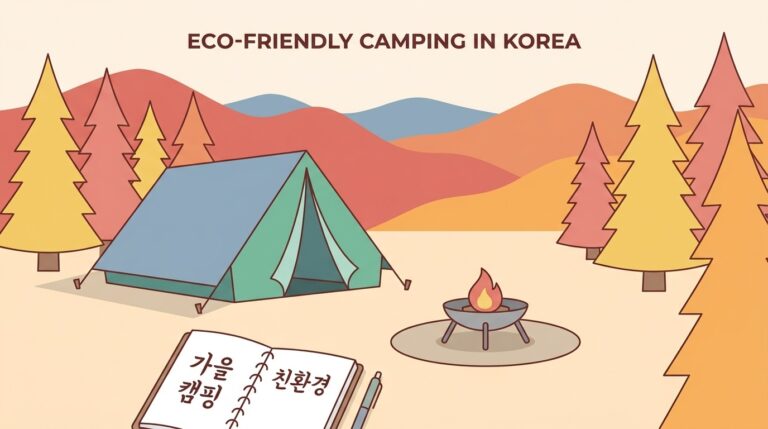
Master Eco-Camping in Korea: The Ultimate Leave No Trace (LNT) Guide for Advanced Learners
Phase 1: Empathy (Story-Driven Opening)
안녕하세요! 매일한글 에디터입니다. (Hello! This is your Daily Hangul editor.)
Imagine this: You have finally booked that coveted riverside campsite in Gapyeong after weeks of refreshing reservation apps. The autumn breeze is crisp, the Han River mist is rolling in, and you’ve spent the evening indulging in samgyeopsal and firewood gazing (bulmeong). But the real test arrives at 10:00 AM the next morning during checkout.
In Korea, camping isn’t just an outdoor hobby—it is a meticulous communal culture governed by strict environmental etiquette and hyper-detailed civic rules. You might know standard textbook Korean, but when the campsite manager (cam-jigi) approaches you asking about jongnyangje bongtu (standardized waste bags), ash disposal, and bunri-baechul (recyclable sorting), stumbling through basic phrases can feel awkward. Leaving even a stray wet wipe behind violates Korea’s sacred “LNT (Leave No Trace)” code, encapsulated by the famous national slogan: “머문 자리도 아름답게” (Keep the spot where you stayed beautiful).
As advanced learners aiming for C1 fluency, mastering eco-camping terminology and subtle conversational nuances will help you seamlessly blend into Korea’s outdoor community, earn respect from campground managers, and navigate complex local recycling bylaws without breaking a sweat. Let’s dive deep into the real Korean spoken around campfire pits and disposal stations!
Phase 2: Core Expressions Deep Dive
1. 머문 자리도 아름답게 흔적을 남기지 맙시다
- Pronunciation: Meomun jarido areumdapge heunjeogeul namgiji mapsida (Think: Muh-moon jah-ree-doh ah-reum-dap-geh hoon-jeok-eul nahm-gee-jee mahp-see-dah)
- Meaning: Literal: “Let us leave no trace so that the place where we stayed remains beautiful.” / Nuance: The definitive Korean outdoor maxim representing civility, civic pride, and eco-consciousness.
- K-Culture Moment: Commonly seen on wooden signposts along Korea’s National Park hiking trails (like Jirisan or Seoraksan) and featured in lifestyle variety shows like House on Wheels (바퀴 달린 집).
- Editor’s Insight: 머물다 (to stay) turned into the noun modifier 머문 자리 (the place one stayed) carries poetic weight. In Korean public culture, how you leave a space reflects your personal integrity (인품).
- Situation Spectrum: Casual (⚠️ with close friends, use 머문 자리 깨끗이 치우자), Semi-formal (✅), Formal (✅)
- 🤔 Think About It: Why does Korean culture emphasize the “trace of a person” (흔적) in public spaces rather than just saying “Clean your trash”? How does this reflect communal stewardship?
2. 종량제 봉투에 담아서 분리배출 하셔야 해요
- Pronunciation: Jongnyangje bongtue damaseo bunribaechool hasyeoya haeyo (Think: Johng-nyahng-jeh bong-too-eh dah-mah-suh boon-ree-beh-chool hah-syuh-yah heh-yoh)
- Meaning: Literal: “You must put it in a volume-rate garbage bag and sort recyclables.” / Nuance: The polite but firm campsite directive regarding Korea’s standardized municipal waste disposal system.
- K-Culture Moment: Essential dialogue in suburban camping trips when purchasing local district-specific bags at the campsite convenience store.
- Editor’s Insight: At C1, distinguish between 분리수거 (the collection/system of sorting) and 분리배출 (the actual citizen action of discharging sorted recyclables). Native speakers respect when you use 분리배출 correctly.
- Situation Spectrum: Casual (⚠️), Semi-formal (✅), Formal (✅)
- 🤔 Think About It: Korea’s waste volume management system (쓰레기 종량제) links cost directly to waste volume. How does your native country incentivize waste reduction outdoors?
3. 화로대 받침대 깔고 불멍 하실 거죠?
- Pronunciation: Hwarodae batchimdae kkalgo bulmeong hasil geojyo? (Think: Hwah-roh-deh baht-cheem-deh kkal-goh bool-mung hah-seel guh-jyoh?)
- Meaning: Literal: “You will lay down a fire pit heat mat before fire-gazing, right?” / Nuance: A subtle reminder to prevent turf damage and wildfire risks while enjoying campfire relaxation.
- K-Culture Moment: A staple phrase on modern camping YouTube channels like Rirang OnAir where solo campers set up aesthetic fire pits.
- Editor’s Insight: 불멍 (fire + meong 때리다, spacing out while watching the fire) is an iconic K-trend. However, eco-friendly campers always pair it with a 받침대 (heat-resistant mat) to prevent scorching the soil.
- Situation Spectrum: Casual (✅), Semi-formal (✅), Formal (⚠️)
- 🤔 Think About It: Notice how the tag question -하실 거죠? functions as a polite nudge rather than an aggressive command.
Phase 3: Textbook Korean vs. Real Korean
Situation 1: Informing the manager you have cleaned your campsite thoroughly
- 📖 교과서 한국어 (Textbook): 저희 텐트 구역의 쓰레기를 모두 청소했습니다. (Jeohui tenteu guyeogui sseuregireul modu cheongsohaessseumnida. / “I have cleaned all the trash in our tent area.”)
- 🗣️ 진짜 한국어 (Real-Life C1): 주변에 떨어진 불씨랑 잔여 쓰레기까지 말끔하게 싹 정리하고 갑니다! (Jubyeone tteoreojin bulssirang janyeo sseuregikkaji malkkeumhage ssak jeongrihago gamnida! / “We’ve neatly swept up everything, down to stray embers and micro-trash!”)
- 💡 왜 다를까?: Real outdoor enthusiasts use vivid adverbs like 말끔하게 (immaculately) and 싹 (cleanly/completely) along with specific terms like 불씨 (residual embers) to signal responsible outdoor mastery.
Situation 2: Asking where to dispose of campfire ash
- 📖 교과서 한국어 (Textbook): 타고 남은 재는 어디에 버려야 합니까? (Tago nameun jaeneun eodie beoryeoya hamnikka? / “Where should I throw away the leftover burnt ash?”)
- 🗣️ 진짜 한국어 (Real-Life C1): 남은 숯이랑 재는 전용 수거함에 따로 비우면 될까요? (Nameun sut-irang jaeneun jeonyong sugeohame ttaro biumyeon doelkkayo? / “Should I empty the leftover charcoal and ash separately into the designated ash bin?”)
- 💡 왜 다를까?: Advanced speakers refer to 숯 (charcoal), 재 (ash), and 전용 수거함 (designated drop bin) while using the considerate ending ~따로 비우면 될까요? instead of the blunt 버려야 합니까.
Phase 4: K-Culture Deep Dive & Non-Verbal Manners
4-1. Nunchi & Non-Verbal Etiquette
- The 360-Degree Ground Sweep: Before unpitching your ground tarp, turn on your smartphone flashlight or headlamp and do a deliberate 360-degree scan for tiny plastic ties, bottle caps, or food residue. In Korean campsites, doing this in plain view of neighbors conveys respect and high civic etiquette.
- Manner Time (매너타임) Compliance: Most Korean campgrounds enforce 매너타임 strictly from 10:00 PM or 11:00 PM. Voices drop to a whisper, lantern intensity is dialed down (조명 밝기 낮추기), and bluetooth speakers are turned off completely.
4-2. Cultural Code: The Evolution from “Chabak” to “Clean Camping”
With the explosive rise of 차박 (car-camping) and solo backpacking (백패킹) popularized through dramas like Hospital Playlist and variety travel shows, unauthorized wild camping (노지 캠핑) led to public backlash over littering. In response, Korea’s camping community launched citizen-led 클린캠핑 (Clean Camping) campaigns and 플로깅 (plogging—picking up litter while jogging/hiking). Knowing this context helps you understand why managers are vigilant about local environmental regulations.
Phase 5: Real-Life Roleplay Scenario
- Setting: Check-out time at Chiaksan Forest Campsite in Gangwon Province. Crisp pine aroma, birds chirping, morning mist clearing.
- Characters:
- Manager Park (캠지기 박 씨): 50s, friendly seasoned woodsman who takes deep pride in maintaining pristine nature.
- Alex (You): Advanced outdoor enthusiast determined to prove high etiquette.
[Scene Start]

Alex: 사장님, 12번 데크 체크아웃 준비 마쳤습니다. (Sajangnim, 12-beon dekeu chekeu-aut junbi machyeossseumnida.)
🎭 [Gently handing over the sorted garbage bags with two hands]
"Manager, we are ready for check-out at Deck 12."

Manager Park: 오, 벌써 가시게요? 데크 상태 한번 슬쩍 둘러봐도 되죠? (O, beolsseo gasigeyo? Dekeu sangtae hanbeon seuljjeok dulleobwado doejo?)
🎭 [Adjusting his sun hat and glancing towards the site]
"Oh, leaving already? Mind if I take a quick look around the deck area?"

Alex: 네, 그럼요! 화로대 주변 재받침대 깔고 썼고, 불씨 하나 없이 완진했습니다. (Ne, geureomyo! Hwarodae jubyeon jaebatchimdae kkalgo sseotgo, bulssi hana eopsi wanjinhaessseumnida.)
🎭 [Speaking with calm confidence and pointing politely towards the fire pit stand]
"Of course! We laid down the heat mat beneath the fire pit, and the embers are completely extinguished."

Manager Park: 와, '완진'이란 말까지 아시네! 숯이랑 타고 남은 재는 어디 두셨어요? (Wa, 'wanjin'-iran malkkaji asine! Sut-irang tago nameun jaeneun eodi dusyeosseoyo?)
🎭 [Looking pleasantly surprised with an approving nod]
"Wow, you even know the term 'complete extinguishment'! Where did you place the leftover charcoal and ash?"

Alex: 타고 남은 재는 충분히 식혀서 저쪽 전용 드럼통에 다 비워뒀습니다. (Tago nameun jaeneun chungbunhi sikhyeoseo jeojjjok jeonyong deureomtonge da biwodwossseumnida.)
🎭 [Gesturing toward the metal ash disposal barrel]
"We let the remaining ash cool down thoroughly and emptied it into the designated metal drum over there."

Manager Park: 분리수거장 봉투는 지역 종량제 봉투 맞게 묶으셨고? (Bunrisugeojang bongtuneun jiyeok jongnyangje bongtu matge mukkeusyeotgo?)
🎭 [Checking the color of the plastic sack]
"And the garbage bags at the recycling area—did you seal the correct local municipal bag?"

Alex: 네! 일반쓰레기는 원주시 종량제 봉투에 묶고, 캔이랑 페트병은 라벨 떼서 압축해 뒀습니다. (Ne! Ilbansseuregineun Wonju-si jongnyangje bongtue mukko, kaen-irang peteubyeon-geun rabel tteseo apchukhae dwossseumnida.)
🎭 [Showing a photo on smartphone of the flattened plastic bottles]
"Yes! General waste is tied in Wonju City standardized bags, and we peeled off bottle labels and crushed the cans."

Manager Park: 허허, 정말 완벽한 LNT 캠퍼시네요! 머문 자리가 그림 같습니다. 조심히 가세요! (Heoheo, jeongmal wanbyeokhan LNT kaempeosineyo! Meomun jariga geurim gatseumnida. Josimhi gaseyo!)
🎭 [Giving a big thumbs-up and warm farewell wave]
"Haha, you are truly a flawless LNT camper! The spot you stayed looks like a picture. Drive safe!"

[Scene End]
🔀 Interactive Decision Point
Suppose you discover a previous camper left tiny pieces of meat and burnt aluminum foil in the gravel. What do you do?
- Option A: Pick them up into your own bag, bring them to the sorting station, and say: “이전 분이 흘리고 간 잔여물까지 다 수거해서 처리했습니다.” (I gathered and disposed of the previous camper’s leftovers as well.)
- 👉 Feedback (Best): Demonstrates supreme C1 cultural fluency and true 클린캠퍼 (Clean Camper) spirit. Campground hosts will remember you and often offer free firewood on your next visit.
- Option B: Ignore it and only clean your own footprint: “저희 쓰레기만 치웠으니 체크아웃해 주세요.” (We only cleaned our own trash, please check us out.)
- 👉 Feedback (Risk): While not technically wrong, the host might mistake the residual waste for yours during inspection, creating unnecessary awkwardness.
- Option C: Leave your unextinguished campfire charcoal on the soil to fertilize the ground.
- 👉 Feedback (Bad): Charcoal is not organic fertilizer and takes hundreds of years to decompose; this incurs immediate penalties and severe warnings under Korea’s Forest Protection Act.
Phase 6: 10-Second Emotion Shadowing Drill
Practice these natural rhythm breaks (/) with targeted emotional nuance:
[🌿 정중하고 당당하게 - Polite and Confident]- 국립공원 규정에 따라 / 흔적을 일절 남기지 않고 / 깔끔하게 철수했습니다.
- Guknipgongwon gyujeonge ttara / heunjeogeul iljeol namgiji anko / kkalkkeumhage cheolsuhaessseumnida.
- (“In accordance with National Park rules / without leaving a single trace / we have cleared out neatly.”)
[🔥 세심하고 책임감 있게 - Meticulous and Responsible]- 잔불 정리까지 확실하게 끝냈으니 / 산불 걱정은 전혀 안 하셔도 됩니다.
- Janbul jeongrigkkaji hwaksilhage kkeunnaesseuni / sanbul geokjeongeun jeonhyeo an hasyeodo doemnida.
- (“We’ve thoroughly cleared the remaining embers / so you don’t need to worry about wildfires at all.”)
[♻️ 협조적이고 밝게 - Cooperative and Cheerful]- 재활용품은 투명 페트병 라벨까지 싹 분리해서 / 배출함에 넣어둘게요!
- Jaehwalyongpumeun tumyeong peteubyeong rabelkkaji ssak bunrihaeseo / baechulhame neoeodulgeyo!
- (“For recyclables, I will peel off all clear PET bottle labels / and place them neatly into the sorting bins!”)
Phase 7: K-Culture Mini Dictionary
- 클린캠핑 (Clean Camping): Keullin-kaemping
- The overarching Korean outdoor philosophy of leaving a campsite cleaner than you found it, often involving picking up micro-trash left by others.
- 완진 (Complete Extinguishment): Wanjin
- Technical outdoor term (완전 진화) meaning a fire is 100% dead with zero residual subterranean smoke or heat.
- 매너타임 (Manner Time): Maeneota-im
- Mandatory quiet hours at Korean camping sites (typically 22:00–07:00), where loud chatting, vehicle movement, and harsh lighting are restricted.
- 노지 (Unimproved Wild Land): Noji
- Raw, off-grid camping grounds without paid amenities, running water, or electricity where strict LNT is legally scrutinized.
Phase 8: Traveler’s Survival Kit
Top 3 Survival Expressions
- “남은 숯 버리는 재통이 어디에 있나요?”
- Nameun sut beorineun jaetongi eodie innayo?
- Pro Tip: Ask this immediately when arriving so you plan your morning packing schedule efficiently.
- “이 지역 종량제 봉투 20리터 두 장만 주세요.”
- I jiyeok jongnyangje bongtu isip-riteo du jangman juseyo.
- Pro Tip: Purchase the exact municipal bag at a nearby convenience store; camping sites won’t accept bags from other districts.
- “매너타임 시작 시간이 몇 시부터인가요?”
- Maeneota-im sijak sigani myeot sibuteoingayo?
- Pro Tip: Asking this early establishes you as a thoughtful, high-etiquette guest.
Editor’s Travel Note
- Essential App Setup: Reserve government-managed eco-campsites through the 국립공원공단 예약시스템 (Korea National Park Reservation Service) or private spots using the 캠핏(Camfit) 캠핑 예약 앱.
- Local Bag Rule: If camping in Gapyeong, you cannot use Seoul Jongno-gu trash bags. Always buy bags marked with the exact administrative region (e.g., 가평군 종량제 규격봉투).
Phase 9: “One Step Deeper” (Cultural Reflection)
In many Western outdoor cultures, camping is rooted in pioneer individualism—the lone explorer conquering wild frontiers. In South Korea, however, nature is viewed as an interconnected living habitat shared with local farming villages and fellow citizens under limited land geography. The hyper-punctual sorting of recyclable bottles and zero-trace campfire ethics are not mere administrative chores; they represent 공동체 의식 (communal consciousness). Leaving no trace affirms that your enjoyment did not infringe upon another person’s peaceful refuge.
💬 Your Turn: What is the most critical eco-rule when camping in your home country? How does it compare to Korea’s strict volume-based waste sorting? Share your thoughts below in Korean!
Phase 10: FAQ & Common Mistakes
Q: Can I burn paper cups or plastic snack wrappers in my campfire pit?
A: Absolutely not (절대 금지). Burning plastics or treated paper releases toxic carcinogens and leaves synthetic residues in the campsite soil. Camp hosts will strictly penalize this practice.
Q: Where do I dispose of remaining food scraps (음식물 쓰레기)?
A: Food waste must never be dumped into surrounding bushes or buried in soil. It attracts wild boars (멧돼지) and stray animals. Dispose of it in designated 음식물 전용 수거통 (food waste bins) or local food waste bags.
Q: Are open ground fires (맨땅에 모닥불) permitted in Korea?
A: Never. Direct ground fires are strictly illegal across almost all Korean public lands, riversides, and natural parks. You must always use an elevated fire stand (화로대) combined with a ground-protecting heat cloth (화로대 받침대).
🚨 Common Mistakes Alert Board
| Mistake | Why It Causes Trouble | Correct C1 Action |
|---|---|---|
| 1. Dumping cooled ashes around tree roots | Ash alters soil pH and damages delicate root systems | Always dump in metal ash receptacles (재 수거함) |
| 2. Leaving clear PET bottles with labels attached | Violates mandatory Korean recycling laws | Strip plastic labels completely and crush the bottles flat |
| 3. Playing acoustic music past 10:00 PM | Breaks campsite 매너타임 norms | Switch to earphones or turn off audio equipment |
Phase 11: Action Mission & Community Challenge
- 🥉 Bronze Mission: Shadow Phase 6’s three audio drill sentences five times aloud, focusing on pauses at slashes (
/). - 🥈 Silver Mission: Write a short 3-sentence checklist in Korean for your next weekend outdoor trip including the terms 종량제 봉투, 화로대 받침대, and 분리배출.
- 🥇 Gold Mission: On your next Korean trip or hike, photograph your clean campsite checkout and post it with the caption: “머문 자리도 아름답게! 클린캠핑 완료했습니다.”
🎮 K-Culture Mission: Watch an episode of the Korean variety show 바퀴 달린 집 (House on Wheels) or an outdoor vlog and identify how many times the cast uses the term 정리 (cleanup) or 분리수거 (sorting).
Phase 12: Interactive Quiz Challenge
1. Situation Judgment: You finished your campfire and need to sleep. Which phrase is most appropriate to reassure the campground manager?
* (A) 그냥 타게 놔두고 잘게요. (I’ll just let it burn while I sleep.)
* (B) 불씨 하나 남지 않게 물 뿌려서 완진 확인했습니다. (I sprayed water and verified complete extinguishment without a single ember.)
* (C) 아침에 재 버리면 되니까 상관없어요. (I’ll dump the ash in the morning, so it doesn’t matter.)
2. Fill-in-the-Blank:
투명 페트병은 비닐 _________을/를 완전히 떼어낸 후 압축해서 배출해야 합니다.
3. True or False: In Korean campgrounds, it is acceptable to dispose of general campsite waste using a plastic bag purchased from any other city province as long as it is an official government bag.
🔍 Click to view Answers & Explanations
- Answer: (B)
- Explanation: Leaving a fire unattended overnight violates fire safety bylaws. Expressing 완진 확인 (verification of complete extinguishment) demonstrates top-tier responsibility.
- Answer: 라벨 (Label)
- Explanation: Mandatory recycling rules require stripping the printed vinyl label (라벨) from transparent PET bottles.
- Answer: False (X)
- Explanation: Korea’s 종량제 system operates on strict municipal jurisdiction. A Seoul bag cannot be processed in Gangwon Province or Gyeonggi-do campgrounds.
- Explanation: Korea’s 종량제 system operates on strict municipal jurisdiction. A Seoul bag cannot be processed in Gangwon Province or Gyeonggi-do campgrounds.







