

Phase 1: Empathy (Story-Driven Opening)
안녕하세요! 매일한글 에디터입니다. (Hello! I’m your Daily Hangul editor.)
Picture this: You step onto a packed Seoul Metro Line 2 train at 6:30 PM. The train is gliding smoothly toward Gangnam Station. Suddenly, your favorite K-pop ringtone blasts at full volume. You quickly answer, whispering, “Hey, I’m almost there!” But the moment you speak, you feel an invisible wave of silence. Several passengers glance up from their smartphones, subtle frowns appearing on their faces. You instantly freeze, wondering: Did I break an unspoken rule? Was I too loud?
If you have ever felt nervous navigating Korea’s sleek subway lines, modern cafes, or city buses, you are not alone! In South Korea, public spaces function under a deeply ingrained, collective rhythm where keeping harmony and being considerate of others’ personal space is an art form. Learning how to navigate Korean public etiquette—and knowing the exact polite phrases to handle tricky situations—turns awkward moments into smooth, confident interactions. Based on real experiences from our B1-level international learners, this guide will show you how to blend in naturally and navigate Korean public rules like a seasoned local.
Phase 2: Deep-Dive into 3 Core Expressions
1. 여기서 통화는 조금만 작게 해 주세요 (Yeogiseo tonghwaneun jogeumman jakge hae juseyo)
- Pronunciation: [Yeo-gi-seo tong-hwa-neun jo-geum-man jak-ge hae ju-se-yo] (Sounds like: ‘yaw-gee-saw tong-hwa-noon jo-goom-mahn jahk-geh heh joo-seh-yo’)
- Meaning: Literal: “Please make phone calls a little smaller here.” ➔ Nuance: “Could you please lower your voice on the phone in this area?”
- K-Culture Moment: Seen in K-Dramas whenever a character is on a quiet KTX high-speed train or library study room and needs to remind a chatty friend to keep it down.
- Editor’s Insight: Korean etiquette doesn’t strictly ban phone calls everywhere, but in trains, buses, and elevators, keeping your voice barely audible is standard courtesy.
- Situation Spectrum: Casual: ⚠️ | Semi-formal: ✅ | Formal: ✅
- 🤔 Think About It: In your home country, is speaking on speakerphone in public common? How does community awareness shape volume control in Korean culture?
2. 버스에 테이크아웃 음료 반입 안 돼요 (Beoseue teikeu-aut eumryo ban-ip an dwaeyo)
- Pronunciation: [Beo-seu-e te-i-keu-a-ut eum-ryo ban-ip an dwae-yo] (Sounds like: ‘buh-soo-eh take-out oom-ryo bahn-eep ahn dweh-yo’)
- Meaning: Literal: “Taking out drinks bringing into the bus is not allowed.” ➔ Nuance: “You cannot bring open take-out drinks onto the bus.”
- K-Culture Moment: In Seoul, bus drivers will politely wave their hands and stop you from boarding if you hold an unsealed iced Americano!
- Editor’s Insight: Since 2018, Seoul municipal laws prohibit open beverage cups on city buses to prevent spills. Tumblers with sealed lids are allowed, but disposable plastic cups with straws will get you stopped.
- Situation Spectrum: Casual: ⚠️ | Semi-formal: ✅ | Formal: ✅
- 🤔 Think About It: Why do you think Korea enforces strict beverage rules on public transit compared to other countries?
3. 새치기하지 마시고 줄 서 주세요 (Saechigihaji masigo jul seo juseyo)
- Pronunciation: [Sae-chi-gi-ha-ji ma-si-go jul seo ju-se-yo] (Sounds like: ‘seh-chee-gee-hah-jee mah-she-go jool saw joo-seh-yo’)
- Meaning: Literal: “Don’t cut in line and please stand in line.” ➔ Nuance: “Please don’t cut the line; kindly wait in order.”
- K-Culture Moment: Common at busy subway platform screen doors during morning rush hours when lines form strictly behind marked floor indicators.
- Editor’s Insight: ‘새치기’ (saechigi) specifically means cutting in line. Pairing it with ‘-하지 마시고’ softens the imperative while remaining firm and polite.
- Situation Spectrum: Casual: 🚫 | Semi-formal: ✅ | Formal: ✅
- 🤔 Think About It: How does your culture handle line-cutters? Is it addressed directly or handled through non-verbal cues?
Phase 3: Textbook Korean vs. Real Korean
Situation 1: Asking someone to step aside in a crowded subway
- 📖 교과서 한국어 (Textbook): 저기요, 비켜 주시겠습니까? (Jeogiyo, bikyeo jusigesseumnikka? – Excuse me, would you please get out of the way?)
- 🗣️ 진짜 한국어 (Real Korean): 잠시만 지나갈게요~ (Jamsiman jinagalgeyo~ – Just passing through for a moment~)
- 💡 왜 다를까? (Why the difference?): ‘비키다’ (to move aside) sounds blunt or confrontational. Native speakers prefer ‘잠시만 지나갈게요’ accompanied by a slight head nod to gently announce movement without demanding the other person move.
Situation 2: Informing a seatmate that their bag is taking up a seat
- 📖 교과서 한국어 (Textbook): 여기에 가방을 두시면 안 됩니다. (Yeogie gabang-eul dusimyeon an doemnida. – You must not put your bag here.)
- 🗣️ 진짜 한국어 (Real Korean): 죄송한데 여기 자리 있나요? (Joesonghande yeogi jari innayo? – Excuse me, is this seat taken?)
- 💡 왜 다를까? (Why the difference?): Pointing out someone’s mistake directly can feel aggressive in Korean. Asking if the seat is occupied (‘자리 있나요?’) allows the other person to politely move their bag without losing face.
Phase 4: K-Culture Deep-Dive & Non-Verbal Manners
4-1. 눈치 (Nunchi) & Metro Body Language
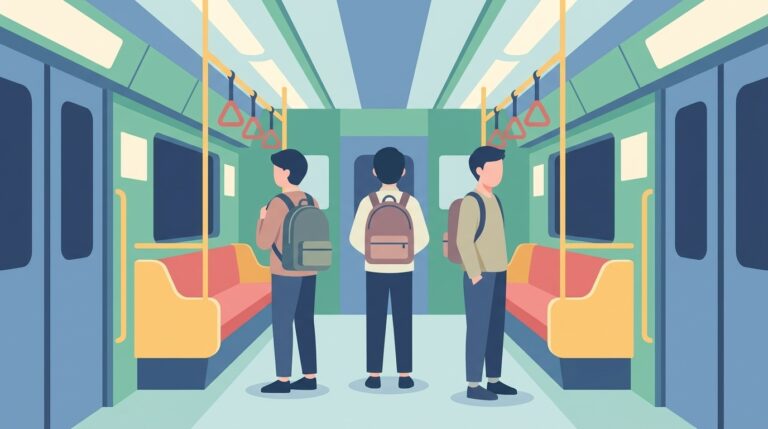
- Backpack Etiquette (백팩 에티켓): On crowded subways and buses, swing your backpack to your front (배낭 앞으로 매기) or hold it down near your feet. This prevents accidentally hitting people behind you.
- The Two-Handed Handover: Whenever giving or receiving a transit card, receipt, or cup at a convenience store, always use both hands or support your right forearm with your left hand.
- Eye Contact Deflection: Looking directly into a stranger’s eyes for more than two seconds in public transport can be perceived as confrontational. Keep your gaze neutral, towards transit route maps or your smartphone.
4-2. Cultural Code Analysis: The Pink Carpet & Silver Seats
In K-dramas and real life, you will notice two sacred seating areas on Korean subways:
1. 노약자석 (Seats for Elderly, Disabled, and Injured): Located at both ends of each train car. Even if the train is completely packed, young and healthy commuters will almost never sit here.
2. 임산부 배려석 (Pregnant Women Priority Seats): Marked with bright pink flooring and pink seat cushions. Keeping this seat open is considered an essential sign of social mindfulness.
Phase 5: Real-Life Roleplay Scenario
Setting: A busy bus stop in Hongdae on a Friday evening. Alex holds an iced coffee and tries to board the green local bus (지선버스).
- 기사님 (Bus Driver): 🎭 손을 흔들며 문 앞에서 막아서며 손님, 그 음료 들고는 못 타세요! (Sonnim, geu eumryo deulgoneun mot taseyo! – Customer, you can’t board holding that beverage!)
- Alex: 🎭 당황하여 눈을 깜빡이며 아, 죄송합니다! 뚜껑 닫혀 있는데도 안 되나요? (A, joesonghamnida! Ttukkeong dachyeo inneundedo an doenayo? – Ah, I’m sorry! Even if the lid is closed, is it not allowed?)
- 기사님 (Bus Driver): 🎭 단호하지만 친절한 목소리로 네, 일회용 컵은 쏟아질 위험이 있어서 안 돼요. (Ne, il-hoe-yong keobeun ssodajil wiheomi isseoseo an dwaeyo. – Yes, disposable cups carry a risk of spilling, so it’s not allowed.)
- Alex: 🎭 컵을 확인하며 아, 몰랐어요. 그럼 어떻게 해야 하죠? (A, mollasseoyo. Geureom eotteoke haeya hajyo? – Oh, I didn’t know. Then what should I do?)
- 기사님 (Bus Driver): 🎭 정류장 쓰레기통을 가리키며 다 드시고 타시거나 버리고 타셔야 해요. (Da deusigo tasigeona beorigo tasyeoya haeyo. – You need to finish drinking it or dispose of it before boarding.)
- Alex: 🎭 고개를 숙여 가볍게 인사하며 알겠습니다! 다음 버스 탈게요. 감사합니다. (Algesseumnida! Daeum beoseu talgeyo. Gamsahamnida. – Understood! I will take the next bus. Thank you.)
- 기사님 (Bus Driver): 🎭 미소를 지으며 끄덕인다 네, 조심히 가세요. (Ne, josimhi gaseyo. – Okay, travel safely.)
- Alex: 🎭 정류장 벤치로 물러나며 네, 수고하세요! (Ne, sugohaseyo! – Yes, have a good shift!)
🔀 Interactive Choice Point
What should Alex do next if he has a non-disposable stainless steel tumbler in his bag?
- Option A: Pour the iced coffee into his sealed personal tumbler and board the next bus quietly. (Best! Fully compliant with transit regulations and eco-friendly.)
- Option B: Hide the disposable cup inside a tote bag without sealing it and try boarding the next bus. (Risk! If it spills, you face public disapproval and severe fines.)
- Option C: Argue with the driver that the bus isn’t bumpy today. (Bad! Confronting public transit staff disrupts everyone and violates etiquette.)
Phase 6: 10-Second Emotion Shadowing Drill
- [🙏 죄송하고 정중하게 / Apologetic and polite]
잠시만요, / 먼저 / 내리고 탈게요! (Jamsimanyo, / meonjeo / naerigo talgeyo!)
(Excuse me, / let people get off / before getting on!) -
[🤫 조용하고 차분하게 / Soft and calm]
영화관에서는 / 핸드폰을 / 진동으로 바꿔 주세요. (Yeonghwagwan-eseoneun / haendeu-poneul / jindong-euro bakkwo juseyo.)
(In the movie theater, / please switch / your phone to vibrate.) -
[😊 상냥하고 확실하게 / Friendly and clear]
여기 / 줄 서 계신 건가요? (Yeogi / jul seo gyesin geongayo?)
(Are you / standing in this line?)
Phase 7: K-Culture Mini Dictionary
- 노약자석 (No-yak-ja-seok) | Seats for the elderly, pregnant, and disabled | Located at car ends in trains; culturally preserved even on crowded commutes.
- 쩍벌남 (Jjeok-beol-nam) | Manspreader (Slang) | A compound of ‘쩍 벌리다’ (spread wide) + ‘남’ (man). Used socially to criticize passengers who take up two seats by spreading their legs.
- 임산부 배려석 (Im-san-bu bae-ryeo-seok) | Maternity priority seat | Distinctive pink seats designated for expecting mothers on Korean subways.
- 에티켓 벨 (Etiquette Bell) | Subway quiet button / noise etiquette | Refers to silent-running courtesy on public transit where ringtones and loud conversations are silenced.
Phase 8: Survival Kit for Travelers
TOP 3 Survival Phrases
- 음소거 해 둘게요. (Eum-sogeo hae dulgeyo.) – “I’ll keep it on mute.”
- Pro Tip: Use this when your phone accidentally rings in a quiet cafe or bus.
- 먼저 타세요. (Meonjeo taseyo.) – “Please go ahead / board first.”
- Pro Tip: Great for letting elderly passengers board the elevator or bus before you.
- 쓰레기통이 어디에 있나요? (Sseuregitong-i eodie innayo?) – “Where is the trash can?”
- Pro Tip: Public trash cans are rare on Seoul streets; convenience stores or station exits are your best bets.
📱 Editor’s Travel Note
- Transit Navigation: Download the official [KakaoMap transit navigation service] or [Naver Map subway and bus route finder] for real-time bus cup policy alerts and station exit information.
- Cashless Mobility: Make sure your T-Money card or Climate Card (기후동행카드) is topped up before boarding to avoid holding up the boarding queue.
Phase 9: Think Deeper (Cultural Perspective)
In Korea, public etiquette is anchored in the concept of 공공의식 (Gonggong-uisik – collective civic mindfulness). In high-density metropolitan cities like Seoul, personal freedom is balanced carefully with mutual comfort. When someone asks you to lower your voice or keep a seat open, it is not personal judgment; it is the community’s way of ensuring shared comfort for millions of daily commuters.
💬 Your Turn: Have you ever experienced an unspoken public etiquette rule while traveling in Korea or watching a K-Drama? Share your story in the comments below!
Phase 10: FAQ & Common Mistakes
Q: Can I talk with my friend on the subway at all?
A: Yes, casual conversations at a low, moderate volume are totally fine! Just avoid loud laughter, watching videos without earphones, or using speakerphone.
Q: What should I do with my empty coffee cup if there are no street trash cans?
A: Carry it to the nearest subway station platform recycling bin, or take it into the coffee shop where you purchased it for proper disposal.
Q: Is it okay to sit in the pink Maternity Seat if the train is completely full?
A: While not legally prohibited, it is socially discouraged. Most locals leave it open so pregnant women never feel pressured to ask for the seat.
🚨 Common Mistakes & Correct Actions
- Mistake 1: Boarding city buses with open plastic iced coffee cups. ➔ Correct Action: Finish the drink or transfer it into a 100% leak-proof thermal flask.
- Mistake 2: Leaving heavy backpacks on your back on crowded peak-hour trains. ➔ Correct Action: Hold the backpack low by your knees or wear it in front.
- Mistake 3: Sitting in the end-car elderly priority seats (노약자석) when tired. ➔ Correct Action: Stand or wait for regular seating to open up.
Phase 11: Action Missions
- 🥉 Bronze Mission (Solo Practice): Practice saying “잠시만 지나갈게요!” 5 times while walking past obstacles at home.
- 🥈 Silver Mission (Social Share): Leave a comment below explaining one difference between public transit etiquette in Korea and your home country.
- 🥇 Gold Mission (Real Life): Next time you ride a train or bus in Korea, practice the backpack-in-front stance and mute your phone notifications.
- 🎮 K-Culture Mission: Watch an episode of a slice-of-life drama (like My Liberation Notes or Extraordinary Attorney Woo) and spot how characters behave on the subway!
Phase 12: Interactive Quiz Challenge
1. Situation Judgment: You are boarding a Seoul bus with a sealed can of soda in your backpack. What is the driver’s rule?
* A) You cannot board at all.
* B) You can board because the beverage is completely sealed and unopened.
* C) You must throw it away.
2. Fill in the blank: In a packed train when you need to get off, say: “잠시만 _________!” (jinagalgeyo)
3. True or False: It is standard Korean subway etiquette to leave the designated Pink Maternity Priority seat empty even if the car is crowded.
🔍 Click here to reveal the answers & explanations!
- Answer: B | Sealed canned drinks, unopened plastic bottles, and securely lidded tumblers are permitted on Seoul city buses!
- Answer: 지나갈게요 (jinagalgeyo) | “잠시만 지나갈게요” means “Just passing through for a moment,” the most natural native way to exit.
- Answer: True | Keeping the pink seat open ensures pregnant passengers can take a seat immediately without asking.







