

Phase 1: Empathy & Story Immersion
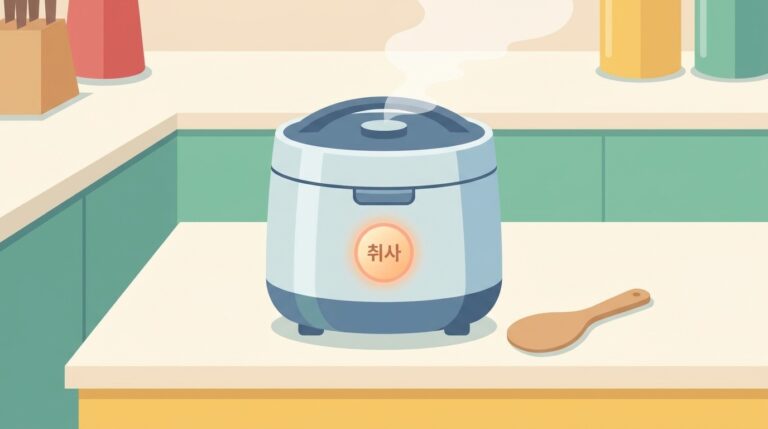
안녕하세요! I’m your Daily Hangul editor, your local cultural navigator. Picture this: You just moved into a cozy Airbnb or a studio apartment in Seoul. You bought fresh Korean short-grain rice, eager to cook a warm meal after binge-watching mouth-watering K-Dramas like Crash Landing on You or Hospital Playlist. You walk up to the shiny high-tech rice cooker (often a proud Cuckoo or Cuchen), wash your rice, put the pot inside, and freeze. The buttons glow with mysterious Korean words: 취사, 보온, 백미, 잡곡… and suddenly, a robotic voice cheerfully speaks fast Korean at you!
Panic kicks in: Did I just start cooking, or did I set a 12-hour timer? Why is steam hissing? Don’t worry! Every foreign resident and traveler faces the legendary ‘Korean Rice Cooker Mystery.’ Today, we will decode the buttons, understand the iconic voice cues, and master the fundamental phrases you need to conquer any Korean rice cooker with total confidence.
Phase 2: 3 Key Expressions Deep Dive
1. 취사 버튼 눌러요 (Chwisa beoteun nulleoyo)
- Pronunciation: [Chwi-sa beo-teun nool-leo-yo] (Sounds like “Chee-sah” + “button” + “noodle-raw-yo”)
- Meaning: “Press the cook button” (취사 = Cooking rice / 취사하다 = to cook rice; 누르다 = to press)
- K-Culture Moment: You are in a shared kitchen (Gosiwon or sharehouse), and your Korean flatmate points at the shiny red button, saying: “이거 취사 버튼 눌러요!”
- Editor’s Insight: 취사 (Chwisa) specifically refers to cooking grains and meals using heat. You will see this exact word on 99% of all rice cookers in Korea. When someone says “취사 눌러요,” they mean “Start the rice cooker.”
- Situation Spectrum: Casual ✅ | Semi-formal ✅ | Formal ⚠️ (Use ‘취사 버튼을 누르세요’ for formal)
- 🤔 Think About It: In English, we just say “start the rice cooker.” In Korean, the action has dedicated Hanja-based terms like 취사 (cook) vs 보온 (keep warm). How does having specific culinary buttons reflect Korean culture’s reverence for perfectly cooked rice?
2. 밥 다 됐어요? (Bap da dwaesseoyo?)
- Pronunciation: [Bap da dwaet-seo-yo] (Sounds like “Bahp” + “dah” + “dwet-so-yo”)
- Meaning: Literal: “Is the rice all done?” / Actual: “Is the rice ready? / Is dinner ready?”
- K-Culture Moment: Seen in almost every family K-Drama when a hungry character opens the kitchen door sniffing the aroma of freshly cooked white rice.
- Editor’s Insight: 밥 (Bap) means cooked rice, but it also translates culturally to “meal.” Asking “밥 다 됐어요?” works for both asking if the rice machine finished and asking if the table is ready.
- Situation Spectrum: Casual ✅ (밥 다 됐어?) | Semi-formal ✅ | Formal ✅
- 🤔 Think About It: Notice how the single word 밥 (Bap) bridges the gap between staple grain and the universal concept of eating. What staple food represents “a whole meal” in your culture?
3. 뚜껑 닫아 주세요 (Ttukkeong dada juseyo)
- Pronunciation: [Ttoo-kkeong da-da joo-seh-yo] (Sounds like “Too-kkyung dah-dah joo-say-yo”)
- Meaning: Literal: “Please close the lid.” / Actual: “Make sure to lock the rice cooker lid.”
- K-Culture Moment: Korean electric pressure cookers won’t activate unless the safety handle is twisted to “Locked (잠김)”. A friend or host will remind you: “뚜껑 닫고 돌려주세요!”
- Editor’s Insight: Korean pressure rice cookers seal tight. Forgetting to close and latch the lid correctly will trigger an error alarm sound (삐-삐-삐!).
- Situation Spectrum: Casual ✅ (뚜껑 닫아줘) | Semi-formal ✅ | Formal ✅
- 🤔 Think About It: Korean appliance instructions prioritize safety and communal consideration. Adding ~주세요 (~juseyo, please) softens requests into polite team efforts.
Phase 3: Textbook Korean vs. Real-Life Korean
Situation 1: Asking how to turn on the machine
- 📖 Textbook Korean: 전기밥솥의 전원을 켜 주십시오. (Jeongibapsot-ui jeon-won-eul kyeo jusipsio. – Please turn on the electric rice cooker’s power switch.)
- 🗣️ Real Korean: 이거 취사 누르면 돼요? (Igeo chwisa nureumyeon dwaeyo? – Do I just press Cook for this?)
- 💡 Why the difference? Textbooks use formal manuals, but native speakers in daily life point at the button and simply ask if pressing 취사 is enough.
Situation 2: Checking if the rice is currently warming
- 📖 Textbook Korean: 밥솥이 보온 모드로 설정되어 있습니까? (Bapsot-i boon modeu-ro seoljeong-doeeo isseumnikka? – Is the rice cooker set to warm mode?)
- 🗣️ Real Korean: 지금 보온 중이에요? (Jigeum boon jung-ieyo? – Is it keeping warm right now?)
- 💡 Why the difference? Koreans use the compact noun suffix ~중 (~jung) to indicate an ongoing appliance state.
Phase 4: K-Culture Deep Dive & Non-Verbal Manners
4-1. Nunchi & Rice Cooker Etiquette
- Steam Alert Safety: When the rice cooker announces “증기 배출을 시작합니다” (Steam release starting), never hover your face or hands over the top vent. Lean back respectfully!
- The Rice Paddle Rule (주걱 매너): Always place the rice scoop (주걱, Jugeok) in its designated clean stand or bowl of clean water—never lay it flat on the dusty counter.
- Fluffing the Rice (밥 섞기): As soon as the melodious completion song plays, gently fluff and turn the rice with the scoop. Leaving it unfluffed causes the bottom to get soggy or overcooked.
4-2. Cultural Code: The Talking Rice Cooker
In Korea, rice is emotional comfort (정, Jeong). Brands like Cuckoo engineer their appliances to speak cheerful, warm sentences because a singing rice cooker signifies a warm, well-fed home. Hearing “쿠쿠가 맛있는 취사를 시작합니다!” (Cuckoo begins delicious cooking!) is a beloved daily soundtrack in Korean homes.
Phase 5: Real-Life Roleplay Scenario
Setting: A modern sharehouse kitchen in Mapo-gu, Seoul. You are standing with Minji, your Korean roommate, trying to prepare instant curry with freshly cooked rice.
- You: 민지 씨, 밥 어떻게 해요? (Minji-ssi, bap eotteoke haeyo?) 🎭 Looking puzzled while holding the inner pot.
- Minji: 쌀 씻어서 넣고 물 맞췄어요? (Ssal ssiseoseo neoko mul matchwosseoyo?) 🎭 Peering into the pot smiling.
- You: 네, 물 선에 맞췄어요! (Ne, mul seone matchwosseoyo!) 🎭 Pointing proudly at the water measurement line.
- Minji: 좋아요! 뚜껑 닫고 손잡이 돌려주세요. (Joayo! Ttukkeong datgo sonjabi dollyeojuseyo.) 🎭 Mimicking turning a handle to ‘Lock’.
- You: 이렇게요? 그리고 취사 버튼 눌러요? (Ireokeyo? Geurigo chwisa beoteun nulleoyo?) 🎭 Pressing the glowing 취사 button.
- Minji: 네, 맞아요! 이제 30분 기다리면 돼요. (Ne, majayo! Ije samsip-bun gidarimyeon dwaeyo.) 🎭 Giving two thumbs up.
- Rice Cooker: 쿠쿠가 맛있는 취사를 시작합니다! (Chwi-sa-reul si-jak-ham-ni-da!) 🎭 Cheerful robotic chime plays.
- You: 와, 밥솥이 말해요! 신기해요! (Wa, bapsot-i malhaeyo! Singihaeyo!) 🎭 Clapping happily with wide eyes.
🔀 Interactive Branching Point
Minji goes to the living room. 30 minutes later, the rice cooker plays a fanfare song and beeps. What do you say to Minji?
* Option A: “민지 씨, 밥 다 됐어요!” (Minji-ssi, bap da dwaesseoyo!)
* Option B: “민지 씨, 밥솥이 취사했어요!” (Minji-ssi, bapsot-i chwisahaesseoyo!)
* Option C: “민지 씨, 밥 끝났습니다.” (Minji-ssi, bap kkeutnasseumnida.)
Feedback:
* Option A (Best Choice ⭐): Natural, friendly, and 100% native conversational Korean!
* Option B (Risk ⚠️): Grammatically awkward. 취사하다 is the function word; for the result, use 다 됐어요.
* Option C (Bad / Unnatural 🚫): Sounds overly robotic and military-like for a home dinner setting.
Phase 6: 10-Second Emotion Shadowing Drill
[😊 Excitement & Wonder]- 와! / 밥솥이 / 말해요! (Wa! / bapsot-i / malhaeyo!)
[🤔 Curious & Inquiring]- 취사 버튼 / 어디 있어요? (Chwisa beoteun / eodi isseoyo?)
[😋 Hungry & Eager]- 밥 / 다 됐어요? / 배고파요! (Bap / da dwaesseoyo? / baegopayo!)
[🤝 Helpful & Polite]- 뚜껑 / 닫아 주세요! (Ttukkeong / dada juseyo!)
Phase 7: K-Culture Mini Dictionary
- 취사 (Chwisa) | Cooking / Cook Mode | The primary button that triggers high-pressure grain cooking.
- 보온 (Bo-on) | Keep Warm | The mode that maintains cooked rice at optimal hot temperature without burning.
- 백미 (Baengmi) | White Rice | The standard default setting for polished white rice.
- 잡곡 (Japgok) | Mixed Grains / Multigrain | The dedicated setting requiring longer steam time for brown, black, or bean-mixed rice.
Phase 8: Traveler’s Survival Kit
Top 3 Survival Phrases
- “취사 눌러주세요.” (Chwisa nulleojuseyo. – Please press the Cook button.) -> Pro Tip: Use this when asking your host to start the cooker.
- “보온 켜져 있어요?” (Boon kyeojyeo isseoyo? – Is it in keep-warm mode?) -> Pro Tip: Check if the leftover rice from yesterday is still warm and safe to eat.
- “주걱 어디 있어요?” (Jugeok eodi isseoyo? – Where is the rice paddle?) -> Pro Tip: Essential when setting up bowls for dinner.
Editor’s Travel Note
- App Tip: If you run into an unfamiliar model, use the Papago Translation Camera App to instantly scan Korean button panels.
- Power Outlets: Korean appliances use Type C and F plugs (220V). Never plug a 110V rice cooker without a heavy-duty transformer!
Phase 9: A Step Deeper (Reflection)
In Korean culture, sharing a freshly cooked bowl of rice is the cornerstone of hospitality and community. When Koreans greet each other with “밥 먹었어요?” (Have you eaten?), they aren’t just checking calorie intake—they are checking on your wellbeing. Operating the rice cooker is more than using a gadget; it is taking part in the quintessential ritual of Korean daily warmth.
💬 Your Turn: Does your home kitchen feature appliances that talk or play melodies? How do you cook your daily staples at home? Leave your comment below!
Phase 10: FAQ & Common Mistakes
Q: What should I do if the rice cooker says ‘E01’ and beeps?
A: This almost always means the top pressure handle was not twisted to the 잠김 (Lock) position. Turn the handle firmly until it clicks, then press 취사 again.
Q: How much water should I put inside?
A: Look inside the inner metal pot (내솥). There are labeled guide lines for 백미 (White Rice) matched to the number of cups of rice you put in (e.g., 2 cups of rice = fill water up to line 2).
Q: What is the ‘재가열’ (Reheat) button for?
A: If rice has been in 보온 (Keep Warm) mode for hours and lost some of its piping-hot texture, pressing 재가열 will give it a rapid 3-minute steam burst to make it taste fresh.
🚨 Common Mistakes Warning Board
- Mistake: Pressing 취사 without locking the lid handle -> Correct Action: Rotate handle to 잠김 first.
- Mistake: Forgetting the inner pot and pouring rice directly into the electrical base -> Correct Action: Always make sure the black metal pot (내솥) is seated inside.
- Mistake: Scraping the non-stick coating with metal spoons -> Correct Action: Only use the plastic or silicone 주걱 (rice paddle).
Phase 11: Action Missions
- 🥉 Bronze Mission (Solo Practice): Say “취사 버튼 눌러요” and “밥 다 됐어요” aloud 5 times in front of your mirror.
- 🥈 Silver Mission (Social Share): Snap a photo of a Korean appliance button panel and label 취사, 보온, and 백미 on your Instagram story tagging
@DailyHangul. - 🥇 Gold Mission (Real Life): Cook a bowl of rice in Korea or an Asian market appliance using the Korean voice cues without looking up the manual!
- 🎮 K-Culture Spotter Mission: Watch one episode of a slice-of-life K-Drama (like Reply 1988 or My Liberation Notes) and spot the moment someone uses a rice scoop (주걱) or opens a rice cooker.
Phase 12: Interactive Quiz Challenge
Q1. Which button should you press to start cooking standard white rice?
a) 보온 (Bo-on)
b) 취사 (Chwisa)
c) 예약 (Yeyak)
👉 Click to reveal Answer & Explanation
Correct Answer: b) 취사 (Chwisa)
Explanation: 취사 means cooking/cook mode. 보온 is keep-warm, and 예약 is the preset timer.
Q2. Fill in the blank:
밥 ______ 됐어요? (Is the rice ready?)
👉 Click to reveal Answer & Explanation
Correct Answer: 다 (da)
Explanation: 밥 다 됐어요? literally means “Is the rice all done?” and is the most natural way to check if cooking is finished.
Q3. [True / False] You should scratch the bottom of the rice cooker with a stainless steel fork to get every grain out.
👉 Click to reveal Answer & Explanation
Correct Answer: False
Explanation: Always use a plastic or silicone rice scoop (주걱) to protect the non-stick pressure coating!







