

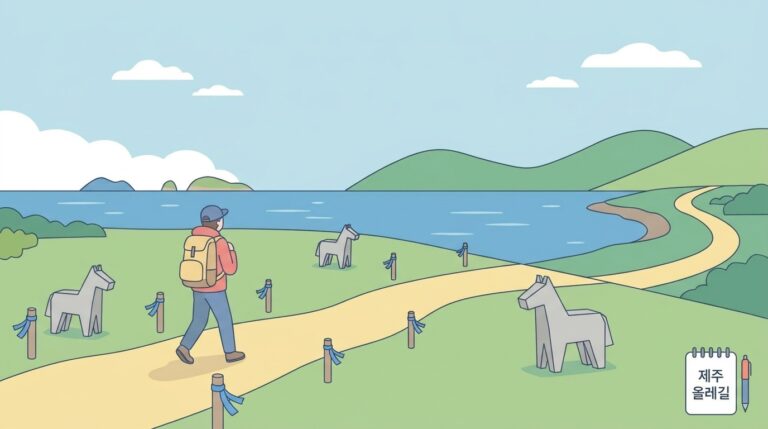
Mastering the Art of Korean Trail Walking: Exploring Dulle-gil and Olle-gil
Phase 1: Empathy (Story-Driven Opening)
안녕하세요! 매일한글 에디터입니다. (Hello! I’m your Daily Hangul editor.)
Imagine this: You’ve stepped away from the neon glow of Seoul or booked a weekend getaway to Jeju Island. Inspired by serene scenes in K-dramas like Our Blues or travel vlogs showcasing tranquil coastal paths, you decide to hike Jeju Olle Trail Route 7 or the Bukhansan Dulle-gil. Equipped with your trekking poles and a sturdy water bottle, you feel ready. But thirty minutes in, the signs branch into color-coded ribbons, an energetic senior hiker offers you a sliced frozen apple with a cheerful greeting you can barely parse, and another hiker asks whether you’re aiming for a Wanju (완주) or just Sanbing (산책/트레킹 코스 탐방).
Navigating Korea’s perimeter paths (Dulle-gil) and iconic coastal footpaths (Olle-gil) requires more than basic hiking vocabulary. While textbook Korean teaches you standard words like “등산로가 어디예요?” (Where is the hiking trail?), real trail culture blends warm communal etiquette (Jeong), specialized trekking terminology, and polite micro-interactions with fellow walkers (Ollegun or Dulle-gil walkers). Over the past decade tutoring advanced Korean learners, I’ve seen even C1-level students freeze when an elder greets them on a ridge or when asking a trail steward for stamp locations. This guide will elevate your conversational agility so you can walk Korea’s scenic paths with total cultural confidence.
Phase 2: Core Expressions Deep Dive
1. 수고 많으십니다! 안전 산행 하세요!
- Pronunciation: [Sugo maneusimnida! Anjeon sanhaeng haseyo!] (Pronounce ‘Sugo’ like ‘soo-go’, ‘maneisimnida’ with a subtle rolling ‘n’)
- Meaning: Literal: “You are undergoing much effort! Have a safe mountain climb!” | Actual Nuance: “Great job out here, keep up the good pace and stay safe!”
- K-Culture Moment: The quintessential trail greeting exchanged when passing fellow hikers going the opposite direction on narrow mountain steps or quiet paths in dramas like Mount Jiri (지리산).
- Editor’s Insight: While “안녕하세요” is fine, seasoned hikers and Olle-gil walkers almost always use “수고하십니다” (or “힘내세요”) combined with “안전 산행/트레킹 하세요” to build instant camaraderie.
- Situation Spectrum: Casual: ⚠️ (with friends use ‘조심히 가!’) | Semi-formal: ✅ | Formal: ✅
- 🤔 Think About It: Why does Korean culture acknowledge someone’s physical effort (Sugo) as a warm form of greeting rather than simply commenting on the weather?
2. 혹시 이쪽 코스가 올레/둘레길 완주 리본 맞나요?
- Pronunciation: [Hoksi ijjok koseuga Olle/Dulle-gil wanju ribon mannayo?]
- Meaning: Literal: “By any chance, are these ribbons for completing the Olle/Dulle trail?” | Actual Nuance: “Excuse me, am I following the official route ribbons correctly to complete the trail?”
- K-Culture Moment: Seen in travel variety shows like House on Wheels or 2 Days & 1 Night when members check trail markers (the iconic blue and orange ribbons in Jeju, or color markers on Dulle-gil).
- Editor’s Insight: The word Wanju (완주 – full completion) carries immense pride in Korean trail culture. Using this phrasing signals that you respect the trail system and understand the ribbon marker convention.
- Situation Spectrum: Casual: ⚠️ | Semi-formal: ✅ | Formal: ✅
- 🤔 Think About It: In many Western trails, blazes are painted on trees; in Korea, woven cloth ribbons flutter in branches. How does language shape our trust in visual landmarks?
3. 여기서 스탬프 찍는 간세/인증대 위치가 어디쯤인가요?
- Pronunciation: [Yeogiseo seutaempeu jjingneun ganse/injeungdae wichiga eodijjeumingayo?]
- Meaning: Literal: “Around where is the Ganse/certification station for stamping here?” | Actual Nuance: “Could you point me toward the trail passport stamp station nearby?”
- K-Culture Moment: Travelers proudly stamping their trail passbooks in Jeju or the Seoul Trail, frequently featured in lifestyle reels and travel documentaries.
- Editor’s Insight: Ganse (간세) is Jeju dialect for the slow-moving pony, representing the blue horse-shaped stamp stations on Jeju Olle trails. On Dulle-gil, it’s called an Injeungdae (인증대).
- Situation Spectrum: Casual: ⚠️ | Semi-formal: ✅ | Formal: ✅
- 🤔 Think About It: Why has tangible stamp collection (Dojang kkaegi) become such a defining cultural motivator for young and older Korean outdoor enthusiasts alike?
Phase 3: Textbook Korean vs. Real Native Korean
- Situation 1: Checking if the upcoming path is steep or easy
- 📖 Textbook Korean: “이 길은 경사가 급합니까, 아니면 완만합니까?” (Is this road steep or gentle?)
- 🗣️ Real Native Korean: “앞에 오르막이나 계단 구간 좀 빡센가요? 아니면 평탄해요?” (Is the uphill or stair section ahead pretty rough, or is it mostly flat?)
- 💡 Why the difference? Real hikers use visceral, descriptive words like Bpak-sen (빡센 – tough/intense) and Pyeong-tan-han (평탄한 – smooth/flat) to gauge physical stamina accurately.
- Situation 2: Accepting snack offers from fellow walkers at rest stops
- 📖 Textbook Korean: “주셔서 감사합니다. 맛있게 먹겠습니다.” (Thank you for giving this to me. I will eat it deliciously.)
- 🗣️ Real Native Korean: “아이고, 귀한 걸 나눠주셔서 정말 감사합니다! 잘 먹고 힘내서 완주할게요!” (Oh my, thank you so much for sharing such a precious snack! I’ll eat well and push through to finish!)
- 💡 Why the difference? Sharing trail snacks (Jeong) like dried sweet potatoes, cherry tomatoes, or cucumbers is a cherished ritual. Acknowledging the food as Gwihan geot (precious item) shows deep etiquette.
Phase 4: K-Culture Deep Dive & Non-Verbal Manners
4-1. Nunchi & Trail Etiquette
- Right-of-Way Nunchi: On narrow cliff paths or wooden walkways, downhill walkers yield to uphill climbers catches their breath. Step slightly aside to the right, make brief eye contact, and nod with a low-tone greeting.
- The Trail Snack Gesture: If an elder hiker offers you a mandarine (Gyul) or rice cake (Tteok), always receive it using both hands (or with your right hand supported at the forearm by your left). Refusing immediately can feel cold; accepting with gratitude honors the communal spirit.
4-2. Cultural Insight: The ‘Healing Trek’ Movement
Unlike extreme mountaineering, Dulle-gil and Olle-gil embody Slow Life and Healing (힐링). Jeju’s Olle Trail, established in 2007, reshaped Korean leisure from rapid summit-conquering (Deungsan) to introspective, low-altitude meandering (Dulle-gil). It has fostered an entire culture of solo female hiking, eco-trekking (Plogging), and post-walk local market feasting (Makgeolli paired with local pancakes).
Phase 5: Real-World Roleplay Scenario
Setting: A mid-route resting shelter along the scenic coastal cliffs of Jeju Olle Route 10. You cross paths with Mr. Park, a veteran Jeju trail caretaker carrying trail maintenance gear.
- Mr. Park: “아이고, 혼자 걸으시나 봐요? 오늘 날씨가 제법 더운데 괜찮으세요?” (Aigo, looks like you’re walking solo? It’s quite hot today, are you holding up okay?)
🎭 (Wiping sweat with a towel, smiling warmly) - You: “네! 경치가 정말 그림 같아서 힘든 줄도 모르고 걷고 있어요. 어르신도 수고 많으십니다!” (Yes! The scenery is so picturesque that I hardly feel tired. Kudos on your hard work too, sir!)
🎭 (Adjusting backpack straps, bowing respectfully) - Mr. Park: “말씀도 참 예쁘게 하시네. 자, 이거 시원한 오이 하나 드시면서 쉬었다 가요.” (You speak so kindly. Here, have this crisp cold cucumber and rest for a bit.)
🎭 (Reaching into his cooler bag, extending a fresh cucumber with both hands) - You: “와, 귀한 간식을 나눠주셔서 정말 감사합니다! 산행 중에 먹는 오이가 제일 꿀맛이네요.” (Wow, thank you so much for sharing such a precious snack! A cucumber during a hike is truly the best flavor.)
🎭 (Accepting the cucumber with two hands and nodding happily) - Mr. Park: “하하, 뭘요. 혹시 오늘 코스 종점인 하모체육공원까지 완주할 계획이에요?” (Haha, don’t mention it. Are you planning to finish the entire route to Hamo Sports Park today?)
🎭 (Leaning on his walking staff, looking curious) - You: “네, 오늘 완주가 목표예요! 그런데 중간에 송악산 쪽 우회로가 있다고 들었는데 길이 많이 헷갈리나요?” (Yes, finishing today is my goal! But I heard there’s a detour around Songaksan, is the trail confusing there?)
🎭 (Pointing slightly toward the distant hill with an open palm) - Mr. Park: “파란색 화살표만 잘 따라가면 절대 길 잃을 일 없어요. 간세 스탬프 찍는 곳도 우회로 직전에 바로 보일 겁니다.” (As long as you follow the blue arrows, you won’t get lost. The Ganse stamp station will be visible right before the detour.)
🎭 (Pointing in the direction of the coastal turn) - You: “명쾌하게 알려주셔서 든든합니다. 잘 먹고 안전하게 완주하겠습니다! 남은 하루도 안전 산행 하세요!” (Your clear explanation gives me peace of mind. I’ll enjoy the snack and complete the walk safely! Have a safe trek the rest of the day!)
🎭 (Standing up, giving a light 30-degree bow)
🔀 Interactive Decision Branch
What would you say if Mr. Park warns you: “송악산 해안길 쪽에 바람이 많이 부니 모자 날아가지 않게 조심해요!” (It’s windy near Songaksan coast, be careful your hat doesn’t blow away!)
- Choice A: “네, 바람 불면 그냥 모자 벗고 가방에 넣을게요! 신경 써주셔서 감사합니다.” (Best response: Acknowledges the safety tip proactively with polite gratitude.)
👉 Feedback: ⭐⭐⭐ Perfect! Shows natural agility, situational awareness, and smooth honorifics. - Choice B: “바람 불어도 저는 괜찮습니다. 신경 쓰지 마세요.” (Risk response: Literal translation of ‘Don’t worry about me’, sounds dismissive.)
👉 Feedback: ⚠️ ‘신경 쓰지 마세요’ can sound cold or annoyed in Korean. Use ‘걱정해 주셔서 감사합니다’ instead. - Choice C: “응, 알겠어요.” (Bad response: Informal Banmal to an elder).
👉 Feedback: 🚫 Disrespectful. Never use Banmal with trail elders you meet for the first time.
Phase 6: 10-Second Emotion Shadowing Drill
[😊 Cheerful & Reverent]
“어르신, / 귀한 간식 나눠주셔서 / 정말 힘이 납니다!”
(Eoreusin, / gwihan gansik nanwojusyeoseo / jeongmal himi namnida!)-
[🤔 Attentive & Polite]
“혹시 / 갈림길에서 / 파란색 리본 방향으로 / 가는 게 맞을까요?”
(Hoksi / gallimgireseo / paransaek ribon banghyang-euro / ganeun ge majeulkkayo?) -
[💪 Resolute & Energetic]
“날씨는 덥지만 / 오늘 꼭 / 종점까지 완주해 보겠습니다!”
(Nalssineun deopjiman / oneul kkok / jongjeomkkaji wanjuhae bogesseumnida!)
Phase 7: K-Culture Mini Dictionary
-
올레꾼 (Olle-kkun) | Jeju Olle Walker
A dedicated hiker who walks the Jeju Olle Trails. The suffix ‘-꾼’ highlights someone passionate and experienced in an activity. -
스탬프 투어 (Seutaempeu Tueo) | Stamp Tour Passport Book
The wildly popular system of collecting physical ink stamps at beginning, middle, and end points of official Korean trails for official completion certificates. -
둘레길 (Dulle-gil) | Circumference Trail / Foothill Path
Unlike direct summit-climbing routes (Deungsan-ro), a Dulle-gil circles the skirts of mountains or coastlines, offering lower-impact cultural exploration. -
하산주 (Hasan-ju) | Post-Hike Celebration Drink
The customary glass of chilled Makgeolli (Korean rice wine) enjoyed with savory pancakes (Jeon) immediately after finishing a mountain descent or long trail.
Phase 8: Traveler’s Survival Kit
-
Top 3 Survival Trail Expressions:
- “화장실이 다음 쉼터까지 얼마나 남았나요?” (Hwajangsiri daeum swimteokkaji eolmana namannayo? / How far is the restroom to the next resting area?) — Pro Tip: Crucial on rural coastal stretches where rest stops are 3-5km apart.
- “이 코스 완주하는 데 보통 몇 시간 정도 걸려요?” (I koseu wanju-haneun de botong myeot sigan jeongdo geollyeoyo? / How many hours does it typically take to finish this route?) — Pro Tip: Local trail elders provide more realistic times than generic map estimates.
- “스탬프 패스포트 수첩은 어디서 구매할 수 있나요?” (Seutaempeu paesepoteu sucheobeun eodiseo gumaehal su innayo? / Where can I purchase the trail stamp passport?) — Pro Tip: Buy at the official Tourist Information Center before starting Route 1.
- Editor’s Travel Note:
Before heading out, download the official [KakaoMap application with offline walking GPS tracking] or the [Jeju Olle Trail Guide official mobile app]. Unlike international map engines, KakaoMap and Naver Map accurately display ribbon branches, elevation gradients, public restrooms, and real-time transit bus connections right at trail exits.
Phase 9: A Step Deeper (Reflection)
In Korean trail culture, walking is rarely a solitary conquest over nature. Rather, it is a communal dialogue with the landscape and fellow wanderers. When strangers exchange snacks and well-wishes on a trail, they are enacting Jeong (정)—a deep-seated sense of shared human warmth and mutual responsibility. The greeting “안전 산행 하세요” is an implicit acknowledgment that we are all navigating the same rugged terrain together.
💬 Your Turn: Have you ever experienced a moment where a stranger on a trail offered you food or guidance? How does this collective outdoor etiquette compare to hiking cultures in your home country? Share your thoughts below!
Phase 10: FAQ & Common Mistakes
Q: What is the difference between Blue and Orange ribbons on Jeju Olle Trail?
A: Blue ribbons and blue arrows direct you in the standard forward direction (순방향), while Orange ribbons indicate the reverse direction (역방향). Always verify your heading before committing to a remote fork in the trail.
Q: Can I use “수고하세요” when passing an elder on the trail?
A: While common, “수고하세요” can occasionally sound like you are commanding an elder to labor. To be completely polite and respectful, use “수고 많으십니다!” or “힘내세요! 안전 산행 하세요!”
Q: Is it rude to decline food offered by hikers at mountain pavilions?
A: It is polite to accept a small piece if possible. If you must decline due to allergies or dietary reasons, smile warmly, bow, and say: “마음만으로도 정말 감사합니다! 제가 방금 밥을 든든하게 먹고 와서요!” (Thank you so much for the thought! I just had a hearty meal!).
🚨 Common Mistakes Alert Board
- Mistake: Calling all trails Deungsan (등산).
- Correct Action: High-altitude peaks are Deungsan (등산); perimeter and walking paths are Dulle-gil (둘레길) or Trekk-ing (트레킹).
- Mistake: Addressing hikers as Ajeossi (아저씨) / Ajumma (아줌마).
- Correct Action: Use refined terms like Eoreusin (어르신 – for elders) or Seonsaengnim (선생님) / Sanwoonu (산우님 – fellow trail friend).
- Mistake: Leaving trash at rest pavilions assuming stewards will clear it.
- Correct Action: Korea strictly follows Leave No Trace (LNT) and Plogging ethics. Say “쓰레기는 제가 챙겨 가겠습니다” (I will pack my trash out).
Phase 11: Action Mission & Engagement
- 🥉 Bronze Level: Stand in front of a mirror and practice saying: “수고 많으십니다! 안전 산행 하세요!” with a bright smile and natural head nod 5 times.
- 🥈 Silver Level: Find a photo of Jeju Olle or Bukhansan Dulle-gil online, post it to your study notes or SNS, and write a caption in Korean asking about trail difficulty using “코스 난이도가 빡센 편인가요?”.
- 🥇 Gold Level: On your next trip to Korea, visit a local Dulle-gil, greet at least three hikers with trail etiquette, and successfully stamp your passport!
🎮 K-Culture Mission: Watch an episode of a Korean hiking travel variety show (such as Europe Outside Your Tent or Healing Camp reruns) and spot whenever a cast member expresses gratitude for trail food (Hasan-ju or trail snacks).
Phase 12: Interactive Quiz Challenge
Test your situational instincts with these three quick questions!
Q1. When asking an elder caretaker whether you are on the right trail for completion, which is the most natural and respectful sentence?
* A) 이 길로 가면 완주 리본 맞습니까?
* B) 어르신, 혹시 이쪽 코스가 올레길 완주 코스 맞나요?
* C) 저기요, 나 길 잃었으니까 길 좀 알려줘요.
Q2. Fill in the blank:
* “정말 감사합니다! 산행 마치고 내려가서 시원하게 _________ 한잔해야겠어요!” (Referring to the celebratory post-hike drink)
Q3. True or False:
* On Korean perimeter trails, orange arrows indicate the standard forward walking route, and blue arrows indicate the reverse route. (True / False)
🔍 Click to Reveal Answers & Explanations
- Q1 Answer: B) It uses the respectful title Eoreusin, gentle question marker Hoksi, and polite ending Mannayo.
- Q2 Answer: 하산주 (Hasan-ju) — The quintessential post-trek drink, usually Makgeolli paired with pajeon.
- Q3 Answer: False — Blue indicates the forward direction (순방향), while Orange indicates the reverse direction (역방향).






