Why Fried Rice is the Ultimate Korean Dessert: The Soul of Korean Dining Culture
Phase 1: Empathy (Story-Driven Opening)
안녕하세요! This is your Daily Hangul editor.
Picture this: You are sitting at a bustling Korean barbecue or spicy dakgalbi (stir-fried chicken) restaurant in Seoul. The grill sizzles, the savory aroma fills the air, and after feasting on juicy pork belly and side dishes, you finally lean back, rub your stomach, and declare, “I couldn’t eat another bite!”
Just then, your Korean friend looks at you with a twinkle in their eye, waving their hand at the server: “사장님, 여기 볶음밥 두 개 볶아주세요!” (Boss, please fry two servings of rice here!). You stare in disbelief. Rice? Now? When we are already stuffed? Your friend smiles warmly and says, “Don’t worry, bokkeumbap is Korean dessert!”
If you have ever felt confused by how Koreans manage to finish an entire feast only to order carb-heavy fried rice at the very end, you are not alone. In Korea, finishing a shared meal with pan-fried rice isn’t just about nutrition; it’s a sacred communal ritual, a culinary climax, and an expression of true satisfaction. In this guide, tailored for B2 intermediate learners, we will break down the essential dining nuances, conversational phrases, and cultural codes so you can order and savor Korean “dessert rice” like a true local.
Phase 2: 3 Core Expressions Deep Dive
1. 밥 배, 디저트 배 따로 있다 (Bap bae, dijeoteu bae ttaro itda)
- Pronunciation: [Bap bae, di-jeo-teu bae tta-ro it-da] (Sounds like: Bahp-beh dee-juh-teu-beh tta-ro eet-dah)
- Meaning: Literal: “There is a separate stomach for rice and a separate stomach for dessert.” | Nuance: “There is always room for dessert (or the finale dish), no matter how full you are!”
- K-Culture Moment: Frequently heard on Korean variety shows like Tasty Guys (맛있는 녀석들) whenever cast members devour 10 servings of meat and immediately transition to fried rice without skipping a beat.
- Editor’s Insight: While Westerners usually mean cakes or pastries when saying “there is room for dessert,” Koreans playfully use this idiom to justify ordering bokkeumbap or cold noodles (naengmyeon) right after a heavy main dish.
- Situation Spectrum: Casual ✅ | Semi-formal ✅ | Formal ⚠️
- 🤔 Think About It: In your native culture, what food category earns its own “separate stomach” privilege?
2. 바닥까지 싹싹 긁어 먹어야 제맛이지 (Badak-kkaji ssak-ssak geulgeo meogeoya jemat-iji)
- Pronunciation: [Ba-dak-kka-ji ssak-ssak geul-geo meo-geo-ya je-mat-i-ji] (Sounds like: Bah-dahk-kkah-jee sahk-sahk geul-guh muh-guh-yah jeh-mah-shee-jee)
- Meaning: Literal: “Scraping it down to the very bottom of the pan is the true flavor.” | Nuance: “The crispy, scorched rice at the bottom is the absolute best part!”
- K-Culture Moment: Seen in K-Dramas like Let’s Eat (식샤를 합시다), where characters compete with metal spoons to scrape off the crunchy burnt rice layer (nurungji).
- Editor’s Insight: The sound mimetic word 싹싹 (ssak-ssak) vividly conveys the rhythmic metal spoon scraping against a stone or iron skillet. Leaving behind the crunchy bottom layer is considered almost criminal among foodies.
- Situation Spectrum: Casual ✅ | Semi-formal ✅ | Formal 🚫
- 🤔 Think About It: Does your food culture value scorched or caramelized food textures in a similar way?
3. 한국인은 밥심으로 산다 (Hanguk-in-eun bapsim-euro sanda)
- Pronunciation: [Han-guk-in-eun bap-sim-eu-ro san-da] (Sounds like: Hahn-gook-een-eun bahp-sheem-oo-ro sahn-dah)
- Meaning: Literal: “Koreans live on the energy of rice.” | Nuance: “Rice is the ultimate fuel and soul food of Korean life.”
- K-Culture Moment: Protagonists in heartwarming family dramas saying this while serving a warm bowl of freshly cooked rice to console a heartbroken or exhausted friend.
- Editor’s Insight: 밥심 (bapsim) is a compound of 밥 (rice/meal) and 힘/심 (strength/power). It signifies vitality, resilience, and emotional sustenance.
- Situation Spectrum: Casual ✅ | Semi-formal ✅ | Formal ✅
- 🤔 Think About It: How does your language encapsulate the cultural foundation of staple foods?
Phase 3: Textbook Korean vs Real Korean
Situation 1: Ordering Fried Rice after Finishing the Main Dish
- 📖 교과서 한국어: 식사를 다 마쳤으니 볶음밥을 주문해 주십시오. (Siksareul da machyeosseuni bokkeumbabeul jumunhae jusipsio.)
- 🗣️ 진짜 한국어: 사장님, 여기 밥 하나 볶아주세요! 치즈 추가도 되나요? (Sajangnim, yeogi bap hana bokk-ajuseyo! Chijeu chugado doenayo?)
- 💡 왜 다를까?: In real dining spots, locals refer to fried rice simply as 밥 볶다 (frying rice) and mention portions as 밥 하나 (one rice) or 밥 둘 (two rices). Asking casually for cheese toppings (치즈 추가) is standard conversational flow.
Situation 2: Telling Friends to Wait Until the Rice Gets Crispy
- 📖 교과서 한국어: 밥이 바삭해질 때까지 조금 더 기다리는 것이 좋습니다. (Babi basak-haejil ttaekkaji jogeum deo gidarineun geosi joseumnida.)
- 🗣️ 진짜 한국어: 잠깐만, 아직 손대지 마! 누룽지 생길 때까지 좀 눌러 붙여야 해. (Jamkkanman, ajik sondaeji ma! Nurungji saenggil ttaekkaji jom nulleo butchyeoya hae.)
- 💡 왜 다를까?: Native speakers use culinary action phrases like 눌러 붙이다 (pressing down to let it crisp) rather than passive, stiff grammar.
Phase 4: K-Culture Deep Dive & Non-verbal Manners
4-1. Nunchi & Table Gestures for Korean Fried Rice
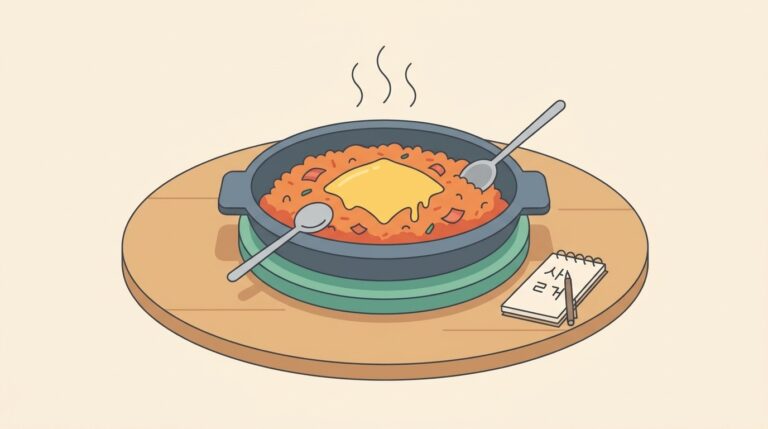
- The Flattening Ritual (밥 펴기): When the server dumps the seasoned rice, shredded seaweed (gim), and sesame oil onto the pan, wait patiently while they stir. Once they finish stirring, use your spoon to gently press and flatten the rice across the skillet to maximize the crispy surface area.
- The Spoon Duel Courtesy: When scraping scorched rice (nurungji), hold the edge of the hot pan with a thick napkin with your non-dominant hand so the pan doesn’t slide around and spill hot sauce on your friends.
- Leaving the Last Bite (양심 한 숟갈): Koreans notoriously leave exactly one bite of fried rice in the pan out of politeness (often dubbed “the conscience bite”). Feel free to break the stalemate by asking cheerfully: “이거 마지막 한 숟갈 제가 먹어도 돼요?” (May I take this last spoonful?).
4-2. Cultural Code Analysis (K-Food Heritage)
Rice in Korea transcends mere sustenance; it represents warmth, care, and closure. Traditionally, an agricultural society relied heavily on communal labor, where sharing a large iron pot of rice cemented village bonds. Today’s modern fried rice served at the end of gamjatang (pork bone soup), dakgalbi, or samgyeopsal is a continuation of this collective culinary heritage—a dish that brings everyone’s spoons together to the same central pan.
Phase 5: Real-life Roleplay Scenario
Setting: A vibrant Dakgalbi restaurant in Hongdae. You are with your Korean friend, Minji.
- 민지 (Minji): (배를 두드리며 만족스러운 표정으로) 아, 닭갈비 진짜 배부르게 잘 먹었다! (Ah, dakgalbi jinjja baebureuge jal meogeotda!) (Pats her stomach with a satisfied expression: “Ah, I ate the stir-fried chicken so well, I’m full!”)
- 나 (You): (미소를 지으며) 응, 양념이 정말 매콤하고 맛있었어. (Eung, yangnyeomi jeongmal maekomhago masisseosseo.) (Smiling: “Yeah, the sauce was really spicy and delicious.”)
- 민지 (Minji): (테이블 벨을 가리키며 눈을 반짝인다) 자, 이제 메인 이벤트 시작해야지? 볶음밥 몇 개 볶을까? (Ja, ije mein ibenteu sijakhaeyaji? Bokkeumbap myeot gae bokkeulkka?) (Points at the call bell with sparkling eyes: “Well, shall we start the main event? How many fried rices should we order?”)
- 나 (You): (깜짝 놀라며) 볶음밥? 우리 배부르다고 하지 않았어? (Bokkeumbap? Uri baebureudago haji anasseo?) (Surprised: “Fried rice? Didn’t we just say we were full?”)
- 민지 (Minji): (장난스럽게 웃으며) 한국인은 볶음밥 배가 따로 있잖아! 이건 디저트야. (Hanguk-ineun bokkeumbap baega ttaro itjanha! Igeon dijeoteuya.) (Laughs playfully: “Koreans have a separate stomach for fried rice! This is dessert.”)
- 나 (You): (고개를 끄덕이며) 아, 그렇구나! 그럼 밥 하나에 치즈 추가하자. (Ah, geureokguna! Geureom bap hana-e chijeu chugahaja.) (Nods understandingly: “Ah, I see! Then let’s fry one rice and add cheese.”)
- 민지 (Minji): (손뼉을 치며) 오, 역시 맛잘알! 사장님, 여기 밥 하나 볶아주시고 치즈 올려주세요! (Oh, yeoksi matjalal! Sajangnim, yeogi bap hana bokk-ajusigo chijeu ollyeojuseyo!) (Claps hands: “Oh, you really know good food! Boss, please fry one rice and put cheese on top!”)
- 나 (You): (숟가락을 집어 들며) 바닥 누룽지 생길 때까지 1분만 기다리자! (Badak nurungji saenggil ttaekkaji ilbunman gidarija!) (Picks up a spoon: “Let’s wait just one minute until the bottom gets crispy!”)
🔀 Interactive Decision Branch
What would you say if the server brings the rice and starts frying it right away?
- Option A: “사장님, 김가루랑 참기름 듬뿍 넣어주세요!” (Boss, please add lots of seaweed flakes and sesame oil!)
- Option B: “배부르니까 그냥 포장해 주세요.” (I am full, so please just pack it to go.)
- Option C: “디저트니까 설탕도 같이 넣어주시나요?” (Since it is dessert, do you add sugar as well?)
Decision Feedback:
* Option A [BEST]: Natural, enthusiastic, and shows authentic understanding of Korean flavor enhancement.
* Option B [RISK]: Taking fried rice to-go loses the magic of sizzling hot skillet pan-frying.
* Option C [BAD]: Calling it “dessert” is a cultural metaphor! Adding sugar will earn you extremely confused looks from the restaurant staff.
Phase 6: 10-Second Emotion Shadowing Drill
Repeat these lines aloud following the rhythm markers (/) and mood directions:
[😋 기대감에 차서 입맛을 다시며]- “배불러도 / 볶음밥은 / 무조건 먹어야지!” (Baebulleodo / bokkeumbabeun / mujogeon meogeoyaji!)
- Even if I’m full / fried rice / is an absolute must!
[🤫 눈치껏 다급하게 친구를 말리며]- “잠깐만! / 누룽지 바삭해질 때까지 / 숟가락 대지 마!” (Jamkkanman! / Nurungji basak-haejil ttaekkaji / sutgarak daeji ma!)
- Wait! / Until the scorched rice turns crispy / don’t touch your spoon!
[😍 바삭한 누룽지를 한 입 먹고 감탄하며]- “와, 역시 / 바닥까지 싹싹 긁어 먹어야 / 찐이야!” (Wa, yeoksi / badak-kkaji ssak-ssak geulgeo meogeoya / jjin-iya!)
- Wow, as expected / scraping down to the bottom / is the real deal!
Phase 7: K-Culture Mini Dictionary
- 누룽지 (Nurungji): Scorched crispy rice layer formed at the bottom of a hot cooking pot or skillet. Beloved for its nutty, crunchy texture.
- 맛잘알 (Mat-jal-al): Slang abbreviation for 맛을 잘 아는 사람 (A person who knows food and flavors thoroughly; a seasoned gourmet).
- 치즈 추가 (Chijeu Chuga): Cheese add-on. Adding shredded mozzarella cheese onto hot fried rice and letting it melt under steam is a modern Korean comfort food staple.
- 탄수화물 중독 (Tansuhwamul Jungdok): Carbohydrate addiction. A self-deprecating humorous term Koreans use to explain why they eat rice after noodles or meat.
Phase 8: Traveler Survival Kit
Survival Expressions Top 3
- “여기 밥 하나 볶아주세요.” (Yeogi bap hana bokk-ajuseyo.)
- Pro Tip: Use 밥 하나 for 1 portion, 밥 둘 for 2 portions. It’s concise and universally understood.
- “치즈 사리 추가해 주세요.” (Chijeu sari chugahae juseyo.)
- Pro Tip: 사리 (sari) refers to add-on ingredients (cheese, ramen noodles, rice cakes).
- “불 좀 줄여도 되나요?” (Bul jom juryeodo doenayo?)
- Pro Tip: Essential when the rice is sizzling too fast and threatens to burn before forming a golden crust.
Editor’s Travel Note
When hunting for authentic skillet dining in Seoul, check user reviews on the Naver Map App Download Page searching for keywords like 볶음밥 맛집 (Best fried rice restaurants). Most Korean casual restaurants accept domestic/foreign credit cards without issue, and tipping is never required.
Phase 9: One Step Deeper (Reflection)
In many Western cultures, a meal is strictly linear: appetizer, entree, and sweet dessert. In Korean culinary philosophy, however, harmony and communal sharing govern the table. Ending a hearty stew or grill dish with bokkeumbap unites every lingering sauce, side dish, and flavor profile into one grand finale. It encapsulates the Korean concept of Jeong (정)—making sure no shared dining experience ends abruptly, ensuring everyone leaves the table fully satisfied and warmly connected.
💬 Your Turn: What is the traditional “grand finale” dish in your home country when dining with friends? Share your stories in the comments below!
Phase 10: FAQ & Common Mistakes
Q: Can I order fried rice at any Korean restaurant?
A: No. Fried rice is typically offered at restaurants serving dishes cooked in flat pans, tabletop grills, or large shallow pots (e.g., Dakgalbi, Samgyeopsal, Gamjatang, Tteokbokki, Gopchang). It is not available at places serving individual soup bowls like Seolleongtang or Gukbap.
Q: What should I leave in the pan before ordering bokkeumbap?
A: Always leave a small amount of meat, vegetables, and sauce (about 2-3 tablespoons). The staff will cut up the leftover ingredients with kitchen shears to flavor your fried rice.
Q: Is bokkeumbap always spicy?
A: While most skillet sauces are spicy gochujang-based, you can always ask for mild seasonings or enjoy non-spicy variations like grilled beef fat fried rice (chadol bokkeumbap).
🚨 Common Mistakes Alert
- Mistake: Eating the entire pan clean before asking for fried rice.
- Correct Action: Leave 10-15% of sauce and toppings behind so the kitchen can utilize it as seasoning.
- Mistake: Stirring the rice continuously like risotto.
- Correct Action: Press the rice flat and let it sit undisturbed over low heat for 1–2 minutes to create the nurungji crust.
- Mistake: Using a plastic spoon to scrape the pan.
- Correct Action: Use the provided stainless steel spoon for safe, effective scraping.
Phase 11: Action Mission & Engagement
- 🥉 Bronze Level: Practice saying “사장님, 여기 밥 하나 볶아주세요!” out loud 5 times using natural rhythm.
- 🥈 Silver Level: Next time you cook at home, try pan-frying leftover rice with kimchi and sesame oil, snapping a photo for social media with the hashtag
#KFoodDessert. - 🥇 Gold Level: Visit a local Korean barbecue or dakgalbi restaurant and successfully order table-fried rice in Korean.
- 🎮 K-Culture Mission: Watch an episode of a Korean food variety show (e.g., Street Food Fighter or Delicious Rendezvous) and spot the exact moment the guests order rice after the main dish!
Phase 12: Interactive Quiz Challenge
Question 1: Situational Judgement
You are at a dakgalbi restaurant with 3 friends. You have finished most of the chicken, but there is still some sauce left. How should you order fried rice?
* A) 사장님, 후식으로 아이스크림 주세요.
* B) 사장님, 여기 밥 두 개 볶아주세요!
* C) 사장님, 새 닭갈비 3인분 다시 주세요.
Question 2: Fill in the Blank
한국인은 고기를 배부르게 먹어도 (_____) 배가 따로 있다고 농담한다.
* A) 빵
* B) 볶음밥
* C) 피자
Question 3: True / False
In Korean food culture, scraping the crispy bottom layer (nurungji) of fried rice is considered a culinary highlight.
* (True / False)
👉 Click here to check answers and explanations!
- Q1 Answer: B | Explanation: “사장님, 여기 밥 두 개 볶아주세요!” is the quintessential natural phrasing to order 2 portions of fried rice for a group.
- Q2 Answer: B | Explanation: Koreans playfully refer to 볶음밥 (bokkeumbap) as having its own designated stomach space.
- Q3 Answer: True | Explanation: Nurungji is prized for its crunchy texture and savory concentrated aroma.