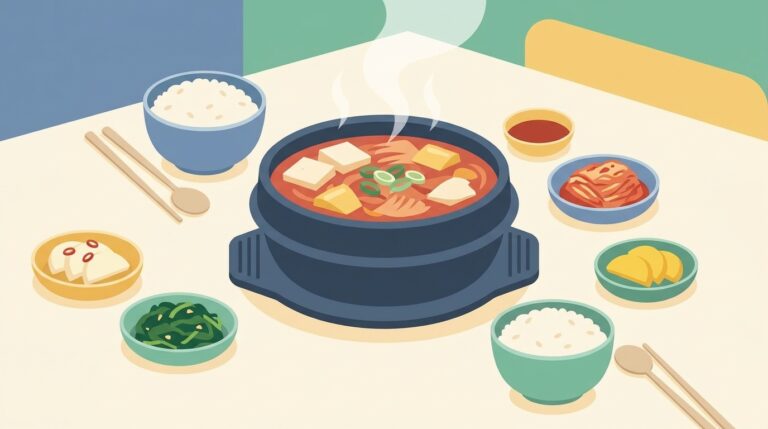
Phase 1: Empathy — Welcome to the Ultimate Kimchi Jjigae Debate!
안녕하세요! 매일한글 에디터입니다! (Hello! This is your Daily Hangul editor!)
Picture this: You are sitting at a bustling Korean diner near Hongdae on a chilly evening. The scent of bubbling chili oil, fermented kimchi, and sizzling sesame oil fills the room. Your Korean coworkers or friends hand you the menu, and then comes the classic, inevitable question that divides families and sparks friendly arguments across Korea: “Kimchi Jjigae… are you Team Pork or Team Tuna?”
If your mind went blank, don’t worry! Ordering Kimchi Jjigae in Korea is not just choosing lunch—it is an iconic cultural debate akin to “Pineapple on pizza.” Expressing your taste with the right intermediate nuances shows that you truly understand the heart of Korean soul food. Drawing from years of feedback from our B2 intermediate learners who struggled to move past simple robot-like phrasing, this guide gives you the natural, flavorful conversational tools you need to sound like an authentic insider at any dining table.
Phase 2: 3 Key Expressions Deep Dive
1. 저는 무조건 돼지고기파예요! (Jeoneun mu-jo-geon dwae-ji-go-gi-pa-ye-yo!)
- Pronunciation: [Jeo-neun moo-jo-geon dwae-ji-go-gi-pa-ye-yo] (Sounds like “moo-joh-gun” with a crisp, punchy rhythm!)
- Meaning: Literal: “I am unconditionally Pork Faction!” / Nuance: “I am hands down Team Pork!”
- K-Culture Moment: You’ll hear this passionate phrasing on popular food reality shows like Baek Jong-won’s Alley Restaurant whenever guests declare their unbreakable loyalty to rich, savory pork broth.
- Editor’s Insight: Attaching 파 (-pa) (faction/party) to any food transforms your preference into an identity. Saying “무조건” (unconditionally) adds confident, playful enthusiasm.
- Situation Spectrum: Casual ✅ | Semi-formal ✅ | Formal (Business Dinner) ⚠️
- 🤔 Think About It: Why do Koreans love categorizing culinary tastes into “factions” (-파)? How does this create instant bonding during social meals?
2. 참치가 들어가면 국물이 훨씬 깔끔해요 (Cham-chi-ga deul-eo-ga-myeon guk-mu-ri hwol-ssin kkal-kkeum-hae-yo)
- Pronunciation: [Cham-chee-gah deul-uh-gah-myun gook-moo-ree hwol-sshin kkal-kkeum-hae-yo] (Stress the double consonant in ‘kkal-kkeum’ for crispness)
- Meaning: Literal: “If tuna goes in, the soup is much cleaner.” / Nuance: “Tuna gives the broth such a light and clean finish!”
- K-Culture Moment: Typical debate line seen in K-Dramas during late-night kitchen cooking scenes where a character prefers a light, non-greasy midnight meal.
- Editor’s Insight: 깔끔하다 (Kkal-kkeum-ha-da) is the ultimate compliment in Korean gastronomy. It means refreshing, crisp, and devoid of heavy greasiness.
- Situation Spectrum: Casual ✅ | Semi-formal ✅ | Formal ✅
- 🤔 Think About It: In your native culture, what words do you use to describe broth that isn’t greasy? Does “clean” carry the exact same appetizing compliment?
3. 라면 사리 하나 추가해서 끓여 먹을까요? (Ra-myeon sa-ri ha-na chu-ga-hae-seo kkeul-yeo meog-eul-kka-yo?)
- Pronunciation: [Rah-myun sah-ree hah-nah choo-gah-hae-suh kkeul-yuh mug-eul-kkah-yoh?]
- Meaning: Literal: “Shall we add one ramen noodle add-on and boil it to eat?” / Nuance: “Should we toss in a ramen noodle pack while it simmers?”
- K-Culture Moment: The iconic communal moment when the stew starts bubbling vigorously on table-top gas burners in casual K-Bistro scenes.
- Editor’s Insight: 사리 (Sari) specifically refers to extra noodle/ingredient add-ons in stews. Asking this shows you know exactly how to maximize the Jjigae dining experience.
- Situation Spectrum: Casual ✅ | Semi-formal ✅ | Formal (Casual dining) ✅
- 🤔 Think About It: How does sharing add-ons from a single pot reflect Korea’s communal Jeong (affectionate bonding) dining culture?
Phase 3: Textbook Korean vs. Real Native Korean
Situation A: Expressing your favorite stew style
- 📖 교과서 한국어 (Textbook): 저는 돼지고기가 들어간 김치찌개를 선호합니다. (Jeoneun dwaejigogiga deureogan gimchijjigaereul seonhohamnida. – “I prefer kimchi stew containing pork.”)
- 🗣️ 진짜 한국어 (Real Native): 김치찌개는 역시 기름진 돼지고기가 푹 우러나야 제맛이죠! (Gimchijjigaeneun yeoksi gireumjin dwaejigogiga puk ureonaya jemas-ijyo! – “Kimchi stew is only at its best when fatty pork is thoroughly simmered!”)
- 💡 왜 다를까? (Why the difference?): Textbook phrasing uses stiff verbs like 선호하다 (to prefer), whereas native speakers use descriptive flavor sensory terms like 우러나다 (to steep/render into broth) and 제맛 (the true, authentic flavor).
Situation B: Proposing to share dishes
- 📖 교과서 한국어 (Textbook): 우리 둘 다 주문해서 나누어 먹을까요? (Uri dul da jumunhaeseo nanueo meogeulkkayo? – “Shall we both order and divide the food?”)
- 🗣️ 진짜 한국어 (Real Native): 2인분 시켜서 같이 떠먹을까요? (I-in-bun sikyeoseo gachi tteomeogeulkkayo? – “Shall we order two portions and ladle it out together?”)
- 💡 왜 다를까? (Why the difference?): In Korean stews, diners use 떠먹다 (to scoop and eat) rather than generic words for sharing, reflecting the physical tabletop pot experience.
Phase 4: K-Culture Deep Dive & Nonverbal Manners
4-1. 눈치 (Nunchi) & Tabletop Etiquette
- The Broth Refill Nunchi: In Korea, Kimchi Jjigae simmered with ramen will thicken quickly. Keep an eye on the liquid level. When it gets too salty or dry, casually catch the server’s eye and ask for 육수 (Yuksu – broth refill) without hesitating.
- The Shared Ladle Etiquette: When the main pot arrives, avoid double-dipping your personal spoon directly into the main cauldron when eating with seniors or coworkers. Always use the communal ladle (국자, Gukja) to serve a portion into your personal small bowl (앞접시, Ap-jeopsi).
4-2. Cultural Code: The Great Pork vs. Tuna Rivalry
- Pork Kimchi Jjigae (돼지 김치찌개): The historic champion. Thick pork belly (삼겹살) or collar (목살) releases rich animal fats that neutralize the sour bite of aged kimchi (묵은지, Mugeunji). It is considered hearty, grounding comfort food.
- Tuna Kimchi Jjigae (참치 김치찌개): Introduced in the 1980s with the rise of canned tuna, this variation quickly captured households and university dorms. It offers a light, savory umami without heavy animal grease. Asking someone “Pork or Tuna?” is a playful personality icebreaker across Korea!
Phase 5: Real-Life Roleplay Scenario
Setting: A cozy Korean stew diner (찌개 전문점) in Euljiro, Seoul. You are having dinner after work with Minho, a friendly Korean team colleague.
- 민호 (Minho): 오늘 날씨도 쌀쌀한데 김치찌개 어때요? (Oneul nalssido ssalssalhande gimchijjigae eottaeyo? / “It’s chilly today, how about Kimchi Jjigae?”) 🎭 [Rubbing cold hands together with a smile]
- 당신 (You): 완전 좋죠! 안 그래도 얼큰한 국물 당겼어요. (Wanjeon jojjyo! An geuraedo eolkeunhan gukmul danggyeosseoyo. / “Sounds fantastic! I was craving spicy broth anyway.”) 🎭 [Nodding enthusiastically]
- 민호 (Minho): 여기 돼지김치찌개랑 참치김치찌개 둘 다 진짜 잘해요. 취향이 어떻게 돼요? (Yeogi dwaeji-gimchijjigaerang chamchi-gimchijjigae dul da jinjja jalhaeyo. Chwihyangi eotteoke dwaeyo? / “They do both pork and tuna kimchi jjigae really well here. What’s your preference?”) 🎭 [Pointing at the wooden wall menu]
- 당신 (You): 저는 무조건 돼지고기파예요! 깊고 진한 국물이 최고더라고요. (Jeoneun mujogeon dwaejigogipayeo! Gipgo jinhan gukmuri choegodeoragoyo. / “I’m strictly Team Pork! Deep, rich broth is the best.”) 🎭 [Smiling with confidence]
- 민호 (Minho): 역시 먹을 줄 아시네요! 그럼 돼지로 2인분 가시죠? (Yeoksi meogeul jul asineyo! Geureom dwaejiro i-inbun gasijyo? / “You really know your food! Shall we go for 2 portions of pork then?”) 🎭 [Giving a thumb-up]
- 당신 (You): 좋아요! 라면 사리도 하나 추가해서 넣을까요? (Joayo! Ramyeon sarido hana chugahaeseo neoheulkkayo? / “Great! Shall we add a ramen noodle pack into it too?”) 🎭 [Making an excited gesture]
- 민호 (Minho): 센스 대박! 이모님, 여기 돼지찌개 2인분에 라면 사리 하나 주세요! (Senseu daebak! Imonim, yeogi dwaejijjigae i-inbune ramyeon sari hana juseyo! / “Awesome taste! Auntie, 2 portions of pork stew and one ramen add-on please!”) 🎭 [Raising a hand toward the kitchen]
- 당신 (You): 국물 끓으면 제가 먼저 앞접시에 덜어 드릴게요. (Gukmul kkeulheumyeon jega meonjeo ap-jeopsie deoreo deurilgeyo. / “Once the broth boils, I’ll ladle some into your personal bowl first.”) 🎭 [Picking up the ladle politely]
🔀 Interactive Choice Point
The stew is boiling down and the broth is getting very thick and salty. What do you say?
- Choice A: “이모님, 여기 육수 좀 더 부어주실 수 있나요?” (Imonim, yeogi yuksu jom deo bueojusil su 있nayo?)
- 👉 Feedback [Best]: Perfect! Asking to pour more 육수 (broth) keeps the stew delicious without diluting flavor.
- Choice B: “물 많이 넣어서 끓여요.” (Mul mani neoeoseo kkeulyeoyo.)
- 👉 Feedback [Risk]: Adding raw tap water flattens the rich flavor and makes the soup bland. Restaurants provide free broth refills!
- Choice C: “너무 짜니까 그냥 불 끄고 먹지 마요.” (Neomu jjanikka geunyang bul kkeugo meogji mayo.)
- 👉 Feedback [Bad]: A bit abrupt and leaves your dining partner hanging.
Phase 6: 10-Second Emotion Shadowing Drill
Practice matching the cadence / and emotional tone markers:
[🔥 단호하고 자신감 넘치게]“저는 / 무조건 / 돼지고기파예요!”
(Jeo-neun / mu-jo-geon / dwae-ji-go-gi-pa-ye-yo!)[😋 입맛을 다시며 기대 가득하게]“참치가 들어가면 / 국물이 / 훨씬 깔끔하더라고요.”
(Cham-chi-ga deul-eo-ga-myeon / guk-mu-ri / hwol-ssin kkal-kkeum-ha-deo-ra-go-yo.)[💡 센스 있게 아이디어를 제안하듯]“라면 사리 하나 추가해서 / 보글보글 끓여 먹을까요?”
(Ra-myeon sa-ri ha-na chu-ga-hae-seo / bo-geul-bo-geul kkeul-yeo meog-eul-kka-yo?)
Phase 7: K-Culture Mini Dictionary
- 묵은지 (Mug-eun-ji) | Well-aged, fermented Kimchi
- Essential for authentic Kimchi Jjigae. It provides the deep, tangy acidity that cuts through fatty meat.
- 얼큰하다 (Eol-keun-ha-da) | Pleasantly spicy and invigoratingly hot
- Used specifically for hot soups that make you feel refreshed and warm from the inside out.
- 앞접시 (Ap-jeop-si) | Small individual sharing dish/plate
- The small plate or bowl used to transfer hot food from communal pots.
- 국물 자작하게 (Guk-mul ja-jak-ha-ge) | Simmered down to a thick, shallow sauce/broth
- The golden state of Kimchi Jjigae just before spooning it generously over steamed white rice.
Phase 8: Traveler’s Survival Kit
Top 3 On-the-Go Phrases
- “육수 리필 가능한가요?” (Yuksu ripil ganeunghangayo?) — Pro Tip: Free broth refills are standard in almost all jjigae establishments.
- “공깃밥 하나 더 추가해 주세요.” (Gonggitbap hana deo chugahae juseyo.) — Pro Tip: Kimchi Jjigae is known as a legendary Bap-doduk (rice thief); you will likely need extra rice!
- “덜 맵게 끓여주실 수 있나요?” (Deol maepge kkeulyeojusil su 있nayo?) — Pro Tip: Great if you have lower spicy tolerance.
Editor’s Travel Note
When hunting for the best historic Kimchi Jjigae alleys in Seoul (like Mapo or Jongno), make sure to install the Naver Map app for local food ratings. Major local places often operate gas burners at your table, so keep napkins and sleeves away from the burner dial!
Phase 9: One Step Deeper — The Heart of Korean Table Culture
In Korean food culture, sitting around a bubbling pot of Kimchi Jjigae is an intimate social ritual. Unlike individual plated courses, sharing a central stew signifies mutual comfort, breaking formal barriers, and building communal warmth (Jeong). When you boldly debate “Pork vs. Tuna,” you are not merely sharing dietary tastes—you are participating in a cherished cultural conversation that turns strangers into friends.
💬 Your Turn: Which one would you order tonight: Pork with rich savory broth, or Tuna with clean, comforting umami? Tell us your pick in the comments below!
Phase 10: FAQ & Common Mistakes
Q: What is the biggest difference in taste between pork and tuna Kimchi Jjigae?
A: Pork Kimchi Jjigae has a heavy, rich, savory broth enriched with animal fat, making it perfect for pairing with Soju. Tuna Kimchi Jjigae has a much lighter, slightly sweet, clean seafood umami finish with less greasiness.
Q: Can I order Kimchi Jjigae for just 1 person at Korean restaurants?
A: Many casual diners (Bunsikjeom or Baekban spots) serve single earthen pots (Ttukbaegi). However, specialized Jjigae restaurants often require a minimum order of 2 portions (2인분 이상) for tabletop gas burner setups.
Q: Is canned tuna raw when added to the stew?
A: In Korea, standard canned tuna (Dongwon Chamchi) is pre-cooked. In stews, it is added along with its savory oil or lightly drained to enrich the kimchi base.
🚨 Common Mistakes Alert
- Mistake: Calling noodles “Ramen” instead of “Ramen Sari” when ordering add-ons.
- Correct Action: Say “라면 사리 (Ramen sari)” to ask for the plain noodle block without the spice powder packet.
- Mistake: Diluting salty stew with cold drinking water from your table bottle.
- Correct Action: Ask the staff for “육수 (Yuksu)” so the broth stays flavorful.
- Mistake: Dipping your shared spoon right into the boiling pot in business settings.
- Correct Action: Always ladle soup into your 앞접시 (Ap-jeopsi) first.
Phase 11: Action Mission
- 🥉 Bronze Mission: Stand in front of a mirror and practice saying: “저는 무조건 돼지고기파예요!” in under 3 seconds.
- 🥈 Silver Mission: Post a picture of your next Korean meal or home-cooked stew with the hashtag
#TeamPorkor#TeamTunawritten in Korean (#돼지파 / #참치파). - 🥇 Gold Mission: Walk into a Korean restaurant or K-Town diner and order extra noodles naturally using “라면 사리 하나 추가해 주세요!”
- 🎮 K-Culture Mission: Watch an episode of a Korean variety show (like Three Meals a Day) and spot the moment they add canned tuna or pork to their camp stew!
Phase 12: Interactive Quiz Challenge
1. Situation Decision
You want to express that you prefer tuna because the soup is not oily and tastes light and refreshing. Which expression is the most natural?
* A) 참치 찌개가 기름이 많아서 좋아요.
* B) 참치가 들어가면 국물이 훨씬 깔끔해서 좋아요.
* C) 참치김치찌개는 선호도가 높습니다.
2. Fill in the Blank
“국물이 너무 졸았어요. 사장님, 여기 ( ) 좀 더 부어주세요!”
3. True or False
When dining with older Korean colleagues, it is polite to dip your spoon directly into the shared center pot rather than using an 앞접시 (individual bowl). (True / False)
🔍 Click to view answers and explanations!
- Answer: B — 깔끔하다 is the ideal adjective for describing light, crisp, non-greasy broth.
- Answer: 육수 (Yuksu – seasoned stock/broth) — Refilling with broth preserves the deep flavor.
- Answer: False — In modern polite dining etiquette, you should always use the communal ladle to transfer stew to your individual dish (앞접시).