

How to Exchange a Faulty Device for a Brand New One in Korea (Without the Awkward Sweat)
Phase 1: Empathy & Story Opening
안녕하세요! Welcome back to Daily Hangul! I’m your Korean cultural navigator and best friend in Seoul.
Picture this: You just bought the trendiest Korean wireless earbuds in Hongdae or a sleek portable vlog camera in Yongsan Electronics Market. You unbox it back at your hotel or apartment, buzzing with excitement—only to realize the left earbud won’t connect, or the lens shutter jams. Panic sets in. In your home country, returning electronics might involve a tense 30-minute debate with customer service or waiting three weeks for mail-in diagnostics.
Walking into a bustling Korean electronics service center (AS 센터) can feel intimidating when your Korean vocabulary stops at “안녕하세요” and “감사합니다.” You don’t just want a vague repair; you want a crisp, brand-new replacement (새 제품 교환). Based on feedback from hundreds of intermediate learners who froze up at customer desks, this guide equips you with the exact B1-level expressions, cultural etiquette, and diplomatic phrasing to secure a smooth exchange on the spot with zero stress.
Phase 2: Top 3 Core Expressions Deep-Dive
1. 새 제품으로 교환해 주세요. (Sae jepumeuro gyohwanhae juseyo.)
- Pronunciation: Sae je-pum-eu-ro gyo-hwan-hae ju-se-yo (Sounds like “Say jeh-poom-oo-ro gyo-hwan-heh joo-seh-yo”)
- Meaning: Literal: “Please exchange with a new product.” / Real Nuance: “I would like a replacement with a brand-new unit, please.”
- K-Culture Moment: Seen in workplace K-Dramas when an office assistant politely but firmly demands a fresh gadget from a supplier after an unboxing defect.
- Editor’s Insight: 교환 (gyohwan) specifically means “exchange/swap,” while 환불 (hwanbul) means “refund.” Adding 새 제품으로 makes your intention crystal clear before they suggest a lengthy repair.
- Situation Spectrum: Casual 🚫 | Semi-formal ✅ | Formal ✅
- 🤔 Think About It: In Korean service interactions, stating your requested outcome (새 제품으로) right at the start prevents unnecessary back-and-forth.
2. 작동이 잘 안 돼요. (Jakdong-i jal an dwaeyo.)
- Pronunciation: Jak-dong-i jal an dwae-yo (Sounds like “Jahk-dong-ee jahl ahn dway-yo”)
- Meaning: Literal: “Operation does not go well.” / Real Nuance: “It’s not working properly / malfunctioning.”
- K-Culture Moment: The relatable scene where a webtoon artist takes a faulty drawing tablet to a service center and shows the flickering stylus.
- Editor’s Insight: Instead of saying “It is broken” (고장 났어요), which sounds a bit dramatic or like you dropped it, 작동이 잘 안 돼요 implies an inherent system or hardware glitch.
- Situation Spectrum: Casual ⚠️ | Semi-formal ✅ | Formal ✅
- 🤔 Think About It: Notice how Korean uses indirect phrasing (작동이 안 되다) rather than blaming the manufacturer directly (당신들이 잘못 만들었다).
3. 산 지 얼마 안 됐어요. (San ji eolma an dwaesseoyo.)
- Pronunciation: San ji eol-ma an dwae-sseo-yo (Sounds like “Sahn jee ull-mah ahn dway-ssuh-yo”)
- Meaning: Literal: “Not much time has passed since buying.” / Real Nuance: “I bought this just recently / only a few days ago.”
- K-Culture Moment: Flashbacks in K-dramas where a character pulls out a digital receipt to prove an item is practically brand new.
- Editor’s Insight: The grammar pattern
-(으)n 지 [시간] 되다expresses time elapsed. Adding 얼마 안 됐어요 immediately triggers the store’s initial-defect replacement policy (usually within 7–14 days).- Situation Spectrum: Casual ⚠️ | Semi-formal ✅ | Formal ✅
- 🤔 Think About It: Time-stamping your purchase politely establishes your eligibility for an exchange without sounding confrontational.
Phase 3: Textbook Korean vs. Real Korean
Situation 1: Explaining that the power won’t turn on
- 📖 Textbook Korean: 전원 장치가 켜지지 않습니다. (Jeonwon jangchiga kyeojiji anseumnida. – “The power apparatus does not switch on.”)
- 🗣️ Real Korean: 전원이 아예 안 켜져요. (Jeonwoni aye an kyeojyeoyo. – “The power won’t turn on at all.”)
- 💡 Why the difference? Real Koreans use 아예 (aye – “at all / completely”) to emphasize total failure concisely, skipping robotic words like 장치 (apparatus).
Situation 2: Asking if a replacement is possible today
- 📖 Textbook Korean: 금일 신제품으로 교체하는 것이 가능합니까? (Geumil sinjepumeuro gyocehaneun geosi ganeunghamnikka? – “Is it permissible to substitute a new item on this day?”)
- 🗣️ Real Korean: 혹시 오늘 바로 새 걸로 바꿀 수 있을까요? (Hoksi oneul baro sae geollo bakkul su isseulkkayo? – “Could I perhaps exchange it for a new one right away today?”)
- 💡 Why the difference? 혹시 (hoksi – “by any chance”) softens your request, and 새 걸로 is the everyday spoken shortcut for 새 제품으로.
Phase 4: K-Culture Deep Dive & Non-Verbal Manners
4-1. Nunchi & Physical Etiquette at Korean AS Centers
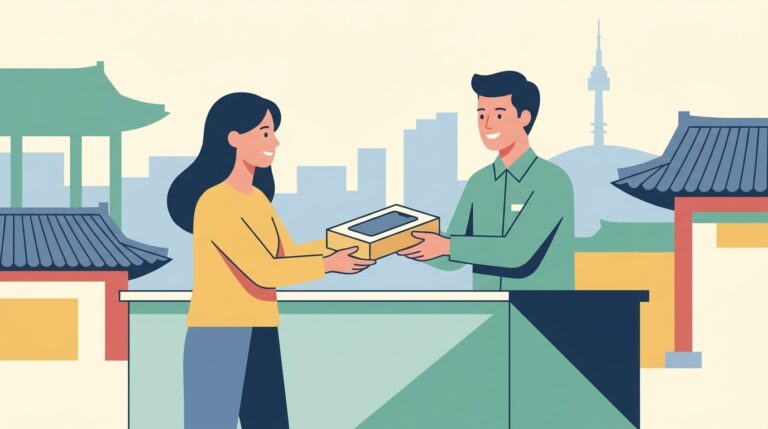
- Two-Handed Device Presentation: Hand your faulty device and receipt to the service technician (기사님, gisa-nim) using both hands or with your left hand supporting your right wrist.
- The Nod & Evidence Show: Rather than arguing verbally, open your phone to show a 5-second video of the glitch happening. Tech staff love clear visual proof.
- Calm Eye Contact: Maintain polite eye contact while explaining, but avoid intense staring or raised voices. Korean customer service is world-class, and politeness gets you faster results.
4-2. The “Ppalli-Ppalli” AS Center Ecosystem
In Korea, electronics after-sales service is renowned for rapid efficiency (빨리빨리 문화). Major tech flagships in Gangnam or Yongsan have computerized ticket kiosks, free coffee lounges, and repair bays where engineers diagnose problems within 10 minutes. If an item is within the initial return window (usually 7 to 14 days) and shows a defect (초기 불량), replacement units are often handed over immediately in sealed packaging.
Phase 5: Real-Life Roleplay Scenario
Setting: A sleek electronics service counter in Gangnam. Counter engineer Min-jun greets you warmly.
- Min-jun (기사님): 어서 오세요, 고객님. 어떤 문제가 있으신가요? (Eoseo oseyo, gogaengnim. Eotteon munjega isseusingayo?)
🎭 Looking up with a friendly bow and welcoming gesture.
“Welcome, valued customer. What issue are you experiencing?” -
You (방문객): 안녕하세요. 며칠 전에 산 블루투스 스피커인데요, 충전이 잘 안 돼요. (Annyeonghaseyo. Myeochil jeone san beullutuseu seupikeoinde-yo, chungjeoni jal an dwaeyo.)
🎭 Placing the speaker box on the counter gently with both hands.
“Hello. This is a Bluetooth speaker I bought a few days ago, but it doesn’t charge properly.” -
Min-jun (기사님): 아, 그러셨군요. 케이블을 연결해도 충전 표시가 안 뜨나요? (A, geureosyeotgunyo. Keibeureul yeongyeolhaedo chungjeon pyosiga an tteunayo?)
🎭 Inspecting the charging port with a penlight.
“Ah, I see. Does the charging indicator not light up even when connected?” -
You (방문객): 네, 다른 케이블로 해봐도 불이 아예 안 들어와요. (Ne, dareun keibeullo haebwado buri aye an deureowayo.)
🎭 Showing a short video on your phone demonstrating the problem.
“Yes, even when I try different cables, the light doesn’t come on at all.” -
Min-jun (기사님): 확인해 보니 단자 쪽 초기 불량이 맞네요. 혹시 구매 영수증 있으신가요? (Haginhae boni danja jjok chogi bullyangi matneyo. Hoksi gumae yeongsujeung isseusingayo?)
🎭 Tapping a diagnostic tablet and looking up politely.
“Checking it now, it is indeed an initial port defect. Do you happen to have the purchase receipt?” -
You (방문객): 네, 여기 모바일 영수증 있어요. 혹시 새 제품으로 교환 가능할까요? (Ne, yeogi mobail yeongsujeung isseoyo. Hoksi sae jepumeuro gyohwan ganeunghalkkayo?)
🎭 Holding out your smartphone display showing the digital receipt.
“Yes, here is the mobile receipt. Could I possibly exchange it for a new product?” -
Min-jun (기사님): 구매하신 지 일주일 이내라서 바로 새 제품으로 교환해 드리겠습니다. (Gumaerasin ji iljuil inaeraseo baro sae jepumeuro gyohwanhae deurigesseumnida.)
🎭 Bringing out a factory-sealed box from the back storage room.
“Since it is within one week of purchase, I will exchange it for a brand-new unit immediately.” -
You (방문객): 빠른 처리 감사합니다! 좋은 하루 보내세요. (Ppareun cheori gamsahamnida! Joeun haru bonaeseyo.)
🎭 Receiving the new box with both hands and bowing 15 degrees.
“Thank you for the quick assistance! Have a great day.”
🔀 Interactive Choice Point
What should you say if the technician says they need to send it to the factory for 5 days of repair, but you bought it only yesterday?
- Option A: “어제 샀는데 수리 말고 새 걸로 교환해 주시면 안 될까요?” (Eoje sanneunde suri malgo sae geollo gyohwanhae jusimyeon an doelkkayo?)
👉 Feedback (Best!): Polite, firm, references yesterday’s purchase, and asks directly for an exchange. - Option B: “왜 수리해요? 그냥 새 거 내놓으세요!” (Wae surihaeyo? Geunyang sae geo naenoh-euseyo!)
👉 Feedback (Bad): Too aggressive and rude; ruins mutual goodwill instantly. - Option C: “네, 그냥 알겠습니다…” (Ne, geunyang algesseumnida…)
👉 Feedback (Risk): Passive; you miss out on your clear consumer right to an instant new replacement for a next-day defect.
Phase 6: 10-Second Emotion Shadowing Drill
Practice matching these rhythm pauses (/) and emotional inflections:
[🥺 Polite & Concerned]
저기요, / 산 지 이틀 됐는데 / 전원이 안 켜져요.
(Jeogiyo, / san ji iteul dwaenneunde / jeonwoni an kyeojyeoyo.)
“Excuse me, / it’s been two days since I bought this / and the power won’t turn on.”-
[💡 Clear & Reasonable]
초기 불량인 것 같은데 / 새 제품으로 교환해 주세요.
(Chogi bullyang-in geot gateunde / sae jepumeuro gyohwanhae juseyo.)
“It seems like an initial defect / please exchange it for a new product.” -
[😊 Relieved & Grateful]
친절하게 도와주셔서 / 정말 감사합니다!
(Chinjeolhage dowajusyeoseo / jeongmal gamsahamnida!)
“Thank you so much / for helping me so kindly!”
Phase 7: K-Culture Mini Dictionary
- 초기 불량 (Chogi Bullyang) | Initial Defect / Dead on Arrival
Used when a brand-new electronics item has factory defects right out of the box. - 영수증 (Yeongsujeung) | Receipt
Paper or mobile proof of purchase required for instant replacement or refund. - AS 센터 (Ei-Eseu Senteo) | After-Sales Service Center
K-Konglish term for customer service and tech repair centers. - 무상 수리 (Musang Suri) | Free Warranty Repair
Service covered under standard manufacturer warranty without extra cost.
Phase 8: Traveler’s Survival Kit
Survival Expressions Top 3
- 교환 되나요? (Gyohwan doenayo?) – “Can I exchange this?”
Pro Tip: Use this while pointing at the item if you need to be brief. - 박스도 다 있어요. (Bakseudo da isseoyo.) – “I have all the original packaging too.”
Pro Tip: Having the complete box guarantees faster exchanges in Korea. - 환불 말고 교환으로 부탁드려요. (Hwanbul malgo gyohwaneuro butakdeuryeoyo.) – “Not a refund, an exchange please.”
Editor’s Travel Note
- App Tip: Use the official Naver Map App Navigation to search for “
[Brand Name] 서비스센터” (e.g., 삼성전자서비스 or 애플 공인서비스센터) to find real-time wait times and opening hours. - Payment & Receipt Tip: If paid via foreign credit card, keep the physical slip (카드 전표) alongside the itemized receipt.
Phase 9: Deep Dive Thought & Cultural Insight
In Korean consumer culture, consumer protection standards for consumer electronics are remarkably swift and consumer-friendly, balanced by high societal trust. When a buyer enters a service desk, the default attitude of technicians is supportive problem-solving rather than skepticism—provided the customer presents the issue with respectful manners (예의). Respectful phrasing like ~해 주실 수 있나요? unlocks far better service than aggressive complaining.
💬 Your Turn: Have you ever experienced tech failure while traveling abroad? How would you handle it in your native language versus Korean? Share your story in the comments below!
Phase 10: FAQ & Common Mistakes
Q: Can I exchange an electronics product if I threw away the original box?
A: In Korea, getting a brand-new boxed replacement (새 제품 맞교환) usually requires all original packaging and components. Without the box, technicians will typically offer a free component repair (무상 수리) instead.
Q: How long is the standard exchange window for electronics in Korea?
A: Most major Korean retailers and tech brands allow instant new product exchanges for initial defects within 7 to 14 days of purchase with a receipt.
Q: What if I bought the item at a duty-free shop at Incheon Airport?
A: Duty-free items must be processed through the specific duty-free brand’s customer service line or downtown branch before international departure.
🚨 Common Mistakes Alert
- ❌ Mistake 1: Saying “바꿔!” (Bakkwo! – Casual imperative).
👉 Correct Action: Say “새 제품으로 교환해 주세요” or “새 걸로 바꿔 주세요” with polite endings. - ❌ Mistake 2: Leaving the receipt at the hotel.
👉 Correct Action: Always carry the physical paper receipt or save the mobile SMS/app receipt on your phone. - ❌ Mistake 3: Saying 고장 냈어요 (“I broke it”).
👉 Correct Action: Use 작동이 안 돼요 (“It isn’t functioning”) so you don’t falsely claim user damage.
Phase 11: Action Missions
- 🥉 Bronze Mission (Solo Practice): Stand in front of a mirror and say “산 지 얼마 안 됐는데 새 제품으로 교환해 주세요” 3 times smoothly in under 5 seconds.
- 🥈 Silver Mission (Social Share): Save this post and tag a friend who is planning an electronics shopping spree in Seoul.
- 🥇 Gold Mission (Real Life / Immersion): Next time you visit an electronics store or AS center in Korea, greet the staff with “안녕하세요!” and state your request in complete Korean sentences.
🎮 K-Culture Mission: Watch an episode of a modern office K-drama and spot when an employee takes a device to an AS 센터. Listen for the word 교환 (gyohwan)!
Phase 12: Interactive Quiz Challenge
1. Situation Judgment: You bought headphones yesterday and sound only comes out of one side. What is the most natural B1 Korean request?
* A) 환불 안 돼요. (Hwanbul an dwaeyo.)
* B) 어제 샀는데 작동이 안 돼서 새 제품으로 교환받고 싶어요. (Eoje sanneunde jakdong-i an dwaeseo sae jepumeuro gyohwanbatgo sipeoyo.)
* C) 물건 고장 냈습니다. (Mulgeon gojang naesseumnida.)
2. Fill-in-the-Blank:
산 ____ 얼마 안 됐어요. (It hasn’t been long since I bought it.)
3. True or False:
In Korea, shouting angrily at the tech counter gets you faster service than politely showing video proof of the issue. (True / False)
🔍 Click here to reveal the answers & explanations!
- Answer: B | B expresses the purchase timeline, the malfunction, and your replacement goal with polite honorifics.
- Answer: 지 | The pattern
-(으)n 지 얼마 안 되다expresses that little time has passed since doing an action. - Answer: False | Calm politeness and concrete video evidence lead to the fastest and friendliest exchange resolutions in Korea!







