

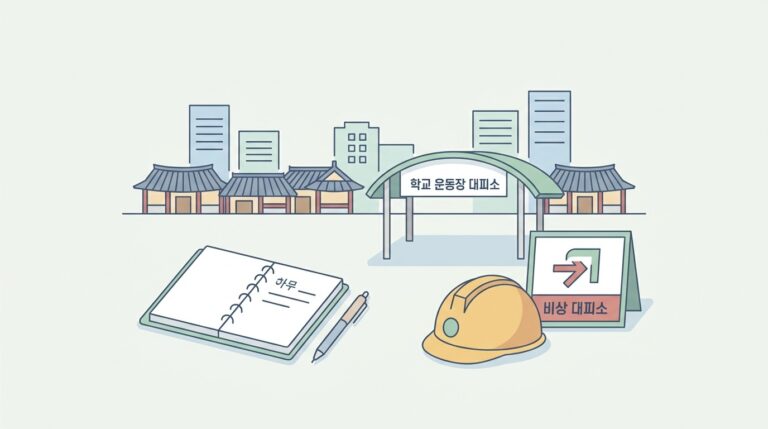
Phase 1: Empathy (Story-Immersive Opening)
안녕하세요! 매일한글 (Daily Hangul) editor here, your dependable local cultural navigator!
Picture this: You are sipping a hand-drip brew on the third floor of a vintage hanok café in Ikseon-dong. Suddenly, every smartphone across the cafe blares in high-pitched unison with the deafening rumble of a Disaster Safety Message (재난문자). Within two seconds, the hanging brass lanterns begin to rattle, and the ground sways. Panic sets in—not necessarily because of the tremor itself, but because critical survival broadcasts and emergency signs in Korea are packed with advanced administrative Sino-Korean vocabulary and rapid-fire municipal instructions that standard tourist phrasebooks never teach.
Even at an advanced C2 level, emergency situations demand spontaneous comprehension and command over high-register crisis terminology. When the earth shakes, navigating evacuation protocols, coordinating with emergency responders, and finding designated subterranean or open-air shelters (지진 옥외대피장소) requires linguistic precision under intense cognitive load. Based on real feedback from seasoned expats and exchange students during the Gyeongju and Pohang tremors, mastering these nuanced directives is literally life-saving. Let us elevate your Korean fluency so you can lead with composure, guide others, and decode any emergency protocol seamlessly.
Phase 2: In-Depth Analysis of 3 Core Expressions
1. 머리를 보호하고 탁자 밑으로 들어가세요 (Meorireul bohohago takja miteuro deureogaseyo)
- Pronunciation: [Meo-ri-reul bo-ho-ha-go tak-ja mi-teu-ro deu-reo-ga-se-yo] (Sounds like: ‘Maw-ri-rule bo-ho-ha-go tahk-jah meet-eu-ro dew-raw-gah-say-yo’)
- Meaning: Literal: Protect your head and enter under the table. / Nuance: Take immediate drop, cover, and hold on action under sturdy furniture.
- K-Culture Moment: The textbook public safety announcement heard across subway PA systems and apartment building intercoms during municipal drills (민방위 훈련).
- Editor’s Insight: ‘보호하다’ (to protect) conveys formal imperative safety protocol. In crisis situations, concise clarity overrides conversational fluff.
- Situation Spectrum: Casual ⚠️ | Semi-formal ✅ | Formal ✅
- 🤔 Think About It: Notice how Korean emphasizes the explicit anatomical object (‘머리를’) before the spatial action (‘탁자 밑으로’), reflecting high-context procedural urgency.
2. 지진 옥외대피장소로 신속히 이동하십시오 (Jijin ogwoedaepijangsoro sinsokhi idonghasipsio)
- Pronunciation: [Ji-jin ong-woe-dae-pi-jang-so-ro sin-so-ki i-dong-ha-sip-si-o] (Sounds like: ‘Jee-jin oak-way-dae-pee-jahng-so-ro sheen-so-kee ee-dong-hah-sheep-shee-oh’)
- Meaning: Literal: Promptly move to the earthquake outdoor evacuation site. / Nuance: Evacuate immediately to an designated open-air assembly ground (like schoolyards or parks).
- K-Culture Moment: Municipal emergency alerts pushed to cellular devices via the Ministry of the Interior and Safety (행정안전부).
- Editor’s Insight: ‘옥외’ (屋外 – outdoor open space) is crucial. Unlike bomb shelters (민방위 대피소, which are underground), earthquake evacuation points must be wide-open outdoor areas away from falling glass.
- Situation Spectrum: Casual 🚫 | Semi-formal ⚠️ | Formal ✅
- 🤔 Think About It: Why does Korean emergency protocol distinguish strictly between indoor sheltering (방공호) and outdoor open-air staging (옥외대피)?
3. 엘리베이터를 이용하지 마시고 계단으로 대피하세요 (Ellibeiteoreul iyonghaji masigo gyedaneuro daepihaseyo)
- Pronunciation: [El-li-be-i-teo-reul i-yong-ha-ji ma-si-go gye-dan-eu-ro dae-pi-ha-se-yo] (Sounds like: ‘El-lee-bay-ee-taw-rule ee-yong-hah-jee mah-she-go gyeh-dahn-eu-ro day-pee-hah-say-yo’)
- Meaning: Literal: Do not use the elevator and evacuate using the stairs. / Nuance: Strictly avoid elevators due to blackout/entrapment risks; proceed via emergency stairwells.
- K-Culture Moment: Building management crisis broadcasts echoing through modern high-rise officetels.
- Editor’s Insight: The prohibition construction ‘~하지 마시고’ combined with the procedural directive ‘~으로 대피하세요’ forms standard polite administrative guidance during high-stakes management.
- Situation Spectrum: Casual ⚠️ | Semi-formal ✅ | Formal ✅
- 🤔 Think About It: How does the honorific ‘~시-‘ soften authoritarian commands even amid urgent survival directives?
Phase 3: Textbook Korean vs. Real Native Korean
Situation 1: Calling out to bystanders to turn off utility valves
- 📖 교과서 한국어: 가스 밸브를 잠그고 전원을 차단해 주시기 바랍니다. (Gaseu baelbeureul jamgeugo jeonwoneul chadanhae jusigi baramnida – Please lock the gas valve and cut off the power supply.)
- 🗣️ 진짜 한국어: 2차 화재 나니까 일단 가스 밸브 잠그고 두꺼비집부터 내려요! (Icha hwajae nanikka ildan gaseu baelbeu jamgeugo dukkeobijipbuteo naeryeoyo! – To prevent secondary fires, shut off the gas valve and flip the main breaker right now!)
- 💡 왜 다를까? In actual emergencies, native speakers drop lengthy formal nominal endings in favor of actionable colloquial terms like ‘두꺼비집’ (toad house / circuit breaker) and immediate causal markers (‘~니까’).
Situation 2: Inquiring about nearby designated shelters from locals
- 📖 교과서 한국어: 근처에 지정된 지진 대피소가 어디에 위치해 있습니까? (Geuncheoe jijeongdoen jijin daepisoga eodie wichihae itseumnikka? – Where is the designated earthquake shelter located nearby?)
- 🗣️ 진짜 한국어: 건물 와해 위험 있으니까 근처 학교 운동장이나 넓은 공터 어디예요? (Geonmul wahae wiheom isseunikka geuncheo hakgyo undongjang-ina neolbeun gongteo eodiyeyo? – There’s a risk of structural collapse; where is the nearest school field or open lot?)
- 💡 왜 다를까? C2-level proficiency blends structural risk terminology (‘건물 와해 위험’) with fast, pragmatic spatial questions prioritizing open assembly grounds.
Phase 4: K-Culture Deep Dive & Non-Verbal Etiquette
4-1. Nunchi & Crisis Gestures
During emergencies in dense Korean urban spaces, self-preservation must harmonize with collective order. Avoid shrieking or shoving, which induces panic (공황 상태). Instead, hold your bag, backpack, or coat firmly over your head with both hands, keep your posture low, and make steady eye contact while gesturing towards exits. If directing others, use an open palm—never a pointed index finger—and deliver short, decisive verbal instructions.
4-2. Cultural Code: The ‘Bbali-Bbali’ (빨리빨리) vs. High-Rise Safety Infrastructure
Korea’s rapid architectural modernization means major cities like Seoul and Busan are packed with high-rise residential complexes (아파트 단지). These buildings are equipped with automated seismic gas shut-off systems and earthquake-resistant designs (내진 설계). The cultural instinct of communal safety drills (민방위) ensures that residents gather at local public school playgrounds (학교 운동장) or neighborhood parks (근린공원) rather than chaotic street corners.
Phase 5: Real-Life Roleplay Scenario
Setting: 4th Floor of an Art Gallery in Jongno, Seoul. A magnitude 5.2 tremor strikes. The ground jolts violently.
Characters:
* 민우 (Min-woo): Gallery Curator & Emergency Warden.
* You (Advanced Learner): Resourceful visitor taking proactive safety measures.
- 민우: 🎭 (전시품을 붙잡으며 다급하게 외친다) 다들 당황하지 마시고 머리부터 감싸세요! 진동 멈출 때까지 웅크리세요!
(Dadeul danghwanghaji masigo meoributeo gamssaseyo! Jindong meomchul ttaekkaji ungkeuriseyo!)
“Everyone, don’t panic and protect your head first! Stay crouched until the shaking stops!” - You: 🎭 (가방으로 머리를 보호하며 튼튼한 탁자 아래로 몸을 피한다) 네, 여진이 올 수 있으니 문부터 열어서 탈출구 확보할게요!
(Ne, yeojini ol su isseuni munbuteo yeoreoseo talchulgu hwakbohalgeyo!)
“Understood. Aftershocks may occur, so I’ll prop the door open first to secure an exit route!” - 민우: 🎭 (감탄하며 고개를 끄덕인다) 감사합니다! 가스 차단 밸브 확인했으니 진동 잦아들면 바로 나갑니다!
(Gamsahamnida! Gaseu chadan baelbeu hwaginhaesseuni jindong jajadeulmyeon baro nagamnida!)
“Thank you! I’ve confirmed the gas shut-off valve, so we move as soon as the tremor subsides!” - You: 🎭 (주변 관람객들을 진정시키며) 엘리베이터 절대 타지 마시고 비상계단으로 한 줄로 내려가세요!
(Ellibeiteo jeoldae taji masigo bisanggyedaneuro han jullo naeryeogaseyo!)
“Never use the elevators; please head down the emergency staircase in a single line!” - 민우: 🎭 (비상구 유도등을 가리키며) 1층 현관 나서서 인근 초등학교 운동장으로 집결해야 합니다.
(Ilcheung hyeongwan naseoseo ingeun chodeunghakgyo undongjangeuro jipgyeolhaeya hamnida.)
“Once out the ground floor entrance, we must assemble at the nearby elementary school playground.” - You: 🎭 (외벽 유리창을 경계하며) 외벽 타일이나 간판 낙하물 조심하면서 넓은 도로 쪽으로 붙읍시다.
(Oebyeok tairina ganpan nakhamul josimhamyeonseo neolbeun doro jjogeuro bueupsida.)
“Let’s watch out for falling facade tiles and signboards while sticking toward the wide roadway.” - 민우: 🎭 (무전기를 들며) 맞습니다. ‘안전디딤돌’ 앱으로 지정 옥외대피소 위치 실시간 확인 중입니다.
(Matseumnida. ‘Anjeondidimdol’ aebeuro jijeong ogwoedaepiso wichi silsigan hwagin jung-imnida.)
“Correct. I am checking the designated outdoor shelter status in real-time via the Emergency Ready App.” - You: 🎭 (침착하게 대열을 정돈하며) 네, 질서 정연하게 신속 이동하겠습니다. 다친 분 없는지 살피시죠.
(Ne, jilseo jeong-yeonhage sinsok idonghagetseumnida. Dachin bun eomneunji salpisijo.)
“Yes, let us move promptly in an orderly fashion. Let’s make sure no one is injured.”
🔀 Interactive Branching Point
During evacuation, an elderly tourist panics and rushes toward the elevator to retrieve their heavy luggage on the lower floor. What do you do?
- Option A: “어르신, 정전되면 갇히니까 짐 버리시고 저랑 계단으로 바로 내려가셔야 해요!” (Best – Direct, empathetic, points out life-threatening risk immediately)
- Option B: “원하시는 대로 하세요, 저는 먼저 비상계단으로 대피하겠습니다.” (Bad – Individualistic, breaches communal crisis duty, leaves a person in mortal peril)
- Option C: “잠깐 기다려보세요, 제가 엘리베이터가 정상 작동하는지 버튼을 눌러볼게요.” (Risk – Extremely dangerous; attempting elevator operation during earthquakes risks severe entrapment)
Phase 6: 10-Second Emotion Shadowing Drill
- Drill 1
[🚨 단호하고 긴박하게 (Resolute & Urgent)]
머리를 / 가방으로 감싸고 / 진동이 멈출 때까지 / 테이블 밑에서 / 버티세요!
(Meorireul / gabang-euro gamssago / jindong-i meomchul ttaekkaji / teibeul mitesseo / beotiseyo!) -
Drill 2
[🧭 침착하고 신뢰감 있게 (Calm & Authoritative)]
당황하지 마시고 / 비상 유도등을 따라 / 계단으로 / 신속하게 / 이동합시다.
(Danghwanghaji masigo / bisang yudodeung-eul ttara / gyedaneuro / sinsokhage / idonghapsida.) -
Drill 3
[📢 공공 안전을 통솔하듯 (Commanding Public Safety)]
낙하물 위험이 있으니 / 건물 외벽에서 떨어져서 / 넓은 공터로 / 집결해 주세요!
(Nakhamul wiheomi isseuni / geonmul oebyeogeseo tteoreojyeoseo / neolbeun gongteoro / jipgyeolhae juseyo!)
Phase 7: K-Culture Mini Dictionary
- 지진 옥외대피장소 (Jijin Ogwoedaepijangso) | Designated Outdoor Earthquake Evacuation Shelter
- Essential open areas (school grounds, civic plazas, sports complexes) certified free of falling object hazards.
- 재난안전알림 / 긴급재난문자 (Gingeup Jaenanmunja) | Emergency Disaster Alert
- High-priority cell broadcast sent to Korean mobile network users containing instant disaster coordinates and directives.
- 여진 (Yeojin) | Aftershock
- Secondary tremors following the main earthquake (본진, Bonjin); vital for estimating structural integrity.
- 안전디딤돌 (Anjeon Didimdol) | Emergency Ready App
- South Korea’s official national disaster portal app operating multi-language real-time alert systems.
Phase 8: Traveler’s Emergency Survival Kit
Survival Expressions TOP 3
- 지진 대피소가 어디에 있습니까? (Jijin daepisoga eodie itseumnikka?)
- Pro Tip: Use this when cellular service drops to inquire about local open-air evacuation points.
- 여진 위험이 있으니 건물 밖으로 나가야 합니다. (Yeojin wiheomi isseuni geonmul bakkeuro nagaya hamnida.)
- Pro Tip: Crucial for evacuating companions who underestimate post-quake vulnerability.
- 다친 사람이 있으니 119에 구조 요청 부탁드립니다. (Dachin sarami isseuni il-il-gue gujo yocheong butakdeurimnida.)
- Pro Tip: Explicit phrasing ensuring bystanders summon fire & rescue paramedics immediately.
Editor’s Travel Note
- Official App Installation: Prioritize the Emergency Ready App download guide provided by the Ministry of the Interior and Safety for offline shelter maps.
- Navigation Maps: On Naver Map search for shelters, search ‘지진옥외대피소’ to pinpoint verified green evacuation zones across Korea.
- Emergency Hotlines: 119 (Fire, Rescue, Medical Dispatch), 112 (Police), 1345 (Immigration Contact Center with multi-language crisis translation support).
Phase 9: A Step Deeper (Reflective Thought)
In South Korea, disaster mitigation is profoundly communitarian. Modern urban architecture incorporates seismic engineering, yet safety relies heavily on mutual coordination—manifested as neighbors checking building exits, apartment leaders clearing stairwells, and municipal announcements prioritizing community assembly. Crisis language in Korean balances swift imperatives with honorific solidarity, proving that true linguistic mastery encompasses cultural accountability and civic duty.
💬 Your Turn: How does emergency guidance in your home country compare to Korea’s strict distinction between indoor civil defense and outdoor earthquake shelters? Share your thoughts below!
Phase 10: FAQ & Common Pitfalls
Q: What is the exact difference between a ‘민방위 대피소’ and a ‘지진 옥외대피장소’?
A: A ‘민방위 대피소’ (Civil Defense Shelter) refers to underground facilities (subway stations, basement bunkers) designed for air raids or chemical incidents. Conversely, a ‘지진 옥외대피장소’ is an outdoor open space (schoolyard, park) designed specifically to keep people safe from falling debris and collapsing structures during an earthquake.
Q: Do cellular disaster messages work on foreign SIM cards or e-SIMs in Korea?
A: Yes, Cell Broadcast Service (CBS) triggers automatically on all LTE/5G handsets in South Korea. However, English translations may not always be available in initial broadcasts, making it imperative to memorize key Sino-Korean terms like ‘지진’ (Earthquake), ‘대피’ (Evacuate), and ‘진원지’ (Epicenter).
Q: What should I do if an earthquake hits while riding the Seoul Metro or KTX?
A: Hold firmly onto straps or handrails to brace against emergency braking. Listen closely to onboard train announcements (‘안내 방송’) and never jump onto railway tracks unless instructed by train conductors or station personnel.
🚨 Common Mistakes Alert
- Mistake: Running straight down into an underground subway station during an earthquake.
- Correct Action: Evacuate to an open-air lot or school playground (옥외대피장소), away from glass facades.
- Mistake: Taking the elevator to get down from a high-rise floor quickly.
- Correct Action: Always take the stairs (‘비상계단’); elevators risk catastrophic power loss.
- Mistake: Shutting doors tightly during initial tremors.
- Correct Action: Prop doors open immediately to prevent doorframes from warping and trapping you inside.
Phase 11: Action Mission & Engagement
- 🥉 Bronze Mission: Record yourself shadow-speaking Drill 1 in Phase 6 with an urgent, commanding tone.
- 🥈 Silver Mission: Open your Korean navigation app (Naver/Kakao Map), type in ‘지진옥외대피소’, and locate the two nearest assembly points from your current stay.
- 🥇 Gold Mission: Write an emergency preparedness checklist in Korean using 5 Sino-Korean disaster keywords learned today.
- 🎮 K-Culture Mission: Watch a scene from the Korean disaster movie Exit (엑시트) or Concrete Utopia (콘크리트 유토피아) and identify how emergency cues are communicated among citizens.
Phase 12: Interactive Quiz Challenge
- Situational Judgment: If an earthquake occurs while you are inside a high-rise café, what is your first immediate action?
- A) Run to the elevator immediately.
- B) Protect your head under a sturdy table and hold on until shaking stops.
- C) Stand by the large glass window to film the situation.
- Fill in the Blank:
“건물 붕괴 위험이 있으니 신속하게 지진 _______(으)로 이동하세요.”
(There is a risk of building collapse, so please move promptly to the outdoor earthquake evacuation site.) -
True / False: During an earthquake, you should seek shelter in an underground Civil Defense bunker (민방위 대피소) rather than a wide school playground.
🔍 Click here to view Answers & Explanations
- Answer: B | Always take cover under a sturdy table and protect your head first. Elevators and glass windows present extreme injury hazards.
- Answer: 옥외대피장소 (Ogwoedaepijangso) | Designated open-air spaces prevent injuries from collapsing structures.
- Answer: FALSE | Underground civil defense bunkers are for air raids/chemical attacks; earthquakes mandate open outdoor areas (옥외대피소).







