

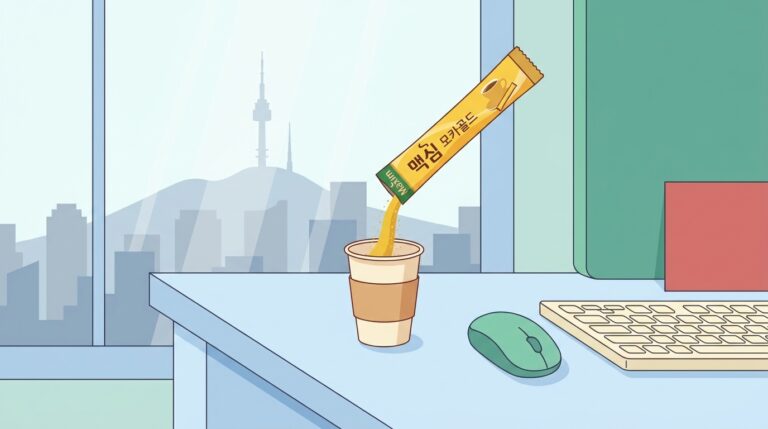
Phase 1: Empathy & Immersion (Story-driven Opening)
안녕하세요! 매일한글 에디터입니다. (Hello! I’m your Daily Hangul editor.)
Picture this: You are sitting in an office in downtown Seoul or visiting a friend’s studio apartment at 3:00 PM. The afternoon slump hits like a freight train. Suddenly, someone walks toward the pantry, tears open a slender yellow stick with their bare fingers, pours the golden powder into a tiny paper cup, and stirs it—not with a spoon, but with the empty packet itself! The sweet, buttery, caramel-like aroma instantly fills the room. They hand you a steaming cup and say with a warm smile, “당 떨어질 땐 믹스 커피가 최고예요.” (When your blood sugar drops, mix coffee is unbeatable.)
If you have watched K-dramas like Vincenzo or Misaeng, you know that instant mix coffee (믹스커피) is not just a cheap caffeine fix; it is the ultimate comfort potion, an office bonding ritual, and the lifeblood of Korea’s hyper-efficient “Ppal-li Ppal-li” (hurry-hurry) culture. However, intermediate learners often stumble here. How do you casually ask a colleague to grab a stick coffee without sounding like a robotic textbook? How do you decline gracefully if you don’t want extra sugar, or express that heavenly afternoon sugar rush naturally in Korean?
Based on feedback from over 500 intermediate Korean learners who wanted to blend seamlessly into authentic Korean social dynamics, this guide breaks down the nuance, slang, and etiquette surrounding Korea’s beloved instant coffee culture. Let’s dive into the sweet world of K-Mix Coffee!
Phase 2: Deep Dive into 3 Core Expressions
1. 당 떨어졌어요 (Dang tteol-eo-jyeo-sseo-yo)
- Pronunciation: [Dang tteol-eo-jyeo-sseo-yo] (Sounds like: “Dahng ttul-uh-jyuh-ssuh-yo”)
- Meaning: Literally “My blood sugar has dropped.” In natural English: “I have a sugar crash / I desperately need a sweet boost.”
- K-Culture Moment: Seen in nearly every slice-of-life K-drama when characters collapse onto their desks during overtime work and reach for a yellow Maxim stick.
- Editor’s Insight: While scientifically referring to hypoglycemia, Koreans use this colloquially whenever they feel lethargic, mentally drained, or craving something sweet. Pairing this with mix coffee makes you sound 100% native.
- Situation Spectrum: Casual ✅ | Semi-formal ✅ | Formal ⚠️
- 🤔 Think About It: In English, we often say “I’m hitting a wall” or “I need coffee.” Why do you think Korean specifically attributes afternoon fatigue to “sugar dropping” (당)?
2. 믹스 커피 한잔 타 드릴까요? (Mik-seu keo-pi han-jan ta deu-ril-kka-yo?)
- Pronunciation: [Mik-seu keo-pi han-jan ta deu-ril-kka-yo] (Sounds like: “Meek-seu cuh-pee hahn-jahn tah deu-reel-kkah-yo”)
- Meaning: Literally “Shall I brew/mix a cup of mix coffee for you?”
- K-Culture Moment: An indispensable phrase in Korean workplaces, clinics, traditional markets, and even home visits showing thoughtful hospitality.
- Editor’s Insight: Notice the verb 타다 (ta-da). In Korean, you don’t use ‘만들다’ (make) or ‘끓이다’ (boil) for powdered drinks; you use ‘타다’ (to stir/dissolve powder into liquid).
- Situation Spectrum: Casual (타 줄까?) ✅ | Semi-formal ✅ | Formal ✅
- 🤔 Think About It: Offering to mix someone a cup represents care and camaraderie in communal Korean culture. How does your culture express casual workplace hospitality?
3. 달달하니 피로가 싹 풀리네요 (Dal-dal-ha-ni pi-ro-ga ssak pul-li-ne-yo)
- Pronunciation: [Dal-dal-ha-ni pi-ro-ga ssak pool-li-ne-yo] (Sounds like: “Dahl-dahl-hah-nee pee-roh-gah ssahk pool-lee-neh-yo”)
- Meaning: Literally “Because it is sweetly pleasant, my fatigue is completely relieved.”
- K-Culture Moment: The iconic reaction after taking that first hot sip from a yellow paper cup after hours of grueling work.
- Editor’s Insight: 달달하다 is a cozy, affectionate synonym for ‘달다’ (sweet), while the mimetic word 싹 (ssak) implies completely, swiftly, and cleanly clearing away exhaustion.
- Situation Spectrum: Casual ✅ | Semi-formal ✅ | Formal ⚠️
- 🤔 Think About It: Korean has dozens of descriptive words for sweetness (달다, 달콤하다, 달착지근하다, 달달하다). How does changing the word nuance change the emotional warmth of your compliment?
Phase 3: Textbook Korean vs. Real Korean
Scenario 1: Expressing extreme fatigue and wanting coffee
- 📖 교과서 한국어: 저는 지금 너무 피곤해서 커피를 마시고 싶습니다. (Jeoneun jigeum neomu pigonhaeseo keopireul masigo sipseumnida. / “I am very tired right now, so I want to drink coffee.”)
- 🗣️ 진짜 한국어: 아, 당 떨어지는데 믹스 하나 때릴까요? (A, dang tteol-eo-ji-neun-de mik-seu ha-na ttae-ril-kka-yo? / “Ah, running low on sugar… should we hit a mix coffee stick?”)
- 💡 왜 다를까?: Native Korean speakers in casual/semi-formal settings use the vivid idiom ‘당 떨어지다’ and colloquial verb ‘때리다’ (slang for quickly consuming food/drink) to express relatable workplace tiredness.
Scenario 2: Adjusting sugar content in the instant coffee packet
- 📖 교과서 한국어: 설탕의 양을 조절해서 마셔 보세요. (Seoltang-ui yangeul jojeolhaeseo masyeo boseyo. / “Try drinking it after adjusting the amount of sugar.”)
- 🗣️ 진짜 한국어: 뒤쪽 꼬집으면 설탕 조절되는 거 아시죠? (Dwi-jjok kko-ji-beu-myeon seol-tang jo-jeol-doe-neun geo a-si-jyo? / “You know you can pinch the tail end to control the sugar, right?”)
- 💡 왜 다를까?: Korean instant coffee packets (like Maxim Mocha Gold) have a built-in sugar reservoir at the bottom. Locals naturally say ‘뒤쪽을 꼬집다’ (pinch the back end) rather than using formal instruction manual phrasing.
Phase 4: K-Culture Deep Dive & Non-Verbal Etiquette
4-1. 눈치 (Nunchi) & Coffee Manners
When an elder or senior colleague offers to prepare mix coffee, proper Nunchi dictates that you jump in and say, “제가 탈게요! 몇 개 타 드릴까요?” (I’ll make it! How many packets would you like?). When stirring, you will notice many Koreans fold the empty foil stick in half and stir the hot water with it. While scientifically debated due to plastic lining, it is an iconic, nostalgic ritual of efficiency! If handed a cup, always receive it with both hands (두 손으로 받기), take a cautious sip, and make appreciative eye contact with a contented “크으~ 달달하네요!”
4-2. The Cultural Code: Maxim Gold & “Ppalli-Ppalli”
Invented by Dongsuh Foods in 1976, Korean mix coffee revolutionized daily life during Korea’s rapid industrialization. In an era when brewed espresso machines were luxury items, the all-in-one packet (coffee + creamer + sugar) provided an instant energy shot. Today, even in Seoul—the cafe capital of the world with an espresso shop on every corner—the humble yellow stick coffee holds sacred nostalgic status across generations.
Phase 5: Real-Life Roleplay Scenario
Setting: A cozy startup office pantry in Seongsu-dong at 3:30 PM. Senior colleague Ji-min (대리님) catches you stretching and yawning.
- Ji-min: 🎭 (Stretching her neck with a sigh) 오늘 회의 진짜 길었죠? 완전 기 빨렸어요. (Oneul hoe-ui jin-jja gir-eot-jyo? Wan-jeon gi ppal-lyeo-sseo-yo. / “That meeting was so long, right? I feel completely drained of energy.”)
- You: 🎭 (Nodding emphatically) 맞아요 대리님, 저도 지금 당 떨어져서 쓰러질 것 같아요. (Maj-a-yo dae-ri-nim, jeo-do ji-geum dang tteol-eo-jyeo-seo sseu-reo-jil geot gat-a-yo. / “Totally, Jimin-nim. My sugar dropped so hard I feel like collapsing.”)
- Ji-min: 🎭 (Opens the pantry drawer filled with yellow Maxim packets) 믹스 커피 한잔 타 드릴까요? 아니면 카누로 드릴까요? (Mik-seu keo-pi han-jan ta deu-ril-kka-yo? A-ni-myeon ka-nu-ro deu-ril-kka-yo? / “Shall I mix you a sweet mix coffee? Or would you prefer Kanu black coffee?”)
- You: 🎭 (Stepping forward politely) 에이, 제가 탈게요! 피곤할 땐 역시 노란색 믹스가 최고죠. (E-i, je-ga tal-ge-yo! Pi-gon-hal ttaen yeok-si no-ran-saek mik-seu-ga choe-go-jyo. / “Oh no, let me make it! When you’re tired, the classic yellow mix is unbeatable.”)
- Ji-min: 🎭 (Laughs and gives a thumbs-up) 오, 믹스 커피 맛을 아시네요! 저는 물 조금만 잡아서 진하게 부탁해요. (O, mik-seu keo-pi mat-eul a-si-ne-yo! Jeo-neun mul jo-geum-man jab-a-seo jin-ha-ge bu-tak-hae-yo. / “Oh, you truly appreciate the taste of mix coffee! Please use less water so it’s extra rich.”)
- You: 🎭 (Pouring hot water into two paper cups) 넵! 설탕 조절 안 하고 오리지널로 타 드릴게요. (Nep! Seol-tang jo-jeol an ha-go o-ri-ji-neol-lo ta deu-ril-ge-yo. / “Got it! I won’t pinch the sugar and will make it full sweet original for you.”)
- Ji-min: 🎭 (Takes the cup with two hands and sips) 크~ 역시 이 맛이죠! 피로가 싹 풀리네요. (Keu~ yeok-si i mat-i-jyo! Pi-ro-ga ssak pul-li-ne-yo. / “Ah~ this is the real deal! My fatigue is melting right away.”)
- You: 🎭 (Smiling warmly after a sip) 달달하니 오후 업무도 힘낼 수 있겠어요! (Dal-dal-ha-ni o-hu eom-mu-do him-nael su it-ge-sseo-yo! / “Because it’s so sweet and comforting, I can power through afternoon work!”)
🔀 Interactive Choice Point
Ji-min asks: “믹스 커피 하루에 몇 잔 정도 마셔요?” (How many cups of mix coffee do you drink a day?)
* Option A: “당 떨어질 때 딱 한두 잔 마셔요. 피로 회복에 최고예요!” (Dang tteol-eo-jil ttae ttak han-du jan ma-syeo-yo. Pi-ro hoe-bok-e choe-go-ye-yo!)
* Option B: “저는 건강 생각해서 설탕 들어간 건 절대 안 마십니다.” (Jeo-neun geon-gang saeng-gak-hae-seo seol-tang deul-eo-gan geon jeol-dae an ma-sim-ni-da.)
* Option C: “잠 깨려고 하루에 열 잔씩 때려 넣어요.” (Jam kkae-ryeo-go ha-ru-e yeol jan-ssik ttae-ryeo neo-o-yo.)
Feedback:
* Option A (Best): Friendly, culturally attuned, perfectly explains moderation and purpose.
* Option B (Risk): While honest, using ‘절대’ (never) when someone just shared a sweet cup can sound blunt and spoil the cozy pantry atmosphere.
* Option C (Bad): Drinking 10 packets a day is alarming! Even native Koreans will worry about your heart and health.
Phase 6: 10-Second Emotion Shadowing Drill
Pay attention to the slash pauses / and emotional milestones:
- [😩 Exhausted & Craving Sugar]
“아 / 진짜 당 떨어져서 / 믹스 커피 한잔 마셔야겠어요.”
(A / jin-jja dang tteol-eo-jyeo-seo / mik-seu keo-pi han-jan ma-syeo-ya-get-sseo-yo.) -
[😊 Cheerful & Polite Hospitality]
“제가 타 드릴 테니까 / 편하게 앉아 계세요!”
(Je-ga ta deu-ril te-ni-kka / pyeon-ha-ge an-ja gye-se-yo!) -
[😋 Deep Satisfaction & Comfort]
“크으~ / 달달하니 / 피로가 싹 풀리네요!”
(Keu-eu~ / dal-dal-ha-ni / pi-ro-ga ssak pul-li-ne-yo!)
Phase 7: K-Culture Mini Dictionary
- 맥심 모카골드 (Maek-sim Mo-ka-gol-deu) | Maxim Mocha Gold | The quintessential gold-packaged instant coffee stick dominating Korean households and offices for decades.
- 종이컵 (Jong-i-keop) | Paper Cup | The standard tiny 6.5oz paper cup engineered to hold the exact optimal water ratio (~90-100ml) for one mix coffee stick.
- 물 조절 (Mul jo-jeol) | Water Ratio Control | The fine art of not adding too much water, ensuring the coffee remains rich, sweet, and creamy rather than diluted.
- 식후 커피 (Sik-hu keo-pi) | Post-Meal Coffee | The deeply rooted Korean habit of drinking a sweet coffee or iced americano immediately after lunch or dinner.
Phase 8: Traveler’s Survival Kit
Survival Phrases TOP 3
- “믹스 커피 어디에 있어요?” (Mik-seu keo-pi eo-di-e it-seo-yo? / Where is the instant mix coffee?)
- Pro Tip: Use this at supermarkets or convenience stores when looking for multi-packs to take home as souvenirs.
- “뜨거운 물 어디서 받아요?” (Tteu-geo-un mul eo-di-seo bad-a-yo? / Where can I get hot water?)
- Pro Tip: Essential at gas stations, rest stops, or office lounges with water purifiers (정수기).
- “종이컵 하나만 주실 수 있나요?” (Jong-i-keop ha-na-man ju-sil su it-na-yo? / Could I get one paper cup, please?)
- Pro Tip: Perfect when you bought coffee sticks and need a single cup at a small mart or guesthouse.
Editor’s Travel Note
When traveling across Korea, look for water purifiers (정수기) in rest areas, community centers, and subway info offices. They almost always have a hot water safety button (온수 잠금 해제). If you’re exploring local coffee shops and stationery hubs, make sure to use the 네이버 지도 앱 다운로드 to find cozy retro “Dabang” (다방) cafes that still serve traditional mix coffee setups.
Phase 9: A Step Deeper (Reflection Essay)
In many Western cultures, coffee is an individualistic, artisanal journey—single-origin beans, oat milk customization, and mindful sipping. In Korea, while third-wave specialty cafes thrive everywhere, the instant mix coffee represents 정 (Jeong)—collective warmth, shared labor, and egalitarian care. It does not judge by wealth or status; the CEO and the intern drink the exact same 150-won yellow stick from the same paper cup. Sharing a stick of mix coffee is an unspoken Korean social gesture saying: “We are tired together, we are working hard together, let’s recharge and carry on.”
💬 Your Turn: What is the go-to comfort drink in your home culture when you experience an afternoon slump? Have you ever tried Korean yellow stick coffee? Tell us in the comments below!
Phase 10: FAQ & Common Mistakes
Q: Can I use boiling water directly from a kettle for mix coffee?
A: Yes, but native Koreans recommend water around 85°C–90°C (slightly below rolling boil) so you don’t scorch the creamer and sugar, preserving the silky, velvety texture.
Q: Is it rude to drink instant coffee if an elder offers fresh cafe coffee?
A: Not rude at all, but if an elder offers to buy cafe coffee, gracefully accept their gesture. If you are in their home or office and they offer mix coffee, happily taking it displays warmth and humility.
Q: How much water should I pour in the standard paper cup?
A: Fill the small paper cup only about halfway to slightly over half (roughly 90ml to 100ml). Overfilling will make it watery and lose its iconic rich sweetness!
🚨 Common Mistakes TOP 3
- Mistake: Saying “커피를 요리해 주세요” (Cook coffee for me).
- Correct Action: Say “커피 한잔 타 주세요” (Please brew/mix a cup of coffee).
- Mistake: Filling the paper cup to the brim with hot water.
- Correct Action: Fill only 50–60% of the cup to maintain optimal sugar-to-cream density.
- Mistake: Using formal literary language like “피로가 회복되었습니다” with close colleagues.
- Correct Action: Use natural expressions like “피로가 싹 풀리네요!”
Phase 11: Action Missions
- 🥉 Bronze Mission (Solo Practice): Stand in front of your mirror, hold a pen as if it’s a mix coffee stick, and practice saying “당 떨어지는데 믹스 커피 한잔 타 드릴까요?” 3 times with a warm smile.
- 🥈 Silver Mission (Social Share): Snap a photo of your afternoon coffee or sweet snack, post it on your Instagram Story, and tag with the Korean caption: #당떨어짐 #달달하니최고.
- 🥇 Gold Mission (Real-life Execution): Visit a local Korean grocery mart (or order online), brew a cup of Maxim Mocha Gold in a paper cup using the 60% water rule, and say out loud: “크~ 피로가 싹 풀린다!”
- 🎮 K-Culture Mission: Watch an episode of the K-drama Misaeng (Incomplete Life) or Hospital Playlist and spot the exact scene where characters tear open a stick coffee packet with their teeth or fingers!
Phase 12: Interactive Quiz Challenge
Question 1: Situational Judgment
Your Korean project partner sighs heavily at 4 PM and rubs their temples. What is the most natural, supportive intermediate-level reaction?
* A) 왜 일을 그렇게 열심히 하셨습니까?
* B) 당 떨어지셨죠? 제가 믹스 커피 한잔 타 드릴게요!
* C) 식사를 다시 하러 식당에 가세요.
🔍 Click to reveal Answer & Explanation
Correct Answer: B
Explanation: Option B accurately identifies the afternoon sugar crash with “당 떨어지셨죠?” and offers caring hospitality with the correct verb “타 드릴게요”. Option A sounds accusatory, and Option C is unnatural during working hours.
Question 2: Fill in the Blank
Complete the natural Korean phrase:
“이 커피는 ________ 피로가 싹 풀려요.” (Because this coffee is pleasantly sweet, my fatigue melts away.)
* A) 달달하니
* B) 매콤하니
* C) 씁쓸하니
🔍 Click to reveal Answer & Explanation
Correct Answer: A (달달하니)
Explanation: ‘달달하다’ is the warm, affectionate colloquial term for sweetness. ‘매콤하다’ means spicy, and ‘씁쓸하다’ means bitter.
Question 3: Cultural True or False
Statement: In Korean instant mix coffee packets, you can control the sugar amount by pinching the designated bottom end of the stick before pouring.
* [True / False]
🔍 Click to reveal Answer & Explanation
Correct Answer: True
Explanation: Most Korean coffee sticks feature a marked sugar section at the tail end. Squeezing it prevents the sugar from pouring out, allowing you to enjoy a less sweet version!







