

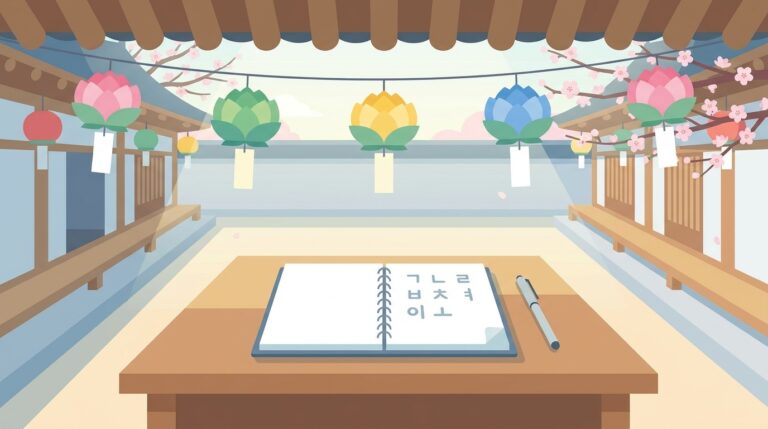
How to Hang a Lotus Lantern at a Korean Temple: A Friendly Guide
Phase 1: Empathy & Storytelling Opening
안녕하세요! 매일한글 에디터입니다. (Hello! This is the Daily Hangul editor.)
Have you ever walked through a Korean temple in springtime, surrounded by a breathtaking ocean of pink, yellow, and green lotus lanterns swaying gently in the mountain breeze? Perhaps you saw a scene in a K-drama like Extraordinary Attorney Woo or Guardian: The Lonely and Great God where characters tie heartfelt wishes beneath radiant paper lanterns.
When foreign travelers visit serene temples like Jogyesa in central Seoul or Bulguksa in Gyeongju, many freeze up. You might wonder: “Can a non-Buddhist hang a lantern?”, “What if I accidentally write something disrespectful on the wish paper?”, or “How do I politely ask the temple staff?” Many learners tell us they stood awkwardly by the temple office, intimidated by formal Buddhist terms and temple etiquette.
Don’t worry! Hanging a lotus lantern (연등 달기) is a warm, inclusive cultural ritual welcoming everyone—regardless of religion or background. Today, we have transformed real learner feedback into an easy, authentic B1-level guide so you can approach the temple with confidence, speak naturally, and leave your own glowing wish in Korea.
Phase 2: 3 Key Expressions Deep Dive
1. 연등 달고 싶어요 (Yeon-deung dal-go si-peo-yo)
- Pronunciation: [Yeon-deung dal-go si-peo-yo] (Sounds like “Yun-deung dahl-go she-poh-yo”)
- Meaning: Literal: “I want to hang a lotus lantern.” / Nuance: “I would like to participate in hanging a lotus lantern, please guide me.”
- K-Culture Moment: Used at the temple administrative office (종무소 – Jongmuso) or outdoor registration tent, especially around Buddha’s Birthday (부처님 오신 날).
- Editor’s Insight: Combining the verb 달다 (to hang/attach) with the polite desire ending -고 싶어요 (-go sipeoyo) makes your intention clear and warm. Temple staff are delighted when international visitors use this natural phrase!
- Situation Spectrum: Casual (⚠️ 달고 싶어) | Semi-formal (✅ 연등 달고 싶어요) | Formal (✅ 연등을 달고자 합니다)
- 🤔 Think About It: In English, we often say “buy a lantern,” but in Korean culture, you “offer” (공양하다) or simply “hang” (달다) a lantern because light symbolizes spreading wisdom and warmth rather than a commercial purchase.
2. 소원지에 뭐라고 써요? (So-won-ji-e mwo-ra-go sseo-yo?)
- Pronunciation: [So-won-ji-e mwo-ra-go sseo-yo?] (Sounds like “Soh-won-jee-eh mwo-rah-go suh-yoh?”)
- Meaning: Literal: “What do I write on the wish paper?” / Nuance: “How should I format my wish, and what traditional phrases do people usually write?”
- K-Culture Moment: When receiving the long strip of colored paper (소원지) to attach beneath your lantern, asking the volunteer (보살님 – Bosal-nim) for phrasing inspiration.
- Editor’s Insight: Traditional wishes often focus on family health (가족 건강 – Gajok geon-gang) or success in endeavors (소원 성취 – Sowon seong-chwi). Asking this question opens up friendly, heartwarming conversations with local elders.
- Situation Spectrum: Casual (⚠️ 소원지에 뭐 써?) | Semi-formal (✅ 소원지에 뭐라고 써요?) | Formal (✅ 소원지에 무엇을 적으면 될까요?)
- 🤔 Think About It: Korean temple wishes rarely focus purely on individual fortune; they usually start with peace and well-being for the entire household.
3. 마음이 편안해져요 (Ma-eum-i pyeon-an-hae-jyeo-yo)
- Pronunciation: [Ma-eum-i pyeon-an-hae-jyeo-yo] (Sounds like “Mah-eum-ee pyuhn-ahn-hae-jyo-yo”)
- Meaning: Literal: “My heart/mind becomes comfortable.” / Nuance: “I feel a deep sense of calm and inner peace.”
- K-Culture Moment: Stepping out into the temple courtyard after lighting incense or hanging your lantern and reflecting on the serene atmosphere.
- Editor’s Insight: The word 마음 (mind/heart/spirit) is central to Korean emotional expression. Using -아/어지다 indicates a gradual shift into a relaxed state.
- Situation Spectrum: Casual (✅ 마음이 편안해져) | Semi-formal (✅ 마음이 편안해져요) | Formal (✅ 마음이 편안해집니다)
- 🤔 Think About It: Notice how English speakers say “I am relaxed” (state), whereas Koreans emphasize “my heart is turning comfortable” (process of the soul).
Phase 3: Textbook Korean vs. Real Korean
Situation 1: Inquiring about lantern registration
- 📖 교과서 한국어 (Textbook): 연등 신청을 하고자 합니다. (Yeon-deung sin-cheong-eul ha-go-ja ham-ni-da. – “I intend to make an application for a lotus lantern.”)
- 🗣️ 진짜 한국어 (Real-life): 저기요, 연등 하나 달 수 있을까요? (Jeo-gi-yo, yeon-deung ha-na dal su iss-eul-kka-yo? – “Excuse me, could I possibly hang a lantern?”)
- 💡 왜 다를까? (Why the difference?): While the textbook uses stiff administrative jargon, real native speakers soften their requests with ~ㄹ 수 있을까요? to sound approachable and polite in spiritual spaces.
Situation 2: Parting greeting with temple volunteers or monks
- 📖 교과서 한국어 (Textbook): 안녕히 계십시오. (An-nyeong-hi gye-sip-si-o. – “Goodbye.”)
- 🗣️ 진짜 한국어 (Real-life): 성불하세요. 감사합니다! (Seong-bul-ha-se-yo. Gam-sa-ham-ni-da! – “May you attain enlightenment/peace. Thank you!”)
- 💡 왜 다를까? (Why the difference?): In Buddhist temple settings, 성불하세요 (Seongbul-haseyo) is the universal blessing greeting between visitors, monks, and volunteers.
Phase 4: K-Culture Deep Dive & Non-verbal Manners
4-1. 눈치 (Nunchi) & Temple Manners
- 합장 (Hapjang – Palm-to-Palm Bow): When passing a monk (스님 – Seunim) or walking past the main Buddha hall, bring your hands together at chest height and bow slightly (반배 – Banbae). Avoid handshakes.
- The Door Threshold Rule: When entering temple halls (대웅전 – Daeungjeon), enter through the side doors—never the center door (reserved for monks)—and never step on the wooden door sill (문턱). Step cleanly over it.
- Whisper Volume: Maintain a calm demeanor. Silence your phone before entering the main courtyard.
4-2. Cultural Code: Yeondeunghoe (연등회)
Korea’s Lantern Lighting Festival (연등회) has a 1,200-year history dating back to the Silla and Goryeo dynasties and is designated as a UNESCO Intangible Cultural Heritage. The lotus flower blooms cleanly out of muddy water, symbolizing purity, wisdom, and illuminating the darkness of ignorance. In modern Korea, even secular youths join temple stays (템플스테이) to experience lantern crafting for digital detox and mindfulness.
Phase 5: Real-World Roleplay Scenario
Setting: A sunny afternoon at Jogyesa Temple in Seoul. Alex (B1 Learner) visits the lantern registration booth to hang a wish lantern for his family and studies.
Characters: Alex (알렉스), Bodhisattva Volunteer (보살님 – Bosal-nim).
- 알렉스: 안녕하세요! 저기… 연등 하나 달고 싶어요.
(An-nyeong-ha-se-yo! Jeo-gi… yeon-deung ha-na dal-go si-peo-yo.)
“Hello! Excuse me… I would like to hang a lotus lantern.”
🎭 [두 손을 모으고 조심스럽게 미소 지으며] -
보살님: 어서 와요! 외국 분이 한국 절 문화를 잘 아시네. 여기 신청서 써 주시겠어요?
(Eo-seo wa-yo! Oe-guk bun-i han-guk jeol mun-hwa-reul jal a-si-ne. Yeo-gi sin-cheong-seo sseo ju-si-gess-eo-yo?)
“Welcome! You know Korean temple culture so well. Could you fill out this form here?”
🎭 [친절하게 볼펜과 종이를 건네며] -
알렉스: 네! 그런데 소원지에 뭐라고 쓰면 좋아요?
(Ne! Geu-reon-de so-won-ji-e mwo-ra-go sseu-myeon jo-a-yo?)
“Sure! But what is good to write on the wish paper?”
🎭 [소원지를 유심히 살펴보며 호기심 가득한 표정] -
보살님: 보통 ‘가족 건강’이나 ‘시험 합격’, ‘소원 성취’를 많이 써요. 원하는 걸 편하게 쓰면 부처님이 다 들어주실 거예요.
(Bo-tong ‘ga-jok geon-gang’-i-na ‘si-heom hap-gyeok’, ‘so-won seong-chwi’-reul man-i sseo-yo. Won-ha-neun geol pyeon-ha-ge sseu-myeon bu-cheo-nim-i da deul-eo-ju-sil geo-ye-yo.)
“Usually people write ‘Family Health’, ‘Exam Success’, or ‘Fulfillment of Wishes’. Whatever you wish for, the Buddha will listen.”
🎭 [소원지 샘플을 손가락으로 짚어주며] -
알렉스: 그럼 저는 ‘가족 건강’이랑 ‘한국어 실력 향상’이라고 쓸게요!
(Geu-reom jeo-neun ‘ga-jok geon-gang’-i-rang ‘han-guk-eo sil-lyeok hyang-sang’-i-ra-go sseul-ge-yo!)
“Then I’ll write ‘Family Health’ and ‘Improvement of Korean Skills’!”
🎭 [정성스럽게 또박또박 한글을 적으며] -
보살님: 글씨도 참 예쁘네요! 이 소원지를 연등 밑에 잘 묶어서 저쪽 마당 줄에 달면 돼요.
(Geul-ssi-do cham ye-ppeu-ne-yo! I so-won-ji-reul yeon-deung mit-e jal muk-eo-seo jeo-jjok ma-dang jul-e dal-myeon dwae-yo.)
“Your handwriting is lovely! Tie this wish paper underneath the lantern and attach it to the line over in the courtyard.”
🎭 [색색의 예쁜 연등을 건네주며] -
알렉스: 와, 정말 감사합니다. 절에 오니까 마음이 편안해져요.
(Wa, jeong-mal gam-sa-ham-ni-da. Jeol-e o-ni-kka ma-eum-i pyeon-an-hae-jyeo-yo.)
“Wow, thank you so much. Coming to the temple makes my heart feel at peace.”
🎭 [합장하며 정중하게 고개를 숙이며] -
보살님: 소원 꼭 이루어질 거예요. 성불하세요!
(So-won kkok i-ru-eo-jil geo-ye-yo. Seong-bul-ha-se-yo!)
“Your wish will surely come true. May you find peace and enlightenment!”
🎭 [따뜻하게 두 손 모아 인사하며]
🔀 Interactive Choice Point
What would you do next after hanging your lantern?
* Option A: Bow toward the main shrine hall with hands pressed together (합장) and say “감사합니다, 성불하세요.”
Feedback: [BEST] Superb cultural immersion! The temple staff and visitors will admire your etiquette.
* Option B: Take a loud selfie call right in front of the meditation hall while pointing at other lanterns.
Feedback: [BAD] Disrespectful to practitioners meditating inside. Keep photo taking silent and mindful.
* Option C: Leave without securing the wish paper string tightly on the line.
Feedback: [RISK] A gust of spring wind might blow your wish away! Always tie a secure double knot.
Phase 6: 10-Second Emotion Shadowing Drill
Practice reading these out loud with natural cadence and emotion! / indicates a micro-pause.
[🙏 정성스럽고 공손하게 - Sincere & Polite]
저기요, / 연등 하나 / 달고 싶어요.
(Jeo-gi-yo, / yeon-deung ha-na / dal-go si-peo-yo.)-
[🤔 궁금하고 진지하게 - Curious & Earnest]
소원지에 / 뭐라고 쓰면 / 좋을까요?
(So-won-ji-e / mwo-ra-go sseu-myeon / jo-eul-kka-yo?) -
[😌 평온하고 감동하며 - Serene & Touched]
연등을 보니까 / 마음이 정말 / 편안해져요.
(Yeon-deung-eul bo-ni-kka / ma-eum-i jeong-mal / pyeon-an-hae-jyeo-yo.)
Phase 7: K-Culture Mini Dictionary
- 연등 (Yeon-deung) [Lotus Lantern]: A paper lantern shaped like a lotus blossom. In daily life, it represents illuminating one’s mind and clearing away dark worries.
- 소원지 (So-won-ji) [Wish Paper]: The elongated strip of paper attached beneath lanterns, containing personal aspirations, family names, and prayers.
- 보시 (Bo-si) [Alms / Giving]: Buddhist act of selfless offering or donation. When you hang a lantern, the modest fee is considered 보시금 (donation supporting temple maintenance and charitable works).
- 성불 (Seong-bul) [Attaining Buddhahood / Inner Peace]: The ultimate spiritual greeting in Korean Buddhism wishing someone enlightenment and complete fulfillment.
Phase 8: Traveler’s Survival Kit
Survival Expressions TOP 3
- 공양간이 어디예요? (Gong-yang-gan-i eo-di-ye-yo?)
Meaning: Where is the temple dining hall?
Pro Tip: Many temples offer free or low-cost vegetarian temple meals (사찰음식) around lunchtime during festivals. - 사진 찍어도 돼요? (Sa-jin jji-geo-do dwae-yo?)
Meaning: May I take a photo?
Pro Tip: Courtyards are usually fine, but photography is strictly prohibited inside prayer halls with Buddha statues. - 신발 벗고 들어가요? (Sin-bal beot-go deul-eo-ga-yo?)
Meaning: Do I take off my shoes to enter?
Pro Tip: All wooden shrine hall floors require shoes off. Step on the stepping stone (디딤돌) cleanly.
Editor’s Travel Note
- Navigation: Open your Naver Map app download to search for accessible historic temples near metro stations (e.g., Jogyesa near Anguk Station, Bongeunsa in Gangnam).
- Temple Stay Booking: If you wish to spend a night experiencing meditation and tea ceremonies, use the Official Templestay reservation portal.
- Payment Tip: Most major temple offices accept credit cards (신용카드) for lantern donations, but having 10,000 KRW in cash is ideal for traditional donation boxes (불전함).
Phase 9: A Step Deeper (한 발 더 깊이)
In Korean society, the temple is not an exclusive club for strict believers; it is a shared cultural sanctuary. Historically, Koreans harmonized Buddhist philosophy, Daoist nature worship, and Confucian ancestral respect. When modern Koreans—regardless of their personal faith—climb mountains and tie wish papers onto lotus lanterns, they participate in Gibeok (기복 – seeking peace and benevolence for loved ones). It represents a collective moment of taking a deep breath and sharing unconditional goodwill with the universe.
💬 Your Turn: If you were to write a wish on a Korean lotus lantern today, what single wish would you choose for yourself or your family? Share in the comments below in Korean!
Phase 10: FAQ & Common Mistakes
Q: Do I need to be a Buddhist to hang a lantern or visit a temple in Korea?
A: Not at all! Korean temples are open public cultural heritage spaces. People of all faiths or no faith are warmly welcomed to hang lanterns, meditate, and enjoy temple stays.
Q: What is the most standard phrase to write on the wish paper (소원지)?
A: The most timeless phrase is 가족 건강 및 소원 성취 (Ga-jok geon-gang mit so-won seong-chwi), meaning “Family health and the fulfillment of all heartfelt wishes.”
Q: Can I hang a lantern at any time of the year?
A: While lanterns are hung year-round at major temples for special prayers, the full sea of colorful lanterns is best experienced during the month leading up to Buddha’s Birthday (typically April to May on the lunar calendar).
🚨 Common Mistakes Alert
- Mistake: Stepping firmly onto the raised wooden threshold (문턱) of the temple door.
Correct Action: Always step high over the threshold. Stepping on it is considered bringing bad luck and wearing down sacred architecture. - Mistake: Wearing revealing tank tops, short shorts, or flip-flops inside main prayer rooms.
Correct Action: Dress comfortably with covered shoulders and knees out of respect for monks and meditating worshippers. - Mistake: Walking directly across the center aisle right in front of the main Buddha statue.
Correct Action: Walk around the edges of the prayer hall; the center path is reserved for ceremonial rituals.
Phase 11: Action Mission & Engagement
- 🥉 Bronze Mission (Solo): Read the Phase 6 Shadowing Drill out loud 3 times until the words flow without hesitation.
- 🥈 Silver Mission (Social): Post your favorite Korean temple wish phrase (e.g.,
가족 건강과 행복) in your Korean study notebook or Instagram story. - 🥇 Gold Mission (Real Life): When visiting Jogyesa or Bongeunsa, step up to the desk and say: “연등 하나 달고 싶어요!” without switching to English!
- 🎮 K-Culture Mission: Watch an episode of a historical or modern drama (like My Liberation Notes) and spot the difference between everyday Korean and peaceful temple greetings!
Phase 12: Interactive Quiz Challenge
1. Situation Challenge: You want to ask the temple volunteer what to write on your wish card. Which expression is most natural?
* A) 소원지에 뭐 써라?
* B) 소원지에 뭐라고 써요?
* C) 소원지를 쓰시오.
🔍 Check Answer & Explanation
Answer: B
소원지에 뭐라고 써요? is the natural polite question form (B1 level). Option A is rude informal speech, and Option C is an imperative command!
2. Fill-in-the-Blank: Complete the classic wish phrase meaning “Fulfillment of wishes”:
* 소원 ______ (So-won ______)
🔍 Check Answer & Explanation
Answer: 성취 (Seong-chwi)
소원 성취 translates to “achieving/fulfilling one’s wishes” and is written on millions of Korean wish cards every year.
3. Culture True/False: Non-Buddhists and international travelers are prohibited from hanging lanterns in Korean temples.
* [True / False]
🔍 Check Answer & Explanation
Answer: False
Lotus lantern hanging is a cultural and spiritual practice open to everyone in the world seeking peace and good fortune!







