

How to Truly Apologize When Changing Plans in Korean
Phase 1: Empathy & Story
안녕하세요! 매일한글 에디터입니다. (Hello! This is your Daily Hangul editor.)
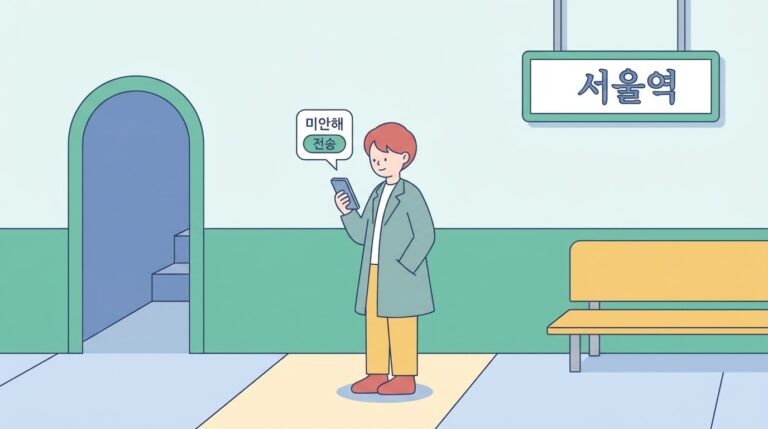
Picture this: You finally made plans with your Korean friend to visit that trendy tteokbokki spot in Hongdae that you saw on TikTok. You are on Seoul Subway Line 2, but an unexpected sudden work emergency or a canceled train occurs. You realize you cannot make it on time—or worse, you have to cancel completely. Your heart drops. You open KakaoTalk, stare at the blank message screen, and wonder: “If I just say ‘Mianhaeyo’, will I sound cold or rude? How do Korean friends sincerely apologize without ruining the friendship?”
Many of our beginner learners tell us that canceling plans is their biggest social anxiety in Korea. In Korean culture, an apology is not just about saying “sorry”—it is about restoring the relationship and showing immediate consideration. Master these phrases today, and you will never fear sending that emergency KakaoTalk message again!
Phase 2: Top 3 Core Expressions Deep-Dive
1. 진짜 미안해요! 다음엔 제가 꼭 살게요! (Jinjja mianhaeyo! Daeumen jega kkok salgeyo!)
- Pronunciation: [Jeen-jja mee-ahn-hae-yo! Dah-eum-en jeh-gah kkok sal-geh-yo!] (Sounds like ‘Jean-jja’ + ‘Me-on-hair-yo’)
- Meaning: Literal: “Really sorry! Next time I will definitely buy!” / Actual Nuance: “I am so sorry for messing up our plans! Let me treat you next time to make it up to you!”
- K-Culture Moment: Frequently heard in K-dramas when a character gets stuck at the office and promises a delicious meal as compensation.
- Editor’s Insight: In Korea, pairing a sincere apology with the offer to treat (내가 살게 / 제가 살게요) is the ultimate gesture of goodwill that instantly melts any awkwardness.
- Situation Spectrum: Casual (✅ with friends: 진짜 미안해! 내가 꼭 살게!), Semi-formal (✅), Formal (⚠️)
- 🤔 Think About It: Why does Korean culture connect personal apologies with sharing food or buying the next round?
2. 오늘 갑자기 일이 생겨서 정말 죄송합니다. (Oneul gapjagi iri saenggyeoseo jeongmal joesonghamnida.)
- Pronunciation: [Oh-neul gahp-jah-gi ee-ree saeng-gyeo-seo jeong-mahl joe-song-hahm-nee-dah.]
- Meaning: Literal: “Something suddenly came up today, so I am truly sorry.” / Actual Nuance: “A sudden emergency popped up, and I sincerely apologize for the inconvenience.”
- K-Culture Moment: The standard polite message sent to study groups, language exchange partners, or senior colleagues (Sunbae).
- Editor’s Insight: Using “갑자기 일이 생겨서” (something came up suddenly) is the most polite and natural way to excuse yourself without oversharing private TMI.
- Situation Spectrum: Casual (⚠️ too stiff for besties), Semi-formal (✅), Formal (✅)
- 🤔 Think About It: Is it customary in your culture to give a specific medical or personal reason, or do you prefer vague politeness?
3. 약속을 미뤄서 너무 죄송해요. (Yaksogeul mirwoseo neomu joesonghaeyo.)
- Pronunciation: [Yahk-sohk-eul mee-rwoh-seo neoh-moo joe-song-hae-yo.]
- Meaning: Literal: “I postponed our appointment, so I am very sorry.” / Actual Nuance: “I’m so sorry for having to push back our meeting time/date.”
- K-Culture Moment: Used when rescheduling from 2 PM to 4 PM or moving dinner from Friday to Saturday.
- Editor’s Insight: “미루다” (miruda) means to postpone. Combining it with “너무 죄송해요” creates a soft, respectful tone.
- Situation Spectrum: Casual (✅ 약속 미뤄서 미안!), Semi-formal (✅), Formal (✅)
- 🤔 Think About It: Notice how Korean places the reason before the apology verb. How does that shift the focus of the sentence?
Phase 3: Textbook Korean vs. Real Korean
Situation 1: Letting your friend know you cannot make it today
- 📖 Textbook Korean: 오늘 약속을 취소하겠습니다. (Oneul yaksogeul chwisohagessseumnida. – I will cancel today’s appointment.)
- 🗣️ Real Korean: 오늘 진짜 못 갈 것 같아요, 어쩌죠? ㅠㅠ (Oneul jinjja mot gal geot gat-ayo, eojjeojyo? – I really don’t think I can make it today, what should we do? T_T)
- 💡 Why is it different? The textbook phrase sounds like an automated airline cancellation notice! Real Koreans soften bad news using “~것 같아요” (seems like) and the crying emoticon “ㅠㅠ”.
Situation 2: Promising to make up for canceling
- 📖 Textbook Korean: 다음 기회에 보상하겠습니다. (Daeum gihwoee bosanghagessseumnida. – I will compensate you next time.)
- 🗣️ Real Korean: 다음엔 내가 진짜 맛있는 거 쏠게! (Daeumen naega jinjja masinneun geo ssolge! – Next time I’ll treat you to something super delicious!)
- 💡 Why is it different? “보상” (compensation) sounds like legal insurance settlement. “쏜다” (to shoot / treat) creates an immediate warm, friendly vibe among peers.
Phase 4: K-Culture Deep Dive & Non-Verbal Manners
4-1. Nunchi & Body Gestures
When apologizing in person for being late or changing plans:
1. The Two-Hand Prayer Gesture: Press both palms together near your chest with a slight head bow when saying “진짜 미안해요!”
2. Eye Contact & Modesty: Don’t stare aggressively. Lower your gaze slightly to show remorse.
3. Quick KakaoTalk Reflex: Do not wait until 5 minutes before the meeting. The moment you realize a delay, text immediately. In Korea, letting someone wait alone at a station without updates is a major social taboo.
4-2. The “내가 쏠게 (I’ll Treat)” Culture
In Korea’s ‘Jeong’ (정) culture, inconveniencing someone emotionally is healed through generosity. Saying “다음엔 내가 쏠게!” (Next time on me!) isn’t just an empty phrase—it actively preserves the harmony of the friendship.
Phase 5: Real-Life Roleplay Scenario
- Background: You were supposed to meet your Korean friend, Minji, at a cafe in Yeonnam-dong at 3:00 PM. A sudden schedule conflict occurs at 2:00 PM.
- Characters: You (유저) & Minji (민지)
- You: 민지 씨, 지금 어디예요? (Minji ssi, jigeum eodieyo?)
🎭 [Looking at watch nervously]
(Minji, where are you right now?) - Minji: 저 지금 연남동 카페 앞이에요! 천천히 와요. (Jeo jigeum Yeonnam-dong kape apieyo! Cheoncheonhi wayo.)
🎭 [Sending a cute cafe sticker]
(I’m in front of the Yeonnam-dong cafe right now! Take your time.) - You: 헉, 민지 씨… 오늘 갑자기 급한 일이 생겼어요. (Heok, Minji ssi… oneul gapjagi geupan iri saenggyeosseoyo.)
🎭 [Bowing head over phone]
(Oh no, Minji… something really urgent just came up today.) - Minji: 앗, 그래요? 무슨 일 있어요? (At, geuraeyo? Museun il isseoyo?)
🎭 [Concerned tone]
(Oh really? Is everything okay?) - You: 정말 죄송해요. 약속을 다음 주로 미룰 수 있을까요? (Jeongmal joesonghaeyo. Yaksogeul daeum juro mirul su isseulkkayo?)
🎭 [Holding phone with two hands]
(I’m so sorry. Could we possibly postpone our meet-up to next week?) - Minji: 아이고, 괜찮아요! 급한 일 먼저 해결하세요. (Aigo, gwaenchanayo! Geupan il meonjeo haegyeolhaseyo.)
🎭 [Understanding smile]
(Oh gosh, it’s totally okay! Handle your urgent matter first.) - You: 진짜 미안해요. 다음엔 제가 맛있는 디저트 꼭 살게요! (Jinjja mianhaeyo. Daeumen jega masinneun dijeoteu kkok salgeyo!)
🎭 [Deeply apologetic & appreciative]
(I am truly sorry. Next time, I will definitely buy delicious dessert!) - Minji: 좋아요! 그럼 다음 주에 연락해요! (Joayo! Geureom daeum jue yeollakhaeyo!)
🎭 [Waving cheerily]
(Sounds great! Text me next week then!)
🔀 Interactive Choice Point
How would you conclude your message to Minji?
* Choice A: “미안. 바이.” (Mian. Bai.)
* Choice B: “진짜 미안해요! 조심히 들어가시고 다음 주에 제가 연락할게요!”
* Choice C: “알겠습니다. 취소되었습니다.”
- Feedback:
- Choice A (Bad): Far too blunt. Sounds angry or dismissive.
- Choice B (Best! ⭐): Warm, polite, asks them to get home safely, and takes initiative to reschedule.
- Choice C (Risk): Sounds like a robotic bank notification.
Phase 6: 10-Second Emotion Shadowing Drill
Practice reading these aloud with feeling! Slashes (/) indicate natural pause points.
[🥺 진심으로 미안하고 다급하게 - Sincerely apologetic & urgent]
“민지 씨, / 오늘 갑자기 급한 일이 생겨서 / 정말 죄송해요! / ㅠㅠ”
(Minji ssi, / oneul gapjagi geupan iri saenggyeoseo / jeongmal joesonghaeyo! / ㅠㅠ)-
[🙏 간절하고 고마운 마음으로 - Earnest and grateful]
“약속 미뤄줘서 / 너무 고마워요! / 다음엔 제가 꼭 쏠게요!”
(Yaksok mirwojwoseo / neomu gomawoyo! / daeumen jega kkok ssolgeyo!)
Phase 7: K-Culture Mini Dictionary
- 파토 (Pato): Noun. A canceled plan or broken appointment. (e.g., “오늘 약속 파토 났어” = Today’s plan got wrecked/canceled).
- 쏘다 (Ssoda): Verb. To treat someone to food/drinks. Literally “to shoot”. (e.g., “커피는 내가 쏠게!” = Coffee is on me!).
- 약속 (Yaksok): Noun. Plans, appointments, or promises with people.
- 급약속 / 번개 (Geup-yaksok / Beongae): Noun. An impromptu or last-minute meetup (“lightning meet”).
Phase 8: Traveler’s Survival Kit
Top 3 Survival Phrases
- 조금 늦을 것 같아요, 죄송합니다! (Jogeum neujeul geot gat-ayo, joesonghamnida! – I think I will be a little late, sorry!)
- Pro Tip: Use this on KakaoTalk if you’re running 10-15 minutes behind.
- 시간을 바꿀 수 있을까요? (Siganeul bakkul su isseulkkayo? – Could we change the time?)
- Pro Tip: Great for calling Korean beauty salons or restaurants to adjust your reservation.
- 다음에 꼭 다시 만나요! (Daeume kkok dasi mannayo! – Let’s definitely meet up next time!)
- Pro Tip: Softens the cancellation and reaffirms that you truly value the friendship.
Editor’s Travel Note
Always track your subway arrival using the Naver Map navigation mobile application. Seoul traffic during rush hour (6 PM – 8 PM) can double your transit time, so check your real-time ETA 40 minutes ahead to send an early heads-up message!
Phase 9: Think Deeper
In many Western cultures, a good apology focuses on identifying the specific issue and explaining boundaries. In Korea, interpersonal harmony (화, Hwa) relies on acknowledging the other person’s invested time and emotional labor. When you cancel, you don’t just state a fact—you cushion the emotional blow by immediately suggesting a remedy (“I’ll buy next time!”).
💬 Your Turn: How do people in your home country usually react when someone cancels plans last minute? Leave a comment below and let’s compare cultures!
Phase 10: FAQ & Common Mistakes
Q: Can I just say ‘Mianhae’ (미안해) when canceling plans?
A: Only to very close friends of the exact same age or younger! If you are speaking with colleagues, language partners, or older acquaintances, always use polite forms like ‘죄송합니다’ (Joesonghamnida) or ‘미안해요’ (Mianhaeyo).
Q: What is the best emoticon to express apology in KakaoTalk?
A: Use crying vowels like ‘ㅠㅠ’ or ‘ㅜㅜ’, paired with hands-clasped emojis (🙏). Avoid sending a plain sentence without any emoticons, as it can appear cold in digital Korean text.
Q: How can I change a salon or restaurant booking politely in Korean?
A: Say: “예약 시간을 조금 변경할 수 있을까요?” (Yeyak siganeul jogeum byeongyeonghal su isseulkkayo? – Could I change the reservation time a bit?).
🚨 Common Mistakes Warning Board
- Mistake 1: Disappearing silently (잠수 타기 – Ghosting). Correct Action: Text immediately, even if it’s awkward!
- Mistake 2: Saying “취소합니다” (I cancel) like a robot. Correct Action: Use “오늘 못 갈 것 같아요” (I don’t think I can go today).
- Mistake 3: Forgetting to offer the next plan. Correct Action: Always add “다음에 제가 꼭 살게요!”
Phase 11: Action Missions
- 🥉 Bronze Mission: Record yourself saying “진짜 미안해요! 다음엔 제가 꼭 살게요!” in voice memos with sincere emotion.
- 🥈 Silver Mission: Write an apology KakaoTalk message to an imaginary Korean friend in the comments section.
- 🥇 Gold Mission: Spot the phrase “내가 쏠게” or “일이 생겨서” in your favorite K-Drama this week and screenshot the subtitle!
- 🎮 K-Culture Mission: Watch an episode of an office K-drama (like Misaeng or Business Proposal) and notice how characters bow slightly when apologizing over phone calls.
Phase 12: Interactive Quiz Challenge
1. Situation Question: You need to tell your Korean language exchange partner that an emergency happened and you cannot meet today. Which is the most polite and natural phrase?
– A) 약속을 파토낼게요.
– B) 오늘 갑자기 일이 생겨서 정말 죄송해요. ㅠㅠ
– C) 다음엔 너가 사.
2. Fill in the blank: “약속을 미뤄서 너무 ______.” (I’m so sorry for postponing the plan.)
– [ 죄송해요 / 쏠게요 ]
3. True / False: In Korea, saying “다음엔 제가 쏠게요!” (Next time on me!) is considered a great way to sincerely make up for canceling plans.
– [ True / False ]
👉 Click to reveal answers & explanations!
- Answer: B. (A is slang and impolite to a partner; C is demanding the other person buy!)
- Answer: 죄송해요. (쏠게요 means ‘I will treat’).
- Answer: True. (It shows warmth, regret, and commitment to the friendship).






