

Phase 1: Empathy & Storytelling Opening
안녕하세요! 매일한글 에디터입니다. (Hello! This is your Daily Hangul editor.)
Have you ever walked into one of Korea’s vibrant used bookstores, like the famous Aladdin (알라딘) branches in Sinchon or Gangnam, carrying a stack of Korean novels or study books you no longer need? You gaze at the sleek sell counter marked “책 팝니다 / 바이백 (Buyback)”, feeling a rush of excitement to earn some pocket money and live like a true local resident. But then, panic strikes! The staff member asks, “회원 가입 되어 있으세요? (Are you a registered member?)” or inspects your book and announces a quality grade like “최상 (Top Tier)” or “매입 불가 (Cannot Purchase)” at lightning speed.
Suddenly, your textbook phrases vanish from your mind. How do you ask if they accept books with pencil marks? How do you choose between getting cash or store credit points? Selling used items in Korea involves specific real-life vocabulary and unique social etiquette. Based on feedback from dozens of our intermediate B1 learners, navigating Korean used bookstores turns out to be one of the most rewarding local milestones once mastered. Today, we’re going to walk through the exact phrases, cultural nuances, and conversational confidence you need to sell your pre-loved books like an experienced Seoulite!
Phase 2: Top 3 Essential Expressions Deep Dive
1. 이 책 팔려고 하는데요. (I’d like to sell these books.)
- Pronunciation: I chaek pal-lyeogo haneundeyo. (Sounds like: Ee check pahl-lyaw-goh ha-neun-day-yo)
- Meaning: Literal: “I intend to sell this book, but…” | Real Nuance: A polite, natural conversation opener when placing your books on the counter.
- K-Culture Moment: Seen frequently in slice-of-life K-Dramas like Romance is a Bonus Book or YouTube college vlogs where students declutter their dorm bookshelves before graduation.
- Editor’s Insight: The ending ~는데요 (~neundeyo) softens the statement, subtly inviting the clerk to respond and initiate the inspection process without sounding demanding.
- Situation Spectrum: Casual: ⚠️ (Use 이 책 팔려고 왔어) | Semi-formal: ✅ (Perfect for counters) | Formal: ✅ (이 책들을 매입 신청하려고 합니다)
- 🤔 Think About It: In English, we might say “I want to sell these books.” Why does Korean favor the trailing ~는데요 instead of a definitive direct statement?
2. 밑줄이나 낙서가 조금 있는데 괜찮을까요? (There are some underlines and scribbles; will it be okay?)
- Pronunciation: Mit-juri-na nak-seoga jogeum inneunde gwaen-chanh-eulkkayo? (Sounds like: Meet-joo-ree-na nahk-saw-gah jo-geum een-neun-day gwen-chahn-eul-kkah-yoh?)
- Meaning: Literal: “Underlines or scribbles exist a little, but is it okay?” | Real Nuance: Preemptively disclosing minor defects politely to ask about bookstore buyback eligibility.
- K-Culture Moment: Used by university students reselling second-hand TOPIK test prep books or essay collections.
- Editor’s Insight: Korean bookstores strictly categorize book conditions into 최상 (Pristine), 상 (Very Good), 중 (Acceptable), and 매입 불가 (Rejected). Pointing out flaws yourself displays honesty and saves time.
- Situation Spectrum: Casual: ⚠️ | Semi-formal: ✅ | Formal: ✅
- 🤔 Think About It: Notice how asking 괜찮을까요? (Will it be okay?) softens the conversation compared to asking “Do you take written books?”
3. 현금 대신 포인트로 적립해 주세요. (Please credit it as points instead of cash.)
- Pronunciation: Hyeon-geum daesin pointeu-ro jeongnip-hae juseyo. (Sounds like: Hyun-geum deh-sheen poin-teu-roh jung-neep-heh joo-seh-yoh)
- Meaning: Literal: “Instead of cash, please accumulate into points.” | Real Nuance: Opting for bookstore points (which often give a 10-20% extra bonus value) to buy more books immediately.
- K-Culture Moment: A classic habit of bookworms and café-goers in Korea who recycle their reading list continuously at franchise used bookstores.
- Editor’s Insight: The particle 대신 (daesin – instead of) combined with ~로 (direction/method) is a high-utility intermediate grammar pattern applicable everywhere from cafés (우유 대신 두유로 – soy milk instead of dairy) to retail.
- Situation Spectrum: Casual: 🚫 | Semi-formal: ✅ | Formal: ✅
- 🤔 Think About It: Why is retail loyalty membership (적립 – jeongnip) so deeply integrated into everyday Korean commercial culture?
Phase 3: Textbook Korean vs. Real Native Korean
Situation 1: Handing over books at the buyback counter
- 📖 Textbook Korean: 이 책들을 당신에게 팔고 싶습니다. 사 주세요. (I want to sell these books to you. Please buy them.)
- 🗣️ Real Native Korean: 안녕하세요, 바이백(중고 매입) 신청하러 왔어요. (Hi, I came to submit books for buyback.)
- 💡 Why the difference? Directly telling a store employee “당신에게 팔고 싶습니다” sounds unnatural and overly literal. Native speakers refer directly to the service term (바이백 or 중고 매입) with an intentional verb ending (~하러 왔어요).
Situation 2: Asking if a damaged book can be sold
- 📖 Textbook Korean: 이 책은 부서졌는데 팔 수 있습니까? (This book is broken, can I sell it?)
- 🗣️ Real Native Korean: 표지에 얼룩이 좀 있는데 매입 가능한가요? (There is a slight stain on the cover; is buyback possible?)
- 💡 Why the difference? Books aren’t described as “부서지다 (broken)” unless physically destroyed. Native speakers specify the exact condition (얼룩 – stain, 낙서 – handwriting, 찢김 – tear) and ask using the business term 매입 가능 (eligible for purchase).
Phase 4: K-Culture Deep Dive & Non-Verbal Manners
4-1. Nunchi & Body Language at the Counter
When approaching the used book counter in Korea, keep these non-verbal cues in mind:
* Two-Handed Stack Placement: Place your stack of books flat on the desk facing the clerk with both hands. It signals respect and care for the merchandise.
* Identification Ready: Korean second-hand trade laws require identity verification to prevent stolen goods circulation. Have your Korean Alien Registration Card (ARC), passport, or store app barcode ready in your hand before they finish scanning.
* Respectful Distance During Inspection: The clerk will quickly flip through every single page using a special thumb technique. Step back slightly and wait quietly rather than hovering over their hands.
4-2. Cultural Code: The “Aladdin Phenomenon” (알라딘 중고서점)
In many countries, used bookstores are quaint, dusty vintage shops. In South Korea, used bookstores are sprawling, ultra-modern cultural spaces equipped with coffee shops, indie stationery, and high-tech inventory systems. Selling books at Aladdin or Yes24 is treated like a smart, eco-friendly lifestyle habit called 미니멀 라이프 (Minimal Life) or 앱테크 (App-Tech / micro-investing). Young Koreans take pride in keeping their books pristine with removable plastic covers just so they can sell them later at “최상 (Pristine Grade)” value!
Phase 5: Real-Life Roleplay Scenario
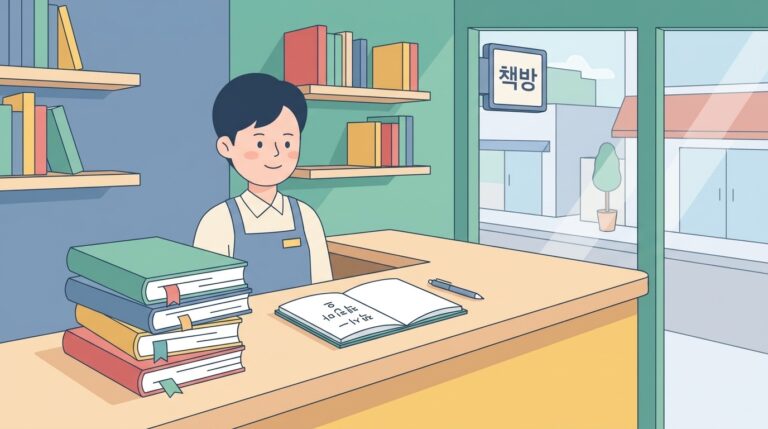
Setting: Aladdin Used Bookstore near Hongdae Station. Warm lighting, ambient acoustic jazz playing, and stacks of neatly categorized books.
Characters:
* 민지 (Minji): Efficient and polite bookstore staff wearing a navy apron and scanning barcode reader.
* 수현 (Suhyeon): B1 Korean learner decluttering Korean study books.
- 민지: 안녕하세요! 책 매입 도와드릴까요? 앞에 올려주세요.
(Annyeonghaseyo! Chaek maeip dowa-deurilkkayo? Ape ollyeo-juseyo.)
🎭 [Takes the books and smiles warmly]
“Hello! Shall I help you with book buybacks? Please place them up front.” -
수현: 네, 안녕하세요. 이 책 세 권 팔려고 하는데요.
(Ne, annyeonghaseyo. I chaek se gwon pal-lyeogo haneundeyo.)
🎭 [Gently places the 3 books on the counter with both hands]
“Yes, hello. I would like to sell these three books.” -
수현: 그런데 한 권은 연필로 필기를 조금 했는데 괜찮을까요?
(Geureonde han gwoneun yeonpil-ro pilgireul jogeum haenneunde gwaen-chanh-eulkkayo?)
🎭 [Points politely to the second book in the stack]
“However, one book has some pencil notes; will it be okay?” -
민지: 상태 한번 확인해 볼게요. 잠시만 기다려 주세요.
(Sangtae hanbeon hwaginhae bolgeyo. Jamsiman gidaryeo juseyo.)
🎭 [Rapidly flips through the pages and checks the barcode]
“Let me check the condition. Please wait a brief moment.” -
민지: 손님, 연필 자국 있는 책은 ‘중’ 등급으로 들어가고요, 나머지 두 권은 ‘최상’ 등급입니다.
(Sonnim, yeonpil jaguk inneun chaegeun ‘jung’ deunggeubeuro deoreogagoyo, nameoji du gwoneun ‘choesang’ deunggeubimnida.)
🎭 [Turns the monitor display towards Suhyeon]
“Customer, the book with pencil marks goes into ‘Acceptable’ grade, and the other two are ‘Pristine’ grade.” -
수현: 아, 다행이네요! 총 얼마예요?
(A, dahaeng-ineyoh! Chong eolmayeyo?)
🎭 [Looks at the screen with a relieved smile]
“Ah, what a relief! How much is it in total?” -
민지: 총 만 삼천 원입니다. 현금으로 받으시겠어요, 예치금(포인트)으로 적립해 드릴까요?
(Chong man samcheon won-imnida. Hyeon-geumeuro badeu-sigesseoyo, yechigeum(pointeu)ro jeongnip-hae deurilkkayo?)
🎭 [Holds a receipt printer pen ready]
“It comes to 13,000 KRW in total. Would you like cash, or shall I credit it as store deposit points?” -
수현: 오늘 다른 소설책도 살 거라서, 포인트로 적립해 주세요!
(Oneul dareun soseolchaekdo sal georaseo, pointeu-ro jeongnip-hae juseyo!)
🎭 [Shows membership barcode on phone]
“I’m going to buy another novel today, so please credit it as points!”
🔀 Interactive Branching Point
If the clerk tells you that one book is “매입 불가 (Cannot be purchased due to high store inventory stock)”, what would you say?
- Option A: “그냥 버려주세요!” (Just throw it away!)”
- Feedback [Bad]: Used bookstores cannot simply dispose of customer property in the regular trash due to waste recycling and liability laws. It can sound dismissive.
- Option B: “매입 안 되는 책은 다시 가져갈게요.” (I will take back the unaccepted book.)”
- Feedback [Best]: Clear, polite, and standard protocol. The clerk will hand it back with a smile.
- Option C: “왜 안 돼요? 제가 샀던 건데요!” (Why not? I bought this here before!)”
- Feedback [Risk]: Book buyback rates depend on real-time stock balance in the warehouse, not just condition. Arguing can create an uncomfortable atmosphere.
Phase 6: 10-Second Emotion Shadowing Drill
Read these sentences aloud following the slashes (/) as micro-pauses and embodying the emotion tags:
[😊 Polite & Friendly]
안녕하세요! / 이 책 세 권 / 팔려고 가져왔어요.
(An-nyeong-ha-se-yo! / I chaek se gwon / pal-lyeo-go ga-jyeo-wass-eo-yo.)-
[🤔 Modest & Inquiring]
안에 필기가 조금 있는데 / 매입 가능할까요?
(An-e pil-gi-ga jo-geum in-neun-de / mae-ip ga-neung-hal-kka-yo?) -
[✨ Bright & Decisive]
현금 대신에 / 알라딘 포인트로 / 적립해 주세요!
(Hyeon-geum dae-sin-e / al-la-din po-in-teu-ro / jeong-nip-hae ju-se-yo!)
Phase 7: K-Culture Mini Dictionary
-
바이백 (Bai-baek / Buyback)
- Definition: Secondhand bookstore purchase service where stores repurchase pre-owned media from customers.
- Usage: Widely used on store signage (e.g., 바이백 창구 = Buyback counter).
- 등급 (Deung-geup / Grade & Condition Rating)
- Definition: The physical quality assessment of a book: 최상 (Pristine), 상 (Very Good), 중 (Acceptable).
- Usage: “이 책은 물에 젖어서 등급이 안 나와요.” (This book has water damage, so it cannot receive a grade).
- 매입 불가 (Mae-ip Bul-ga / Buyback Ineligible)
- Definition: Books the store refuses to buy due to excess stock, severe tears, CD/supplement loss, or expired editions.
- Usage: Common automated message on scanning apps.
- 적립 / 예치금 (Jeong-nip / Ye-chi-geum / Store Credit & Accumulation)
- Definition: Saving monetary value onto your digital bookstore account balance for future purchases.
- Usage: “포인트로 적립하시면 10% 추가 혜택이 있어요.” (You get a 10% extra benefit if you credit as points).
Phase 8: Traveler’s Survival Kit
Top 3 Survival Phrases
- 바코드 찍어봐도 될까요? (Ba-ko-deu jjik-eo-bwa-do dwel-kka-yo? / May I scan the barcode?)
- Pro Tip: Use this when using in-store self-scanning kiosks to check book buyback prices yourself!
- 신분증 여기 있어요. (Sin-bun-jeung yeo-gi iss-eo-yo. / Here is my ID.)
- Pro Tip: Hand over your passport or foreign registration card smoothly with two hands.
- 매입 안 되면 폐기해 주실 수 있나요? (Mae-ip an doe-myeon pye-gi-hae ju-sil su in-na-yo? / If it cannot be bought, can you discard/recycle it for me?)
- Pro Tip: Some major branches allow eco-recycling drop-offs if you check the agreement box on the touch screen.
Editor’s Travel Note
- Essential App: Before carrying heavy books to the store, download the Aladdin Official App on the Apple App Store / Google Play Store and tap the barcode camera search under “중고 팔기”. It instantly shows whether the branch accepts your exact book and the estimated payout!
- Location Tip: Look for the signature phrase “오늘 들어온 책 (Books arrived today)” near the entrance to find rare Korean graphic novels and translated bestsellers.
Phase 9: A Step Deeper (Reflection)
In South Korea, physical books are treated with remarkable reverence. Notice how the buyback system scrutinizes even microscopic pen marks and sun-bleached spines. This standard reflects Korea’s collective respect for educational goods and the aesthetic desire for clean, orderly shared items. Selling your used book in Korea is not just a commercial transaction; it is passing a baton of knowledge to the next learner in pristine shape.
💬 Your Turn: Have you ever bought or sold a secondhand book in your home country or in Korea? What difference in inspection culture surprised you the most? Share your stories in the comments below!
Phase 10: FAQ & Common Pitfalls
Q: Can foreigners without a Korean bank account sell books for cash?
A: Yes! As long as you present a valid physical passport or Alien Registration Card (ARC), you can receive cash directly at the counter. However, digital bank transfers (계좌이체) require a verified domestic Korean bank account.
Q: Why did the store reject my brand new book?
A: Korean used bookstores operate on inventory caps. If a branch already has more than 5-10 copies of that exact bestseller in their warehouse, the system automatically tags it as “재고 과다 (Excess Inventory / 매입 불가)” regardless of condition.
Q: Do secondhand bookstores buy English or foreign books in Korea?
A: Yes! Major branches in university hubs (Sinchon, Gangnam, Hyehwa) actively buy English paperbacks, classics, and popular business books provided they have a valid international ISBN barcode.
🚨 Common Mistakes Alert (TOP 3)
- Writing names on the front cover: In Korean standards, writing your name on the inside page instantly drops the condition from 최상 (Pristine) to 중 (Acceptable) or causes rejection.
- Forgetting included components: If a language book originally came with an audio CD or workbook booklet, missing it results in automatic 매입 불가.
- Speaking in informal banmal to store clerks: Avoid saying “이거 얼마야?”. Always maintain courteous polite endings like “얼마로 책정되었나요?” or “얼마예요?”.
Phase 11: Action Mission & Engagement
- 🥉 Bronze Mission: Practice saying the shadowing drill sentence “이 책 세 권 팔려고 하는데요” 5 times in front of the mirror with a bright smile.
- 🥈 Silver Mission: Download a Korean bookstore app, scan 1 Korean book on your desk, and check its condition tier (최상/상/중).
- 🥇 Gold Mission: Visit a physical Aladdin or Yes24 used bookstore in Korea, sell 1 book or ask the staff: “중고 책 매입 창구가 어디에 있어요?” (Where is the used book buyback counter?).
- 🎮 K-Culture Mission: Watch an episode of a Korean bookstore vlog and spot whenever the character presents their barcode app for loyalty points (적립).
Phase 12: Interactive Quiz Challenge
Test your knowledge before visiting a Korean used bookstore!
1. Situation Quiz
You brought 3 books to the buyback counter. The clerk says: “한 권은 재고 과다로 매입이 어렵습니다.” What does this mean?
* A) The book is too dirty to sell.
* B) The store already has too many copies in stock.
* C) The book’s price is too expensive.
2. Fill-in-the-Blank
현금 대신에 포인트로 __________ 해 주세요. (Please accumulate it as points instead of cash.)
* A) 환불 (Hwanbul)
* B) 적립 (Jeongnip)
* C) 취소 (Chwiso)
3. True or False Cultural Trivia
- (T/F) In Korea, you do not need any personal identification when selling used books for cash at franchise bookstores.
👉 Click for Answer & Detailed Explanations
- Answer: B | 재고 과다 (Jae-go gwa-da) means excess inventory. The store cannot accept more copies of that title right now.
- Answer: B | 적립 (Jeongnip) means point accumulation/store credit. 환불 means refund, and 취소 means cancellation.
- Answer: False | By Korean regulatory trade laws, you must present a valid ID (Passport, ARC, or verified mobile membership) for identity tracking against stolen items.







