

Phase 1: Empathy & Immersion
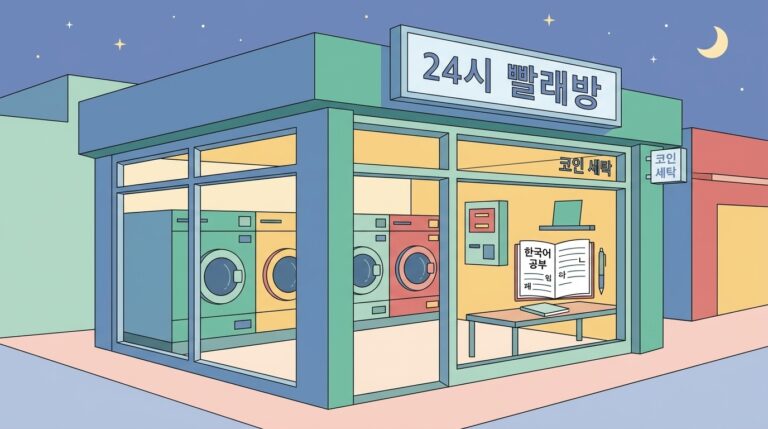
안녕하세요! 매일한글 에디터입니다. (Hello! I am your Daily Hangul editor.) Have you ever found yourself in Seoul, suitcase overflowing with clothes after days of exploring night markets and scenic alleys, desperately needing fresh laundry? In many K-Dramas, self-service laundromats—called koin ppallaebang (코인 빨래방)—are cozy, warm havens where characters share canned coffee while waiting for their dryers to finish. But when you are standing on a quiet street corner with a heavy laundry bag in hand and your map app seems confusing, finding one can feel daunting.
Don’t worry! Asking locals for directions to a 24-hour coin laundromat is one of the easiest ways to build your Korean speaking confidence. Based on feedback from hundreds of our beginner learners, mastering just a couple of natural phrasing tweaks will turn awkward stares into friendly, pinpoint directions. Let’s make sure you never have to wear that same travel t-shirt three days in a row!
Phase 2: Top 3 Core Expressions Deep-Dive
1. 근처에 빨래방 있어요? (Geuncheo-e ppallaebang isseoyo?)
- Pronunciation: guhn-chuh-eh bbal-lae-bang ee-ssuh-yo? (Think of ‘geun’ like ‘gun’ with a soft smile, and ‘ppal’ like a crisp pop sound).
- Meaning: Direct: “Is there a laundry room nearby?” | Nuance: “Excuse me, is there a laundromat around here?”
- K-Culture Moment: Seen frequently in slice-of-life dramas when a newcomer moves into an officetel or goshiwon and asks the convenience store clerk for neighborhood basics.
- Editor’s Insight: Ppallaebang combines ppallae (laundry) + bang (room). Adding geuncheo-e (nearby) sets an instant polite, conversational tone.
- Situation Spectrum: Casual: ⚠️ (Use with friends: 근처에 빨래방 있어?) | Semi-formal: ✅ | Formal: ✅
- 🤔 Think About It: Notice how Korean places the location topic first (geuncheo-e) rather than the object (ppallaebang). How does setting the spatial context first reflect Korean conversational flow?
2. 코인 빨래방이 어디예요? (Koin ppallaebang-i eodiyeyo?)
- Pronunciation: ko-in bbal-lae-bang-ee uh-dee-yeh-yo? (‘Koin’ sounds identical to English ‘coin’, and ‘eodi’ sounds like ‘uh-dee’).
- Meaning: Direct: “Where is the coin laundromat?” | Nuance: “Could you tell me where the coin laundry is?”
- K-Culture Moment: Ideal when you specifically want a 24/7 coin laundromat with self-service machines rather than a traditional dry cleaner (setakso).
- Editor’s Insight: If you only say setakso, locals might point you to an owner-operated dry cleaner that closes early and takes days to wash shirts.
- Situation Spectrum: Casual: ⚠️ | Semi-formal: ✅ | Formal: ✅
- 🤔 Think About It: In English, we say “Where is…” right away. In Korean, the question word eodi comes right before the verb ending. What does this reveal about what information is saved for last?
3. 걸어서 갈 수 있어요? (Georeoseo gal su isseoyo?)
- Pronunciation: guh-ruh-suh gal soo ee-ssuh-yo? (‘Georeo’ sounds like ‘guh-ruh’, ‘gal su’ rhymes with ‘calm sue’).
- Meaning: Direct: “Can I go by walking?” | Nuance: “Is it within walking distance?”
- K-Culture Moment: Asking the front desk host or a cafe barista before hauling your laundry bag through town.
- Editor’s Insight: Georeoseo comes from geotta (to walk). It saves you from accidentally taking a 20-minute uphill hike with heavy clothes!
- Situation Spectrum: Casual: ⚠️ | Semi-formal: ✅ | Formal: ✅
- 🤔 Think About It: Instead of measuring distance in kilometers or miles, Koreans very often measure destination proximity by walking time (dubo) or effort.
Phase 3: Textbook Korean vs. Real Korean
Situation 1: Asking if a self-service laundry exists nearby
- 📖 Textbook Korean: 이 근방에 자동빨래터가 존재합니까? (I geunbang-e jadongppallaeteoga jonjaehamnikka? – Does an automatic laundry facility exist in this vicinity?)
- 🗣️ Real Korean: 저기요, 이 근처에 코인 빨래방 있어요? (Jeogiyo, i geuncheo-e koin ppallaebang isseoyo? – Excuse me, is there a coin laundromat near here?)
- 💡 Why is it different? Textbook phrases can be overly archaic. Modern locals simply combine polite Jeogiyo (Excuse me) with koin ppallaebang.
Situation 2: Asking how long the walk is
- 📖 Textbook Korean: 보행 시간은 얼마나 소요됩니까? (Bohaeng siganeun eolmana soyodoemnikka? – How much pedestrian time is required?)
- 🗣️ Real Korean: 걸어서 몇 분 걸려요? (Georeoseo myeot bun geollyeoyo? – How many minutes does it take on foot?)
- 💡 Why is it different? Real everyday Korean favors simple verbs like geollida (to take time) over Sino-Korean administrative vocabulary.
Phase 4: K-Culture Deep-Dive & Non-Verbal Manners
4-1. Nunchi & Street Gestures
When approaching a stranger in Korea to ask for directions, avoid touching their arm or standing directly in their walking path. Instead, stand about an arm’s length away, give a slight 15-degree head nod, and open with a soft Jeogiyo (저기요). If you have your smartphone map open, politely hold it out with two hands (yangson) to show the location screen. This non-verbal cue signals respect and immediate clarity.
4-2. Cultural Code: The 24-Hour Coin Wash Cafe Craze
In South Korea, many young singles live in one-room studios where indoor drying rack space is limited and drying clothes during humid rainy seasons (jangma) can cause mildew smell. As a result, modern koin ppallaebang have evolved into mini lifestyle hubs equipped with free Wi-Fi, air conditioning, massage chairs, and capsule coffee dispensers. They are clean, safe, and often open 24/7!
Phase 5: Real-Life Roleplay Scenario
Setting: You are standing outside a 24-hour convenience store in Yeonnam-dong holding a tote bag of clothes. You ask the friendly store clerk, Min-ho (20s).
- You: 저기요, 실례지만 이 근처에 코인 빨래방 있어요? (Jeogiyo, sillyejiman i geuncheo-e koin ppallaebang isseoyo? – Excuse me, but is there a coin laundromat near here?)
🎭 Giving a polite, light nod while pointing down the street - Min-ho: 아, 빨래방이요? 네, 저기 사거리에서 우회전하시면 바로 있어요. (A, ppallaebang-iyo? Ne, jeogi sageori-eseo uhoejeonhasimyeon baro isseoyo. – Ah, a laundromat? Yes, make a right turn at that intersection over there and it’s right there.)
🎭 Pointing his finger toward the traffic light - You: 걸어서 몇 분 정도 걸려요? (Georeoseo myeot bun jeongdo geollyeoyo? – About how many minutes does it take on foot?)
🎭 Smiling curiously - Min-ho: 천천히 걸어도 3분이면 가요. 파란색 간판이에요. (Cheoncheonhi georeodo sambun-imyeon gayo. Paransaek ganpan-ieyo. – Even walking slowly, you’ll be there in 3 minutes. It has a blue sign.)
🎭 Gesturing size of sign with both hands - You: 지금 시간에도 문 열려 있어요? (Jigeum sigan-edo mun yeollyeo isseoyo? – Is it open even at this hour?)
🎭 Looking slightly worried about late opening hours - Min-ho: 네! 24시간이라서 언제든 이용할 수 있어요. (Ne! Isipsigan-iraseo eonjedeun iyonghal su isseoyo. – Yes! It is 24 hours, so you can use it anytime.)
🎭 Giving a reassuring thumbs-up - You: 아, 정말 감사합니다! 좋은 하루 보내세요. (A, jeongmal gamsahamnida! Joeun haru bonaeseyo. – Ah, thank you so much! Have a great day.)
🎭 Giving a warm 30-degree thank-you bow - Min-ho: 네, 조심히 가세요! (Ne, josimhi gaseyo! – Yes, go safely!)
🎭 Waving cheerfully
🔀 Interactive Decision Point
What would you say next if you couldn’t understand Min-ho’s fast directions?
* Choice A: 저기요? 다시 말해. (Jeogiyo? Dasi malhae.)
* Choice B: 죄송하지만, 지도 앱에서 한번 보여주실 수 있어요? (Joesonghajiman, jido aeb-eseo hanbeon boyeojusil su isseoyo?)
* Choice C: 몰라요, 그냥 갈게요. (Mollayo, geunyang galgeyo.)
Feedback:
* Choice A (Risk): Dasi malhae is informal banmal. It sounds rude to a stranger.
* Choice B (Best): Polite, proactive, and natural. Asking them to point on your map app resolves confusion smoothly.
* Choice C (Bad): Walking away abruptly can make the helper feel dismissed after trying to guide you.
Phase 6: 10-Second Emotion Shadowing Drill
Repeat each line out loud, pausing at the / marks while matching the mood indicator!
[😊 Politeness & Inquiring]
저기요, / 근처에 / 코인 빨래방 있어요? (Jeogiyo, / geuncheo-e / koin ppallaebang isseoyo?)[🤔 Curious & Practical]
여기서 / 걸어서 / 갈 수 있어요? (Yeogiseo / georeoseo / gal su isseoyo?)[✨ Relieved & Thankful]
알려주셔서 / 정말 / 감사합니다! (Sallyeojusyeoseo / jeongmal / gamsahamnida!)
Phase 7: K-Culture Mini Dictionary
- 코인 빨래방 (Koin Ppallaebang): Coin Laundromat. Self-service laundry shop with coin or card-operated washers and dryers.
- 세탁소 (Setakso): Traditional Dry Cleaner / Laundry Store. Typically staffed by a master cleaner who does pressing, alterations, and dry cleaning.
- 건조기 (Geonjogi): Clothes Dryer. Crucial word to spot on the machine buttons so you don’t accidentally put wet clothes into another washer!
- 세제 자판기 (Seje Japangi): Detergent Vending Machine. Dispenser in coin laundromats selling single-use detergent sheets and fabric softener.
Phase 8: Traveler’s Survival Kit
Survival Expressions Top 3
- 현금만 돼요? (Hyeongeumman dwaeyo? / Is it cash only?)
- Pro Tip: Some older Korean coin machines accept only 500-won coins, though modern ones take T-Money or travel cards.
- 동전 교환기 어디 있어요? (Dongjeon gyohwangi eodi isseoyo? / Where is the coin exchange machine?)
- Pro Tip: Look for a small metal box near the detergent vending machine to swap 1,000-won and 5,000-won bills.
- 세제는 자동으로 나와요? (Sejeneun jadong-euro nawayo? / Does detergent dispense automatically?)
- Pro Tip: Many Korean commercial washers auto-inject detergent, saving you from buying extra soap.
Editor’s Travel Note
Make sure to install the official Naver Map navigation application or KakaoMap transit guide before exploring. Type “코인빨래방” in the search bar for live opening hours and customer reviews.
Phase 9: A Step Deeper (Reflection)
In Korea, asking for directions is rarely seen as an intrusion; it is often welcomed as an opportunity to show jeong (warm communal hospitality). When you ask a store owner or neighbor for a laundromat, they might even step out of their shop to point down the street with two hands. Small, polite interactions reflect how Korean society prioritizes collective neighborly care.
💬 Your Turn: Have you ever used a self-service laundromat while traveling abroad? Share your funny or memorable travel laundry stories in the comments below!
Phase 10: FAQ & Common Mistakes
Q: What is the main difference between 빨래방 (ppallaebang) and 세탁소 (setakso)?
A: Ppallaebang refers to a self-service laundromat with coin-operated washers and dryers. Setakso is a dry cleaning shop managed by a person where you leave formal wear or winter coats for dry cleaning.
Q: Do I need to bring my own laundry detergent to a Korean coin laundromat?
A: Not necessarily. Most modern laundromats either automatically dispense liquid detergent during the wash cycle or have an on-site vending machine selling single-use packets for 500–1,000 KRW.
Q: Can I pay with foreign credit cards at Korean coin laundromats?
A: It varies. Newer franchise laundromats have kiosk touchscreens accepting foreign cards, but many still require 500-won coins or local payment apps. It is always wise to keep a few 1,000-won cash notes on hand.
🚨 Common Mistakes Top 3
- Mistake: Calling all laundromats setakso.
- Correct Action: Say koin ppallaebang if you want self-service 24/7 washers.
- Mistake: Adding powdered detergent to machines with automated detergent injection.
- Correct Action: Check the sign on the drum for “세제 자동 투입” (Automatic Detergent Injection).
- Mistake: Leaving dry laundry inside the dryer for hours after the cycle ends.
- Correct Action: Laundromats have laundry baskets provided so the next person can carefully place finished clothes aside if space is tight.
Phase 11: Action Mission & Participation
- 🥉 Bronze Mission (Solo): Practice saying “근처에 코인 빨래방 있어요?” out loud 5 times in front of a mirror until smooth.
- 🥈 Silver Mission (Social): Open your Korean map app, search “코인빨래방”, take a screenshot of the closest one to your accommodation, and write the route in Korean.
- 🥇 Gold Mission (Real Life): Next time you pass a convenience store in Korea, ask the staff for laundromat directions using the full 3-part sentence from Phase 5.
- 🎮 K-Culture Mission: Spot a laundromat scene in your favorite K-Drama (like When the Camellia Blooms or Crash Landing on You) and write down the signage words in your notes!
Phase 12: Interactive Quiz Challenge
1. Situational Judgment Quiz
You want to ask an elderly shopkeeper if there is a 24-hour self-wash laundromat within walking distance. Which phrase is best?
a) 야, 세탁기 어디 있냐? (Ya, setakgi eodi innya?)
b) 저기요, 근처에 코인 빨래방 있어요? (Jeogiyo, geuncheo-e koin ppallaebang isseoyo?)
c) 세탁소에 당장 가세요. (Setakso-e dangjang gaseyo.)
2. Fill-in-the-Blank Quiz
여기서 (_______) 갈 수 있어요? (Can I go on foot / by walking from here?)
3. True / False Culture Quiz
In Korea, setakso (세탁소) is always open 24 hours a day with self-service dryers. (T / F)
🔍 Click here to view Quiz Answers & Explanations!
- Answer: b) Jeogiyo, geuncheo-e koin ppallaebang isseoyo? is the most polite and natural choice.
- Answer: 걸어서 (georeoseo). Georeoseo gal su isseoyo? means “Can I get there on foot?”
- Answer: False. Setakso are traditional dry cleaners operated by owners during business hours. For 24-hour self-service washing, look for a koin ppallaebang (코인 빨래방)!







