

Phase 1: Empathy (Story-Driven Opening)
안녕하세요! 매일한글 에디터입니다. (Annyeonghaseyo! It’s your Daily Hangul editor.)
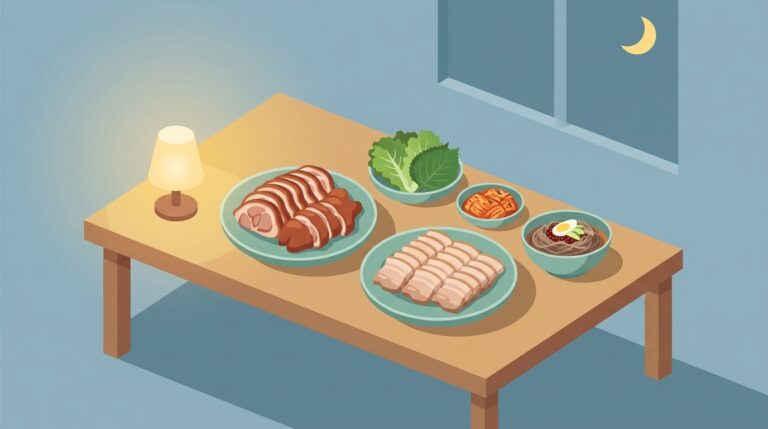
Picture this: It’s 11:30 PM on a Friday in Seoul. You and your Korean colleagues just wrapped up a marathon project or finished a fun gathering, and someone inevitably drops the magical sentence: “출출한데 야식 뭐 먹을까?” (Chulchulhande yasik mwo meogeulkka? / “I’m a bit peckish, what late-night snack should we order?”). Your heart leaps, but then comes the classic, high-stakes culinary dilemma that divides entire friend groups across Korea: 족발 (Jokbal – braised pig’s trotters) versus 보쌈 (Bossam – boiled pork belly/shoulder wrapped in fresh kimchi).
For non-native speakers, even advanced learners, navigating the late-night delivery culture (야식 문화) in Korea can feel surprisingly overwhelming. Which one has that rich, gelatinous, savory bite? Which one comes wrapped in crisp radish kimchi and steamed Napa cabbage? How do you customize your order on a delivery app or handle the shared-table etiquette (눈치, nunchi) when sharing a giant set with locals?
This guide isn’t just about vocabulary; it is a masterclass in culinary nuance, table dynamics, and sophisticated Korean phrasing designed for C1-level fluency. Based on feedback from hundreds of advanced learners living in Korea, mastering these subtle cultural markers will transform you from a simple tourist ordering food into a culturally attuned insider who commands the table with confidence.
Phase 2: 3 Core Expressions in Depth
1. 쫀득쫀득하다 vs 야들야들하다 (Jjondeuk-jjondeuk-hada vs Yadeul-yadeul-hada)
- Pronunciation: [Jjon-deuk-jjon-deuk-ha-da / Ya-deul-ya-deul-ha-da] (Think of jjondeuk like the snappy, elastic chew of gummy mochi, and yadeul like the soft, melting texture of slow-cooked brisket).
- Meaning: 쫀득쫀득하다 means chewy, dense, and gelatinous. 야들야들하다 means extremely tender, velvety, and melt-in-the-mouth soft.
- K-Culture Moment: In food variety shows like Delicious Guys (맛있는 녀석들), cast members often debate jokbal skins using 쫀득쫀득 while praising warm bossam slices with 야들야들.
- Editor’s Insight: These mimetic words (의태어) are crucial at C1 level. Using them demonstrates an intimate grasp of Korean sensory descriptions beyond generic words like 맛있다 (delicious).
- Situation Spectrum: Casual ✅ | Semi-formal ✅ | Formal ⚠️ (Replace with 부드럽다 or 탄력 있다 in business reports)
- 🤔 Think About It: English relies heavily on adjectives for flavor, but Korean possesses an extraordinarily vast vocabulary for mouthfeel and texture. What does this reveal about Korean gastronomy?
2. 반반 세트로 시킬까? (Ban-ban seteuro sikilkka?)
- Pronunciation: [Ban-ban se-teu-ro si-kil-kka?] (Sounds like “Bahn-bahn set-ro see-keel-kkah?”)
- Meaning: Literal: “Shall we order half-and-half set?” / Nuance: The ultimate diplomatic solution when your group cannot agree between jokbal and bossam.
- K-Culture Moment: Seen in countless office K-Dramas during late-night overtime scenes where teammates avoid petty conflicts by ordering 족보세트 (Jok-Bo Set, Jokbal + Bossam combo).
- Editor’s Insight: Combining prefixes like 반반 (half-and-half) or blended portmanteaus (족보) shows high conversational fluency.
- Situation Spectrum: Casual ✅ | Semi-formal ✅ | Formal 🚫
- 🤔 Think About It: Why is compromise such a celebrated dining ritual in communal Korean eating culture?
3. 쌈 싸 먹을 때 겉절이 꼭 올려봐 (Ssam ssa meogeul ttae geotjeori kkok ollyeobwa)
- Pronunciation: [Ssam ssa meo-geul ttae geot-jeo-ri kkok ol-lyeo-bwa]
- Meaning: Literal: “When wrapping, definitely put fresh unfermented kimchi on top.” / Nuance: Sharing insider foodie wisdom on flavor harmony.
- K-Culture Moment: Classic Korean table-bonding moment where a friend gently prepares a wrap for you or tells you the definitive topping combination.
- Editor’s Insight: 겉절이 (geotjeori) is freshly made, crisp kimchi, distinct from aged 묵은지 (mukeunji). For bossam, the sweetness of fresh kimchi or seasoned radish (무말랭이) is non-negotiable.
- Situation Spectrum: Casual ✅ | Semi-formal ✅ | Formal ⚠️
- 🤔 Think About It: How does the act of recommending specific wrap (쌈) combinations foster social intimacy (정, jeong)?
Phase 3: Textbook Korean vs Real Korean
Situation 1: Choosing between Jokbal and Bossam
- 📖 교과서 한국어 (Textbook): “족발은 돼지 발이고, 보쌈은 삶은 돼지고기입니다. 무엇을 드시겠습니까?” (Jokbaleun dwaeji barigo, bossameun salmeun dwaejigogi-imnida. Mueoseul deusigesseumnikka? / Jokbal is pig’s feet, and bossam is boiled pork. What will you have?)
- 🗣️ 진짜 한국어 (Real-life): “콜라겐 충전하면서 쫄깃한 거 땡기면 족발이고, 담백하고 깔끔하게 쌈 싸 먹고 싶으면 보쌈이지!” (Kollagen chungjeonhamyeonseo jjolgit-han geo ddaenggimyeon jokbal-igo, dambaekhago kkalkkeumhage ssam ssa meokgo sipeumyeon bossam-iji! / If you’re craving chewy texture with a collagen boost, it’s jokbal; if you want clean, savory slices wrapped with fresh kimchi, it’s bossam!)
- 💡 왜 다를까? (Why the difference?): Native speakers talk about food in terms of mood, texture, and cravings (땡기다) rather than clinical descriptions of the animal part.
Situation 2: Deciding what side noodles to add
- 📖 교과서 한국어 (Textbook): “비빔국수를 추가로 주문할까요?” (Bibimguksureul chugaro jumunhalkkayo? / Shall we order spicy mixed noodles additionally?)
- 🗣️ 진짜 한국어 (Real-life): “야, 막국수 빠지면 섭하지. 무조건 쟁반막국수 세트로 가자.” (Ya, makguksu ppajimyeon seophaji. Mujogeon jaengban-makguksu seteuro gaja. / Hey, it’s incomplete without makguksu. Let’s definitely go with the jumbo spicy buckwheat noodles set.)
- 💡 왜 다를까? (Why the difference?): The phrase ~빠지면 섭하지 (“It’s disappointing if we leave out ~”) captures a deep cultural rule that jokbal and bossam must be paired with chilled, spicy-sour buckwheat noodles (막국수).
Phase 4: K-Culture Deep Dive & Non-Verbal Manners
4-1. Nunchi & Table Gestures
When sharing a large Jokbal/Bossam platter (야식상) in Korea:
1. The Shared Tongs Protocol: Don’t stab the meat with your personal chopsticks if communal tongs or a serving fork are provided. If using chopsticks, subtly turn them or check if everyone is comfortable.
2. The Ssam Etiquette: If someone older wraps a 쌈 (ssam) and hands it to you, receive it with both hands, bow your head slightly, and eat it in one single bite. Biting a wrap in half is seen as clumsy and causes fillings to spill.
3. Radish & Kimchi Distribution: The fresh kimchi (보쌈김치) and sliced garlic are premium components. Avoid hoarding the crunchiest center parts; share evenly.
4-2. Cultural Code Analysis: The Alchemy of Korean Yasik (야식)
Jokbal is simmered for hours in a master aromatic soy broth containing herbal medicinal ingredients (한약재), ginger, and scallions, creating a dark, shiny, gelatinous skin packed with collagen. Bossam, on the other hand, is gently boiled with aromatics (like doenjang and coffee powder) to leach out excess fat, producing mild, tender slices designed to be crowned with sharp, sweet kimchi.
In Korean late-night culture, these two dishes represent the pinnacle of evening indulgence because they feel less greasy than fried chicken (치맥) while offering rich communal satisfaction with soju or makgeolli.
Phase 5: Real-Life Roleplay Scenario
Setting: A cozy late-night delivery pub (포차/배달 전문 식당) in Hongdae. 11:45 PM.
Characters:
* Min-woo (민우): Your energetic Korean coworker and late-night food enthusiast.
* You (당신): A discerning C1 Korean speaker handling the order.
Dialogue:
1. 민우: (메뉴판을 뚫어져라 보며) 아, 오늘 진짜 야근 빡셌다. 족발 뜯으면서 스트레스 풀래, 아니면 깔끔하게 보쌈 갈래?
(Ah, oneul jinjja yageun ppaksetda. Jokbal dteudeumyeonseo seuteureseu pullae, animyeon kkalkkeumhage bossam gallae?)
(Staring intently at the menu) “Ah, overtime was intense today. Do you want to tear into jokbal to blow off steam, or go clean with bossam?”
2. 당신: 🎭 (미소를 지으며 턱을 괸다) 둘 다 포기하기 아쉬운데… 혹시 여기 ‘족보 세트’ 있어?
(Dul da pogihagi aswiunde… Hoksi yeogi ‘Jok-Bo sete’ isseo?)
(Smiling and resting chin on hand) “It’s too hard to give up either… Do they have a ‘Jok-Bo Set’ here by any chance?”
3. 민우: 🎭 (눈을 크게 뜨며 감탄한다) 오, 짬바(연륜) 좀 나오는데? 반반 세트 중자(中) 시키면 딱이겠다!
(O, jjamba jom naoneunde? Banban sete jung-ja sikimyeon ttagigetda!)
(Eyes widening with admiration) “Ooh, look who knows the ropes! Ordering a medium half-and-half set would be perfect!”
4. 당신: 🎭 (자신만만하게 덧붙이며) 막국수 추가하는 거 잊지 마. 족발의 기름기를 싹 잡아줘야 하잖아.
(Makguksu chugahaneun geo itji ma. Jokbal-ui gireumgireul ssak jabajwoya hajanh-a.)
(Adding confidently) “Don’t forget to add makguksu. We need it to cut right through the richness of the jokbal.”
5. 민우: 🎭 (박수를 치며) 제대로 배웠네! 사장님, 여기 족보 세트 중자에 막국수 하나, 그리고 참이슬 한 병이요!
(Jedaero baewonne! Sajangnim, yeogi jokbo sete jungja-e makguksu hana, geurigo cham-iseul han byeong-iyo!)
(Clapping hands) “You learned properly! Boss, over here, one medium Jok-Bo set, one makguksu, and a bottle of Chamisul, please!”
6. 당신: 🎭 (수저 밑에 냅킨을 깔아주며) 김치는 무말랭이랑 겉절이 둘 다 나오는지 여쭤볼까?
(Gimchineun mumallaeng-irang geotjeori dul da naoneunji yeojjwo-bolkka?)
(Placing napkins under the cutlery) “Shall we ask if the kimchi comes with both dried radish and fresh geotjeori?”
7. 민우: 여긴 보쌈김치가 예술이라 무조건 넉넉하게 줄 거야. 자, 수저 챙겨줘서 고마워!
(Yeogin bossam-gimchiga yesur-ira mujogeon neongneokhage jul geoya. Ja, sujeo chaenggyeojwoseo gomawo!)
(Here, the bossam kimchi is a work of art, so they’ll definitely give plenty. Thanks for setting the utensils!)
8. 당신: 🎭 (소주잔을 채워주며) 오늘 고생 많았어. 한잔하고 피로 싹 풀자!
(Oneul gosaeng manasseo. Hanjan-hago piro ssak pulja!)
(Pouring the soju glass) “You worked hard today. Let’s have a drink and shake off the fatigue!”
🔀 Interactive Branching Point:
Min-woo asks: “야, 너 족발 껍데기(콜라겐) 쪽 좋아해, 아니면 살코기 쪽 좋아해?” (Hey, do you prefer the collagen skin part or the lean meat?)
* Option A: “난 살코기만 먹어. 껍질은 징그러워.” (I only eat lean meat. Skin is gross.)
* Feedback (Bad): While honest, calling a beloved delicacy ‘gross’ can dampen the late-night excitement.
* Option B: “원래 족발의 진수는 쫀득한 껍질에 붙은 콜라겐이지! 둘 다 골고루 먹자.” (The true essence of jokbal is the chewy collagen attached to the skin! Let’s enjoy both evenly.)
* Feedback (Best): Shows deep appreciation of traditional Korean culinary values and keeps the vibe joyful.
* Option C: “상관없어, 아무거나 줘.” (Doesn’t matter, give me whatever.)
* Feedback (Risk): Too indifferent; misses the chance to engage in fun food banter.
Phase 6: 10-Second Emotion Shadowing Drill
Practice these lines with precise cadence and feeling:
[🤤 입에 군침이 돌며 기대에 찬 톤]
“와… / 윤기 흐르는 것 좀 봐! / 이건 무조건 / 막국수에 싸 먹어야 돼.”
(Wa… / yungi heureuneun geot jom bwa! / Igeon mujogeon / makguksue ssa meogeoya dwae.)-
[🤔 진지하게 고민하는 미식가 톤]
“솔직히 / 쫀득한 식감은 족발인데, / 아삭한 보쌈김치는 / 절대 포기 못 하지.”
(Soljikhi / jjondeuk-han sikgameun jokbal-inde, / asak-han bossam-gimchineun / jeoldae pogi mot haji.) -
[🍻 유쾌하고 시원시원한 건배 톤]
“야식엔 / 족보 세트가 진리지! / 오늘 야근 스트레스 / 싹 날려보자!”
(Yasigen / jokbo setega jinriji! / Oneul yageun seuteureseu / ssak nallyeoboja!)
Phase 7: K-Culture Mini Dictionary
- 족보세트 (Jok-Bo Sete) | Jokbal + Bossam Combo Set | A combined meal offering both braised pig’s trotters and boiled pork belly. Standard phrasing on 90% of late-night delivery menus.
- 겉절이 (Geotjeori) | Fresh, Unfermented Kimchi | Kimchi made right before serving, dressed with sweet chili sauce and sesame oil. Essential for pairing with bossam.
- 막국수 (Makguksu) | Chilled Spicy Buckwheat Noodles | Buckwheat noodles tossed in sweet-and-sour gochujang sauce. It cuts the richness of fatty pork.
- 새우젓 (Sae-u-jeot) | Salted Fermented Tiny Shrimp | The indispensable condiment served with pork. Enriched with natural enzymes (lipase) that aid in digesting pork fat.
Phase 8: Survival Kit for Travelers
Survival Expressions TOP 3
- “쌈채소랑 새우젓 좀 더 주실 수 있나요?” (Ssam-chaeso-rang sae-u-jeot jom deo jusil su innayo?)
Pro Tip: Korean restaurants provide free refills on lettuce, perilla leaves, and salted shrimp. - “막국수 양념 따로 주실 수 있나요?” (Makguksu yangnyeom ttaro jusil su innayo?)
Pro Tip: If you have low spice tolerance, ask for the spicy sauce on the side. - “남은 고기 포장 가능한가요?” (Nameun gogi pojang ganeunghangayo?)
Pro Tip: Portions are massive; requesting takeout packaging for leftovers is standard practice.
Editor’s Travel Note
When hunting for the best jokbal and bossam in Seoul, skip tourist traps and head to historic food alleys like the Jangchung-dong Jokbal Street (장충동 족발골목) near Dongguk University Station. To easily navigate back alleys and check real local ratings, rely on the Naver Map Application download and guide. Late-night restaurants generally accept all major international credit cards, but having contactless T-Money or quick mobile payment makes late-night taxi hailing after your meal seamless.
Phase 9: “One Step Deeper” (Reflective Essay)
In Western dining cultures, choosing a meal is often an individualized pursuit where each diner orders a separate plate. In contrast, the Korean 야식 (Yasik) ritual around 족발 and 보쌈 revolves around collective synergy. The platter sits physically at the center of the table, flanked by shared bowls of steaming soup, spicy noodles, and banchan. Choosing between jokbal and bossam is rarely a solitary preference; it is an ongoing negotiation where everyone’s cravings are harmonized into one communal feast.
💬 Your Turn: When dining with friends late at night, are you Team Jokbal (collagen & chewiness) or Team Bossam (tender meat & crisp kimchi)? Drop your vote and reasoning in the comments below!
Phase 10: FAQ & Common Mistakes
Q: What is the main nutritional and culinary difference between Jokbal and Bossam?
A: Jokbal uses pig’s feet stewed in soy sauce, spices, and herbs, resulting in high gelatin and collagen content with a savory, sweet flavor profile. Bossam uses pork belly or shoulder simmered in water with aromatics, which reduces fat content, yielding a milder meat intended to be wrapped with highly seasoned fresh kimchi.
Q: Why do Koreans always dip Jokbal or Bossam in salted shrimp sauce (새우젓)?
A: Beyond flavor enhancement, fermented salted shrimp contains abundant protease and lipase enzymes that break down proteins and fats in pork, easing digestion during late-night meals.
Q: Can I order half-and-half (반반) for solo delivery?
A: Most delivery apps (Baemin, Yogiyo, Coupang Eats) now offer 1인 족보세트 (Single Diner Jok-Bo Set), designed specifically for single households (1인 가구).
🚨 Common Mistakes Alert
- Mistake: Eating Bossam without Kimchi/Ssam.
- Correct Action: Bossam is intentionally cooked with mild seasoning because it is designed to be eaten with 보쌈김치 and salted shrimp.
- Mistake: Assuming Jokbal is eaten raw or cold.
- Correct Action: Jokbal is fully braised and served either warm and soft (온족) or cooled for enhanced chewiness (식은 족발).
- Mistake: Cutting the Ssam wrap in half with your teeth mid-bite.
- Correct Action: Make your lettuce wrap modest in size so you can eat the entire parcel in one clean bite.
Phase 11: Action Missions
- 🥉 Bronze Mission (Solo Practice): Read the Phase 6 Shadowing Drill aloud 3 times, emphasizing the difference between 쫀득쫀득 and 야들야들.
- 🥈 Silver Mission (Social Share): Post an Instagram Story of your favorite Korean food using the hashtag
#매일한글 #야식정복and state whether you prefer jokbal or bossam in Korean. - 🥇 Gold Mission (Real-world Challenge): Next time you visit a Korean restaurant or order delivery, use the term 족보 세트 중자 (Medium Jok-Bo set) or ask for 새우젓 (Sae-u-jeot) in natural Korean.
- 🎮 K-Culture Mission: Watch an episode of a K-Drama with an office late-night dinner scene (like Misaeng or Business Proposal) and spot whether they order Jokbal, Bossam, or Chicken!
Phase 12: Interactive Quiz Challenge
1. Situation Judgment Quiz: You are at a restaurant with 3 friends. Two want Bossam and two want Jokbal. What is the most natural sentence to suggest a compromise?
a) 그냥 샐러드 먹으러 가자.
b) 우리 족보 세트 시켜서 둘 다 맛보자!
c) 각자 돈 내고 따로 먹자.
2. Fill in the Blank:
보쌈 고기는 부드럽고 ( ________ )한 식감이 매력적이고, 족발 껍데기는 ( ________ )하다.
3. True or False:
Jokbal is boiled in plain water with no seasoning, while Bossam is braised in dark soy sauce. (True / False)
👉 Click here to reveal Answers & Explanations!
- Answer: b) 우리 족보 세트 시켜서 둘 다 맛보자! (Let’s order the Jok-Bo set and try both!)
- Answer: 야들야들 / 쫀득쫀득 (or 쫄깃쫄깃) — Bossam is tender and velvety (야들야들), while Jokbal skin is chewy and elastic (쫀득쫀득).
- Answer: False. It is the exact opposite! Jokbal is braised in soy sauce and medicinal herbs, while Bossam is boiled in aromatic broth to keep the pork clean and mild.







