

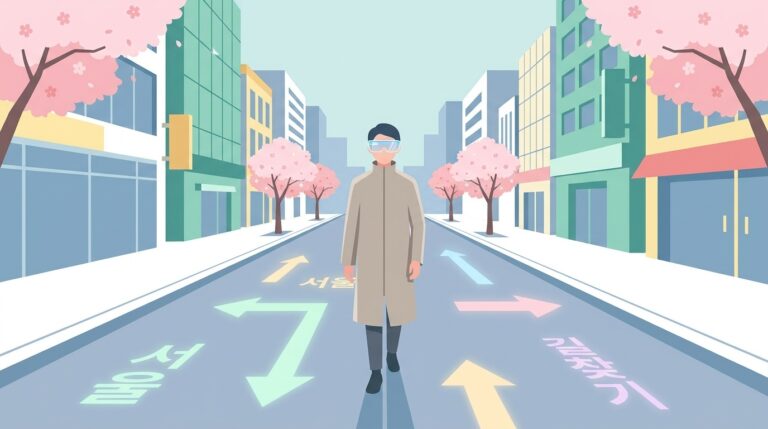
Mastering Next-Gen AR Navigation in Seoul: The C2 Guide to Smart Glasses & Tech Korean
Phase 1: 공감 (Immersive Tech Narrative)
안녕하세요! 매일한글 (Daily Hangul) editor here. Imagine stepping out of Gangnam Station Exit 11, donning your brand-new sleek AR smart glasses. You anticipate a seamless cybernetic path projected onto Teheran-ro’s bustling pavement, but suddenly, the spatial mapping collides with Seoul’s hyper-dense multi-level underground alleys and towering glass skyscrapers. The AR waypoint drifts erratically into a 3rd-floor barbecue restaurant, and you find yourself struggling to articulate subtle technical calibration issues with your local tech-enthusiast friend or customer support. At the C2 mastery level, discussing future technology isn’t just about knowing standard vocabulary like ‘지도 (map)’ or ‘길 (road)’; it demands sophisticated discourse on spatial computing, latency discrepancies, sensor fusion, and seamless contextual interaction. This guide draws upon real field observations from Seoul’s Pangyo Techno Valley testbeds to elevate your Korean expression to native-level precision.
Phase 2: 핵심 표현 3선 심층 분석 (Key Expressions Deep Dive)
1. 실시간 증강 렌더링에 레이턴시가 생겨서 보행 동선이 완전히 꼬여버렸어요.
(Silsigan jeunggang rendeoring-e reiteonsiga saenggyeoseo bohaeng dongseon-i wanjeonhi kko-yeobeoryeosseoyo.)
* Sound Metaphor: Pronounce ‘꼬여버렸어요’ like kko-yeo-beo-ryeo-ssyo-yu, echoing the tangled twist of coiled headphone cables.
* Meaning: Literal: “Latency occurred in real-time AR rendering, completely tangling my pedestrian route.” / Nuance: A sophisticated complaint describing how digital mapping lag physically misdirected you.
* K-Culture Moment: Frequently heard in tech-focused K-dramas (e.g., Memories of the Alhambra or Start-Up) when engineers debug spatial AR software under high pressure.
* Editor’s Insight: ‘동선 (movement line/path)’ combined with ‘꼬이다 (to get tangled)’ expresses physical and spatial frustration with effortless naturalness.
* Situation Spectrum: Casual: ✅ | Semi-formal: ✅ | Formal: ✅
* 🤔 Think About It: Notice how Korean uses physical, tactile verbs (꼬이다 – to tangle) to describe abstract algorithmic and digital malfunctions.2. 시야각(FOV)에 오버레이된 핀포인트가 실제 지형지물이랑 싱크가 미세하게 어긋나네요.
(Siyagak-e obeoreidoen pinpointeuga silje jihyeongjimul-irang singkeuga misehage eogeunnane-yo.)
* Sound Metaphor: ‘어긋나네요’ (eo-geun-na-ne-yo) captures the crisp snap of two misaligned puzzle pieces.
* Meaning: Literal: “The pinpoint overlaid on the field of view is subtly out of sync with the actual terrain features.” / Nuance: High-precision critique of spatial drift in AR optics.
* K-Culture Moment: Used by tech reviewers on Korean YouTube channels (such as ITSub) during field tests of wearable smart displays.
* Editor’s Insight: ‘미세하게 (subtly/minutely)’ softens the critique while showcasing advanced descriptive nuance.
* Situation Spectrum: Casual: ✅ | Semi-formal: ✅ | Formal: ✅
* 🤔 Think About It: Why does Korean technical discourse favor Sino-Korean roots (지형지물) combined with English loanwords (오버레이, 싱크)?3. 도심 협곡 현상 때문에 GPS 난청 구역이라 비전 측위(VPS)로 전환해야겠어요.
(Dosim hyeopgok hyeonsang ttaemune GPS nancheong gu-yeog-ira bijeon cheuk-wiro jeonhwanhaeyagesseoyo.)
* Sound Metaphor: ‘난청’ (nan-cheong) sounds like the muffled sensation of trying to hear underwater.
* Meaning: Literal: “Due to the urban canyon effect, this is a GPS blind spot, so I should switch to Visual Positioning Service (VPS).” / Nuance: Professional command of spatial computing jargon applied to urban navigation.
* K-Culture Moment: Standard dialogue among R&D developers in Pangyo or Digital Media City navigating Seoul’s high-rise architecture.
* Editor’s Insight: ‘난청 구역’ metaphorically applies ‘hard-of-hearing’ to describe signal shadow zones.
* Situation Spectrum: Casual: ⚠️ | Semi-formal: ✅ | Formal: ✅
* 🤔 Think About It: How does personifying satellite reception as ‘hearing impaired’ reflect Korean metaphorical cognition?
Phase 3: 교과서 한국어 vs 진짜 한국어 (Textbook vs. Real Korean)
Situation 1: Highlighting an AR Glitch
- 📖 교과서 한국어: 화면의 화살표가 잘못된 방향을 가리키고 있습니다. (The arrow on the screen points the wrong way.)
- 🗣️ 진짜 한국어: AR 글래스 포인팅 좌표가 튀어서 엉뚱한 골목으로 안내하네요. (The AR glasses pointing coordinates are jumping, leading me into a random alley.)
- 💡 왜 다를까? Native C2 speakers describe the dynamic behavior of hardware algorithms (좌표가 튀다 – coordinates jittering/jumping) rather than static visuals.
Situation 2: Calibration Request
- 📖 교과서 한국어: 기기의 보정이 필요하니 센서를 다시 설정해 주세요. (Device calibration is needed, please reset sensors.)
- 🗣️ 진짜 한국어: 자이로 센서 영점이 틀어진 것 같으니 캘리브레이션 다시 잡아볼게요. (Looks like the gyro sensor zero-point drifted, so I’ll recalibrate it.)
- 💡 왜 다를까? Korean techies use dynamic collocations like ‘영점이 틀어지다’ (zero point drifted) and ‘캘리를 잡다’ (run calibration).
Phase 4: K-Culture 딥다이브 & 비언어적 매너 (Cultural Nuances & Etiquette)
4-1. Nunchi & Public Spatial Etiquette with Smart Glasses
Wearing smart glasses in public transit hubs like Gangnam or Hongdae requires acute 눈치 (Nunchi). Because Korean society is hyper-vigilant regarding non-consensual filming (몰카 방지), wearing AR glasses with front-facing camera apertures while making continuous direct eye contact can trigger immense discomfort. When checking heads-up AR overlays, slightly angle your chin upward or lower your gaze toward your step so nearby commuters recognize you are navigating the UI rather than filming bystanders.
4-2. The K-Smart City Culture
South Korea’s urban landscape blends ancient palace alleys (피맛골) with hyper-dense smart architecture. In sci-fi and K-Dramas, navigation is not merely geographic; it is socio-spatial. AR displays in Korea frequently integrate public transit arrival APIs down to the exact subway carriage door number (빠른 환승 칸), making AR navigation a socio-technical ritual for saving precious seconds in fast-paced Seoul life.
Phase 5: 실전 롤플레이 시나리오 (Advanced Roleplay Scenario)
Setting: Teheran-ro, Gangnam. You and Min-jun, a senior UX/Spatial Computing researcher, are field-testing an experimental AR navigation headset.
- Min-jun: 선배, 지금 글래스에 투영되는 증강 경로가 코엑스 지하 아케이드 맵이랑 제대로 연동되나요? (Seonbae, does the path projected on your glasses sync properly with the COEX underground mall map?)
- You: 🎭 [Adjusting the glasses frame with a slight squint] 지상에서는 완벽했는데, 지하 진입하자마자 공간 앵커링이 풀려서 층수 인식을 못 하고 헤매네요. (Jisang-eseoneun wanbyeokhaenneunde, jiha jin-iphajamaja gonggan aengkeoring-i ppullyeoseo cheungsu insig-eul mot hago hemaeneyo. – It was flawless on ground level, but the moment we entered the basement, spatial anchoring broke, failing to recognize vertical levels.)
- Min-jun: 아, IMU 센서 드리프트 현상 같네요. 라이다(LiDAR) 스캔 데이터 기반으로 수동 매핑 전환해 보시겠어요? (Ah, sounds like IMU sensor drift. Would you try switching to manual mapping based on LiDAR data?)
- You: 🎭 [Swiping through the micro-gesture virtual ring on your index finger] 수동으로 전환하니까 뎁스(Depth) 오차가 보정되면서 보행 유도선이 노면 밀착 상태로 복구됐어요. (Sudong-euro jeonhwanhanikka depseu ochaga bojeongdoemyeonseo bohaeng yudoseon-i nomyeon milchak sangtaero bokgudoeeosseoyo. – Switching to manual corrected the depth error, restoring the guide line flush onto the pavement.)
- Min-jun: 다행이네요! 그래도 인파가 몰리는 구간에서는 오클루전(차폐) 처리가 매끄러운지 계속 모니터링해야 합니다. (What a relief! Still, we must monitor if occlusion processing stays smooth in crowded zones.)
- You: 🎭 [Looking toward the bustling crowd] 보행자 실루엣 차폐는 자연스러운데, 반사 유리벽 쪽에서 홀로그램 번짐 현상이 살짝 두드러져요. (Bohaengja silru-et chapye-neun jayeonseureounde, bansa yuribyeok jjok-eseo hologeuraem beonjim hyeonsang-i saljjak dudeureojyeoyo. – Pedestrian occlusion is natural, but hologram ghosting/bleeding is noticeable around reflective glass walls.)
- Min-jun: 글래스 렌즈의 웨이브가이드(도파관) 반사율 튜닝이 추가로 필요하겠군요. 오늘 수집된 로그 파일 바로 백업해 둘게요. (We will need additional tuning on the waveguide reflectance of the lenses. I will back up today’s log files immediately.)
- You: 🎭 [Removing the smart glasses and smiling with satisfaction] 네, 필드 테스트 결과 치고는 렌더링 안정성과 공간 인지성이 기대 이상이네요. (Ne, pildeu teseuteu gyeolgwa chigoneun rendeoring anjeongseong-gwa gonggan injiseong-i gidae isang-ineyo. – Yes, for a field test, the rendering stability and spatial perception are beyond expectations.)
🔀 Interactive Choice Point
Min-jun asks how you want to resolve the hologram ghosting near glass storefronts:
* Option A: 조도 센서 연동 광량 자동 제어 모드를 활성화합시다. (Best: Scientifically sound and polite.)
* Option B: 그냥 선글라스 모드로 어둡게 덮어버리죠. (Risk: Unprofessional and ignores spatial lighting science.)
* Option C: 기계가 이상하니 환불 신청서 작성하죠. (Bad: Misunderstands that this is a research testbed.)
Phase 6: 10초 감정 섀도잉 드릴 (Emotional Shadowing Drill)
[🧐 분석적이고 차분하게 / Analytical & Composed]
“시야각 가장자리에서 / 그래픽 왜곡이 미세하게 감지되는데, / 왜곡 보정 알고리즘을 / 한 번 더 돌려야겠어요.”
(Siyagak gajangjarieseo / geuraepik waegog-i misehage gamjidoeneunde, / waegok bojeong algorijeum-eul / han beon deo dollyeoyagesseoyo.)-
[⚡ 긴박하고 직관적으로 / Urgent & Tech-Savvy]
“지금 턴바이턴 화살표 싱크가 / 1초씩 밀려요! / 교차로 진입 전에 / 캐시 비우고 재부팅합시다.”
(Jigeum teonbaiteon hwasalpyo singkeuga / il-chossik millyeoyo! / Gyocharo jin-ip jeone / kaesi bi-ugo jaebuting-hapsida.)
Phase 7: K-Culture 미니 사전 (Mini Tech Dictionary)
- 공간 앵커링 (Gonggan Aengkkeoring) | Spatial Anchoring | Pinning virtual holographic objects to physical coordinates so they remain fixed in physical space.
- 차폐 처리 / 오클루전 (Chapye Cheori / Okeullujeon) | Occlusion Processing | Hiding virtual graphics behind real-world physical obstacles (e.g., people walking in front of a digital marker).
- 노면 밀착 렌더링 (Nomyeon Milchak Rendeoring) | Ground-Plane Snapping | Projecting digital lines flush against the asphalt surface rather than floating in mid-air.
- 도심 협곡 효과 (Dosim Hyeopgok Hyogwa) | Urban Canyon Effect | GPS signal multipath interference caused by towering glass skyscrapers.
Phase 8: 여행자를 위한 생존 키트 (Traveler Survival Kit)
Top 3 Spatial Tech Survival Phrases
- 스마트 글래스 실시간 번역 모드 좀 켜주시겠어요? (Could you enable real-time translation overlay on the smart glasses?)
- 복합 환승 센터 지하에서는 AR 도보 내비가 먹통이에요. (In complex multi-level underground transit centers, AR walking navigation is unresponsive.)
- 디스플레이 투과율을 높여야 보행 시 안전사고를 막을 수 있어요. (We need to increase display transmittance to prevent accidents while walking.)
Editor’s Travel Note
When navigating futuristic Seoul, install the Naver Map Application to experience Korea’s leading Visual Positioning System (VPS) AR pedestrian routing in major subway terminals.
Phase 9: 한 발 더 깊이 (Reflective Essay)
In Korean technology discourse, spatial awareness is deeply intertwined with relational empathy and shared urban space. The concept of ‘길치’ (a directionally challenged person) is increasingly replaced by discussions on algorithmic digital inclusion. Navigating with AR smart glasses in Seoul reveals a society negotiating the boundaries of ultra-connectivity and private personal boundaries.
💬 Your Turn: How does your native language describe spatial mapping errors compared to Korean’s visceral imagery like ‘동선이 꼬이다’ (paths getting tangled)? Share your thoughts below!
Phase 10: FAQ & 흔한 실수 (Structured FAQ & Common Pitfalls)
Q: Can I use the English term ‘AR’ directly when speaking Korean?
A: Yes, Koreans universally pronounce it as ‘에이알 (A-R)’ or say ‘증강현실 (Jeunggang-hyeonsil)’ in formal, journalistic, and academic contexts.
Q: What is the difference between ‘길을 잃다’ and ‘동선이 꼬이다’?
A: ‘길을 잃다’ means you are lost. ‘동선이 꼬이다’ means your planned itinerary, route, or pedestrian movement efficiency became tangled and disrupted due to layout or navigational glitches.
Q: How do I politely ask someone if their smart glasses are recording?
A: Use: “혹시 지금 글래스로 상시 녹화 중이신가요?” (Hoksi jigeum geullaeseuro sangsi nokhwa jung-isingayo?).
🚨 Common Mistakes Alert
- Wrong: “GPS가 죽었어요” (Literal: GPS died) -> Correct: “GPS 수신이 끊겼어요 / 먹통이에요” (Signal dropped / unresponsive).
- Wrong: “화면이 늦어요” (Literal: Screen is late) -> Correct: “화면 딜레이 / 지연 시간이 심해요” (Severe latency/lag).
- Wrong: “AR이 길을 안 보여요” -> Correct: “AR 경로 가이드가 노면에 투영되지 않아요” (AR route guide is not projecting onto the surface).
Phase 11: 액션 미션 & 참여 유도 (Action Missions)
- Bronze Mission: Practice saying “도심 협곡 현상 때문에 GPS 난청 구역이 발생했어요” with clean C2 cadence in 5 seconds.
- Silver Mission: Post an Instagram story or note discussing your favorite AR gear using the Korean tag
#증강현실네비게이션. - Gold Mission: In your next technical chat or language exchange, explain how LiDAR sensors prevent spatial occlusion issues using 차폐 처리 and 노면 밀착.
Phase 12: 인터랙티브 퀴즈 챌린지 (Quiz Challenge)
1. [상황 판단] When your AR glasses project an arrow floating 2 meters in the air rather than on the floor, which technical phrase is most accurate?
* A) 자이로 센서 배터리가 다 닳았어요.
* B) 노면 밀착 뎁스(Depth) 보정이 어긋났어요.
* C) 글래스 화면 해상도가 낮아요.
🔍 정답 및 해설 확인 (Click to View Answer)
정답: B
해설: Floating waypoints indicate an issue with vertical depth calibration and ground plane snapping (노면 밀착 뎁스 보정).
2. [빈칸 채우기]
“고층 빌딩 사이에서는 ( ) 현상으로 인해 GPS 신호 수신율이 급격히 저하됩니다.”
🔍 정답 및 해설 확인 (Click to View Answer)
정답: 도심 협곡 (Urban Canyon)
해설: High-rise skyscrapers causing signal bounce is termed ‘도심 협곡 현상’.







