

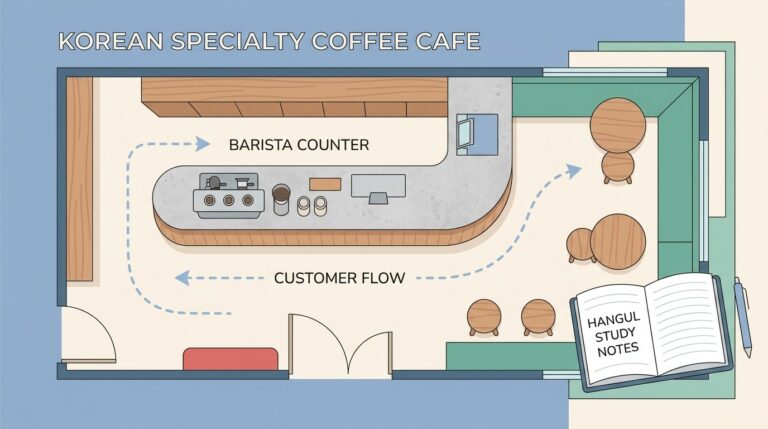
Mastering Cafe Interior & Layout Flow in Korea: The Professional C1 Blueprint
Phase 1: Empathy & Immersion (The K-Cafe Dream Meets Reality)
안녕하세요! It is your Daily Hangul editor and cultural navigator. Picture this: You are standing in the middle of a newly leased commercial space in Seongsu-dong (성수동) or Yeonnam-dong (연남동). Exposed concrete beams frame the high ceiling, natural light pours through expansive floor-to-ceiling windows, and the scent of freshly roasted specialty beans lingers in the air. You have an ambitious vision of launching your own aesthetic boutique cafe in Seoul.
However, the moment your Korean interior contractor (인테리어 소장님) pulls out the blueprinted floor plan and asks, “바리스타 동선이랑 퇴식구 위치를 어떻게 빼실 건가요?” (How do you want to configure the barista traffic flow and return counter?), standard textbook Korean suddenly leaves you stranded. Running a successful cafe in South Korea is an intricate art form where spatial ergonomics, photogenic aesthetics (‘인스타 감성’), and operational speed collide. If the customer circulation clashes with the barista’s brewing line, peak rush hour turns into absolute chaos. Drawing from real consulting experiences with expatriate entrepreneurs and C1-level professionals in Seoul, this guide will equip you with sophisticated, native-level spatial design Korean so you can negotiate, design, and direct your dream cafe with total confidence.
Phase 2: In-Depth Breakdown of 3 Core Expressions
1. 동선이 꼬이다 (Dong-seon-i kko-i-da)
- Pronunciation: [Dong-seoni kko-i-da] (Sounds like “dong-sun-ee kko-ee-da”)
- Meaning: Literally “traffic lines are tangled / twisted.” Practically, it describes poorly optimized floor circulation where customer and staff paths uncomfortably overlap.
- K-Culture Moment: Seen frequently in K-drama business scenes (such as Itaewon Class or Search: WWW) where managers critique showroom or restaurant layouts during pre-opening walkthroughs.
- Editor’s Insight: Dongseon (동선 / 動線) is the single most vital buzzword in Korean commercial design. Saying “동선이 꼬이지 않게 잡아주세요” (Please arrange it so circulation paths do not clash) immediately establishes your professional design acumen.
- Situation Spectrum: Casual ⚠️ | Semi-formal ✅ | Formal ✅
- 🤔 Think About It: Korean commercial spaces emphasize ultra-fast turnover and compact efficiency. How does this prioritize continuous circulation differently from spacious Western cafe layouts?
2. 개방감을 살리다 (Gae-bang-gam-eul sal-li-da)
- Pronunciation: [Gae-bang-gameul sal-lida] (Sounds like “gay-bahng-gahm-eul sahl-lee-dah”)
- Meaning: Literally “to bring alive the sense of openness.” It means designing a space to feel unconfined, spacious, and airy.
- K-Culture Moment: Architectural home-makeover shows like Where is My Home (구해줘! 홈즈) where hosts praise glass partitions, high ceilings, or minimalist seating.
- Editor’s Insight: Sal-li-da (살리다) means “to revive” or “to bring to life.” Paired with aesthetic concepts like Gae-bang-gam (openness) or Ip-che-gam (dimensionality), it turns a plain structural request into an artistic design intent.
- Situation Spectrum: Casual ✅ | Semi-formal ✅ | Formal ✅
- 🤔 Think About It: Why is creating visual openness so prized in high-density urban Korean architecture?
3. 무드를 잡다 (Mu-deu-reul jap-da)
- Pronunciation: [Mu-deureul jap-da] (Sounds like “moo-deu-reul jahp-dah”)
- Meaning: Literally “to catch/establish the mood.” In spatial styling, it denotes curating an intentional ambience through tone-on-tone textures, lighting, and materials.
- K-Culture Moment: Cafe influencers and lifestyle vloggers evaluating whether a new spot in Euljiro has successfully established a “vintage industrial mood” or “mid-century modern mood.”
- Editor’s Insight: While derived from the English loanword ‘mood’, 무드를 잡다 in C1 Korean implies professional atmospheric art direction, especially regarding indirect lighting (간접 조명) and acoustics.
- Situation Spectrum: Casual ✅ | Semi-formal ✅ | Formal ⚠️
- 🤔 Think About It: How does the Korean usage of English loanwords in design capture trendy, generational nuances that pure Sino-Korean terms might not?
Phase 3: Textbook Korean vs. Real Native Korean
Situation 1: Discussing Table Spacing and Customer Privacy
- 📖 Textbook Korean: “손님들이 편하게 앉을 수 있도록 테이블 사이의 간격을 넓게 만들어 주세요.” (Please make the space between tables wide so customers can sit comfortably.)
- 🗣️ Real Native Korean: “테이블 간격을 넉넉하게 둬서 옆자리 대화가 안 겹치게, 프라이빗한 무드로 가고 싶어요.” (I’d like to leave generous spacing between tables to avoid conversational overlap and maintain a private mood.)
- 💡 Why the Difference? C1 natives specify practical sensory outcomes—like sound bleed and intimate ambiance—rather than stating generic physical actions.
Situation 2: Requesting Bar Counter Optimization for Baristas
- 📖 Textbook Korean: “바리스타가 커피를 쉽게 만들 수 있게 카운터를 디자인해 주세요.” (Please design the counter so the barista can make coffee easily.)
- 🗣️ Real Native Korean: “주문 접수부터 추출, 픽업까지 바리스타 작업 동선이 끊기지 않게 ‘ㄷ자형’으로 빼주세요.” (Please configure a U-shaped layout so the barista workflow from ordering to extraction and pickup remains uninterrupted.)
- 💡 Why the Difference? Professional contractors expect functional spatial geometry (e.g., ‘ㄷ자형’ / ‘ㅡ자형’ layouts) and streamlined workflow terminology.
Phase 4: K-Culture Deep Dive & Non-Verbal Nuance
4-1. Nunchi & Contractor Etiquette (눈치와 현장 매너)
When negotiating spatial layouts on an active construction site in Korea, eye contact and physical gestures convey your operational readiness. Contractors often hold architectural blueprints (도면) at waist level. Instead of pointing with a single index finger (which can feel confrontational or overly critical), gesture gently across the blueprint with your open hand, palm facing slightly upward. When proposing layout revisions, preface with reflective pacing: “소장님 말씀대로 하면 시공은 편한데, 손님 입장에서는…” (I understand that doing it your way makes construction easier, but from the customer’s perspective…). This softens your critique while upholding your design vision.
4-2. The ‘Photo Spot’ Culture (포토존과 인스타 감성)
In South Korea’s hyper-competitive cafe landscape, interior design is not merely functional; it is your primary organic marketing engine. Every successful cafe intentionally incorporates an “Insta-spot” (포토존)—whether it is a statement mirror illuminated with warm halo lighting (3000K 웜톤 조명), a glass brick facade, or a curated mini rock garden (중정/석재 인테리어). Understanding how natural light shifts throughout the day to flatter customer photos is considered as critical as selecting the espresso machine itself.
Phase 5: Live Roleplay Scenario
Setting: A sunlit, bare concrete commercial unit in Hapjeong-dong. You are reviewing structural blueprints on-site with Contractor Park (박 소장님).
- 박 소장: 도면대로라면 입구 바로 옆에 에스프레소 머신 바를 두는 게 배관 공사하기엔 제일 수월합니다. (Do-myeon-dae-ro-ra-myeon ip-gu ba-ro yeop-e e-seu-peu-re-so meo-sin ba-reul du-neun ge bae-gwan gong-sa-ha-gi-en je-il su-wol-ham-ni-da.)
“According to the blueprint, placing the espresso machine bar right next to the entrance is easiest for plumbing work.”
🎭 도면을 손가락으로 톡톡 치며 현실적인 시공 편의를 강조한다. - You: 배관 작업이 수월한 건 알겠지만, 그렇게 되면 들어오는 손님이랑 주문 대기 줄 동선이 겹치지 않을까요? (Bae-gwan ja-gwo-bi su-wol-han geon al-get-ji-man, geu-reoh-ge doe-myeon deu-reo-o-neun son-nim-i-rang ju-mun dae-gi jul dong-seon-i gyeop-chi-ji anh-eul-kka-yo?)
“I understand plumbing is easier that way, but wouldn’t that cause the incoming customers and the ordering queue to collide?”
🎭 입구 쪽 바닥을 가리키며 진지하게 공간 흐름을 짚어본다. - 박 소장: 음, 듣고 보니 피크 타임엔 병목 현상이 생길 수도 있겠네요. (Eum, deut-go bo-ni pi-keu ta-im-en byeong-mok hyeon-sang-i saeng-gil su-do it-get-neyo.)
“Hmm, now that you mention it, a bottleneck could definitely happen during peak hours.”
🎭 턱을 괴고 출입문 폭을 다시 한번 줄자로 측정한다. - You: 네, 그래서 바를 안쪽으로 1미터만 밀고, 퇴식구는 나가는 문 쪽에 따로 분리해서 순환 구조로 만들고 싶어요. (Ne, geu-rae-seo ba-reul an-jjog-eu-ro il-mi-teo-man mil-go, toe-sik-gu-neun na-ga-neun mun jjog-e tta-ro bun-ri-hae-seo sun-hwan gu-jo-ro man-deul-go sip-eo-yo.)
“Exactly. So I’d like to push the counter in by one meter and separate the tray return by the exit to create a circular flow.”
🎭 두 손으로 원을 그리며 고객의 이동 경로를 시각적으로 보여준다. - 박 소장: 바를 안쪽으로 밀면 홀 좌석 수가 두 테이블 정도 줄어들 텐데, 괜찮으시겠어요? (Ba-reul an-jjog-eu-ro mil-myeon hol jwa-seok su-ga du te-i-beul jeong-do jul-eo-deul ten-de, gwaen-chan-eu-si-get-eo-yo?)
“If we push the bar inward, you’ll lose about two tables in the main seating area. Will that be okay?”
🎭 살짝 우려 섞인 표정으로 테이블 배치도를 가리킨다. - You: 좌석 회전율보다는 공간의 쾌적함과 개방감을 살리는 게 저희 브랜드 콘셉트에 맞습니다. (Jwa-seok hoe-jeon-yul-bo-da-neun gong-gan-ui kwae-jeok-ham-gwa gae-bang-gam-eul sal-li-neun ge jeo-hui beu-raen-deu kon-sep-teu-e mat-seum-ni-da.)
“Rather than table turnover rate, prioritizing spatial comfort and open ambience aligns best with our brand concept.”
🎭 확신에 찬 눈빛으로 미소를 지으며 고개를 끄덕인다. - 박 소장: 좋습니다! 그럼 주문대 뒤쪽으로 간접 조명을 넣어서 시선이 자연스럽게 안쪽으로 유도되게 설계해 보죠. (Jot-seum-ni-da! Geu-reom ju-mun-dae dwi-jjog-eu-ro gan-jeop jo-myeong-eul neo-eo-seo si-seon-i ja-yeon-seu-reop-ge an-jjog-eu-ro yu-do-doe-ge seol-gye-hae bo-jyo.)
“Sounds great! Then let’s install indirect cove lighting behind the order counter to naturally draw eyes inward.”
🎭 볼펜으로 도면 위에 새로운 배관 및 조명 라인을 기분 좋게 스케치한다. - You: 완벽하네요, 소장님. 마감재 톤앤매너도 미드센추리 모던 느낌으로 잘 맞춰주세요! (Wan-byeok-ha-ne-yo, so-jang-nim. Ma-gam-jae ton-aen-mae-neo-do mi-deu-sen-chu-ri mo-deon neu-kkim-eu-ro jal mat-chwo-ju-se-yo!)
“That’s perfect. Please also ensure the finishing material tone-and-manner matches our mid-century modern aesthetic!”
🎭 양손으로 수정된 도면을 맞잡으며 감사를 표한다.
🔀 Interactive Decision Point
The contractor suggests using high-gloss reflective marble on the floor to make it easy to mop, but you want a cozy, matte micro-cement finish. How do you respond?
* Option A: “반사광이 심하면 눈이 피로하고 차가운 느낌이 들어요. 무광 마이크로시멘트로 매트하고 차분한 텍스처를 살리고 싶습니다.” (Best: Professionally articulates sensory impact and aesthetic direction.)
* Option B: “대리석은 촌스러우니까 그냥 요즘 유행하는 시멘트 발라주세요.” (Risk: Dismissing materials as ‘uncool’ sounds unprofessional and dismissive of the contractor’s experience.)
* Option C: “그냥 소장님이 알아서 예쁜 걸로 골라주시면 안 돼요?” (Bad: Relinquishes creative control and risks misaligned results.)
Phase 6: 10-Second Emotional Shadowing Drill
Practice these natural rhythm pauses (/) with designated emotional intent:
[🧐 Analytical & Discerning]
“출입구 쪽이랑 / 퇴식구 동선이 겹치면 / 피크 타임에 / 병목 현상이 생길 수밖에 없어요.”
(Chur-ip-gu jjog-i-rang / toe-sik-gu dong-seon-i gyeop-chi-myeon / pi-keu ta-im-e / byeong-mok hyeon-sang-i saeng-gil su-bakk-e eop-seo-yo.)-
[✨ Aesthetic & Inspiring]
“좌석 수를 조금 줄이더라도 / 통창 쪽 채광과 / 개방감을 확실하게 / 살리고 싶습니다.”
(Jwa-seok su-reul jo-geum jul-i-deo-ra-do / tong-chang jjok chae-gwang-gwa / gae-bang-gam-eul hwak-sil-ha-ge / sal-li-go sip-seum-ni-da.) -
[🤝 Decisive & Professional]
“마감재는 매트한 질감으로 가고 / 간접 조명으로 / 은은한 무드를 잡아주세요.”
(Ma-gam-jae-neun mae-teu-han jil-gam-eu-ro ga-go / gan-jeop jo-myeong-eu-ro / eun-eun-han mu-deu-reul ja-ba-ju-se-yo.)
Phase 7: K-Culture Mini Dictionary
- 톤앤매너 (Ton-aen-mae-neo) | Tone and Manner / Visual Consistency
Borrowed from advertising, it describes the unified color palette, texture, and mood of an interior, branding, and staff attire. - 회전율 (Hoe-jeon-yul) | Table Turnover Rate
A crucial metric in cafe operations. Balancing long-stay digital nomads (카공족) with high turnover is a prime factor when choosing between ergonomic sofas and aesthetic wooden chairs. - 마감재 (Ma-gam-jae) | Finishing Materials
The final surface layer visible to customers (wood veneer, terrazzo, micro-cement, tile). It directly determines acoustic warmth and tactile quality. - 시인성 (Si-in-seong) | Visual Visibility / Legibility
How clearly an entrance, sign, or coffee menu board is recognized by pedestrians from the street.
Phase 8: Traveler & Entrepreneur Survival Kit
Top 3 Layout Survival Expressions
- “콘센트 위치는 어디에 매립되나요?” (Where are the electrical outlets embedded?)
Romanization: Kon-sen-teu wi-chi-neun eo-di-e mae-rip-doe-na-yo?
Pro Tip: Korea’s laptop culture is immense. Specifying built-in concealed outlets (매립형 콘센트) on bench seating prevents messy cord clutter. - “퇴식구와 픽업대를 분리해 주세요.” (Please separate the return counter and the pickup counter.)
Romanization: Toe-sik-gu-wa pik-eop-dae-reul bun-ri-hae ju-se-yo.
Pro Tip: Prevents dirty dishes from crowding freshly extracted pour-overs. - “조도 조절이 가능한 디머 스위치로 달아주세요.” (Please install dimmer switches so we can adjust lighting lux levels.)
Romanization: Jo-do jo-jeor-i ga-neung-han di-meo seu-wi-chi-ro dal-a-ju-se-yo.
Pro Tip: Vital for transitioning daytime coffee warmth into nighttime wine/dessert vibes.
Editor’s Travel & Sourcing Note
When researching benchmark cafes in Seoul, use the Naver Map App Download to save curated cafe lists across Seongsu, Hannam, and Euljiro. For architectural materials and custom furniture fabrication, take subway Line 2 to Euljiro 4-ga station to explore the Euljiro Lighting and Tile Alley (을지로 조명·타일 거리).
Phase 9: A Step Deeper (한 발 더 깊이)
In modern Korean society, a cafe is far more than a beverage vending point—it functions as a vital “third place” (제3의 공간) between compact urban apartments and intense workplace environments. When you design a cafe in Korea, you are curating personal boundaries in a densely populated metropolis. Korean patrons value Gae-bang-gam (개방감) because residential spaces in high-rise complexes can feel restrictive, yet they simultaneously demand Si-seon-ui bun-ri (시선의 분리—visual privacy from neighboring eyes). Mastering this delicate equilibrium between shared aesthetic openness and secluded comfort is what separates a flash-in-the-pan viral hotspot from a sustainable neighborhood sanctuary.
💬 Your Turn: What matters more to you when you walk into a cafe: an ultra-streamlined, quick-order layout or a cozy, hidden corner with indirect lighting? Share your thoughts below in Korean using today’s expressions!
Phase 10: FAQ & Common Pitfalls
Q: Can I use the word ‘라인’ (Line) instead of ‘동선’ (Dongseon)?
A: While ‘라인’ works for physical lines (e.g., 배관 라인 – plumbing line), human circulation is almost exclusively called ‘동선’ (동선 설계, 고객 동선, 바리스타 동선). Using ‘동선’ conveys deep cultural fluency.
Q: How do I politely disagree with a senior contractor’s suggestion without causing offense?
A: Cushion your counterproposal with acknowledge-and-pivot phrasing: “소장님 말씀도 맞지만, 저희 타깃 고객층이 2030 여성분들이라 사진 구도를 고려 안 할 수가 없네요.” (You make a good point, but since our target demographic is women in their 20s and 30s, we really need to prioritize photo framing angles).
Q: What is the Korean term for “Instagrammable aesthetics” in design meetings?
A: While casual vloggers say 인스타 감성, in professional design consultations it is refined as 비주얼 포인트 (visual focal point), 포토제닉한 연출 (photogenic staging), or 공간 브랜딩 (spatial branding).
🚨 Common Mistakes Warning Board
- Mistake: Calling the tray return counter ‘쓰레기통’ (trash can).
➔ Correct Action: Use 퇴식구 (Toe-sik-gu) or 리턴바 (Return Bar). - Mistake: Saying ‘길이 좁아요’ when discussing cramped aisle space.
➔ Correct Action: Use “통로가 협소해서 교행이 힘들어요” (The aisle is too narrow for two people to cross paths comfortably). - Mistake: Overusing ‘분위기’ for every aesthetic aspect.
➔ Correct Action: Diversify with 무드 (Mood), 조도 (Illumination levels), and 질감/텍스처 (Texture).
Phase 11: Action Missions
- 🥉 Bronze Level: Stand in your kitchen or workspace and describe your brewing/cooking path aloud in Korean using 동선이 끊기지 않다.
- 🥈 Silver Level: Post a photo of your favorite local cafe on Instagram and write a two-sentence Korean caption evaluating its 개방감 and 톤앤매너.
- 🥇 Gold Level: Visit a newly opened specialty cafe in Korea, observe the barista station, and explain to a friend how their 동선 설계 handles peak order rushes.
🎮 K-Culture Mission: Watch an episode of a Korean architectural renovation show (e.g., Where is My Home) and spot how many times the hosts praise 개방감 and 동선!
Phase 12: Interactive Quiz Challenge
- Context Judgment: Choose the most professional way to tell your architect that customer and staff paths are colliding.
- (A) 동선이 복잡하게 꼬여서 정리가 필요합니다.
- (B) 사람들이 마구 걸어 다녀서 위험해요.
- (C) 길이 엉망진창이라 손님이 싫어해요.
- Fill in the Blank: “테이블 수를 줄이더라도 큰 창을 활용해 매장의 ________을 극대화하고 싶습니다.” (I want to maximize the sense of openness using large windows even if we reduce the number of tables.)
-
True / False: In Korean commercial cafe design, 퇴식구 (tray return) and 픽업대 (pickup counter) should ideally be placed immediately next to each other to save space.
🔍 Click to Reveal Answers & Explanations
- Answer: (A) 동선이 복잡하게 꼬여서 정리가 필요합니다 is the refined, professional C1 phrasing.
- Answer: 개방감 (Gae-bang-gam) — The sense of visual and physical openness.
- Answer: False — Placing them immediately adjacent causes bottleneck congestion during rush hours. Separating them creates smooth circular circulation (순환 동선).






