

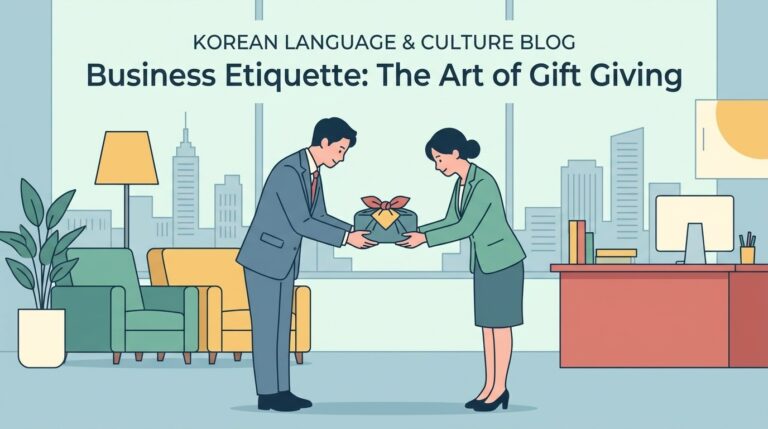
Mastering Korean Business Gift Etiquette: How to Present Gifts and Explain Their Meaning Like a Pro
Phase 1: Empathy & Storytelling Opening
안녕하세요! 매일한글 에디터입니다. (Hello! This is your Daily Hangul editor.)
Picture this: You are seated at a traditional Hanjeongsik (Korean full-course meal) restaurant in Gwanghwamun. Across from you sits Team Leader Kim, a high-value client you’ve been courting for months. The meeting has gone smoothly, and the dessert tea arrives. You reach into your briefcase to pull out a beautifully wrapped package—a specially curated local specialty from your home country. Suddenly, a wave of panic hits you. If you say “이거 선물이에요” (This is a present), it sounds too casual or blunt. If you say “받으세요” (Take it), it sounds commanding. How do you present the gift with genuine humility while gracefully explaining its value and story without making your counterpart feel pressured or burdened?
In Korean corporate culture, gift-giving is not merely a transaction; it is a nuanced art form known as Jeong (정) packaged in layers of tactful respect. Through years of guiding expat managers and global professionals, I’ve seen that the right words can transform a simple souvenir into a multi-year partnership bridge. Let’s unlock the refined expressions and cultural subtleties that will make your Korean business partners admire your etiquette!
Phase 2: Top 3 Core Expressions in Depth
1. 약소하지만 마음에 드셨으면 좋겠습니다 (Yaksohajiman maeume deusyeosseumyeon joketssumnida)
- Pronunciation: [Yak-so-ha-ji-man ma-eu-me deu-syeot-sseu-myeon jo-ket-ssum-ni-da] (Sounds like: Yahk-so-hah-jee-mahn mah-eum-eh deu-shee-oht-seum-yeon joh-ket-soom-nee-dah)
- Meaning: Literal: “It is modest/insignificant, but I hope you like it.” vs. Actual Nuance: “I prepared this with sincere care for you, humbly hoping it brings you joy.”
- K-Culture Moment: Seen in K-Dramas like Misaeng or Reborn Rich, where a junior partner or counterpart presents a carefully wrapped gift to an esteemed senior, bowing slightly while maintaining a humble posture.
- Editor’s Insight: 약소하다 (to be meager or modest) is the golden standard of business modesty. Even if you are gifting premium red ginseng, calling it 약소하다 protects your partner from feeling overwhelmed by social obligation (부담).
- Situation Spectrum: Casual 🚫 | Semi-formal ⚠️ | Formal ✅
- 🤔 Think About It: In many Western cultures, we hype up a gift (“You’re going to love this!”). Why does Korean culture emphasize downplaying the material value while maximizing emotional sincerity?
2. 팀장님 생각이 나서 정성껏 준비했습니다 (Teamjangnim saenggagi naseo jeongseongkkeot junbihaessumnida)
- Pronunciation: [Tim-jang-nim saeng-ga-gi na-seo jeong-seong-kkeot jun-bi-haet-ssum-ni-da] (Sounds like: Teem-jahng-neem seng-gah-gee nah-suh jung-sung-kkut joon-bee-hat-soom-nee-dah)
- Meaning: Literal: “I thought of Team Leader, so I prepared it with all my heart.” vs. Actual Nuance: “I personally picked this out with your tastes and our relationship specifically in mind.”
- K-Culture Moment: Used when presenting a customized gift after closing a successful project, showing that the gift isn’t corporate swag, but a tailored token of appreciation.
- Editor’s Insight: 정성 (Jeongseong – heartfelt devotion) is one of the highest compliments in Korean gift culture. It implies thoughtful deliberation over monetary expense.
- Situation Spectrum: Casual ⚠️ | Semi-formal ✅ | Formal ✅
- 🤔 Think About It: How does highlighting why you thought of someone elevate a business interaction beyond mere professional formality?
3. 저희 지역의 특산품인데, 의미가 깊어서 골라봤습니다 (Jeohui jiyeogui teuksanpuminde, uimiga gipeoseo golla-bwasseumnida)
- Pronunciation: [Jeo-hui ji-yeok-tteuk-san-pu-min-de, ui-mi-ga gi-peo-seo gol-la-bwat-ssum-ni-da] (Sounds like: Juh-hee jee-yuh-gee teuk-sahn-poo-meen-deh, oo-ee-mee-gah gee-puh-suh gohl-lah-bwaht-soom-nee-dah)
- Meaning: Literal: “It’s a local specialty of our region, and I chose it because it has deep meaning.” vs. Actual Nuance: “This represents my background/heritage, and I wanted to share its cultural value with you.”
- K-Culture Moment: Essential during cross-border delegations or foreign partner visits when explaining souvenirs brought from overseas.
- Editor’s Insight: Follow this sentence immediately with a 1-sentence cultural backstory (e.g., “It symbolizes longevity and shared prosperity”). Koreans love storytelling behind physical objects.
- Situation Spectrum: Casual ⚠️ | Semi-formal ✅ | Formal ✅
- 🤔 Think About It: What signature item from your hometown or country could serve as a conversational centerpiece in Korea?
Phase 3: Textbook Korean vs. Real-World Korean
Situation 1: Offering a gift modestly at the end of a business dinner
- 📖 교과서 한국어 (Textbook Korean): 이 선물을 당신에게 드리겠습니다. (I seonmureul dangsinege deurigetseumnida.)
- 🗣️ 진짜 한국어 (Real-World Korean): 약소하지만 저희 팀의 작은 성의입니다. (Yaksohajiman jeohui timui jageun seong-ui-imnida.)
- 💡 왜 다를까? (Why the difference?): The textbook sentence uses 당신 (which is taboo in face-to-face business) and sounds robotic. Real business professionals emphasize 성의 (heartfelt sincerity/token) and self-deprecation.
Situation 2: Explaining why you brought this specific gift
- 📖 교과서 한국어 (Textbook Korean): 이 물건은 아주 비싸고 유명한 것입니다. (I mulgeoneun aju bissago yumyeonghan geosimnida.)
- 🗣️ 진짜 한국어 (Real-World Korean): 대표님 건강을 바라는 마음으로 특별히 챙겨왔습니다. (Daepyonim geon-gangeul baraneun maeumeuro teukbyeolhi chaenggyeowasseumnida.)
- 💡 왜 다를까? (Why the difference?): Boasting about price or fame creates social discomfort and can violate anti-corruption sensibilities (like the Kim Young-ran Act). Expressing care for their health (건강) and wellbeing is universally welcomed.
Phase 4: K-Culture Deep Dive & Non-Verbal Etiquette
4-1. Nunchi & Physical Gestures: The Two-Hand Rule
In Korea, hands speak louder than words. When handing over a business gift:
1. Two-Hand Delivery: Hold the gift with both hands. If it is small, support your right wrist or forearm with your left hand.
2. The 15-Degree Bow: Maintain gentle eye contact before leaning forward slightly in a respectful 15-degree nod.
3. Unwrapping Protocol: Do not expect them to rip open the gift immediately in front of you. In traditional Korean etiquette, opening a gift right away can be perceived as greedy unless the giver explicitly urges: “지금 편하게 열어보세요!” (Please feel free to open it now!).
4-2. Cultural Code: The Art of Balanced Reciprocity (Pumasi)
In Korean corporate dynamics, gifts symbolize 품앗이 (Pumasi — mutual support and reciprocity). When you present a gift from your hometown or country, you are extending an olive branch of hospitality. However, remember the regulatory context: under Korean public ethics standards, overly lavish gifts can cause genuine distress. Thoughtfulness, elegant packaging (such as Bojagi cloth wrap), and story value beat high price tags every single time.
Phase 5: Real-World Business Hospitality Roleplay
Setting: Private dining room at a traditional restaurant in Jongno, Seoul. You are meeting Director Park (박 이사님) after concluding an annual contract review.
- Turn 1 (You): 이사님, 오늘 바쁘신 와중에도 시간 내주셔서 진심으로 감사드립니다. (🎭 Standing slightly, gesturing toward the tea table)
(Isanim, oneul bappeusin wajung-edo sigan naejusyeoseo jinsimeuro gamsadeurimnida.)
“Director Park, thank you sincerely for taking the time out of your busy schedule today.” - Turn 2 (Director Park): 아이고, 아닙니다. 이번 프로젝트 진행하느라 고생 많으셨어요. 덕분에 결과가 좋습니다.
(Aigo, animnida. Ibeon peurojekteu jinhaenghaneura gosaeng maneusyeosseoyo. Deokbune gyeolgwaga joseumnida.)
“Oh, not at all. You went through a lot of trouble carrying out this project. Thanks to you, the results are great.” - Turn 3 (You): 다 이사님께서 잘 이끌어주신 덕분입니다. 아, 그리고… (🎭 Reaching into your bag with both hands to retrieve a boxed gift)
(Da isanimkkeseo jal ikkeureojusin deokbunimnida. A, geurigo…)
“It’s all thanks to your excellent leadership. Ah, and also…” - Turn 4 (Director Park): 음? 그게 뭡니까?
(Eum? Geuge mwomnikka?)
“Hm? What is that?” - Turn 5 (You): 약소하지만 저희 본사 지역의 특산 차(Tea)입니다. 이사님 건강에 도움 되셨으면 해서 정성껏 준비했습니다. (🎭 Handing the box with both hands and a 15-degree bow)
(Yaksohajiman jeohui bonsa jiyeogui teuksan cha-imnida. Isanim geon-gange doum doesyeosseumyeon haeseo jeongseongkkeot junbihaessumnida.)
“It is modest, but it’s a specialty tea from our headquarters’ region. I prepared it with care hoping it aids your health.” - Turn 6 (Director Park): 아이고, 이런 걸 다 챙겨오셨습니까? 매번 이렇게 신경 써주시니 제가 몸 둘 바를 모르겠네요. (🎭 Receiving with two hands with a warm, surprised smile)
(Aigo, ireon geol da chaenggyeoosyeotseumnikka? Maebeon ireoke singyeong sseojusini jega mom dul bareul moreugenneyo.)
“Oh my, you brought something like this? You take such good care of us every time, I don’t know what to do.” - Turn 7 (You): 피로 회복에 아주 좋은 차라서, 야근하실 때 한 잔씩 드시면 좋을 것 같습니다.
(Piro hoeboge aju joeun charaseo, yageunhasil ttae han janssik deusimyeon joeul geot gatseumnida.)
“It’s very good for fatigue recovery, so having a cup during overtime might be wonderful.” - Turn 8 (Director Park): 하하, 고맙습니다! 팀원들과 함께 감사히 잘 마시겠습니다.
(Haha, gomapseumnida! Timwondeulgwa hamkke gamsahi jal masigetseumnida.)
“Haha, thank you! I will enjoy it with my team members with gratitude.”
🔀 Interactive Choice Point
Director Park smiles and holds the box. How do you respond next?
* Choice A: “비싸게 주고 산 거니까 꼭 혼자 드세요!” (It was expensive, so make sure to drink it alone!)
* Choice B: “약소하지만 마음에 드셨으면 좋겠습니다. 편하실 때 드셔보세요.” (It’s modest, but I hope you like it. Please try it whenever convenient.)
* Choice C: “빨리 지금 당장 뜯어서 맛을 평가해주세요.” (Hurry, open it right now and review the taste.)
Feedback:
* Choice A (Bad): Mentions price and discourages sharing, which clashes with Korean team collectivism.
* Choice B (Best ✅): Modest, considerate, and gives the partner total freedom to open and consume at their pace.
* Choice C (Risk ⚠️): Violates Korean gift-opening etiquette and pressures the client.
Phase 6: 10-Second Emotion Shadowing Drill
Practice these lines with cadence markers (/ indicates a breath/pause) and authentic emotional delivery:
[😊 정중하고 겸손하게 / Respectful & Modest]- 약소하지만 / 마음에 드셨으면 / 좋겠습니다.
- (Yaksohajiman / maeume deusyeosseumyeon / joketssumnida.)
[🤝 신뢰감 넘치고 따뜻하게 / Warm & Trust-Building]- 이사님 생각이 나서 / 정성껏 / 준비해 보았습니다.
- (Isanim saenggagi naseo / jeongseongkkeot / junbihae boatseumnida.)
[🍵 자부심을 담아 차분하게 / Calm & Proud Storytelling]- 저희 지역 특산품인데요 / 건강에 아주 좋은 차입니다.
- (Jeohui jiyeok teuksanpumindeyo / geon-gange aju joeun chaimnida.)
Phase 7: K-Culture Mini Dictionary
- 성의 (Seong-ui) | Sincerity / Token of Goodwill | Used in phrases like “작은 성의입니다” (It is a small token of my goodwill) to frame gifts without arrogance.
- 특산품 (Teuksanpum) | Regional Specialty | The most universally appreciated business gift category because it carries cultural narrative rather than monetary bribery.
- 부담 (Budam) | Burden / Social Obligation | Crucial in business hospitality. You must reassure partners: “부담 갖지 마세요” (Please don’t feel burdened).
- 보자기 (Bojagi) | Traditional Wrapping Cloth | High-end business gifts wrapped in aesthetic Bojagi signify deep honor and care for the receiver.
Phase 8: Survival Kit for Business Travelers
Top 3 Business Hospitality Survival Phrases
- 포장 깔끔하게 해주세요. (Pojang kkalkkeumhage haejuseyo.)
- Pro Tip: Use this at Korean department stores or gift shops so they package it in exquisite presentation boxes.
- 선물용 쇼핑백 하나 더 주실 수 있나요? (Seonmulyong syopingbaek hana deo jusil su innayo?)
- Pro Tip: Having a crisp, extra gift bag ensures no wrinkled handles before meeting the executive.
- 감사의 뜻으로 작은 선물을 준비했습니다. (Gamsaui tteuseuro jageun seonmureul junbihaessumnida.)
- Pro Tip: Perfect opening line during formal banquet speeches or kickoff presentations.
Editor’s Travel & Logistics Note
- Navigate to prestigious business dining and gift stores using the Naver Map App for English Navigation. When purchasing premium gifts in department stores, ask for “선물 포장 코너” (Gift wrapping corner) for elite presentation.
Phase 9: Think Deeper (한 발 더 깊이)
In Korean society, a gift is never simply an object; it is an incarnation of 정 (Jeong) and 예의 (Ye-ui). When you minimize the object’s grandeur (약소하지만) while elevating the recipient’s status (생각이 나서), you create harmony (화합). You acknowledge that your mutual human bond is infinitely more valuable than any retail price tag.
💬 Your Turn: What gift from your country would you bring to a Korean counterpart, and what cultural story would you tell? Share your ideas in the comments below!
Phase 10: FAQ & Misconception Buster
Q: Should I open a gift immediately when a Korean partner gives me one?
A: In general business settings, it is best to wait unless they specifically invite you to open it by saying “열어보세요”. If you do open it, express admiration for the packaging and sincerity before admiring the item itself.
Q: Are there gifts I should avoid giving in Korean business?
A: Avoid sharp objects like knives or scissors (symbolizing cutting ties), shoes (mythology about running away), and items in sets of 4 (associated with the Hanja for death). Red ginseng, regional teas, quality liquor, and traditional craft sets are safe and prized.
Q: What if a client politely declines my gift once?
A: This is often 양보 (modest refusal). Politely offer it a second time with two hands saying: “정말 약소한 것이니 편하게 받아주세요” (It is truly modest, so please accept it comfortably).
🚨 Common Mistakes Alert
- ❌ Mistake 1: Handing the gift with one hand while holding a smartphone with the other. ➔ Correct Action: Put everything down and use both hands.
- ❌ Mistake 2: Mentioning how much money you spent. ➔ Correct Action: Focus on why it is meaningful or healthy for them.
- ❌ Mistake 3: Using plain grocery plastic bags. ➔ Correct Action: Always present gifts in dedicated, clean shopping bags or Bojagi wrapping.
Phase 11: Action Mission Challenge
- 🥉 Bronze Mission (Solo Shadowing): Stand in front of a mirror and deliver Expression #1 holding an item with both hands and bowing 15 degrees.
- 🥈 Silver Mission (Social Connection): Post your favorite local specialty on Instagram or LinkedIn and write the Korean caption: “저희 지역의 특산품인데, 의미가 깊습니다!”
- 🥇 Gold Mission (Real Field Execution): Present your next client or tutor a small treat (like coffee or snacks) using: “약소하지만 작은 성의입니다.”
🎮 K-Culture Mission: Watch an episode of Hospital Playlist or King the Land. Spot how characters hand over beverage gifts or health supplements to their seniors—observe the two-handed handoff!
Phase 12: Interactive Quiz Challenge
Q1. Which phrase is the most natural and polite way to downplay your gift modestly in front of a client?
* A) 이거 아주 비싼 거니까 잘 쓰세요.
* B) 약소하지만 마음에 드셨으면 좋겠습니다.
* C) 그냥 심심해서 샀어요.
Q2. Fill in the blank: “대표님 건강을 바라는 _________ 특별히 챙겨왔습니다.”
* A) 마음으로 (maeumeuro)
* B) 돈으로 (doneuro)
* C) 손으로 (soneuro)
Q3. [True / False] In Korean business culture, you should aggressively insist that the client opens the gift immediately at the dinner table.
* A) True
* B) False
🔍 Click here to reveal Answer Key & Explanations!
- Q1 Answer: B | 약소하지만 마음에 드셨으면 좋겠습니다 demonstrates intermediate/advanced business tact and modesty.
- Q2 Answer: A | 마음으로 (with the heart/mind of wishing you good health) is the quintessential way to frame care.
- Q3 Answer: B (False) | Forcing immediate unwrapping causes pressure. Let the client guide the timing.







