

Master Korean Street Food: How to Order Tteokbokki and Twigim Like a Local
Phase 1: Empathy & Story Opening
안녕하세요! 매일한글 에디터입니다. (Hello! I’m your Daily Hangul editor.)
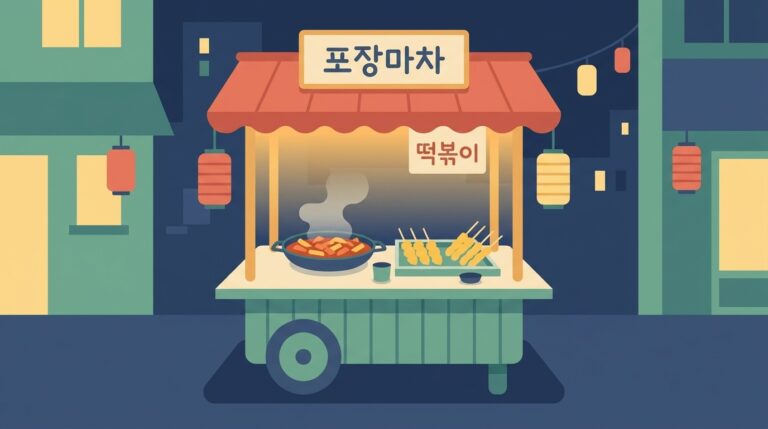
Picture this: You are walking down a bustling street in Myeongdong on a chilly evening. Steam rises into the night air carrying the sweet, spicy aroma of simmering gochujang and golden, sizzling fried snacks. You see locals huddled around an authentic pojangmacha (street cart), chatting merrily while dipping crispy fried dumplings straight into thick red sauce. You want to join in, but anxiety strikes: “How do I ask for mixed fried snacks?”, “Can I drink the broth for free?”, “Will they think I’m rude if I just stand here?”
If you have ever felt frozen in front of a street food cart, you are not alone! Over 80% of our beginner students tell us that ordering at a fast-paced food stall felt far more intimidating than a sit-down restaurant. But street food stalls are the warmest, friendliest spots in Korea once you know just a few magic phrases. Today’s guide is crafted from real street-tested learner feedback to give you the confidence to order, customize, and enjoy tteokbokki and twigim like a true Seoulite!
Phase 2: 3 Key Expressions Deep Dive
1. 떡볶이 1인분 주세요 (Tteokbokki il-inbun juseyo)
- Pronunciation: [Tteok-bok-ki il-in-bun ju-se-yo] (Sounds like: ‘Ttok-bok-key eel-een-boon joo-seh-yo’)
- Meaning: Literal: “Please give me 1 serving of tteokbokki” | Nuance: The standard, polite way to order street food portions.
- K-Culture Moment: In classic K-dramas like Weightlifting Fairy Kim Bok-joo, friends stop by a red tent after school shouting this exact sentence before grabbing their skewers.
- Editor’s Insight: Street vendors count food by inbun (servings). 1인분 (il-inbun = 1 serving) is usually plenty for one person alongside snacks!
- Situation Spectrum: Casual: ✅ | Semi-formal: ✅ | Formal: ⚠️
- 🤔 Think About It: In English, we often say “Can I get a tteokbokki?” but Korean clearly specifies person counts (in-bun). How does counting by ‘person servings’ reflect communal dining?
2. 떡볶이 국물에 묻혀 주세요 (Tteokbokki gungmure mutyeo juseyo)
- Pronunciation: [Tteok-bok-ki gung-mu-re mu-chyeo ju-se-yo] (Think: ‘Ttok-bok-key goong-moo-reh moo-chyeo joo-seh-yo’)
- Meaning: Literal: “Please smear it in tteokbokki sauce” | Nuance: “Please dip/coat my fried snacks in the spicy tteokbokki sauce!”
- K-Culture Moment: K-pop idols during street food mukbangs almost always ask the vendor for tteokbokki gukmul over their crispy seaweed rolls (gimmari).
- Editor’s Insight: If you prefer keeping your fried food crunchy, skip this sentence. But if you want the ultimate flavor bomb, this is the magic insider secret phrase!
- Situation Spectrum: Casual: ✅ | Semi-formal: ✅ | Formal: 🚫
- 🤔 Think About It: Korean food culture loves harmonious flavor blending (sauce + fry). Do you prefer dipping or pouring sauce on your food?
3. 국물 좀 더 마셔도 돼요? (Gungmul jom deo masyeodo dwaeyo?)
- Pronunciation: [Gung-mul jom deo ma-syeo-do dwae-yo?] (Think: ‘Goong-mool jom duh mah-shuh-doh dweh-yo?’)
- Meaning: Literal: “May I drink a little more broth?” | Nuance: “Could I have a refill of the warm fish cake broth?”
- K-Culture Moment: Characters in Korean variety shows standing in the winter cold, holding a paper cup of steamy eomuk broth with both hands to warm up.
- Editor’s Insight: Odeng/fish cake broth is practically unlimited and free at almost all Korean street carts! Asking politely shows great Korean manners.
- Situation Spectrum: Casual: ✅ | Semi-formal: ✅ | Formal: ⚠️
- 🤔 Think About It: Offering complimentary hot soup shows the deep-rooted Korean culture of Jeong (warm affection and hospitality).
Phase 3: Textbook Korean vs. Real Korean
Situation 1: Choosing an assortment of fried snacks
- 📖 교과서 한국어 (Textbook): 튀김 여러 종류를 섞어서 주십시오. (Twigim yeoreo jongryureul seokkeoseo jusipsio. – “Please mix several kinds of fried food.”)
- 🗣️ 진짜 한국어 (Real-Life): 튀김 섞어서 1인분 주세요. (Twigim seokkeoseo il-inbun juseyo. – “Please give me 1 serving of mixed fried snacks.”)
- 💡 왜 다를까? (Why the difference?): Street vendors work quickly. Saying seokkeoseo (mixed) is short, punchy, and instantly understood.
Situation 2: Asking for total payment
- 📖 교과서 한국어 (Textbook): 제가 지불해야 할 총금액이 얼마입니까? (Jega jibulhaeya hal chonggeumaegi eolmaimnikka? – “What is the total sum I must pay?”)
- 🗣️ 진짜 한국어 (Real-Life): 이모님, 얼마예요? (Imo-nim, eolmayeyo? – “Auntie, how much is it?”)
- 💡 왜 다를까? (Why the difference?): Addressing female street cart owners warmly as Imo-nim (Auntie) creates instant rapport and feels natural.
Phase 4: K-Culture Deep Dive & Non-Verbal Manners
4-1. 눈치 (Nunchi) & Street Food Gestures
- The Cup & Ladle Rule: When scooping fish cake soup (eomuk gukmul), pick up a small paper cup provided on the counter and scoop gently without letting your cup touch the communal soup pot.
- The Skewer Counter: When eating fish cake skewers, never throw the wooden sticks into the trash can. Keep them in front of you—the owner counts the sticks at the end to calculate your bill!
- Standing Space Courtesy: Korean stalls get packed. Keep your bag close to your front and take half a step back once you finish your food to let others step up.
4-2. K-Culture Code: Bunsik (분식) & Comfort Food
Street food is categorized as Bunsik (flour-based quick bites). For Koreans, Tteokbokki + Twigim + Sundae is considered the holy trinity called “Tteok-Twi-Sun”. It represents after-school memories, quick late-night bites with coworkers, and ultimate soul food.
Phase 5: Real-Life Roleplay Scenario
Setting: A vibrant outdoor pojangmacha near Hongdae Station on Friday night.
Characters: You (Hungry Traveler) & Imo-nim (Warm, energetic stall owner).
- You: 🎭 (Approaches cart with a friendly smile) 안녕하세요, 이모님! (Annyeonghaseyo, imo-nim! / Hello, Auntie!)
- Imo-nim: 🎭 (Stirring the red tteokbokki pan) 어서 와요! 뭐 줄까? (Eoseo wayo! Mwo julkka? / Welcome! What can I get you?)
- You: 떡볶이 1인분하고 모둠 튀김 주세요. (Tteokbokki il-inbun-hago modum twigim juseyo. / 1 serving of tteokbokki and mixed fried snacks, please.)
- Imo-nim: 🎭 (Points tongs toward the red sauce) 튀김 국물에 묻혀줄까? (Twigim gungmure mutyeojulkka? / Shall I coat the fries in sauce?)
- You: 네, 국물에 묻혀 주세요! (Ne, gungmure mutyeo juseyo! / Yes, please coat them in sauce!)
- Imo-nim: 🎭 (Hands over a hot plate with wooden picks) 어묵 국물은 종이컵에 떠서 마셔요~ (Eomuk gungmureun jongikeobe tteoseo masyeoyo~ / Drink fish cake broth in a paper cup~)
- You: 🎭 (Holds cup with both hands) 와, 국물 진짜 맛있어요! (Wa, gungmul jinjja masisseoyo! / Wow, the broth is really delicious!)
- Imo-nim: 🎭 (Beams with pride) 많이 먹어요, 학생! (Mani meogeoyo, haksaeng! / Eat lots!)
🔀 Interactive Decision Branch
What do you say when you are ready to pay?
* Option A: “이모님, 계산해 주세요!” (Imo-nim, gyesanhae juseyo!)
* Option B: “돈 가져가세요.” (Don gajyeogaseyo.)
* Option C: “저기요, 카드 돼요?” (Jeogiyo, kadeu dwaeyo?)
- Feedback:
- Option A (Best): Polite, clear, and natural! You will get an immediate friendly total.
- Option B (Bad): “Take money” sounds demanding and rude to native speakers.
- Option C (Risk): While many stalls now take cards, small street carts prefer cash or bank transfer. Better to ask gently: “현금만 돼요?” (Hyeongeumman dwaeyo? / Cash only?).
Phase 6: 10-Second Emotion Shadowing Drill
Practice these natural rhythm pauses (/) with the assigned emotion:
[😊 Cheerful & Polite]떡볶이 1인분 / 포장해 주세요! (Tteokbokki il-inbun / pojanghae juseyo! / Please pack 1 serving of tteokbokki to go!)[😋 Eager & Excited]튀김도 / 국물에 꼭 / 묻혀 주세요! (Twigimdo / gungmure kkok / mutyeo juseyo! / Please definitely coat the fried snacks in sauce too!)[🥺 Grateful & Cozy]어묵 국물 / 조금만 더 / 마셔도 될까요? (Eomuk gungmul / jogeumman deo / masyeodo doelkkayo? / Could I have just a bit more broth?)
Phase 7: K-Culture Mini Dictionary
- 김말이 (Gimmari): Deep-fried seaweed roll filled with glass noodles. The absolute #1 dipping snack for tteokbokki sauce.
- 오뎅 / 어묵 (Odeng / Eomuk): Savory fish cake skewered in zig-zag shapes on wooden sticks and simmered in radish-kelp broth.
- 포장 (Pojang): Takeout / To-go. Street vendors always ask “드시고 가세요, 포장이에요?” (Eating here or to-go?).
- 순대 (Sundae): Korean traditional blood sausage stuffed with glass noodles, typically dipped in seasoned salt or spicy sauce.
Phase 8: Traveler’s Survival Kit
Top 3 Survival Phrases
- 덜 맵게 해줄 수 있어요? (Deol maepge haejul su isseoyo?)
- Pro Tip: If you have low spice tolerance, ask this before they scoop your tteokbokki!
- 여기서 먹고 갈게요. (Yeogiseo meokgo galgeyo.)
- Pro Tip: Means “I will eat here.” Say this when the vendor looks at you questioning to-go or dine-in.
- 계좌이체 돼요? (Gyejw-a-iche dwaeyo?)
- Pro Tip: If you run out of cash at a street stall, Korean bank transfer via travel money cards is often accepted.
Editor’s Travel Note
Most traditional street vendors prefer Korean Won cash (1,000 and 5,000 KRW bills) or Korean mobile pay. When exploring famous street food alleys like Gwangjang Market or Dongdaemun, check real-time store hours and vendor locations via the Naver Map App Download Guide.
Phase 9: A Step Deeper (Reflection Essay)
In Korean street stalls, personal space boundaries soften. Strangers share communal soy sauce dishes, stand shoulder-to-shoulder under plastic tarps, and chat with friendly owners called Imo (Aunt) or Samchon (Uncle). Street food culture reflects Korea’s Jeong (정)—a deep sense of warmth where even a passing stranger is fed like family.
💬 Your Turn: What is your all-time favorite street food in your home country, and would you dare try dipping fried snacks into spicy tteokbokki sauce? Share your thoughts below!
Phase 10: FAQ & Common Mistakes
Q: Is the fish cake soup (Eomuk gukmul) really free at street stalls?
A: Yes! You can pour broth into a paper cup using the ladle on the counter as long as you ordered something at the stall.
Q: Can I pay with an international credit card at street stalls?
A: Larger stalls in tourist hubs take credit cards, but smaller roadside carts often accept only Korean cash, T-Money transport cards, or local bank transfers.
Q: How spicy is standard street Tteokbokki for beginners?
A: Most street tteokbokki ranges from medium to quite spicy. If you struggle with spice, eat an eomuk (fish cake) or drink warm broth to soothe your tongue.
🚨 Common Mistakes Board
- ❌ Mistake 1: Double-dipping fish cake into communal soy sauce.
- 👉 Correct Action: Use the sauce brush provided at the cart to brush soy sauce onto your fish cake.
- ❌ Mistake 2: Tossing wooden skewers into public trash before paying.
- 👉 Correct Action: Keep your skewers on the plate; the owner tallies your bill based on remaining sticks.
- ❌ Mistake 3: Sitting at the cart table without ordering food first.
- 👉 Correct Action: Tell the owner your order at the counter first, then take a seat.
Phase 11: Action Missions
- 🥉 Bronze Mission (Solo Practice): Say “떡볶이 1인분 포장해 주세요” out loud 5 times in 10 seconds.
- 🥈 Silver Mission (Social Share): Take a photo of your favorite spicy snack and share it online with the caption “떡볶이 먹고 싶어요!”.
- 🥇 Gold Mission (Real Life Action): Visit a Korean grocery store or local street food stall and order 1 item entirely in Korean!
- 🎮 K-Culture Mission: Watch any episode of a Korean variety show (like Running Man) and spot when someone drinks street cart broth with two hands.
Phase 12: Interactive Quiz Challenge
Q1. You want 1 serving of mixed fried snacks dipped in tteokbokki sauce. What is the most natural sentence?
* A) 튀김 혼자서 주세요. (Twigim honjaseo juseyo.)
* B) 튀김 섞어서 국물에 묻혀 주세요. (Twigim seokkeoseo gungmure mutyeo juseyo.)
* C) 튀김을 물에 넣어 주세요. (Twigimeul mure neoeo juseyo.)
👉 Click to reveal Answer & Explanation
Answer: B
Explanation: “섞어서” (seokkeoseo) means mixed, and “국물에 묻혀 주세요” (gungmure mutyeo juseyo) means to coat in sauce. A means “give me fried food alone” and C means “put fried food in water”.
Q2. True or False: You should throw away fish cake skewers in the garbage right after eating so the table stays clean.
👉 Click to reveal Answer & Explanation
Answer: False (X)
Explanation: Leave the skewers in your cup or on your plate! The street vendor counts the skewers to determine how much you need to pay.







