

Phase 1: Empathy (Story-Driven Opening)
안녕하세요! I’m your Daily Hangul editor.
Imagine you are tucked comfortably inside a cozy guest house in Hongdae after a long day of exploring Seoul. Suddenly, the building alarm rings loudly: “Beep-beep-beep!” Smoke starts drifting into the hallway. Your heart races, your mind goes completely blank, and while you might know complex words from flashcard apps, your tongue freezes. You open the door and wonder: What do I scream? How do I tell people there is a fire in Korean?
In real emergencies, complicated textbook grammar is useless. When every second counts, you need sharp, visceral one-word alerts that trigger immediate human response. This guide gives you the exact emergency survival vocabulary used by locals, designed to keep you safe and confident in any Korean accommodation, restaurant, or subway station.
Phase 2: Top 3 Core Expressions Deep Dive
1. 불이야! (Buriya!)
- Pronunciation: [Boo-ree-yah] (Sounds like shouting “Boo!” followed by “Ree-yah!”)
- Meaning: Literal: “It’s a fire!” | Real Nuance: “FIRE! EVERYONE EVACUATE!”
- K-Culture Moment: Seen in K-Dramas like The First Responders or emergency training scenes where neighbors yell out loud across corridors to alert everyone.
- Editor’s Insight: You do not need polite particles (요/-yo) here. Yelling “불이야!” instantly breaks through panic and cuts across all social hierarchies.
- Situation Spectrum: Casual ✅ | Semi-formal ✅ | Formal ✅ (Universal Emergency Alert)
- 🤔 Think About It: Why does Korean combine the noun for fire (Bul) and the copula (Iya) into one urgent shout rather than a polite sentence?
2. 도와주세요! (Dowajuseyo!)
- Pronunciation: [Doh-wah-joo-seh-yo] (Think of “Dough” + “Wah” + “Juice” + “Say-yo”)
- Meaning: Literal: “Please help.” | Real Nuance: “Someone please help me right now!”
- K-Culture Moment: The quintessential distress call echoed across countless thriller K-dramas when someone is trapped or in imminent danger.
- Editor’s Insight: Beginners often mix this up with “도와줘 (Dowajwo)”. Always attach “-세요 (-seyo)” so bystanders instantly feel directly addressed and compelled to assist.
- Situation Spectrum: Casual ⚠️ | Semi-formal ✅ | Formal ✅
- 🤔 Think About It: In your native language, do you ask for help politely or bluntly during an emergency?
3. 나가세요! (Nagaseyo!)
- Pronunciation: [Nah-gah-seh-yo] (Sounds like “Nah” + “Gah” + “Say-yo”)
- Meaning: Literal: “Please exit/go out.” | Real Nuance: “Get out! Evacuate immediately!”
- K-Culture Moment: Said by security personnel, building managers, or station staff directing crowds to emergency stairs.
- Editor’s Insight: Short, punchy imperative. It signals direction clearly without causing confusion.
- Situation Spectrum: Casual ✅ | Semi-formal ✅ | Formal ✅
- 🤔 Think About It: How does body language reinforce short directional commands in high-stress situations?
Phase 3: Textbook Korean vs. Real Korean
- Situation 1: Discovering smoke in a hallway
- 📖 Textbook Korean: 화재가 발생했습니다. (Hwajaega balsaenghaesseumnida. – A fire has occurred.)
- 🗣️ Real Korean: 불이야! 불났어요! (Buriya! Bulnasseoyo! – Fire! A fire broke out!)
- 💡 Why it differs: In life-threatening emergencies, passive formal statements delay action. Loud, direct alarms save lives.
- Situation 2: Pointing someone toward the emergency exit
- 📖 Textbook Korean: 비상구로 이동하십시오. (Bisangguro idonghasipsio. – Please proceed to the emergency exit.)
- 🗣️ Real Korean: 이쪽으로 나가세요! (Ijjogeuro nagaseyo! – Go out this way!)
- 💡 Why it differs: Everyday Koreans prioritize rapid physical orientation over technical architectural terms when evacuating.
Phase 4: K-Culture Deep Dive & Non-Verbal Manners
- 4-1. Nunchi & Emergency Body Language: When shouting 불이야!, do not stay still. Wave your arms outward to signal the direction of danger and cover your nose and mouth with your sleeve or a wet tissue (물티슈 / multisyu). Quick, decisive physical motion combined with vocal clarity creates immediate situational awareness (눈치 / Nunchi).
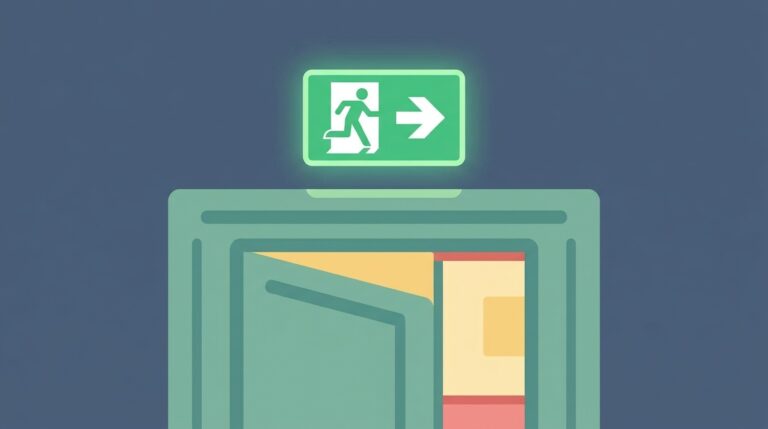
- 4-2. Safety Culture & 119 System: South Korea boasts one of the fastest emergency response systems in the world via 119. Emergency buttons in high-rises and subways are clearly marked with bright green running figures (비상구 / Bisang-gu). Calling 119 connects you to translation services for foreigners immediately.
Phase 5: Real-Life Roleplay Scenario
- Setting: 3rd floor hallway of a boutique hotel in Seoul. Smoke triggers the building alarm.
- Characters: You (Traveler) & Min-su (Hotel Front Desk Staff).
- You: 🎭 (Smelling smoke, running to the hallway) 저기요! 불났어요! (Jeogiyo! Bulnasseoyo! / Excuse me! There’s a fire!)
- Min-su: 🎭 (Checking the corridor urgently) 어디예요? (Eodiyeyo? / Where is it?)
- You: 🎭 (Pointing to room 304) 304호예요! 연기 나와요! (Sambaeksaho-yeyo! Yeongi nawayo! / Room 304! Smoke is coming out!)
- Min-su: 🎭 (Tapping emergency bell) 알겠습니다! 119에 전화했어요! (Algetseumnida! Il-il-gue jeonhwahaesseoyo! / Understood! I called 119!)
- You: 🎭 (Panicking) 엘리베이터 타요? (Ellibeiteo tayo? / Should we take the elevator?)
- Min-su: 🎭 (Shaking head firmly) 안 돼요! 계단으로 가세요! (An dwaeyo! Gyedaneuro gaseyo! / No! Use the stairs!)
- You: 🎭 (Looking around) 비상구가 어디예요? (Bisangguga eodiyeyo? / Where is the emergency exit?)
- Min-su: 🎭 (Guiding with hand outstretched) 오른쪽 끝이에요. 빨리 나가세요! (Oreunjjok kkeutieyo. Ppalli nagaseyo! / At the end on the right. Please exit quickly!)
🔀 Interactive Choice: What do you do when smoke fills the stairway?
* A. Shout “불이야!” and crawl low along the wall toward the green exit light. (Best: Standard safety procedure)
* B. Take the elevator to escape faster. (Bad: Elevators can lose power and turn into traps)
* C. Return to your room to pack your heavy luggage. (Risk: Smoke inhalation occurs within seconds)
Phase 6: 10-Second Emotional Shadowing Drill
- 🚨
[Urgent & Loud]불이야! / 도와주세요! (Buriya! / Dowajuseyo!) - 🏃
[Fast & Direct]계단으로 / 빨리 나가세요! (Gyedaneuro / ppalli nagaseyo!) - 📞
[Clear & Serious]119에 / 신고해 주세요! (Il-il-gue / singohae juseyo!)
Phase 7: K-Culture Mini Dictionary
- 불 (Bul): Fire. Used as a root in daily words like 불꽃 (fireworks) or 불고기 (fire meat/bulgogi).
- 소방차 (Sobangcha): Fire truck. Readily recognized by sirens across Korean metropolitan roads.
- 비상구 (Bisang-gu): Emergency exit. Marked by standard green illuminated signs across all public venues.
- 119 (Il-il-gu): The national emergency telephone number for fire and medical rescue in Korea.
Phase 8: Survival Kit for Travelers
- Top 3 Survival Phrases:
- 불이야! (Buriya!) – Fire! (Yell this at the top of your lungs)
- 비상구가 어디예요? (Bisangguga eodiyeyo?) – Where is the emergency exit?
- 119에 전화해 주세요. (Il-il-gue jeonhwahae juseyo.) – Please call 119.
- Editor’s Travel Note: Before your trip, be sure to complete the official Emergency Ready App download provided by the Korean Ministry of the Interior and Safety for real-time English disaster alerts.
Phase 9: A Step Deeper
In Korean culture, the exclamation “불이야!” carries an instinctive community duty. Unlike routine conversational interactions that demand precise honorifics, acute distress requires collective solidarity. Shouting this single phrase activates mutual protection among complete strangers without social hesitation.
💬 Your Turn: What is the most immediate word people shout in your country when a fire is spotted? Leave a comment below!
Phase 10: FAQ & Common Mistakes
Q: Can 119 operators in Korea speak English?
A: Yes. When you dial 119, state “English, please” to be immediately connected to a 3-way translation service provided by the Korea Tourism Organization or emergency dispatch.
Q: Is it disrespectful to drop honorifics when yelling ‘불이야’?
A: Not at all. In life-or-death emergencies, short imperative alerts like “불이야!” are expected and critical for survival.
Q: What if I smell gas instead of seeing open fire?
A: Say “가스 냄새가 나요” (Gaseu naemsaega nayo – I smell gas) and avoid turning electric switches on or off.
🚨 Common Mistakes Board:
1. ❌ Whispering politely: 저기요, 불이 났습니다…
👉 Correct Action: Shout loudly: 불이야!
2. ❌ Calling 911 directly on a local SIM without country routing.
👉 Correct Action: Dial 119 directly inside South Korea.
3. ❌ Attempting to ride elevators during alarms.
👉 Correct Action: Locate the 비상구 (Emergency Exit) and take stairs.
Phase 11: Action Mission & Engagement
- 🥉 Bronze Mission: Practice yelling “불이야!” and “도와주세요!” out loud three times in front of a mirror.
- 🥈 Silver Mission: Spot and photograph a green 비상구 (Exit) sign in a public space and name it in Korean.
- 🥇 Gold Mission: Save Korean emergency numbers (119 for Fire/Ambulance, 112 for Police) into your phone contacts.
- 🎮 K-Culture Mission: Watch a scene in an action K-drama and listen for how emergency personnel direct civilians to safety.
Phase 12: Interactive Quiz Challenge
Q1. What is the quickest and most effective way to shout ‘Fire!’ in Korean?
* A) 화재 발생을 보고합니다
* B) 불이야!
* C) 안녕히 계세요
Q2. Fill in the blank:
“계단으로 ________!” (Please go out by the stairs!)
* Hint: Na-ga-se-yo
Q3. True or False: In Korea, dialing 119 connects you to the fire department and ambulance services.
Click for Answer & Explanation
- Answer: B (불이야!) – This is the standard, universally recognized shout for fire.
- Answer: 나가세요 (nagaseyo) – Combined: 계단으로 나가세요! (Please exit via the stairs!)
- Answer: True – 119 covers both fire emergencies and paramedic rescue across South Korea.







