

Shopping for Clothes in Korea: How to Ask About Fabrics and Laundry Like a Pro
Phase 1: Empathy (Story-Driven Opening)
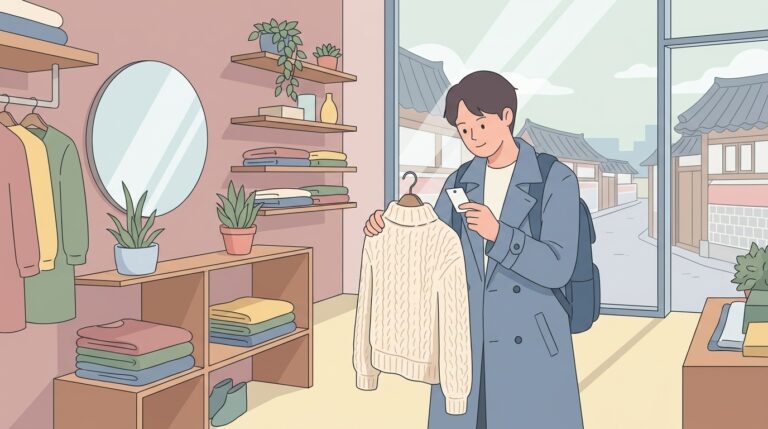
안녕하세요! (Annyeonghaseyo!) I’m your Daily Hangul editor. Imagine this: you are walking through the trendy, aesthetic boutiques of Seongsu-dong or Hongdae. You spot an exquisite, minimalist knit sweater—the exact style worn by your favorite K-drama leads. You check the price tag, and it’s an investment piece. But suddenly, your practical mind kicks in: Can I machine wash this? Will it shrink into doll clothes? What material is this made of?
You look at the tag, but it’s packed with Korean textile abbreviations like ‘면 (myeon)’, ‘울 (ul)’, and confusing laundry symbols. You try asking the chic boutique staff, but you freeze because standard beginner textbooks only taught you how to say “이거 얼마예요? (How much is this?)”.
As a B2-level learner, you’ve moved past basic price negotiations. You need specific, practical phrases to protect your wardrobe and budget. Today’s guide is built directly from real student experiences to help you confidently inquire about fabric compositions, delicate materials, and laundry care instructions in modern Korean retail settings.
Phase 2: Deep Dive into 3 Essential Expressions
1. 이거 소재가 어떻게 돼요? (Igeo sojaega eotteoke dwaeyo?)
- Pronunciation: [I-geo so-jae-ga eo-tteo-ke dwae-yo?] (Sounds like: “Ee-guh so-jeh-gah uh-ttuh-keh dweh-yo?”)
- Meaning: Literal: “How does this material become?” / Natural: “What kind of fabric is this made of?”
- K-Culture Moment: You’ll hear fashion vloggers and stylists on YouTube channels like W Korea or Vogue Korea use this expression during haul reviews when assessing high-end garments.
- Editor’s Insight: While textbook Korean often uses “재질 (jaejil)” or “원단 (wondan)”, “소재 (sojae)” is the most refined and natural B2-level term used in contemporary boutiques.
- Situation Spectrum: Casual ⚠️ | Semi-formal ✅ | Formal ✅
- 🤔 Think About It: In English, we ask “What is it made of?” focusing on the components. Korean often uses “어떻게 돼요?” (How is it?), focusing on the state or nature of the item. How does this reflect Korean conversational politeness?
2. 물세탁 가능한가요, 아니면 드라이 맡겨야 하나요? (Mulsetak ganeunghangayo, animyeon deurayi matgyeoya hanayo?)
- Pronunciation: [Mul-se-tak ga-neung-han-ga-yo, a-ni-myeon deu-ra-i mat-gyeo-ya ha-na-yo?]
- Meaning: Literal: “Is water-wash possible, or must I entrust dry-cleaning?” / Natural: “Can I wash this in water, or does it need to be dry-cleaned?”
- K-Culture Moment: In lifestyle K-dramas, whenever someone ruins a luxury blazer at home, their roommate screams this rhetorical question in despair.
- Editor’s Insight: Koreans say “드라이를 맡기다 (to entrust dry cleaning)” rather than just “드라이클리닝 하다”. The verb “맡기다 (to entrust/leave in care)” highlights leaving garments with professional neighborhood cleaners (세탁소).
- Situation Spectrum: Casual ⚠️ | Semi-formal ✅ | Formal ✅
- 🤔 Think About It: Notice the linguistic trust placed in local services with the word 맡기다. Does your culture also view laundry care as a specialized neighborhood craft?
3. 이거 세탁하면 줄어들거나 보풀이 잘 일어나나요? (Igeo setakhamyeon jureodeulgeona bopuri jal ireonanayo?)
- Pronunciation: [I-geo se-tak-ha-myeon ju-reo-deul-geo-na bo-pu-ri jal i-reo-na-na-yo?]
- Meaning: Literal: “If washed, does this shrink or do lint/pills rise easily?” / Natural: “Does this shrink or pill easily when washed?”
- K-Culture Moment: A staple question asked by savvy shoppers at Dongdaemun Night Market when inspecting high-turnover fast fashion versus premium knitwear.
- Editor’s Insight: “보풀이 일어나다” specifically describes pilling or lint formation on wool and knitwear. Using “일어나다 (to rise/occur)” makes you sound remarkably native.
- Situation Spectrum: Casual ⚠️ | Semi-formal ✅ | Formal ✅
- 🤔 Think About It: Describing lint as “rising (일어나다)” gives a dynamic visual quality to fabric aging in Korean.
Phase 3: Textbook Korean vs. Real Korean
Situation A: Asking if fabric wrinkles easily
- 📖 Textbook Korean: 이 옷은 주름이 생깁니까? (I oseun jureumi saenggimnikka? – “Does this garment generate wrinkles?”)
- 🗣️ Real Korean: 구김이 잘 가는 편인가요? (Gugimi jal ganeun pyeon-in-gayo? – “Does it tend to crease easily?”)
- 💡 Why the difference? Textbook phrasing uses rigid Sino-Korean nouns (주름) and formal verbs (생기다), whereas natives naturally use “구김 (creasing)” combined with “~는 편이다 (to tend to)” for softer, colloquial inquiry.
Situation B: Asking if colors will bleed in the wash
- 📖 Textbook Korean: 염료가 빠집니까? (Yeomryoga ppajimnikka? – “Does dye discharge?”)
- 🗣️ Real Korean: 이염이나 물 빠짐 있어요? (Iyeomina mul ppajim isseoyo? – “Is there any color bleed or fading?”)
- 💡 Why the difference? Shoppers and fashion insiders use the compound terms 물 빠짐 (water fading) and 이염 (color transfer to other garments), capturing practical daily laundry concerns.
Phase 4: K-Culture Deep Dive & Non-Verbal Manners
4-1. Nunchi & Gesture Guide
- The Two-Finger Touch: When examining fabric texture in upscale boutique shops, avoid gripping or pulling garments. Gently feel the hem between your index finger and thumb.
- Care Tag Etiquette: Always look for the care label inside the lower-left seam or neckline gently. If you need help finding it, make soft eye contact with the clerk, tilt your head slightly, and point gently toward the seam rather than flipping the whole outfit inside out.
4-2. Cultural Code: The Neighborhood “세탁소 (Setakso)”
In Korea, dry cleaners are cornerstones of residential neighborhoods. Traditional 세탁소 owners (세탁소 사장님) are renowned garment repair masters. Koreans rarely throw away damaged luxury knitwear or coats; they take them to the local laundry master. Knowing whether a garment requires specialized care (드라이클리닝) or can handle standard coin laundromat (코인 빨래방) cycles directly impacts your daily living routine in Korea.
Phase 5: Real-World Roleplay Scenario
- Setting: A boutique showroom in Hannam-dong.
- Characters: You (Savvy Shopper) & Staff Min-ji (Knowledgeable Boutique Clerk).
- You: 저기요, 죄송한데 이 니트 소재가 어떻게 돼요? (Jeogiyo, joesonghande i niteu sojaega eotteoke dwaeyo? / Excuse me, what material is this knit made of?) 🎭 Gently touching the sleeve hem.
- Min-ji: 네, 고객님! 그 제품은 울 80%에 캐시미어 20% 혼방이에요. (Ne, gogaeknim! Geu jeepeumeun ul palsip peosenteue kaesimieo isip peosenteu honbang-ieyo. / Yes! That piece is an 80% wool and 20% cashmere blend.)
- You: 만져보니까 되게 부드럽네요. 혹시 세탁할 때 물세탁도 가능한가요? (Manjyeobonikka dwoege budeureomneyo. Hoksi setakhal ttae mulsetakdo ganeunghangayo? / It feels very soft. Can this be hand/water washed, by any chance?)
- Min-ji: 캐시미어가 섞여 있어서 첫 세탁은 꼭 드라이클리닝 맡겨주시는 게 좋아요. (Kaesimieoga seokkyeo isseoseo cheot setageun kkok deurayikeullining matgyeojusineun ge joayo. / Because it contains cashmere, we recommend dry cleaning for the first wash.)
- You: 아, 그렇군요. 평소에 입을 때 보풀은 잘 안 일어나는 편인가요? (A, geureokgunyo. Pyeongsoe ibeul ttae bopureun jal an ireonaneun pyeon-in-gayo? / Ah, I see. Does it not pill too easily during daily wear?)
- Min-ji: 고급 원사라 보풀은 적은 편인데, 마찰이 잦은 팔꿈치 쪽은 가볍게 빗어주시면 오래 입으실 수 있어요. (Gogeup wonsara bopureun jeogeun pyeon-inde, machari jajeun palkkumchi jjogeun gabyeopge biseojusimyeon orae ibeusil su isseoyo. / Since it is premium yarn, pilling is minimal, but gently brushing friction areas like elbows will help it last long.)
- You: 친절하게 설명해 주셔서 감사해요. 이걸로 입어보고 구매할게요. (Chinjeolhage seolmyeonghae jusyeoseo gamsahaeyo. Igeollo ibeobogo gumaehalgeyo. / Thank you for the kind explanation. I will try this on and purchase it.)
- Min-ji: 네, 피팅룸 이쪽으로 안내해 드릴게요! (Ne, pitingrum ijjogeuro annaehae deurilgeyo! / Sure, let me guide you to the fitting room over here!)
🔀 Interactive Branching Choice
After hearing that the garment contains cashmere, what would you say to check for skin sensitivity?
- Option A: “피부가 예민한 편인데 맨살에 입으면 따갑거나 껄끄럽지 않나요?” (Is it scratchy or prickly against bare skin?)
- Option B: “왜 이렇게 비싸요? 깎아주세요.” (Why is it so expensive? Discount it.)
- Option C: “이거 그냥 세탁기에 넣고 돌려도 되죠?” (Can I just throw it in the regular washing machine?)
-
Feedback:
- Option A [BEST]: Natural B2 level vocabulary (맨살, 따갑다, 껄끄럽다), showing sophisticated conversational nuance.
- Option B [BAD]: In modern boutique stores, haggling price bluntly comes across as rude.
- Option C [RISK]: You ignore previous care advice and risk ruining fine knitwear.
Phase 6: 10-Second Emotional Shadowing Drill
Practice matching native intonation and rhythm using natural speech pauses marked by /:
[🤔 호기심 가득하고 정중하게]
“저기요 / 이거 소재가 / 울 혼방인가요?”
(Jeogiyo / igeo sojaega / ul honbang-in-gayo?)[💡 조심스럽고 꼼꼼하게]
“혹시 / 집에서 물세탁 하면 / 많이 줄어들까요?”
(Hoksi / jibeseo mulsetak hamyeon / mani jureodeulkkayo?)[😊 만족스럽고 밝게]
“구김도 잘 안 가고 / 관리가 편해서 좋네요!”
(Gugimdo jal an gago / gwanliga pyeonhaeseo jomneyo!)
Phase 7: K-Culture Mini Dictionary
- 혼방 (Honbang / Blend): Blended fabrics (e.g., 면/폴리 혼방 = Cotton/Polyester blend). Vital for evaluating durability.
- 이염 (Iyeom / Color Migration): Unwanted transfer of dye onto other clothes during washing or friction.
- 손빨래 (Sonppallae / Hand Washing): Gentle hand washing for delicate knitwear, silks, and undergarments.
- 단독 세탁 (Dandok Setak / Separate Washing): Washing an item by itself to prevent discoloration or friction damage.
Phase 8: Traveler’s Survival Kit
- Survival Top 3 Phrases:
- 세탁 라벨 어디 있어요? (Setak rabel eodi isseoyo? / Where is the care label?) – Pro Tip: Quick way to check symbols without searching.
- 건조기 돌려도 돼요? (Geonjogi dollyeodo dwaeyo? / Can this go in the tumble dryer?) – Pro Tip: Essential to ask, as many Korean garments will shrink in hot dryers.
- 보풀 제거기 써도 되나요? (Bopul jegeogi sseodo doenayo? / Can I use a fabric shaver on this?) – Pro Tip: Useful for delicate knits.
- Editor’s Travel Note: When shopping in Korea, search trendy districts with the Naver Map app download. Use Papago Translation image recognition feature to scan detailed laundry tags instantly on your phone.
Phase 9: A Step Deeper (Reflection)
Korean consumer culture places great value on maintaining garments in pristine, showroom condition. The frequent use of dry cleaners and specialized laundry detergents (like 중성세제 / neutral detergents for wool) shows how clothing care reflects self-presentation (자기관리). Asking detailed fabric care questions is seen not as fussy, but as the mark of a meticulous, respectful consumer.
💬 Your Turn: In your home country, do people prefer low-maintenance, machine-washable clothes, or do you also enjoy investing in high-maintenance luxury fabrics like wool and silk? Share your thoughts below!
Phase 10: FAQ & Common Mistakes
Q: Can I negotiate prices if I find a minor fabric defect or lint?
A: In Department stores or branded flagship showrooms, prices are fixed. However, you can politely say, “여기에 약간 올 풀림(loose thread)/보풀이 있는데 새 상품으로 교환 가능한가요?” to receive a flawless item from inventory.
Q: What does “중성세제 사용 (Use neutral detergent)” on Korean laundry tags mean?
A: It means using a gentle, pH-neutral wool wash detergent (like Wool Shampoo) rather than standard alkaline laundry powders.
Q: How do I say “Do not bleach” in Korean?
A: Look for the phrase “표백제 사용 금지 (Pyo-baek-je sa-yong geum-ji)” on the care tag.
🚨 Common Mistakes Alert Board
- Mistake: Saying “빨래할 수 있어요?” to mean “Can I wash this specific fabric?”
- Correction: Use “물세탁 가능한가요?” (물세탁 refers to water washing versus dry cleaning).
- Mistake: Confusing “구김 (crease/wrinkle)” with “주름 (intentional pleats or aging wrinkles)”.
- Correction: When referring to linen or cotton shirts getting crumpled, always say “구김이 가다”.
- Mistake: Forgetting to ask about tumble dryers (건조기).
- Correction: Many Korean clothes are designed for air drying (자연 건조). Always verify with “건조기 사용 가능한가요?”.
Phase 11: Action Mission & Engagement
- 🥉 Bronze Level: Go to your closet, pick your favorite sweater or shirt, and practice asking aloud: “이거 소재가 어떻게 돼요?”
- 🥈 Silver Level: Find a garment with a Korean care tag or search online for a Korean brand (e.g., Musinsa) and identify whether it requires 드라이클리닝 or 손빨래.
- 🥇 Gold Level: Visit a Korean boutique or post a question on an online Korean fashion forum inquiring about fabric care using B2 phrasing.
- 🎮 K-Culture Mission: Watch a Korean fashion haul video on YouTube and spot when the creator says “소재감 (texture/fabric feel)” or “구김 (creasing)”!
Phase 12: Interactive Quiz Challenge
1. Situation Judgment: You want to ask the boutique clerk if a light linen shirt gets wrinkled quickly during everyday wear. Which sentence is most natural?
* A) 이 셔츠는 구김이 잘 가는 편인가요?
* B) 이 셔츠는 주름이 폭발합니까?
* C) 이 셔츠는 세탁기를 파괴하나요?
Click to view Answer & Explanation
Answer: A
Explanation: “구김이 잘 가는 편인가요?” is the natural, idiomatic way to inquire about fabric creasing. Options B and C use unnatural, hyperbolic terms.
2. Fill in the Blank:
“캐시미어 니트라서 집에서 물세탁 하지 마시고 꼭 _________ 맡겨주세요.” (Because it is cashmere, please do not water-wash at home and make sure to entrust it for dry cleaning.)
Click to view Answer & Explanation
Answer: 드라이클리닝 (or 드라이)
Explanation: The collocation with “맡기다 (to entrust)” is “드라이클리닝(을) 맡기다”.
3. True or False: In Korea, if a tag says “단독 세탁”, you should wash it together with bright white clothes in one large batch.
Click to view Answer & Explanation
Answer: False
Explanation: “단독 세탁” means separate washing to avoid color bleeding or friction damage.







