

How to Say I am Sad in Korean: Simple Words to Express Your Feelings
Phase 1: Empathy (Story Intro)
안녕하세요! 매일한글 에디터입니다. (Hello! This is your Daily Hangul editor.)
Have you ever sat through the final episode of a heart-wrenching K-Drama like Crash Landing on You or Twenty-Five Twenty-One, tears streaming down your cheeks, wanting to express that deep ache in Korean—only to freeze because you did not know the right word? Or maybe you had a rough day at work or during your travels in Seoul, and when your Korean friend asked, “Are you okay?”, you could only manage a quiet “No” in English.
Expressing negative emotions is hard enough in our own native language, let alone in Korean where emotional nuance, politeness, and social closeness matter so much. At Daily Hangul, we hear from thousands of A1 beginners who worry about sounding too blunt or overly dramatic when they feel down. Today, we are unlocking the exact beginner-friendly phrases native speakers use to share sadness naturally and connect deeper with the people around them. Let’s dive in together!
Phase 2: Core 3 Expressions Deep-Dive
1. 슬퍼요 (Seul-peo-yo)
- Pronunciation: [Seul-peo-yo] (Think of saying “soul-paw-yo” smoothly)
- Meaning: Direct: “It is sad” / Real nuance: “I feel sad” or “This makes me sad”
- K-Culture Moment: When characters in a romance drama realize they have to part ways at an airport or train station and softly whisper their honest feeling.
- Editor’s Insight: This is the most standard, foundational word for sadness (
슬프다). At the A1 level, adding-요 (-yo)makes it polite yet warm, suitable for almost any everyday conversation.- Situation Spectrum: Casual (슬퍼): ✅ | Semi-formal (슬퍼요): ✅ | Formal (슬픕니다): ✅
- 🤔 Think About It: In English, we say “I am sad.” But in Korean, the subject “I” (
저는) is almost always dropped. Why do you think Korean focuses more on the feeling itself rather than the person feeling it?2. 눈물이 나요 (Nun-mu-ri na-yo)
- Pronunciation: [Nun-mu-ri na-yo] (Sounds like “Noon-moo-ree na-yo”)
- Meaning: Direct: “Tears come out” / Real nuance: “I’m tearing up” or “I feel like crying”
- K-Culture Moment: When your favorite K-Pop idol receives an award on a music show, holds the microphone with trembling hands, and confesses they cannot stop crying.
- Editor’s Insight:
눈물means “tears” (literally eye-water), and나요means “comes out”. Koreans often describe the physical reaction of sadness rather than stating abstract mental states. It sounds very tender and natural.- Situation Spectrum: Casual (눈물 나): ✅ | Semi-formal (눈물이 나요): ✅ | Formal (눈물이 납니다): ✅
- 🤔 Think About It: Describing physical symptoms (tears appearing) makes the sadness feel shared and visible to the listener. How does your language express holding back tears?
3. 속상해요 (Sok-sang-hae-yo)
- Pronunciation: [Sok-sang-hae-yo] (Sounds like “Soak-sahng-hae-yo”)
- Meaning: Direct: “My inside is spoiled/hurt” / Real nuance: “I’m upset”, “I feel heartbroken/bummed out”
- K-Culture Moment: When a plans gets canceled last minute, or when a student works hard for an exam but gets an unfair result.
- Editor’s Insight:
속means “inside / stomach / heart”, and상하다means “to go bad / get hurt”. Use this when you are sad because something frustrating or disappointing happened, not just pure grief.- Situation Spectrum: Casual (속상해): ✅ | Semi-formal (속상해요): ✅ | Formal (속상합니다): ⚠️
- 🤔 Think About It: Korean connects deep distress directly to bodily gut feelings (
속). Does your language have a similar “gut-wrenching” or “heartache” phrase?
Phase 3: Textbook vs Real Korean
Situation 1: Letting a friend know you are feeling down
- 📖 Textbook Korean: 저는 슬픔을 느낍니다. (Jeo-neun seul-peum-eul neu-kkim-ni-da. / I feel sadness.)
- 🗣️ Real Korean: 오늘 좀 슬퍼요… (O-neul jom seul-peo-yo… / I feel a bit sad today…)
- 💡 Why is it different? Textbook sentences are overly formal and sound like a line from an old poetry book. In real life, inserting
좀(jom – a little/bit) softens the statement and invites comfort.
Situation 2: Reacting to bad news or a sad story
- 📖 Textbook Korean: 그것은 매우 비극적입니다. (Geu-geo-seun mae-u bi-geuk-jeog-im-ni-da. / That is very tragic.)
- 🗣️ Real Korean: 너무 속상해요 ㅠㅠ (Neo-mu sok-sang-hae-yo ㅠㅠ / That’s so upsetting / I’m so bummed ㅠㅠ)
- 💡 Why is it different? Native speakers rarely use the formal word “tragic” in daily chats. They use
너무 속상해요paired with the crying vowel symbolㅠㅠin texting.
Phase 4: K-Culture Deep Dive & Non-verbal Manners
4-1. 눈치 (Nunchi) & Emotional Manners
In Korea, comforting someone who is sad involves attentive Nunchi (reading the room without words). When someone says 슬퍼요 or 속상해요:
* Body Language: Avoid overly loud, boisterous reactions or forced toxic positivity. Instead, offer a gentle head nod, soft eye contact, and a quiet silence to let them speak.
* Small Gestures: Silently handing a warm drink or placing a tissue pack nearby speaks much louder than long philosophical advice.
4-2. The Comfort Food Culture: Warm Soup & Pojangmacha
When sadness strikes in K-Dramas, characters almost never stay isolated in their bedroom forever. They head to a cozy street tent (Pojangmacha) for hot fishcake broth (어묵 국물), spicy tteokbokki, or comfort stew (찌개). In Korean culture, comforting your sad friend by offering a warm meal (밥 사줄게 – “Let me buy you a meal”) is the highest form of emotional empathy.
Phase 5: Real-Life Roleplay Scenario
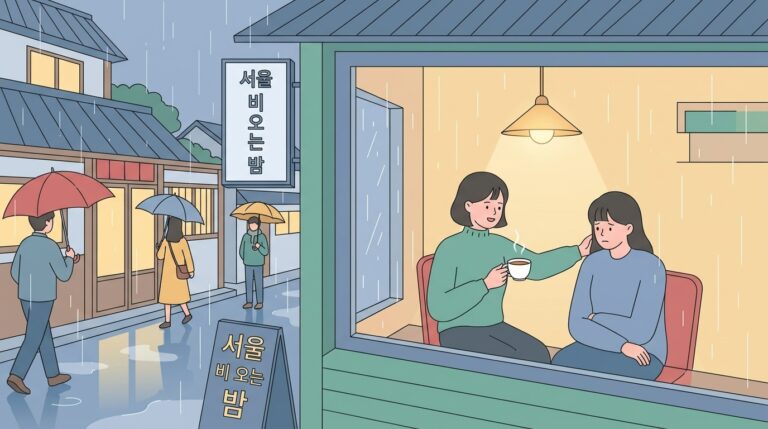
- Setting: A quiet cafe near the Han River on a rainy evening.
- Character: Minji (민지), your warm and attentive Korean classmate.
-
Minji: 오늘 얼굴이 안 좋아요. 무슨 일 있어요? (Oneul eolguri an joayo. Museun il isseoyo?) 🎭 Leaning forward with concerned eyes (You don’t look well today. Is something wrong?)
- You: 사실… 오늘 시험을 못 봤어요. (Sasil… oneul siheomeul mot bwasseoyo.) 🎭 Looking down at your cup (To be honest… I did poorly on my exam today.)
- Minji: 아, 정말요? 열심히 공부했잖아요. (A, jeongmalyo? Yeolsimhi gongbuhaetjanhayo.) 🎭 Patting the table gently (Ah, really? But you studied so hard.)
- You: 네, 그래서 너무 속상해요. (Ne, geuraeseo neomu soksanghaeyo.) 🎭 Sighing softly (Yeah, that’s why I feel so upset/down.)
- Minji: 속상할 만해요. 저도 눈물이 나려고 하네요. (Soksanghal manhaeyo. Jeodo nunmuri naryeogo haneyo.) 🎭 Handing you a warm napkin (It makes total sense you’re upset. I almost feel like tearing up too.)
- You: 위로해 줘서 고마워요, 민지 씨. (Wirohae jwoseo gomawoyo, Minji ssi.) 🎭 Smiling faintly (Thank you for comforting me, Minji.)
- Minji: 우리 맛있는 거 먹으러 갈까요? 떡볶이 어때요? (Uri masinneun geo meogeureo galkkayo? Tteokbokki eottaeyo?) 🎭 Brightening up to cheer you up (Shall we go eat something delicious? How about tteokbokki?)
- You: 좋아요. 기분이 조금 나아졌어요! (Joayo. Gibuni jogeum naajyeosseoyo!) 🎭 Nodding gratefully (Sounds great. I feel a bit better already!)
🔀 Interactive Choice Point: If Minji asks how you feel after failing a test, how do you reply?
- Choice A: “너무 속상해요. (I’m so upset.)”
- Feedback (Best): ⭐⭐⭐ Perfect! Accurate emotion, natural tone, invites genuine connection.
- Choice B: “저는 비극적이에요. (I am tragic.)”
- Feedback (Bad): ❌ Grammatically awkward and overly theatrical. Avoid calling yourself “tragic”.
- Choice C: “슬퍼! (Sad! – informal 반말)”
- Feedback (Risk): ⚠️ Unless Minji is already your very close peer of the exact same age, dropping
-요without asking might sound slightly rude or abrupt.
- Feedback (Risk): ⚠️ Unless Minji is already your very close peer of the exact same age, dropping
Phase 6: 10-Second Emotion Shadowing Drill
Read these aloud, pausing at / and mimicking the exact feeling!
[🥺 조금 울먹이며 - Soft & teary]- 오늘 / 너무 / 슬퍼요… (O-neul / neo-mu / seul-peo-yo… / I’m so sad today…)
[💔 아쉽고 속상하게 - Disappointed & heartbroken]- 계획이 취소돼서 / 진짜 / 속상해요. (Gye-hwoeg-i chwi-so-dwae-seo / jin-jja / sok-sang-hae-yo. / The plan got canceled, so I’m really upset.)
[😭 감동받아 벅차게 - Deeply touched & tearful]- 너무 감동받아서 / 눈물이 나요. (Neo-mu gam-dong-bad-a-seo / nun-mu-ri na-yo. / I’m so touched that tears are coming.)
Phase 7: K-Culture Mini Dictionary
- 위로 (Wi-ro) | Comfort / Consolation | Used when giving or receiving emotional support, as in
위로해 줘서 고마워요(Thank you for comforting me). - 눈물 (Nun-mul) | Tears | Literally “eye-water”. Essential for drama discussions:
눈물 버튼(tear-button) means a scene guaranteed to make you cry. - 한 (Han) | Deep Collective Sorrow / Longing | A unique cultural concept referring to lingering historical or personal sorrow turned into resilience.
- 힐링 (Hil-ling) | Healing / Emotional Recovery | Konglish word widely used in Korea when doing relaxing activities to soothe sadness or burnout.
Phase 8: Survival Kit for Travelers
Top 3 Travel Survival Phrases:
- 도와주세요, 길을 잃어서 속상해요. (Do-wa-ju-se-yo, gir-eul ir-eo-seo sok-sang-hae-yo.)
- Pro Tip: “Please help me, I lost my way and feel so distressed.” A great polite sentence when lost.
- 너무 아쉬워요. (Neo-mu a-swi-wo-yo.)
- Pro Tip: Use this when a famous restaurant is sold out or closed for the day (“What a pity/bummer!”).
- 울지 마세요. (Ul-ji ma-se-yo.)
- Pro Tip: “Please don’t cry.” Handy when comforting a fellow traveler or emotional friend.
🧳 Editor’s Travel Note
If you find yourself overwhelmed, lost, or stressed during your trip in Seoul, don’t wander in sadness. Make sure you have the [Official Naver Map Navigation App Guide] installed rather than Google Maps, as it provides accurate walking routes and English navigation across Korea.
Phase 9: “A Step Deeper” (Think & Reflect)
In many Western cultures, sadness is often treated as a private matter to be dealt with alone. In Korea, however, the concept of Jeong (정 – deep emotional bond) means that sharing negative feelings is seen as an act of trust, not weakness. When you tell a Korean friend 속상해요 or 슬퍼요, you are welcoming them into your heart, and in return, they will gladly share your burden over a warm bowl of soup.
💬 Your Turn: What Korean drama or song made you cry the most recently? Tell us in the comments using 슬퍼요 or 눈물이 나요!
Phase 10: FAQ & Common Mistakes
Q: What is the exact difference between 슬퍼요 and 속상해요?
A: 슬퍼요 is pure sadness or grief (like a sad movie or missing family). 속상해요 is used when things did not go the way you hoped, causing a mix of sadness, frustration, and heartache.
Q: Can I say “나는 슬프다” to my Korean friends?
A: “나는 슬프다” sounds like a poetic monologue or diary entry. In real speech with friends, say 나 슬퍼 (casual) or 저 슬퍼요 (polite).
Q: Does 울어요 (U-reo-yo) mean “I am sad”?
A: 울어요 specifically means “I am actively crying” (the action). If you just feel sad inside without tears, stick to 슬퍼요.
🚨 Common Mistakes Board
| Mistake | Why it is wrong | Correct Action |
|---|---|---|
| ❌ 저는 슬픔입니다 | Translates literally as “I am the concept of sadness.” | ✅ (저는) 슬퍼요 |
| ❌ 기분이 나빠요 (when sad) | 기분이 나빠요 means “I am in a bad mood / irritated / offended.” |
✅ 기분이 안 좋아요 / 속상해요 |
| ❌ 속이 아파요 (for heartache) | 속이 아파요 means physical stomachache/heartburn! |
✅ 속상해요 (for emotional distress) |
Phase 11: Action Missions
- 🥉 Bronze Mission (Solo): Look into the mirror and practice saying
오늘 조금 속상해요with realistic facial expressions 3 times. - 🥈 Silver Mission (Social): Leave a comment under your favorite K-pop singer’s emotional music video:
노래가 너무 슬퍼요 ㅠㅠ. - 🥇 Gold Mission (Real Life): Next time something doesn’t go your way, tell your language partner or friend:
너무 아쉽고 속상해요instead of switching back to English! - 🎮 K-Culture Bonus Quest: Watch an episode of a tear-jerker K-drama and count how many times characters say
속상해or울지 마!
Phase 12: Interactive Quiz Challenge
Q1. You studied all night for a test, but the exam was canceled. Which expression best fits your feeling?
* A) 기뻐요
* B) 속상해요
* C) 맛있어요
👉 Click to reveal Answer & Explanation
Correct Answer: B) 속상해요 (Soksanghaeyo)
Explanation: When you are disappointed and upset because things didn’t go as planned, 속상해요 is the most natural choice!
Q2. Fill in the blank:
* “영화가 너무 감동적이어서 ______ 나요.” (The movie was so touching that tears are coming.)
👉 Click to reveal Answer & Explanation
Correct Answer: 눈물이 (Nun-mu-ri)
Explanation: 눈물이 나요 translates to “tears are coming / I am tearing up.”
Q3. True or False?
* Saying 기분이 나빠요 is the best way to politely tell someone you are crying from sadness.
👉 Click to reveal Answer & Explanation
Correct Answer: False
Explanation: 기분이 나빠요 means you are annoyed, angry, or offended. To express sadness, use 슬퍼요 or 기분이 안 좋아요 (I don’t feel good) instead!







